An AI toy company secures tens of millions in financing, with core product sales increasing fivefold | Exclusive from Hardcore Kr
Author | Huang Nan
Editor | Yuan Silai
Yingke learned that Shanghai Xili Information Technology Co., Ltd. (hereinafter referred to as "FoloToy"), an AI toy manufacturer, recently completed a new round of financing of tens of millions of yuan. Index Capital served as the company's exclusive financial advisor. We have summarized the information of this round of financing and several highlights of the company:
Financing Amount and Investment Institutions
Financing Round: Pre - A Round / Pre - A+ Round
Financing Scale: Tens of millions of yuan
Investors: Shenzhen Capital Group, Nanshan Strategic Emerging Industry Investment, and existing shareholder Huohuotu
Use of Funds: The funds will be mainly used to accelerate technological R & D and continuous iteration of products, and to ensure mass production and large - scale market delivery.
Basic Company Information
Establishment Time: Officially started operation in 2023
Registered Address: Xuhui District, Shanghai
Company Positioning: FoloToy is an innovative enterprise focusing on global AI companion toys. By transforming cutting - edge AI technologies into low - cost, highly adaptable interactive modules and terminal products, it is committed to providing emotional interaction solutions for users of all ages.
Technological Highlights: FoloToy is the first AI toy brand in the industry to support the Self - Hosting mode. Its self - developed "MagicBox" system can deploy users' dialogue models and data storage on local terminals. While providing personalized AI interaction services, it realizes data privacy and security management, meeting the needs of families, educational institutions, and data - sensitive users.
Specifically at the algorithm level, the R & D team has built a flexible computing architecture that supports hybrid deployment in the cloud, on the edge, and in private environments. It can be compatible with mainstream large models at home and abroad, and through algorithm optimization, the response time is compressed to within 1 second, ensuring real - time and smooth interaction. At the same time, the system has deep personalization and memory capabilities. Through cloud storage authorized by parents, the system will record children's interests and preferences, such as favorite story types, allergic foods, and learning progress. In subsequent conversations, the product can continuously learn user preferences and adjust dialogue strategies based on adaptive algorithms, and actively initiate relevant topics. It adjusts the language style and knowledge depth as the user grows older, achieving a "more understanding with more use" companion experience.
In terms of multi - modality, it also integrates interactive capabilities such as sound, shape, and movement. Some products have the ability to recognize emotions and provide anthropomorphic action feedback. They can judge whether a child is happy or sad through voice intonation and actively adjust the response mode to enhance emotional resonance. In addition, to adapt to global families and more user preferences, MagicBox also supports conversations in more than 10 foreign languages and various Chinese dialects.
Market Size
According to a relevant report by Market Research Future, the global market size of AI toys reached $11 billion in 2024, with the main growth coming from the three core markets of China, the United States, and Europe. China contributed more than 20% of the growth. By 2030, its market size is expected to reach $58 billion, with a compound annual growth rate of about 32.7%.
With the natural growth of the demand for intelligent interaction among the "AI natives" such as the post - 2010 and post - 2020 generations, and the increasing strong dual demands of young parents for "high - quality companionship" and "scientific enlightenment", the domestic market for AI companion toys is facing a structural opportunity. According to a research report by Northeast Securities, the market penetration rate of this market is expected to increase rapidly from about 20% in 2025 and reach 47% by 2030, corresponding to a domestic market size of more than 85 billion yuan.
Team Background
Wang Le, the founder and CEO, graduated from the Department of Computer Science at Tianjin University. He once worked at a Silicon Valley smart hardware company and has profound technological R & D capabilities and productization experience in the fields of robotics and smart hardware. Guo Xinghua, the co - founder, once served as a senior engineer at a global leading industrial robot company and has many years of experience in hardware design and engineering implementation in the core technology field of industrial robots.
Business Progress
FoloToy has built a product matrix covering the full scenarios of "individual - family - enterprise". In 2025, the product sales volume increased five - fold compared with the previous year.
In the consumer market at the C - end, according to the needs of different age groups of users, a corresponding price system has been proposed. Its product line includes the classic companion series, such as the sunflower AI doll and the AI panda "Mengmeng", which offer basic dialogue and multi - language enlightenment functions at a price range of 258 - 398 yuan. The growth and education series, such as the AI bear "LeLe", is priced at 398 - 598 yuan, integrating light subject tutoring and habit - forming functions. In addition, there are also products such as the AI cat curator designed for the cultural and tourism scenarios.
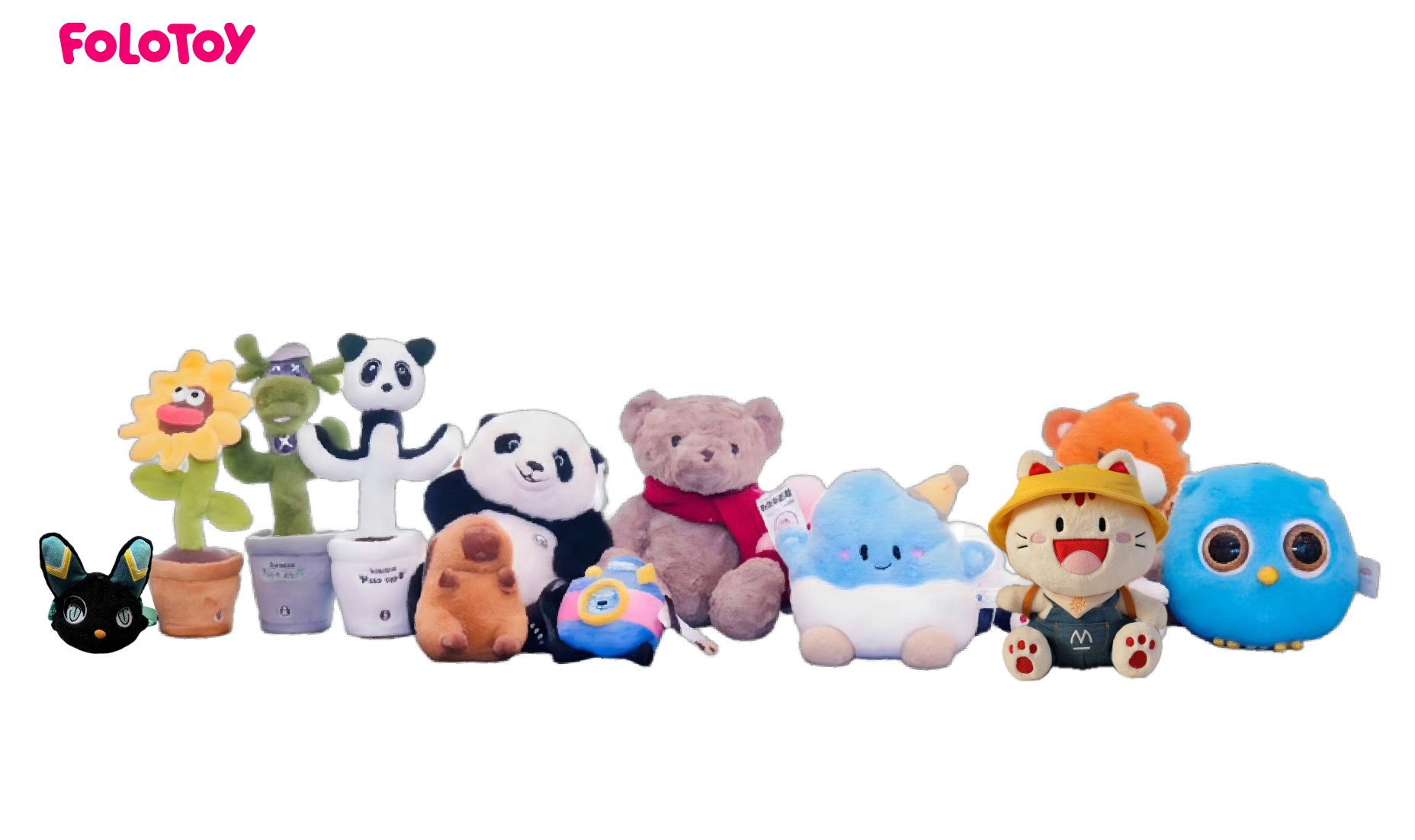
Product matrix covering the full scenarios of "individual - family - enterprise" (Source/Company)
In the B - end and ecological aspects, through enterprise IP customization, the company previously launched products such as the "Eye - catching Package" in collaboration with Volcengine and the "Golden Little Sunflower" in cooperation with China Merchants Bank. Through IP co - branding cooperation and industry scenario solutions, such as providing the "Octopus" AI learning kit for educational and training institutions, it has achieved the connection from hardware sales to the technology ecosystem.
Founder's Thoughts
Yingke: Since 2024, what changes have taken place in the market popularity of AI toys? According to your observations, what are the characteristics of FoloToy's product users?
Wang Le: Overall, 2025 is still the exploration stage of the AI toy industry, but both the domestic and foreign markets are showing an obvious positive trend. The commercial viability of this track has been fully verified, and overseas attention has been continuously increasing. The domestic market is even more popular, and several large companies have entered the market one after another.
As of now, our product sales volume has increased five - fold compared with last year. Different from some competitors, we adopt a dual - track business model of To B and To C. On the one hand, we undertake cooperation orders from leading enterprises. On the other hand, we sell products to the C - end under our own brand and launch a number of co - branded products.
The target age group of FoloToy's products is children aged 3 to 12, with children aged 3 to 9 as the main service objects. In terms of user distribution, the core consumer group of the products is concentrated in first - tier cities, and their purchase decisions are mainly driven by two factors. One is the curiosity about AI smart toys and the willingness to try new products with a sense of technology and interactivity. The other is the core demand related to education. Parents highly value the educational attributes when choosing products.
Yingke: For child users, FoloToy has proposed the scenario direction of "cognition + companionship". How to understand this positioning?
Wang Le: As an early entrant in the AI toy track, we began to conceive the product form of "large model + toy" when ChatGPT was just launched (at the end of 2022) and established the product positioning centered on "cognition and companionship". FoloToy gives top priority to the knowledge popularization ability of large models, aiming to achieve the dual goals of improving parents' parenting cognition and children's knowledge acquisition through companionship.
We believe that the massive knowledge contained in large models can be effectively popularized by being integrated into toys, which are easy for children to accept and access, in the family scenario. Therefore, FoloToy's product definition and form design always revolve around "solving the dual needs of parents and children and focusing on specific scenario pain points". For example, the recently launched "Holiday Museum" AI toy, in the form of an AI commentator, precisely meets users' knowledge acquisition needs in the museum scenario.
In addition, due to the general concern about children's screen time in the global market and the popularity of the "no screen" concept, all our products adopt a screen - less design. Instead, we enhance the interactivity of the products by integrating physical interaction elements such as motor drive and action feedback.
Yingke: Considering the limited attention span and easy - to - shift interests of young children, how to balance attention guidance and long - term user stickiness in the design?
Wang Le: The core principle of the FoloToy team is not to make "extending usage time and improving stickiness" the primary goal, and we firmly oppose addictive design. On the contrary, when a child uses the product continuously for about two hours, the toy will actively trigger the anti - addiction mechanism with anthropomorphic expressions such as "I'm tired and want to rest". After 9 p.m. to 10 p.m., it will also remind "It's too late. It's time to go to bed", guiding children to develop reasonable usage habits through detailed scenario - based guidance.
These designs are based on our understanding that toys should not follow the thinking logic of Internet products that "pursue daily active users and retention rates". Traditional toys don't need to overly worry about usage frequency. The core advantage of AI toys should be to establish a deep connection with users through stronger interactivity, rather than simply pursuing usage time.
According to user feedback, children's preferences for products vary individually. Some children will develop the habit of actively interacting with the toy after school every day, which requires moderate parental intervention. Currently, we have designed a special mini - program for parents, allowing them to make customized settings according to their children's personality traits. This not only makes the product more suitable for children's needs but also turns the toy from a "mere entertainment tool" into a bond for parent - child interaction through parents' participation, thereby naturally improving user stickiness and avoiding relying solely on short - term curiosity to attract users.