In 2003, a student studying in the United States dropped out of school to start a business in AI education and received millions of dollars in investment from BAI and Hillhouse.
Written by Zhou Xinyu
Edited by Su Jianxun
If nothing unexpected happens, an ordinary student born in 2003 will most likely finish their undergraduate studies in June 2026 and then enter society, becoming an ordinary worker.
However, for Li Wenxuan and Zhong Ziqiu, both born in 2003, ChatGPT, which was released at the end of 2022, became that unexpected factor. A series of bold decisions followed: dropping out of school and starting a full - time business.
"College suddenly seemed meaningless. ChatGPT can basically handle what we're learning," said Li Wenxuan, who was then a freshman in the Department of Computer Science at the University of California, Berkeley. He discovered a harsh truth: even by participating in college courses, his professional knowledge could still be easily covered by ChatGPT.
But from this, he also saw the possibility of new content interaction forms brought by AI. In mid - 2023, after finishing his freshman year, Li Wenxuan and his high - school classmate Zhong Ziqiu, who was majoring in finance at the Stern School of Business, New York University, hit it off and decided to drop out and start a business. Li Wenxuan, who is good at algorithms, serves as the CEO and CTO, while Zhong Ziqiu, with social media operation experience, serves as the COO and CMO. They entered the field of AI education.
Now, their product, ThetaWave AI, which is defined as a "next - generation Agentic personalized knowledge content generation platform", has achieved an ARR (Annual Recurring Revenue) of over one million US dollars nine months after its paid subscription was launched.
Recently, Intelligent Emergence exclusively learned that ThetaWave AI has completed a pre - A round of financing of several million US dollars, led by BAI Capital and Hillhouse Ventures, with participation from US - based funds such as MBA Fund. Miracle Plus, a shareholder from the seed round, continued to increase its investment, and Tanqi Capital served as the exclusive financial advisor for this round.
If you study the team sample of ThetaWave AI, you'll find that this small team of ten people is entirely made up of post - 2000s. In today's AI field, which values "young people" and "geniuses", the age profile of ThetaWave AI has brought them a lot of attention. Even a former FA advised Li Wenxuan to mention the post - 2000s in the business plan.
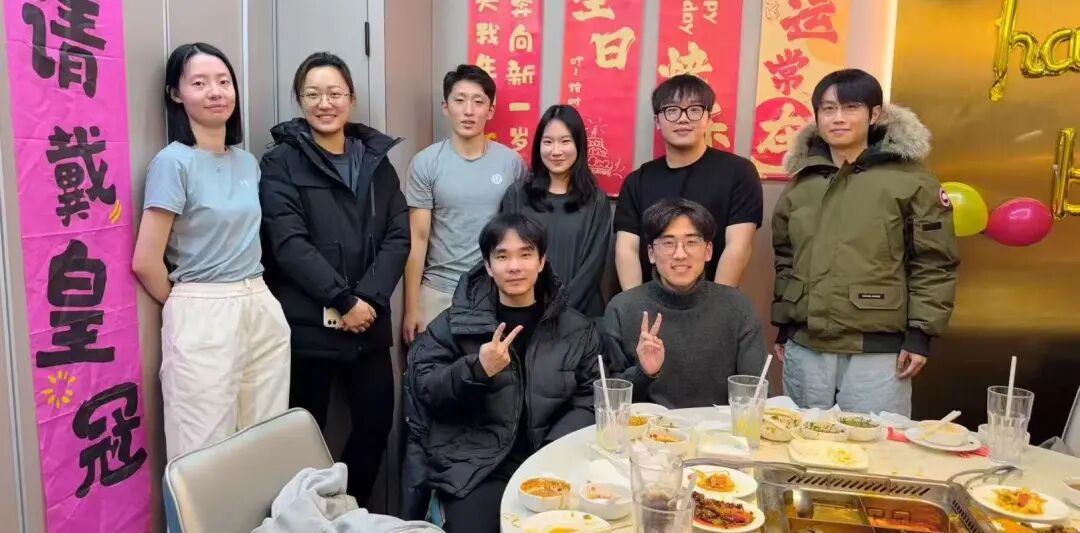
△Members of ThetaWave AI. Li Wenxuan and Zhong Ziqiu are the second and third from the right in the back row respectively. Photo source: Provided by the interviewee
However, during their communication with us, Li Wenxuan and Zhong Ziqiu both believe that this label is a "double - edged sword".
"The key to being labeled as post - 2000s is to make others believe that your age matches what you're doing," Zhong Ziqiu told us.
Different from large companies and experienced entrepreneurs, Li Wenxuan believes that the advantage of being "post - 2000s" is that they are the group most familiar with learning and closest to students.
Both Li Wenxuan and Zhong Ziqiu were "top students". In high school, Li Wenxuan won a gold medal in the Physics Olympiad and got the opportunity to participate in research at Tencent's recommendation algorithm department at the age of 17. Zhong Ziqiu once sold her high - school study notes online, with a final sales volume of over 100,000 yuan.
"In the past, people had to actively adapt to knowledge; now, AI can make knowledge actively adapt to people, transforming into a more absorbable form during interaction with people." The product construction of ThetaWave AI is based on the judgment of its two founders, who have just completed K12 education: AI will reconstruct the interaction form between people and knowledge.
"Once knowledge is presented, it becomes 'dead' and can't adapt to people," Li Wenxuan gave an example. "If you're interested in quantum physics, and the introductory professional books are three or four hundred pages long, your curiosity will be quickly worn out. 'Why do we think learning goes against human nature? Because we need to adapt to knowledge.'"
Now, relying on the rapidly developing multi - modal understanding and generation capabilities of large AI models, personalized and interactive knowledge management has become possible. What ThetaWave AI can do is transform complex knowledge into a form that is easier for users to absorb. For example, a tens - of - thousands - word English paper can be quickly summarized into structured notes by the platform.
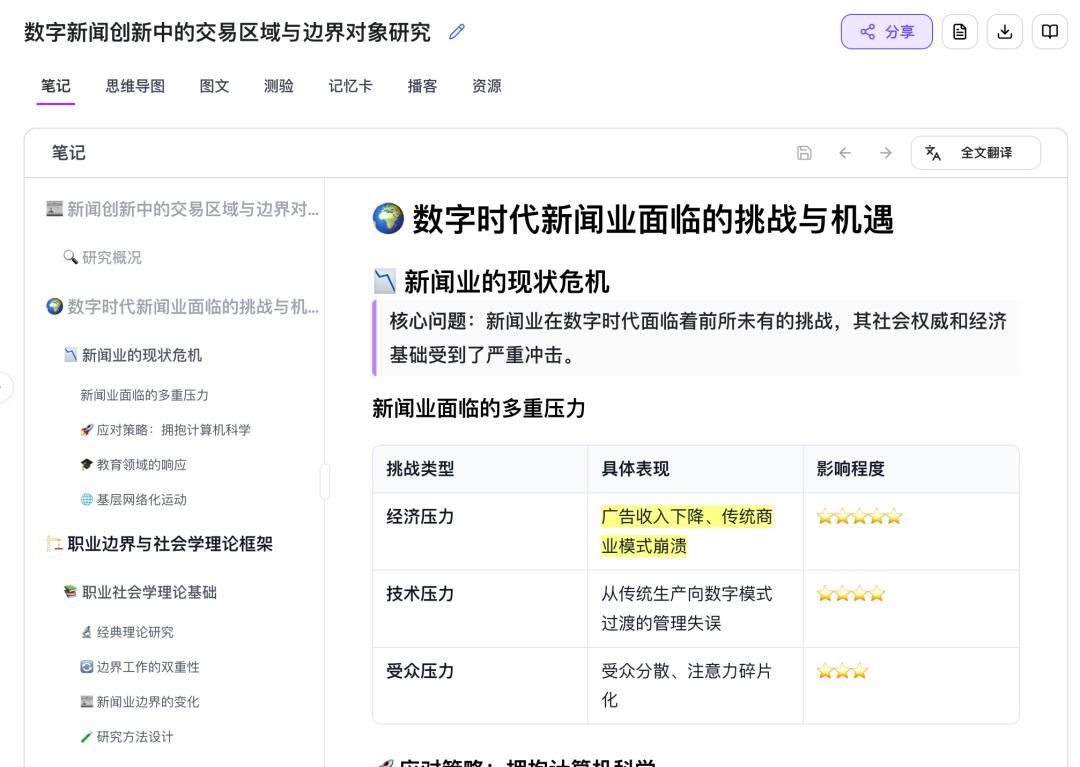
△ThetaWave AI's note summary of a tens - of - thousands - word English professional paper. Photo source: Author's trial use
Currently, the main users of ThetaWave AI are not students in the K12 education stage but college students. The main scenario it targets is the most painful and essential scenario for most students: taking notes and organizing review materials.
Li Wenxuan has two considerations for choosing college students' class notes as the entry scenario. First, the product needs to collect more personalized learning data as early as possible, so it enters a high - frequency and essential scenario like taking class notes. Second, students receive relatively homogeneous education during the K12 stage, and their learning habits start to become personalized in college.
Therefore, the current ThetaWave AI provides two knowledge management modes for high - frequency scenarios:
First, it can generate notes, summarize knowledge, and answer knowledge - related questions for existing multi - modal materials (such as class PPTs, papers, audios, websites, YouTube, etc.).
Second, it has real - time transcription and real - time note - taking functions for scenarios like classes and meetings.
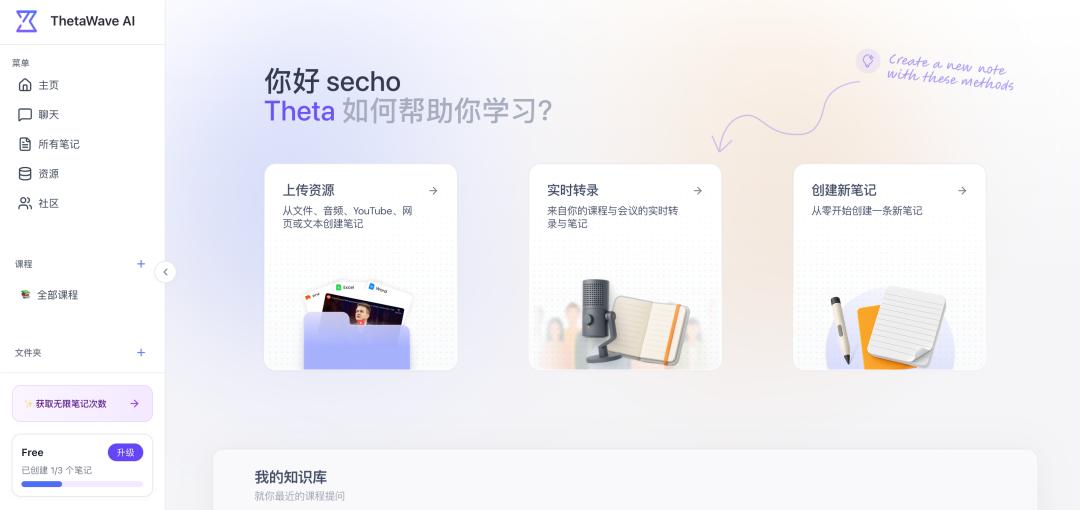
△ThetaWave AI. Photo source: Official website
For student users, especially exam - takers, the attractiveness of ThetaWave AI lies in its practicality.
ThetaWave AI provides five common knowledge organization and summarization modes, including text notes, mind maps, graphics and text, memory cards, and AI podcasts. It can also generate test questions to help students test and consolidate their knowledge.
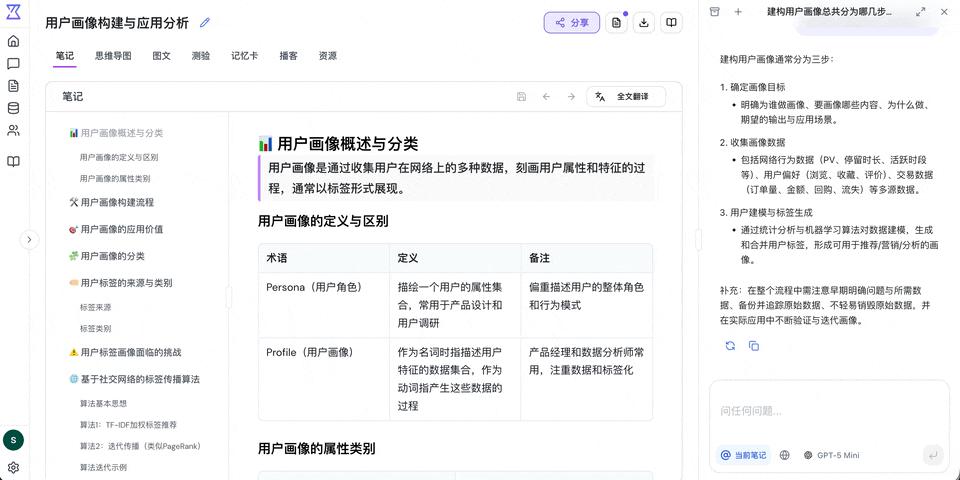
△Note summary forms provided by ThetaWave AI. Photo source: Author's trial use
For many AI education products, the biggest invisible competitor is not established education companies like Yuanfudao and Zebra AI, but ChatBots like ChatGPT and Doubao, which have lower usage thresholds and higher user penetration rates.
However, in Li Wenxuan's view, ChatBots still have many limitations. In late 2024, before ThetaWave AI was launched, Li Wenxuan and Zhong Ziqiu returned to the United States.
They found that even though ChatGPT, Claude, and Gemini have become high - frequency AI tools for students, when faced with large amounts of complex and multi - modal information sources, ChatBots can only perform coarse - grained information summarization. They cannot quickly understand the most essential content and cannot understand the hierarchical relationships between various knowledge points.
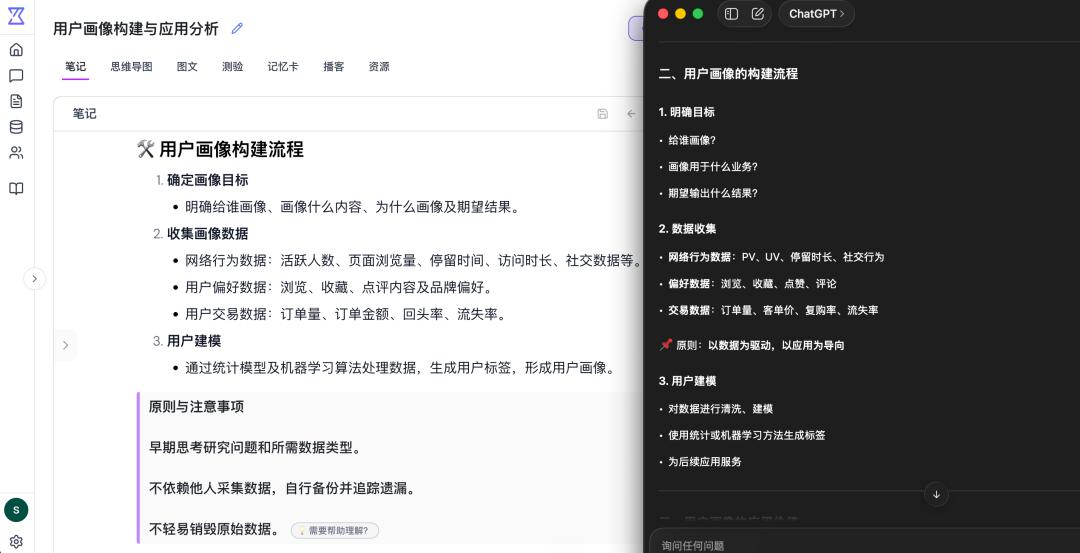
△Note summaries of the same PPT by ThetaWave AI (left) and ChatGPT (right). Photo source: Author's trial use
Meanwhile, in Li Wenxuan's view, the notes summarized by ChatBots are still "dead" and cannot be edited, queried, or have their forms adjusted in real - time according to users' preferences. Therefore, the pain point of students having to adapt to knowledge still cannot be solved.
For the student note - taking scenario, the team conducted a lot of optimization and Agentic engineering based on third - party models such as Qianwen and GPT in the early stage.
For example, the recognition accuracy of large AI models for PDFs is not high. The team improved the recognition accuracy of the original information source by self - developing a graphic analysis and recognition model for files such as PDFs. For note generation, the team developed a multi - Agent workflow, which is responsible for processes such as file recognition, outputting in JSON format, extracting knowledge points, and secondary note generation.
In the note panel of ThetaWave AI, in addition to basic editing functions for text, charts, etc., users can also perform personalized editing and learning, such as AI queries, AI polishing, AI image matching, and translation, by selecting specific content.
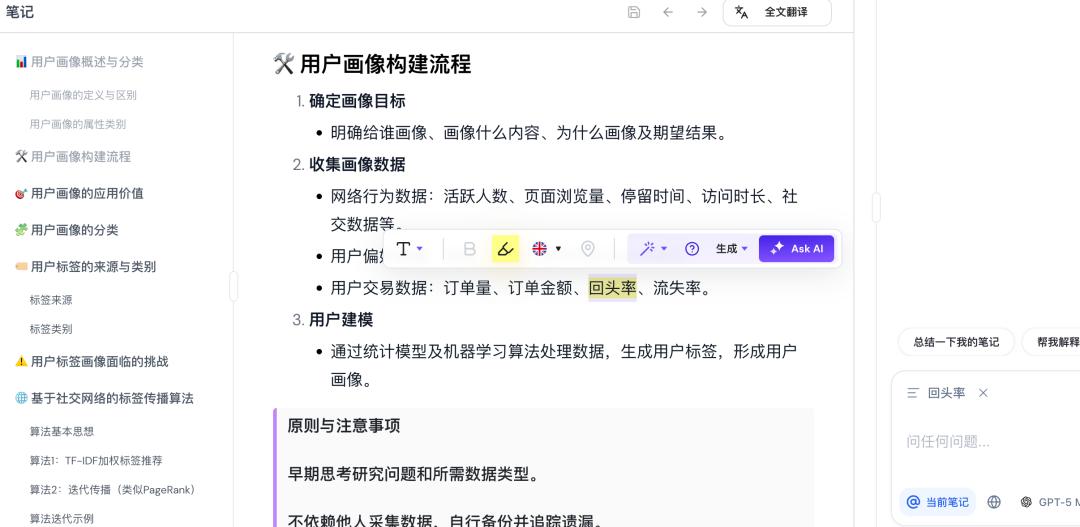
△Note editing and interaction functions of ThetaWave AI. Photo source: Author's trial use
Since ThetaWave AI was launched a year ago, the team doesn't believe that there is a ready - made and directly replicable successful methodology for entrepreneurship.
Zhong Ziqiu once collaborated with product growth and operation experts from large companies. She found that these experienced operators often fall into a thinking pattern: they first ask how much budget is available for user acquisition, affirm or deny certain channels based on past experience, and then ask the company to connect to certain third - party monitoring back - ends.
"We're a startup, and the budget for operation is limited. Moreover, the product is still in the early growth stage, so it's too early to connect to third - party monitoring back - ends," she doesn't appreciate the methodology of directly applying ready - made experience. "Most of the methods used by large companies are for proven models. The advantage of startups is that they can flexibly test unproven models."
The growth system of ThetaWave AI was gradually explored by Zhong Ziqiu and the team in the early stage through a simple and direct way of "hand - to - hand combat".
She attaches great importance to the natural spread on social media rather than heavy investment in advertising. On the one hand, for practical reasons, startups need to avoid competing with large companies in advertising bidding.
On the other hand, "where the users' attention is, our future lies," Zhong Ziqiu told us. Testing the factors of natural growth is essentially testing users' interest points in the product, and then feeding this back into product design.
In the early stage of entrepreneurship, Thetawave's growth team made hundreds of short videos on average every day and uploaded them to test accounts without a fan base on various platforms. Through a controlled - variable model, they tested the factors that determine whether a video can go viral. Discovering each factor often required more than ten rounds of testing, but the daily cost was actually less than a fraction of the tens - of - millions advertising budget of large companies.
They found that the factors that determine whether a video can go viral are often very subtle elements, such as whether the ChatGPT logo and usage interface should appear in the video and whether the ChatGPT error page should be shown.
Recently, the team noticed that the key to the popularity of their "Professor Losing His Temper" series of videos is the need to show the contrast brought by a "handsome professor" losing his temper.
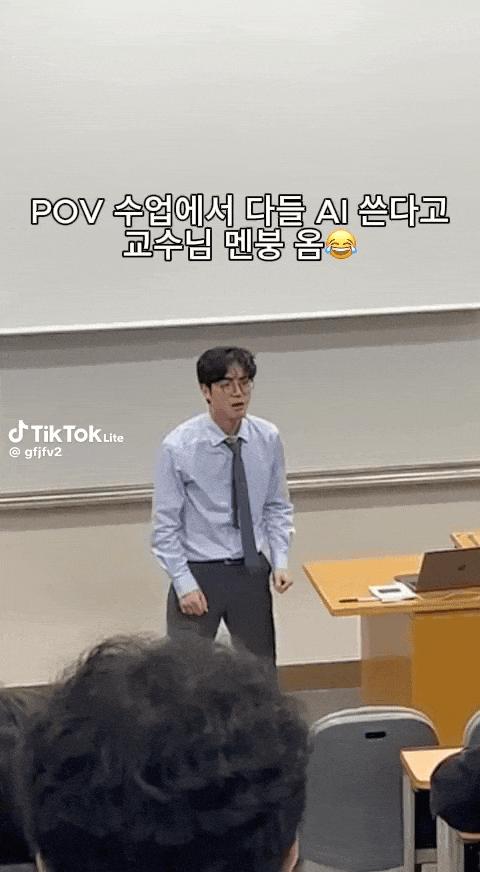
△"Professor Losing His Temper" series of videos. Photo source: TikTok
After testing and identifying the factors for popularity, the team needs to replicate them in batches on platforms such as TikTok and Xiaohongshu. On each platform, Zhong Ziqiu and the growth team manage an average of hundreds of matrix accounts, which are used for testing popularity factors, local fine - tuning in different markets, official promotion, and as nodes for spreading and amplifying with a certain fan base.
To create a batch of spread effects, ThetaWave AI's growth team also recruited hundreds of amateur student bloggers from different countries and regions. These bloggers shoot videos according to the popular video frameworks accumulated by the team and upload them to their own social platforms. Every ten days, they can get tens of millions of exposure traffic on major platforms such as Instagram and TikTok.
"This methodology is not static. Our product is iterating every day, and the platform's recommendation algorithm is also changing." Now, the growth team led by Zhong Ziqiu has increased the number of test videos posted every day to 70 - 100. She also needs to study a large number of competitor spread cases every day and exchange experiences with cross - border e - commerce practitioners with annual revenues of over 100 million yuan. "The most important thing is to practice on your own, otherwise, the experience will always belong to others."
Relying on such a brute - force growth method, as of now, ThetaWave AI has maintained a weekly user growth rate of over 20%, and 90% of this growth comes from natural traffic and spontaneous user spread.
In the early stage of the product's launch, the main users of ThetaWave AI were Chinese students studying in the UK, the US, Australia, and Canada. Then, with the influence of social media promotion, the proportion of local users in the UK and the US began to increase.
Recently, Zhong Ziqiu found that there are still rich opportunities in markets outside Europe and the US. "With social media recommendations, the number of users from Spain, Germany, and South Korea has been growing rapidly. Non - Anglo - American Tier 1 countries are underestimated markets."
Subscription payment is the main business model of ThetaWave AI. Currently, the product offers three subscription modes: annual payment, quarterly payment, and weekly payment for the need of last - minute exam preparation. Zhong Ziqiu told us that ThetaWave AI's payment rate is maintained at 7% - 8%, and the payment retention rate in the second month is 85%, which is at a healthy level.
