Im Jahr 2003 brach ein chinesischer Student in den USA seinen Studienabschluss ab und gründete ein Unternehmen im Bereich der KI-Education. Das Unternehmen erhielt mehrere Millionen US-Dollar an Investitionen von BAI und Hillhouse Capital.
Text | Zhou Xinyu → Text | Zhou Xinyu (Here, the name remains unchanged and does not need to be translated)
Redaktion | Su Jianxun → Redaktion | Su Jianxun (Here, the name remains unchanged and does not need to be translated)
If nothing unexpected happens, an ordinary student born in 2003 will most likely complete their bachelor's degree in June 2026 and then enter society and become a "workhorse."
However, for Li Wenxuan and Zhong Ziqiu, both born in 2003, ChatGPT, which was released at the end of 2022, was the unexpected event - followed by bold decisions: They dropped out of school and founded a company full - time.
"Suddenly, studying didn't make sense anymore. What we were learning, ChatGPT could basically handle." Li Wenxuan, who was then in his first semester of studying computer science at the University of California, Berkeley, realized a harsh fact: Even if he attended university courses, ChatGPT could easily replace his professional knowledge.
But from this, he also saw the possibility that AI would bring a new form of content interaction. In the middle of 2023, after he completed his first year at university, Li Wenxuan and his high - school classmate Zhong Ziqiu, who was studying finance at the Stern School of Business at New York University, agreed to drop out of school and start a company. Li Wenxuan, who is strong in algorithms, took on the roles of CEO and CTO, while Zhong Ziqiu, who has experience in social - media marketing, became COO and CMO. Their focus was on AI education.
Today, their product, ThetaWave AI, which is defined as the "Next - Generation Agentic Personalized Knowledge Content Generation Platform," has achieved an ARR (Annual Recurring Revenue) of over one million US dollars nine months after the start of the paid subscription.
Recently, "Intelligent Emergence" exclusively learned that ThetaWave AI has completed a pre - Series A financing round of several million US dollars. The round was led by BAI Capital and Hillhouse Ventures, and US funds such as the MBA Fund participated in the investment. The seed - round investor, Miracle Plus, increased its stake, and Tanqi Capital was the exclusive financial advisor for this round.
If you look at the ThetaWave AI team, you'll find that this small team of ten people consists entirely of the younger generation (post - 2000s). In today's AI industry, which relies on "young talents," the age profile of ThetaWave AI attracts a lot of attention. Even a former financial intermediary advised Li Wenxuan to include the post - 2000s generation in the business plan.
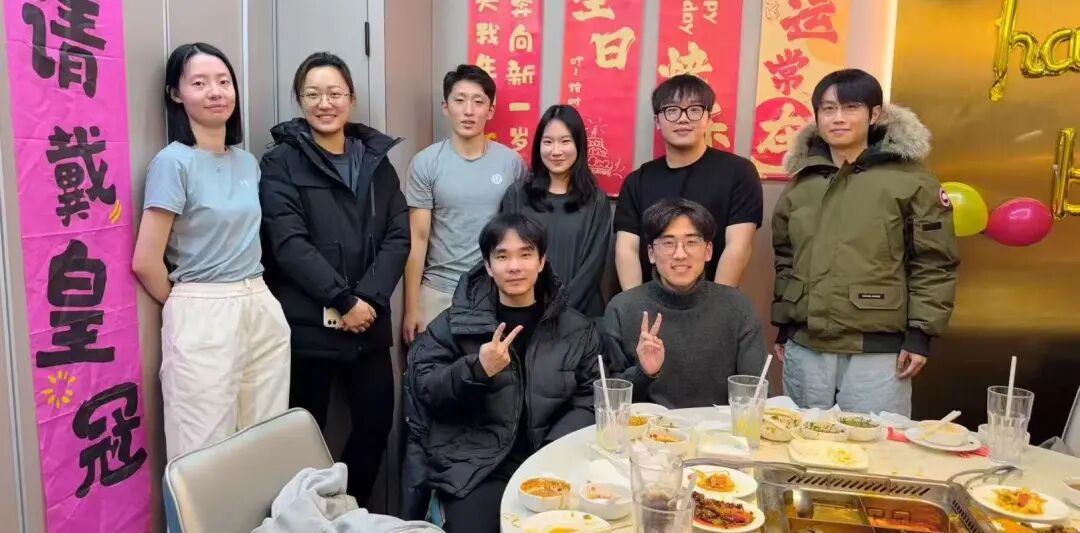
△ Members of ThetaWave AI. Li Wenxuan and Zhong Ziqiu are the second and third from the right in the back row. Source: Photo from the interviewee.
But in our conversations, Li Wenxuan and Zhong Ziqiu agreed that this label is a "double - edged sword."
"The most important thing about the 'post - 2000s generation' label is to make others believe that your age matches what you're doing." Zhong Ziqiu told us.
In contrast to large companies and experienced entrepreneurs, Li Wenxuan sees the advantage of the "post - 2000s generation" in that they are the ones who are most familiar with the learning process and are closest to students.
Both Li Wenxuan and Zhong Ziqiu were once "top students in the class." During high school, Li Wenxuan won a gold medal in the Physics Olympiad and had the opportunity to conduct research at Tencent's recommendation algorithm department at the age of 17. Zhong Ziqiu once sold his high - school notes online and achieved a sales volume of over 100,000 yuan.
"In the past, people had to adapt to knowledge; today, AI can adapt knowledge to people and present it in an easier - to - digest form during interactions with people." The product development of ThetaWave AI is based on the assessment of the two founders, who have just completed the K12 education system: AI will reshape the form of interaction between people and knowledge.
"Once knowledge is presented, it is 'dead' and can no longer adapt to people." Li Wenxuan gave an example: If you're interested in quantum physics, and the introductory literature is already three or four hundred pages long, your curiosity will quickly be destroyed. "Why do we find learning repulsive? Because we have to adapt to knowledge."
Today, thanks to the rapid development of the multimodal understanding and generation capabilities of AI models, personalized and interactive knowledge management is possible. ThetaWave AI can transform complex knowledge into an easier - to - digest form for users. For example, an English dissertation of tens of thousands of words can be quickly summarized into structured notes by the platform.
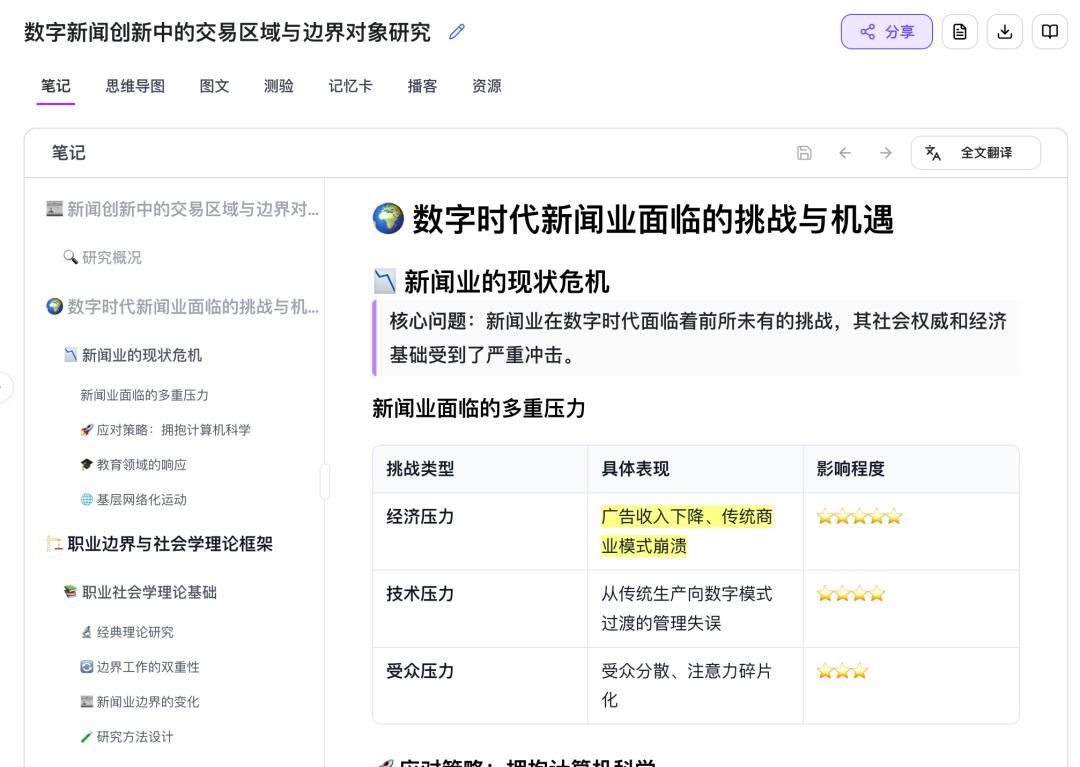
△ Summary by ThetaWave AI of an English academic dissertation of tens of thousands of words. Source: Author's sample.
Currently, ThetaWave AI is mainly targeted at college students rather than students in the K12 education system. The main use - case is the one that is the "most painful" and most urgently needed for most college students - taking notes and organizing learning materials.
When using college - student notes as a use - case, Li Wenxuan had two considerations: First, the product needs to collect more personalized learning data early on, so it makes sense to be used in a frequent and urgently needed scenario like taking notes. Second, education in the K12 phase is more homogeneous, and people's individual learning habits only develop in college.
Currently, ThetaWave AI offers two knowledge - management models for common scenarios:
First, the generation of notes, summarization of knowledge, and knowledge - based questions for existing multimodal materials (e.g., presentations, dissertations, audio, websites, YouTube, etc.).
Second, the real - time transcription and real - time note - taking function for scenarios such as lectures and meetings.
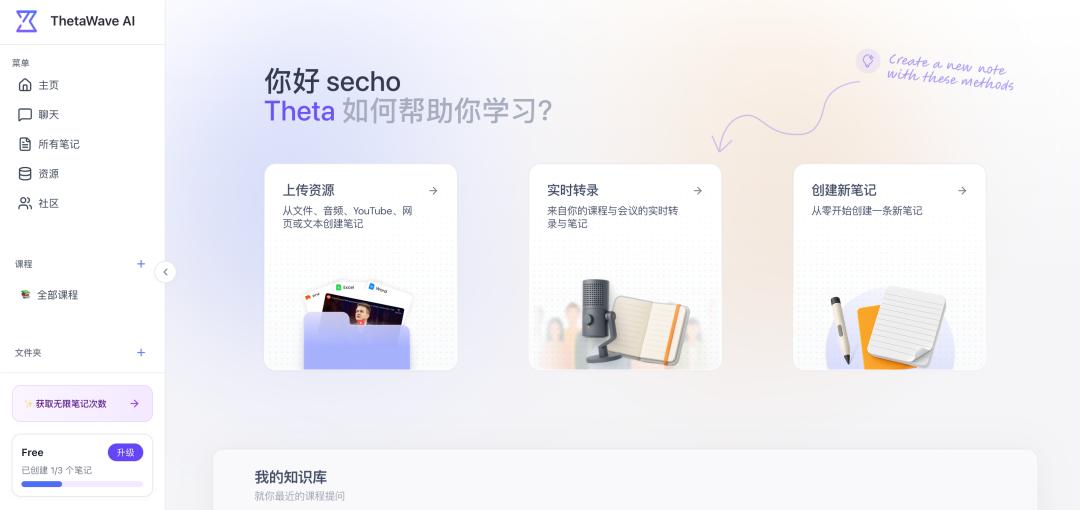
△ ThetaWave AI. Source: Official website.
For college students, especially exam candidates, the appeal of ThetaWave AI lies in its practicality.
ThetaWave AI offers five common models for knowledge organization and summarization: text notes, mind maps, image - and - text combinations, flashcards, and AI podcasts. In addition, it can generate test questions to help students review and consolidate knowledge.
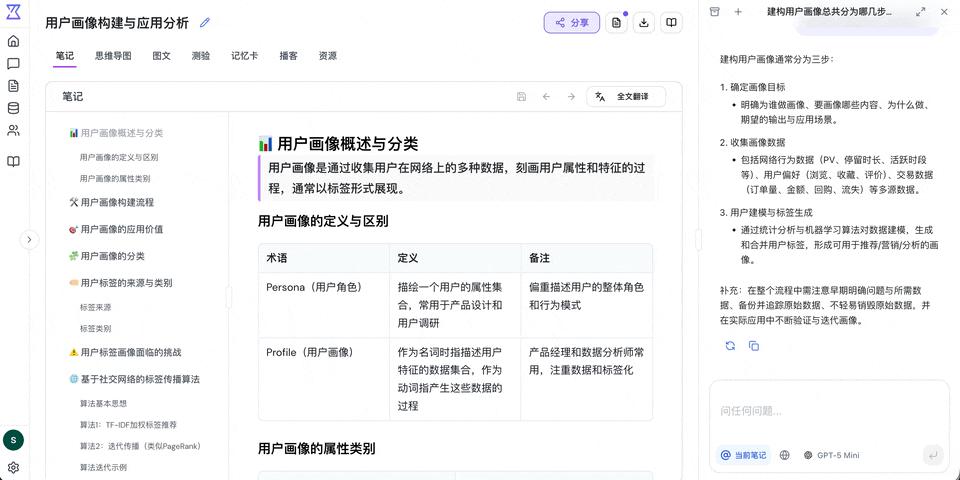
△ Summarization formats of ThetaWave AI. Source: Author's sample.
For many AI education products, the biggest hidden competitor is not established education giants like Yuanfudao or Zebra AI, but chatbots like ChatGPT and Doubao, which have a lower usage threshold and higher user penetration.
But in Li Wenxuan's view, chatbots still have many limitations. At the end of 2024, before ThetaWave AI was founded, Li Wenxuan and Zhong Ziqiu returned to the United States.
They found that even though ChatGPT, Claude, and Gemini have become the most common AI tools for students, the chatbot can only summarize rough information when processing a large amount of complex and multimodal information sources. It cannot quickly understand the core content and also cannot understand the hierarchical relationships between individual knowledge points.
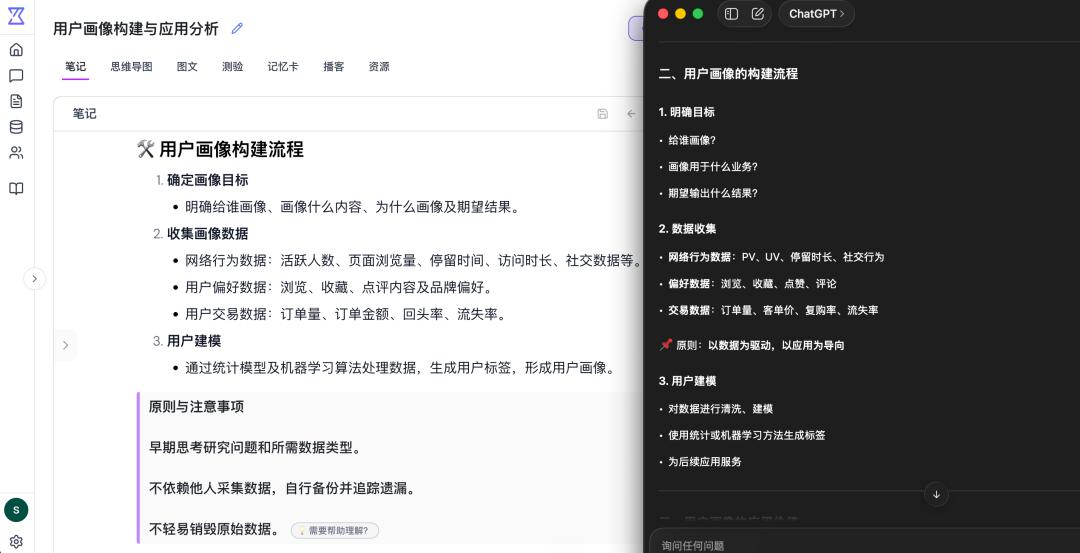
△ Note summarization by ThetaWave AI (left) and ChatGPT (right) for the same presentation. Source: Author's sample.
At the same time, in Li Wenxuan's view, the notes summarized by chatbots are still "dead" and cannot be edited, queried, or have their form adjusted in real - time according to users' preferences. Therefore, the problem that students have to adapt to knowledge still cannot be solved.
For the college - student note - taking scenario, the team has carried out a lot of optimizations and agentic engineering based on third - party models such as Qianwen and GPT in advance.
For example, the recognition accuracy of current AI models for PDFs is not very high. The team has improved the recognition accuracy of raw information sources by independently developing an image - and - text analysis and recognition model for PDFs and other files. For note generation, the team has developed a multi - agent workflow, which is responsible for file recognition, output in JSON format, extraction of knowledge points, secondary note generation, and other processes.
In the note - taking panel of ThetaWave AI, in addition to the basic text and diagram editing functions, users can also perform personalized edits and learning activities such as AI queries, AI improvements, AI image selection, and translations by selecting specific content.
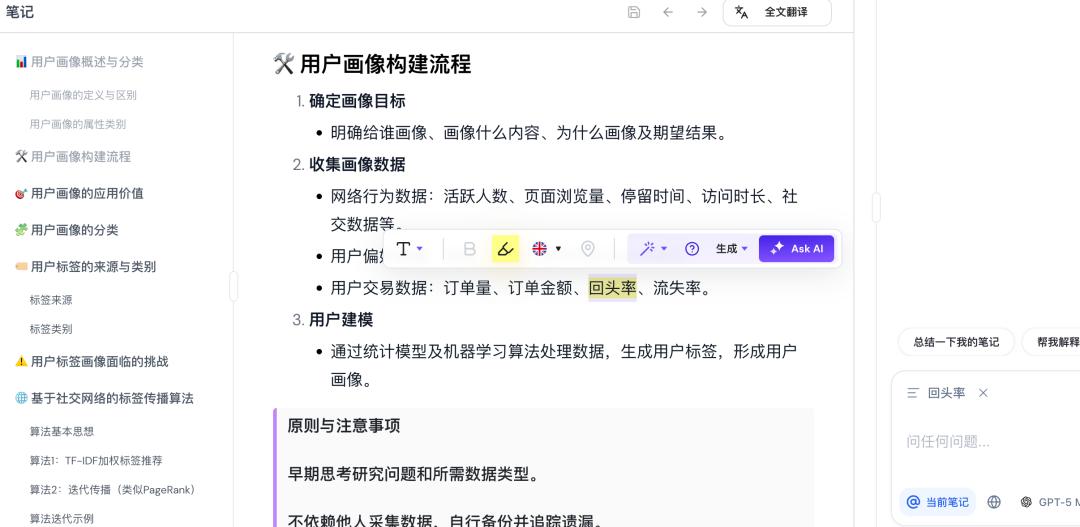
△ Note - editing and interaction functions of ThetaWave AI. Source: Author's sample.
Since ThetaWave AI has been online for a year, the team doesn't believe that there is a ready - made and directly copyable successful methodology for enterprises.
Zhong Ziqiu has previously worked with product expansion and marketing experts from large companies, but she found that these experts often fall into a thinking pattern: They first ask how much advertising budget is available, approve or reject certain channels based on past experience, and then have the company integrate into certain third - party monitoring back - ends.
"We are a young company, and the marketing budget is limited. Moreover, the product is still in the early growth stage, and it's too early to integrate into third - party monitoring back - ends." She doesn't appreciate the method of directly applying existing experience. "The methods of large companies are mostly applied to already validated models. The advantage of a young company lies in its ability to flexibly test unvalidated models."
The growth system of ThetaWave AI was developed piece by piece by Zhong Ziqiu and the team in the early stage in a simple, "hand - in - hand" way.
She attaches great importance to natural spread on social media rather than investing a lot of money in advertising. On the one hand, for practical reasons, young companies need to avoid advertising auction competition with large companies.
On the other hand, Zhong Ziqiu told us: "Where users' attention lies, our future lies." Testing the factors for natural growth essentially means testing users' points of interest in the product and then incorporating them into product development.
At the beginning of the company's founding, Thetawave's growth team produced an average of more than a hundred short videos per day and uploaded them to test accounts without a follower base on various platforms. Through the control - variable method, they tested the factors that determine whether a video goes viral. Often, they had to conduct more than ten rounds of tests to discover each factor, but the daily costs were still far below the million - dollar advertising budgets of large companies.
They found that it is often very subtle elements that determine whether a video goes viral, such as whether the ChatGPT logo and user interface should be visible in the video or whether a ChatGPT error message should appear in the video.
Recently, the team noticed that the key to the success of the "Professor goes off the rails" series of videos lies in showing the "handsome professor" losing his temper, which creates a contrast.