The crossroads of AI videos: Sora faces obstacles in monetization, Kelin focuses on practicality for survival, and Jimeng builds dreams with its ecosystem.
When Sora2 achieved one million downloads in just five days but still couldn't escape the fate of being "used and discarded," when KeLing AI exceeded 12 million monthly active users and reached an annual revenue of $140 million, successfully running through the commercial closed - loop, and when JiMeng AI was called the "TikTok of the AI era" by Zhang Yiming but chose a long - term strategy—behind these three different paths lies a triple game among Silicon Valley's hit products, Kuaishou's practical approach, and ByteDance's "future bet." This is not only a divergence in technical routes but also a profound contest in the understanding of the essence of AI video.
The AI video track, which had been calm for a long time, has recently seen some ripples.
According to an exclusive report from "LatePost": KeLing has successfully run through the commercial closed - loop. Its monthly active users have exceeded 12 million, and its revenue in 2025 is expected to reach $140 million. It is like a practical achiever who has grown rapidly and can "support a family." Its success is due to its clear positioning as a tool and a clear - cut payment model. It started with professional creators (P - end) and enterprises (B - end) and successfully broke into the mass market with hit features like "motion control," proving the strong potential of immediate technology monetization. Once the news came out, Kuaishou's stock price rose by 5% in the secondary market, and the story of its second growth curve is quietly coming true.
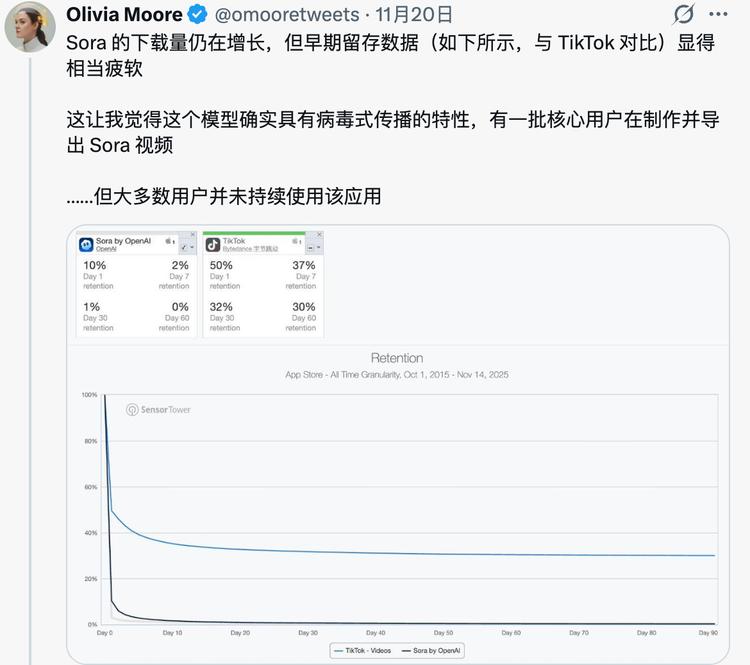
In contrast, JiMeng, backed by ByteDance, was once called the "TikTok of the AI era" by Zhang Yiming. However, the two companies that started almost at the same time seem to have different paths. In a recent interview, Zhang Nan, the person - in - charge of JiMeng, redefined the relationship between humans and AI through a review of JiMeng's practice: AI is not only a tool but also an "amplifier" of human capabilities, just like what Steve Jobs called the "bicycle for the mind." From her words, it seems that JiMeng is "not in a hurry to support the family." Although JiMeng has greater ambitions, it also shows a kind of calmness of "long - termism." On the other side of the ocean, at the end of 2025, OpenAI's Sora2 app emerged suddenly. With its amazing visual effects, it achieved one million downloads globally in just five days and quickly topped the app stores in many countries. However, the halo of Silicon Valley did not last. According to data from venture capital firm a16z, its 30 - day user retention rate dropped sharply to only 1%, becoming a technological wonder of being "used and discarded."

The three different paths reflect the different understandings and strategic bets of global top - tier technology companies on the disruptive technology of AI video.
The core proposition is to lay the foundation for the future content ecosystem. Zhang Nan's view also confirms this: at the current stage when the technological gap between companies has not significantly widened, rushing to monetize may not be the optimal solution. More importantly, it is to build long - term capabilities and ecological niches.
Therefore, this is not a simple competition of superiority and inferiority but a "two - way verification" of the future of AI video. KeLing verifies the current path of successful commercialization of independent products, while JiMeng is exploring the potential of ecosystem - level applications to shape rules in the future. And Sora2, which chases possibilities, verifies the explosive power of the track. The progress of these three is not only a portrayal of the present but also a reflection on the future: should we pursue immediate commercial victory or plan an ecological blueprint in the deep - water area?
01
Path Divergence:
Sora's Hit Product Dilemma, KeLing's Pragmatic Closed - Loop, and JiMeng's Ecosystem Bet

Three distinct development paths have emerged in the field of AI video. From Silicon Valley to Beijing, Sora2, JiMeng, and KeLing are exploring the future of video generation in completely different ways. Specifically, Sora2 rose rapidly with its technological first - mover advantage. It achieved one million downloads in just five days and once topped the app stores in many countries. However, this explosive growth failed to translate into long - term user retention.
Data publicly released by Olivia Moore, a partner at venture capital firm a16z, shows that Sora's user retention rates at 1 day, 7 days, 30 days, and 60 days are 10%, 2%, 1%, and 0% respectively. This data is in sharp contrast to TikTok's 50% first - day retention rate and 32% 30 - day retention rate.
The problem lies in the ambiguity of product positioning. Sora2 tries to combine tools and social functions, but it neither provides stable and controllable generation effects like professional tools nor has the interactivity that a social platform should have. Currently, it seems that Sora2 is taking the C - end platform route. Most users only regard it as a one - time toy. After generating one or two videos to satisfy their curiosity, they quickly leave. More seriously, its social vision of being the "AI version of TikTok" is difficult to achieve due to the immature recommendation algorithm.
According to user feedback, Sora2's recommendation system "always pushes the same type of videos," and its function design is not satisfactory, failing to form effective user stickiness.
KeLing AI has chosen a pragmatic path completely different from Sora2. This AI video platform under Kuaishou has clearly formed a business model centered around professional creators (P - end). Paid subscription members at the P - end contribute nearly 70% of the operating income. Official Kuaishou data shows that the core revenue source of KeLing is the paid subscription for professional creators, contributing nearly 70% of the operating income. This efficient monetization ability has elevated it to a first - level business department within Kuaishou, on par with the main website, commercialization, and e - commerce departments.
As of January 2026, its monthly active users have exceeded 12 million, and its full - year revenue in 2025 is expected to reach $140 million. Of course, the B2B solution seems to be the optimal solution at present. However, from another perspective, it also means limited room for imagination. KeLing has also noticed this problem and is trying to expand its imagination by continuously integrating with the C - end business. For example, the previously popular "AI Wonders" focused on the live - streaming room scenario, enriching the ecosystem. It can be seen that KeLing is making early arrangements for commercialization and future development.

Different from both Sora2 and KeLing, JiMeng AI under ByteDance has chosen a long - term path centered around ecosystem construction. Although also backed by a short - video giant, JiMeng is not in a hurry to commercialize. Instead, it focuses on lowering the creation threshold and cultivating an AI - native content ecosystem. In March 2025, JiMeng's monthly active users reached 893,000, indicating its strategy of prioritizing user expansion.
JiMeng vigorously supports the creation of AI short dramas through the "AIGC Short Drama Recruitment Program," providing up to 50% - 70% investment for a single high - quality work, with a maximum investment of up to $2 million. This strategy has achieved initial results: the first paid AI short drama "Mysteries in the Greater Khingan Mountains" reached over 30 million views in three days after its launch on Douyin.
These three paths represent three different choices: should we pursue short - term traffic explosion, focus on in - depth commercialization closed - loop, or plan for a long - term content ecosystem? This is not only a strategic divergence among the three players but also a crossroads for the entire AI video industry. The ultimate answer to this track competition lies in the next moves of each company.
02
Game Focus:
The Temptation of Short - Term Monetization, Long - Term Ecosystem Planning, and the Challenge of Technical Controllability

Behind the different paths chosen by the three companies are their different judgments on the essence of video AI and the timing of commercialization. These judgments directly affect their product strategies, resource allocation, and long - term visions.
The dilemma faced by Sora2 reveals the limitations of a purely technology - driven route. Although Sora2 is amazing in technical demonstrations, when users actually use it, problems such as distorted human limbs, objects disappearing out of thin air, and broken physical logic are common.
Industry analysis shows that only 5% - 10% of the videos generated by Sora2 can be actually used for publication. This "lottery - like" uncertainty makes it difficult for Sora2 to become a reliable productivity tool.
Meanwhile, Sora2's social vision of being the "AI version of TikTok" also faces challenges. Compared with TikTok's mature recommendation algorithm and user interaction mechanism, Sora2's recommendation system "always pushes the same type of videos," and "some function designs are not satisfactory."
Most users download Sora2 out of curiosity. After generating a few videos for social sharing, their interest quickly fades.
KeLing AI's pragmatic path is based on an accurate grasp of market demand. Since its inception, the platform has established a "professional - first" strategy, with its core user group being professional creators and enterprise - level customers. This focus has led to efficient commercial conversion.
In terms of revenue performance, KeLing's ARPU (Average Revenue Per User) is 6.4 times that of its competitor PixVerse. Although its download volume is only 15.4% of PixVerse's, KeLing's total revenue is almost the same. This high - efficiency commercialization ability has made KeLing a key business within Kuaishou, being listed as a first - level business department on par with the main website, commercialization, and e - commerce.
JiMeng AI's ecosystem strategy reflects ByteDance's forward - looking layout for the transformation of the content industry. Zhang Nan, the person - in - charge of JiMeng, once said that at the current stage when the technological gap has not significantly widened, rushing to monetize may not be the optimal solution. More importantly, it is to build long - term capabilities and ecological niches.
From an ecosystem perspective, the number of platforms within the ByteDance system that require content production is increasing. The growing popularity of the short - drama platform Hongguo and the successive launches of platforms like Douyin Select and AI Douyin have made people realize that in the future, content supply may have to rely on more powerful efficiency tools and mature supply chains. This means that JiMeng, as a key part of the upstream of this chain, is becoming more important.

Picture/AI video in Douyin
For example, this strategy is particularly evident in the layout of the AI short - drama field. Through the "AIGC Short Drama Recruitment Program," JiMeng not only provides financial support but also offers unlimited credits for half a year, annual memberships, and customized technical solutions.
More importantly, JiMeng is committed to connecting the entire chain from AI generation to content distribution. The platform can provide up to 30 - 50 million views for a single work, and key works can even get up to 100 million views.
This seamless connection between generation and distribution is exactly the key link that Sora2 lacks.
Judging from the game of these three paths, it seems that everyone is moving towards their goals. Then, where lies the key to victory in the future? This seems to be the key to solving the problem in the next stage.
03
Key to Victory:
Balance of Computing Power Costs, Verification of Business Models, and Cultivation of Creator Ecosystem
As the competition in video AI enters the deep - water area, simple model capabilities are no longer the decisive factor. The key to victory in the future will depend on a company's ability to find the best balance between technology, ecosystem, and sustainability.
The fundamental challenge in video generation is computing power costs. Industry data shows that the inference cost for high - quality video generation is still $30 - 50 per minute. This high cost makes it difficult for most video AI companies to achieve large - scale profitability.
Users' usage patterns further exacerbate this dilemma. Due to the uncontrollability of generation results, users often need to generate and modify repeatedly. Behind a single usable video segment, there may be a dozen or even dozens of discarded video generations. The computing power consumed by these discarded videos is all sunk cost.
In the exploration of business models, the three companies show different ideas. Sora2 tries to form a closed - loop through its in - app ecosystem, but the low retention rate indicates that this attempt has not been successful.
KeLing is seeking a way out through in - depth integration with Kuaishou's e - commerce ecosystem. KeLing has established cooperation with thousands of enterprise customers such as Xiaomi, Amazon Web Services, BlueFocus, and NetEase. In industries such as e - commerce and gaming, the penetration rate of AI materials for some typical customers has reached 60%.
JiMeng's long - termism is reflected in the systematic cultivation of the creation ecosystem. The platform not only provides tools but also focuses on solving the talent gap problem - most people who understand AI technology do not understand film and television production, and most people who understand film and television production do not understand AI.