China's Rebound vs. Japan's Stability: Decoding the Temperature Difference in the Chinese and Japanese Venture Capital Markets in 2025
IT Juzi has recently been conducting a review of China's primary market equity investment in 2025.
Yesterday, I happened to see a media outlet in the circle, @Investment Bank Little Buddha, publish a "Summary Report on the Japanese Equity Investment Market in 2025".
Some friends asked if we could make a comparison between China and Japan?
Come on, with two ready - made data reports, let's leave the comparison to the large - language model ——
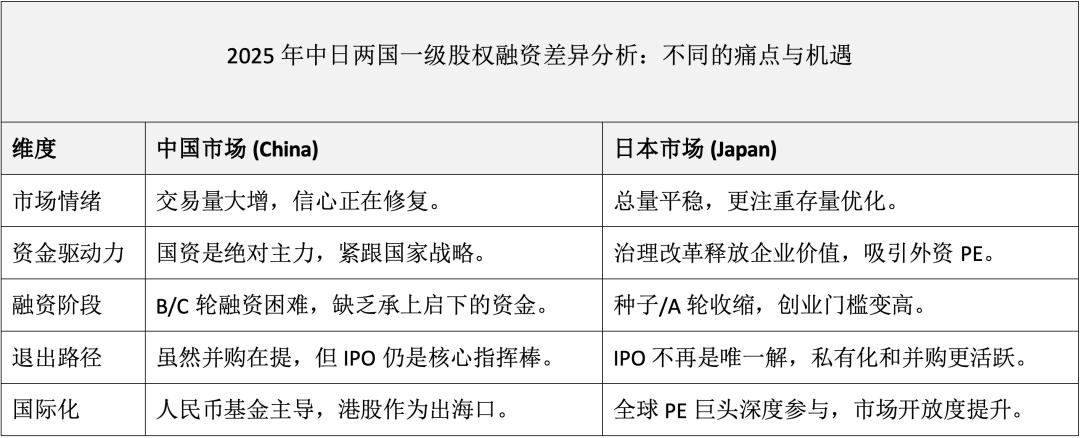
In 2025, against the complex background of macro - economy and geopolitics, the equity investment markets of China and Japan showed completely different evolution paths.
The Chinese market experienced a "V - shaped rebound". After two years of downturn, the number of transactions increased significantly, showing distinct characteristics of "policy - driven, state - owned capital - led, and early - stage and small - scale investment". The market is transforming from simple financial investment to industrial investment serving the national strategy.
The Japanese market presented a situation of "stable overall volume, structural reshaping, and PE explosion". Under the reform of the Tokyo Stock Exchange and the attention of global capital, the VC market entered a strict selection period, while the PE market reached a record high due to corporate governance reform and the wave of privatization.
Although they are at different cycle nodes, both are facing a profound transformation from "scale expansion" to "quality and efficiency".
In - depth Comparison of Core Dimensions
1. Market Size and Activity
● China: A Surge in Transaction Volume and Stable Transaction Amount
○ Number of Transactions: A total of 9,058 investment transactions took place throughout the year, a significant year - on - year increase of 28%, even exceeding the peak in 2021, indicating a strong recovery of market activity.
○ Investment Amount: The total amount was 821.368 billion yuan, a slight year - on - year decrease of 0.44%.
○ Characteristics: It presented a typical situation of "increasing volume and stable price", which means that the amount of single - investment decreased significantly, and the fragmentation trend of funds was obvious.
● Japan: Stable VC and Explosive PE
○ VC Market: The total investment was about 761.3 billion yen (about 37 billion yuan), basically the same as in 2024.
○ PE Market: The transaction scale is expected to exceed 40 billion US dollars (about 290 billion yuan), reaching a record high and becoming a highlight in the Asian market.
○ Characteristics: The VC market entered a stock game, while the PE market expanded significantly driven by large - scale mergers and acquisitions.
2. Financing Rounds and Structure
● China: Extreme "Early - stage and Small - scale Investment"
○ Early - stage Dominance: Early - stage financing (seed/angel/Series A) accounted for as high as 67%.
○ Middle - stage Collapse: The proportion of financing in the growth stage (Series B/C) dropped sharply, forming a dumbbell - shaped structure of "large at both ends and small in the middle". Many early - stage projects faced a "financing gap" when seeking large - scale expansion.
● Japan: Contraction in the Early - stage and Concentration in the Middle - stage
○ Early - stage Contraction: The total amount of Series A financing decreased by 18%, and investors no longer "spread the net widely".
○ Middle - stage Concentration: The total amount of Series B financing increased by 11%, and funds were concentrated on proven high - quality projects.
○ Extended Late - stage: There were more "life - sustaining" financings in the late - stage rounds, and the waiting period before IPO was prolonged.
3. Source and Nature of Funds
● China: Inflow of State - owned Capital and Retreat of Institutional Capital
○ State - owned Capital Dominance: The penetration rate of institutions with state - owned background reached 44.55%, a record high. State - owned capital is no longer a supporting role but the protagonist of the market, leading large - scale investments and strategic layouts.
○ RMB Dominance: US - dollar funds continued to decline, and RMB funds occupied an absolute dominant position.
● Japan: Dual - wheel Drive of Industrial Capital and Foreign Capital
○ Rise of CVC: The investment amount of corporate legal persons/industrial capital increased by 32 billion yen year - on - year. Large enterprises deeply participated in innovation through CVC.
○ Inflow of Foreign Capital: Global PE giants such as Blackstone and KKR increased their layout in Japan, mainly targeting mergers, acquisitions, and privatization of mature enterprises.
4. Exit Environment: IPO vs. M&A
● China: Recovery of IPO and Development of M&A Channels
○ IPO Data: The number of IPOs throughout the year rebounded to 277, a year - on - year increase of 26%; the total amount of funds raised soared by 143%.
○ Channel Differentiation: The Hong Kong Stock Exchange rose (contributing 59% of the funds raised), and the A - share market focused on hard technology.
○ Penetration Rate: The penetration rate of VC/PE in listed enterprises reached 77.37%, indicating that institutional investment has become a "standard" for enterprises to go public.
○ M&A Trend: Meanwhile, M&A, as another important exit path besides IPO, also showed a development trend. A total of 955 M&A transactions took place in the Chinese market in 2025. Although this figure decreased slightly by 2% year - on - year compared with 979 in 2024, it had increased significantly in the past two years compared with 614 in 2023. This shows that, similar to the Japanese market, M&A, as a supplementary channel to IPO, is receiving more attention, and the exit paths in the Chinese market are becoming more diversified.
● Japan: Cold IPO and M&A Becoming the Mainstream
○ IPO Data: There were only 108 IPOs throughout the year, and the number of IPOs of start - up enterprises reached a 10 - year low.
○ Active M&A: There were 167 cases of being acquired/turned into subsidiaries. Due to the increase in IPO thresholds and window fluctuations, M&A is replacing IPO as a more realistic exit channel.
5. Investment Tracks and Hot Spots
● China: Hard Technology and National Strategy
○ Core Tracks: Advanced manufacturing (4,129 events, accounting for half of the market, covering fields such as integrated circuits/semiconductors, robots/embodied intelligence, intelligent equipment, new energy, new materials, and aerospace), artificial intelligence (AI), and healthcare.
○ Cold Areas: Traditional Internet models such as consumption, social networking, and education have been substantially "abandoned" by capital.
● Japan: Deep Technology and Digitalization
○ Core Tracks: Deep Tech (AI, semiconductors, aerospace, biomedicine), industrial digitalization (DX).
○ Trend: Funds favored projects with high - tech barriers, and the traditional consumer Internet also cooled down.
6. Matthew Effect and Capital Concentration
● China: Extreme "One - to - Nine Differentiation"
○ Top - tier Attracting Capital: 1.43% of top - tier companies (with annual financing exceeding 1 billion yuan) took 40.48% of the market capital.
○ Long - tail Dilemma: 75.9% of companies with financing of less than 100 million yuan only shared 15.67% of the capital.
● Japan: "Picky" Capital Allocation
○ Decline of Median: The median of single - financing decreased from 77.6 million yen to 62.4 million yen.
○ Structural Differentiation: Capital was concentrated on the top - tier, and the number of enterprises in the middle layer (in the range of 10 million - 500 million yen) decreased significantly.
Common Characteristics: Farewell to Wild Growth
Despite different paths, the markets of China and Japan showed some profound commonalities in 2025:
1. Transition from "Scale" to "Quality": Both markets bid farewell to the era of blindly pursuing scale. China emphasizes "high - quality development" and "new - quality productivity", while Japan emphasizes "efficiency optimization" and "governance reform".
2. Intensified Top - tier Effect: Capital was no longer evenly spread across the market but highly concentrated on top - tier high - quality assets. Whether it is the "one - to - nine differentiation" in China or the "dumbbell - shaped" structure in Japan, it shows that the survival space of tail - end projects has been extremely compressed.
3. Strategic Capital Replacing Pure Financial Capital:
○ In China, it is reflected in the dominant position of government - guided funds, emphasizing industrial implementation and strengthening the industrial chain.
○ In Japan, it is reflected in the strong rise of CVC (industrial capital), emphasizing business synergy and strategic layout.
○ Traditional VCs purely pursuing financial returns are facing the challenge of marginalization in both countries.
4. Strong Policy Intervention: China guides the flow of capital through IPO policies and state - owned capital assessment; Japan reshapes market rules through the Tokyo Stock Exchange reform (PBR reform) and government start - up support programs.
Outlook and Enlightenment
For the Chinese market, the recovery in 2025 was based on the strong support of state - owned capital. The future challenges lie in how to solve the problem of "financing collapse in the growth stage" and how to activate the vitality of private capital to avoid the market being completely dependent on policy guidance. The normalization of the IPO market and the cultivation of the M&A market will be crucial.
For the Japanese market, 2025 was a big year for PE, marking the most profound capital - structure adjustment in the Japanese business community in 30 years. The future challenges lie in maintaining the vitality of the start - up ecosystem (the risk of early - stage capital contraction) and how to maintain the independence and competitiveness of domestic industries under the influx of global capital.
In summary, in 2025, the equity investment markets of China and Japan are reconstructing order under the strong push of the "visible hand" and exploring value under the combined force of the "invisible hand" and institutional reform respectively. Both are accumulating strength for the next round of industrial competition, and "hard technology" and "industrial upgrading" are the future bets of both sides.
Data Sources
● Chinese Market: The data is from the year - end series report of IT Juzi, "Answer the Call of Chinese Venture Capital in 2025", and the "Report on Equity Investment and Financing in China's Primary Market from 2025 - 2026".
● Japanese Market: The data is comprehensively compiled based on public data released by institutions such as the Japan Venture Capital Association (JVCA), Speeda, RECOF, and Reuters, as well as analysis reports of multiple research institutions.
Note: This report is compiled based on public information and does not constitute any investment advice. There may be differences in statistical caliber or lag in some data, which is for reference only.
This article is from the WeChat official account "IT Juzi" (ID: itjuzi521), author: Judy, published by 36Kr with authorization.