Is the world sliding from the "1920s" to the "1930s"?
In the cold wind of Davos, top global financial power players issued a warning: out - of - control government finances and geopolitical fragmentation may be offsetting the productivity dividends brought by AI.
During a high - profile panel discussion on the second day of the 2026 World Economic Forum, Larry Fink, the CEO of BlackRock, the world's largest asset management company and the " Godfather of Wall Street " (managing $14 trillion in assets), Ken Griffin, the founder of Citadel Securities, one of the most successful hedge funds (managing $65 billion in assets), Christine Lagarde, the President of the European Central Bank, and Adam Tooze, a famous economic historian, gathered together.
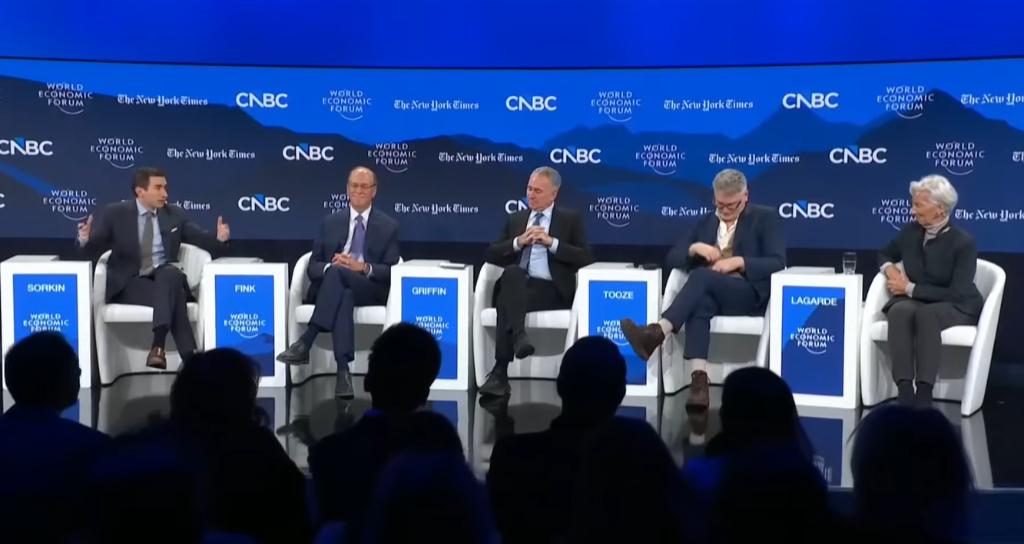
Photo: From left to right are Andrew, the host in Davos, Larry Fink, the CEO of BlackRock, Ken Griffin, the founder of Citadel Securities, Adam Tooze, a famous economic historian, and Christine Lagarde, the President of the European Central Bank.
In this discussion, which Griffin jokingly called "gloom and doom", the guests profoundly analyzed how the AI technology explosion, soaring sovereign debts, and geopolitical fragmentation are pushing the global economy towards a dangerous crossroads "eerily similar to the eve of 1929" - an era that led to the Great Depression after a technological frenzy.
Key points summary:
- Historical mirror:
Christine Lagarde, the President of the European Central Bank, and historian Adam Tooze warned that the current "technological boom + trade protectionism + geopolitical fragmentation" bears a striking resemblance to the path towards the Great Depression from the 1920s to the 1930s.
- Debt crisis:
Ken Griffin, the founder of Citadel Securities, criticized the "reckless spending" of governments around the world (especially the United States) as the biggest threat to the current market, rather than the private capital market. "All governments are overspending, almost without exception."
AI is not a bubble but shows a K - shaped divergence: Larry Fink, the CEO of BlackRock and the "Godfather of Wall Street", believes that AI is not a bubble, but it will lead to a "winner - takes - all" situation, where giants with scale and data (such as Walmart) will crush their opponents. Lagarde revealed that training a cutting - edge model costs $1 billion, and Griffin estimated that the capital expenditure on data centers in the United States this year will reach as high as $600 billion.
Tariffs and fragmentation threaten the expansion of AI: Christine Lagarde, the President of the European Central Bank, warned that geopolitical fragmentation and protectionism will hinder the data flow and energy access required by AI, leading to a decline in efficiency.
- Cost of tariffs:
Lagarde pointed out that the tariffs between Europe and the United States are rising from 2% to 15%; Griffin warned that tariffs are actually a regressive tax on American consumers and businesses and may give rise to crony capitalism, stifling the vitality of small and medium - sized enterprises.
- Central bank independence:
Facing political pressure, Lagarde reiterated the importance of central bank independence, emphasizing that fiscal consolidation cannot rely on the central bank to "bail out".
Refuse to "repeat" history, but be vigilant against "rhyming"
"Mark Twain said that history doesn't repeat itself, but it often rhymes." Adam Tooze, a historian from Columbia University, pointed out the core issue at the beginning. He noted that there are striking similarities between the current 2020s and the 1920s a century ago: back then, it was the technological explosion of electrification and the Ford assembly line; today, it is the rapid advancement of AI. Back then, it was the rise of the US dollar hegemony; today, the US dollar system is under pressure.
The most disturbing parallel lies in "political failure". Tooze warned that in the 1920s, people tried to use technology and finance to cover up political rifts. This model of "over - relying on money due to a lack of political imagination" ultimately led to the collapse of the system.
Lagarde agreed with this view. She added that in the 1920s, the global trade - to - GDP ratio plummeted from 21% to 14% within a few years. Today, although an avalanche has not occurred, global trade is under unprecedented pressure due to geopolitical fragmentation and tariff barriers. She warned that without a minimum level of global cooperation, the "economies of scale" required by AI will be strangled by fragmented markets.
Fiscal "recklessness": the real systemic risk
Ken Griffin, the head of Citadel Securities, gave a sharp judgment on the root cause of the current market risks.
"This is a story about recklessness, but it's not the recklessness of the private capital market, but the recklessness of government spending." Griffin said bluntly that, different from the excessive leverage of the private sector in 1929, the core risk in 2026 lies in the unrestrained spending of governments. "All governments are overspending, almost without exception." He warned that this fiscal indulgence is threatening the foundation of the market.
The current US national debt has reached as high as $38 trillion. Griffin questioned whether Washington's hope that AI will bring huge productivity improvements to "save" the deficit can be realized. If AI fails to bring a productivity leap as expected, this unrestrained spending will be unsustainable.
AI: not a bubble, but a cruel "K - shaped" cleansing
Larry Fink, who manages $14 trillion in assets, has a more microscopic and cruel view of AI. He clearly stated: "I don't think we're in an AI bubble, but I think there will be huge failure cases."
Fink proposed the concept of a "K - shaped economy". He observed that in various industries, enterprises with scale advantages (Scale Operators) are using AI to quickly widen the gap with small and medium - sized enterprises. He took Walmart as an example, pointing out that its ability to use AI for inventory control and consumer preference analysis is far ahead.
The root of this divergence lies in the staggering capital threshold. Lagarde revealed on - site that the cost of developing a cutting - edge AI model has now reached as high as $1 billion and is extremely dependent on cross - border data flow. Ken Griffin gave a more macro figure: just this year, the capital expenditure (Capex) on data centers in the United States will reach $600 billion - Larry Fink even interjected, thinking that "the actual figure will be higher".
Such a high "entry ticket" means that only "scale operators" with deep capital moats can play this game. As Fink said, AI will not naturally "democratize"; instead, it may intensify the winner - takes - all situation.
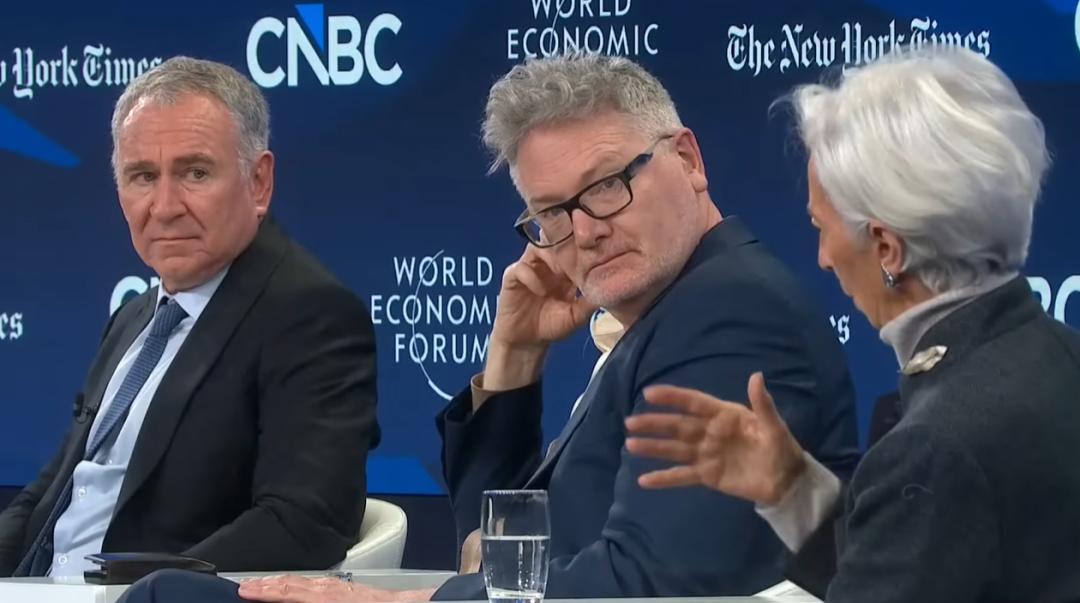
Tariff boomerang: who is paying the bill?
With the recent escalation of geopolitical tensions, tariffs have become a lingering shadow over the Davos Forum. Lagarde provided a staggering set of data: the average tariff level between the United States and Europe has soared from 2% a year ago to over 12% currently and is at risk of further rising to 15%.
"If 96% of the cost of these tariffs is borne by consumers, it's definitely not good for inflation," Lagarde warned.
Griffin criticized the drawbacks of tariffs from the perspective of micro - enterprises. He pointed out that tariffs are not only a regressive tax on consumers but also give rise to "crony capitalism". Under tariff barriers, companies with the closest relationships with Washington will gain privileges, which is a poison for strangling the innovation vitality of small and medium - sized enterprises. He reminded that whether it's BlackRock, Citadel, or today's AI giants, they all started as small and medium - sized enterprises in the beginning, and it's crucial to protect this market vitality.
Central bank independence and the "last line of defense"
Facing huge debts and fiscal deficits, the market often expects the central bank to "print money to rescue the market" again. Lagarde is tough on this issue. She cited the example of Paul Volcker, emphasizing that the central bank must maintain its independence and cannot become an appendage of fiscal policy.
"I don't think the central bank will always be the 'only savior'," Lagarde said. Relying solely on monetary policy cannot solve the structural fiscal imbalance.
Tooze also added that the concept of central bank independence itself was born in the 1920s to deal with populist pressure. In the current extremely politicized environment, maintaining the "knave - proof" attribute of the central bank is more critical than ever.
This article does not constitute personal investment advice and does not represent the views of the platform. The market is risky, and investment requires caution. Please make independent judgments and decisions.
This article is from the WeChat official account "Wall Street Insights" . Author: Long Yue. Republished by 36Kr with permission.