Visit to Li Auto's Changzhou Factory: "Forced vacations" are the norm, and this Spring Festival is tough.
"We're on holiday starting today."
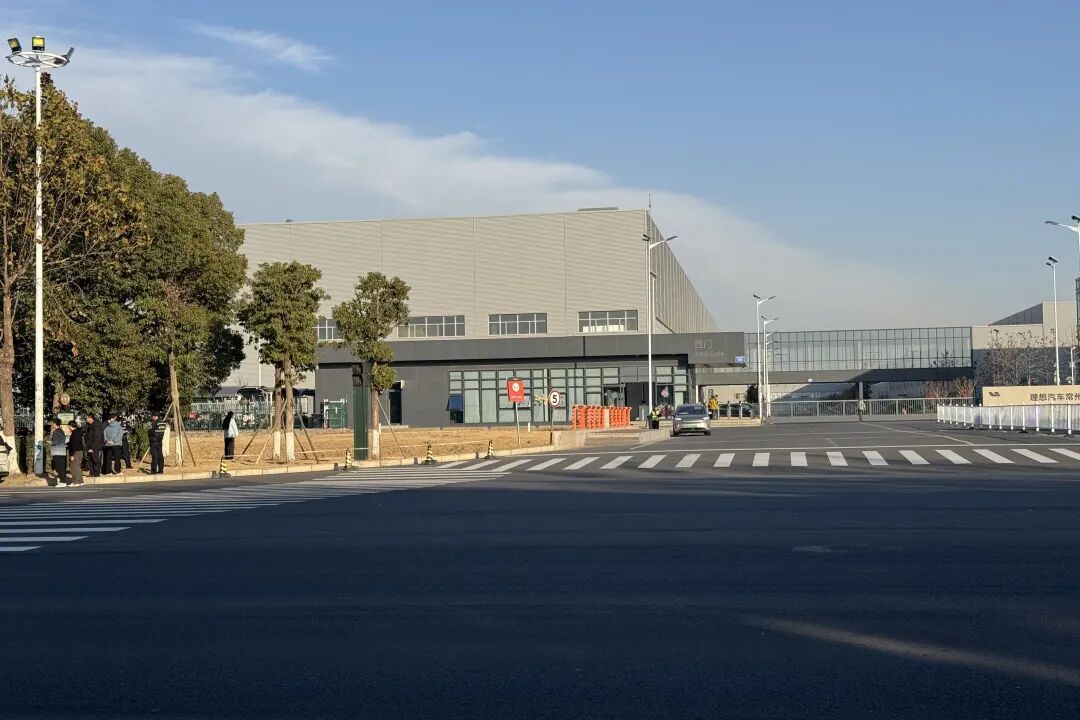
On the evening of January 15th, at the entrance of Area 2 of Li Auto's Changzhou base, two production line workers waiting for a taxi uttered these words in a low voice, with no expression on their faces.
"We've had such idle days for some time. We work three days and rest four."
One of them said, and the other continued, "It seemed good at first, but when it comes to calculating work points, we can't smile anymore. Who can still smile with so many holidays?"
The "work three days and rest four" they mentioned became a frequently - used phrase in subsequent conversations with many front - line workers in Area 2. And this kind of "leisure" is not an exclusive treatment for full - time employees on Li Auto's production front line.
Just one day before, three sophomore students who had taken a more than twenty - hour train ride from Lanzhou also experienced a similar situation. They were outsourced workers coming for winter vacation jobs, full of hopes for more pay for more work. However, on their first day at work, they were told that the production line in Area 2 of the Changzhou Li Auto base had long been operating below full capacity, and they even had to be "put on holiday" frequently.
They had already paid 95 yuan for labor protection suits and shoes, and spent money on the journey, but there wasn't much work. The three young men squatted outside the factory area and discussed, "Let's leave after today."
On one hand, full - time employees are worried about "work points", and on the other hand, outsourced workers want to "leave" as soon as they arrive. This scene at Li Auto's Changzhou factory is obviously the most intuitive manifestation of the current real - world pressure Li Auto is facing.
NO.1 [ The i8 is moving, and the production capacity of the L7 and L8 is idle ]
Li Auto's Changzhou base covers a large area and is divided into two major areas, the South and the North, with a comprehensive production capacity of over 500,000 vehicles per year. Among them, Area 2, which produces the L7 and L8, is connected to Area 3, which produces the i6 and i8, and they are collectively referred to as the South Area; while Area 1, which produces the L6 and L9, is 3 kilometers away and is called the North Area.
The days in each factory area are quite different.
"Our Area 2 mainly produces the L7 and L8. Now, the orders for these two models have decreased, so the production line naturally has to stop. According to our leader, we'll have another ten - day holiday or so before the end of this month," said a slightly younger master with a crew cut as he walked out of the entrance of Area 2, in a definite tone.
As he spoke, he unconsciously looked towards the other end of the base. "Over there is Area 3, which mainly produces electric vehicles. There's a lot of work. We all want to go there, but full - time employees can't choose their work areas by themselves. We have to obey the arrangement from above."
The word "arrangement" was heard again later that day from Lao Liu (a pseudonym), a quality inspector in Area 1.
On his way to the parking lot, pushing his electric bike and getting ready to go home, he said, "Naturally, there's less work when there are fewer orders. That's the case in every factory."
Lao Liu didn't talk much, but what he said was practical. "Our factory also has a policy. For workshops with no work, full - time workers can be transferred internally to other workshops. Of course, how the transfer is arranged depends on the decision from above, and whether the employees are willing to accept the transfer also depends on their personal willingness."
He gave an example, such as being transferred to Li Auto's factory in Shunyi, Beijing. "It's too far away. Not many people with families are willing to go."
Compared with the "leisure" of the workers in Area 1 and Area 2, the days of the workers in Area 3 are obviously much better.
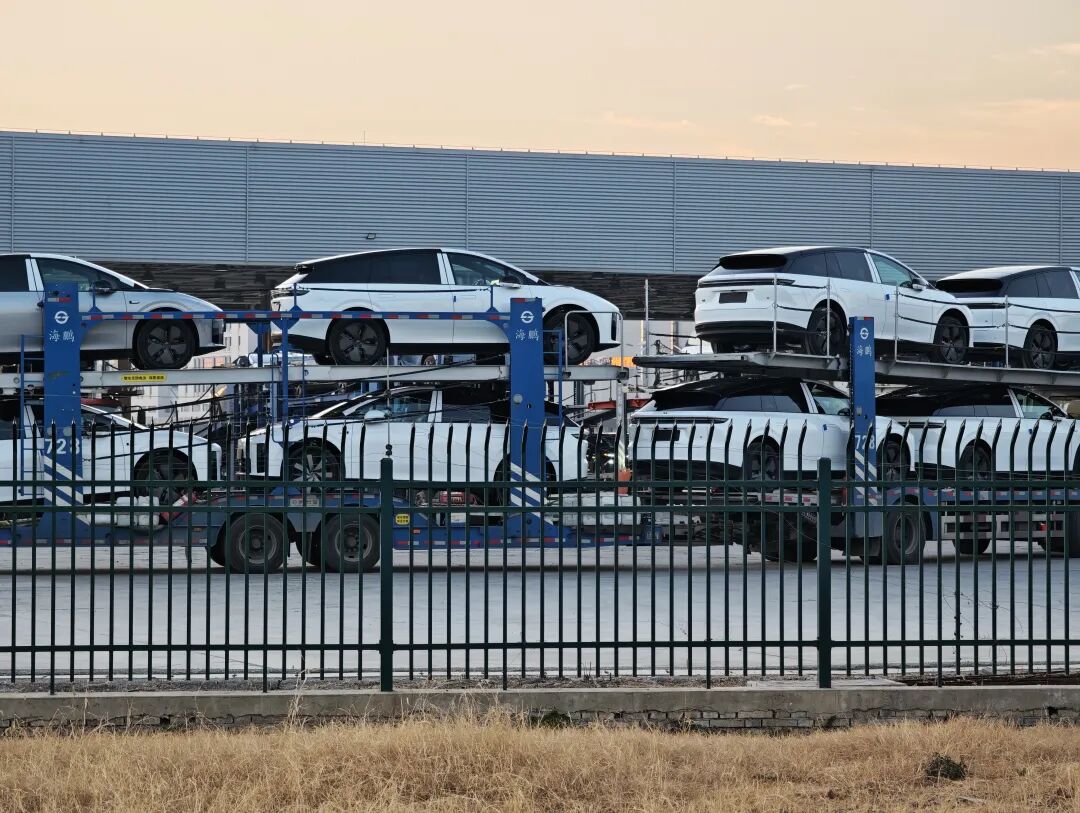
Loading the i6 at Area 3 of Li Auto's Changzhou factory
Wang Yuan (a pseudonym), who had just finished his morning shift and had worked in the automobile manufacturing industry for a full ten years, was now the team leader of a production line in the i6 workshop in Area 3. Fatigue could be seen in his eyes and eyebrows as he said, "It's okay here. We work in two shifts, with the machines running non - stop. We produce at least 700 vehicles a day."
However, Wang Yuan quickly added, "It's only the production line of the i6 here that's okay. The production line of the i8 at the other end of Area 3 is currently shut down. One reason is the few orders, and the other is that I heard from the leader that they're going to move it to the factory in Shunyi, Beijing."
The feedback from the above - mentioned workers all points to a fact: The busyness or idleness of the production line is directly related to the market performance of the models.
A direct and practical question then emerges: Is the idle production capacity at Li Auto's factory a common situation in the entire industry? After all, January is often regarded as a traditional off - season after the sales rush in December.
For this reason, we went to BYD's factory, which is also in Changzhou. In the evening, the scene there was in sharp contrast to the desolation at the entrance of Area 2 of Li Auto's base.
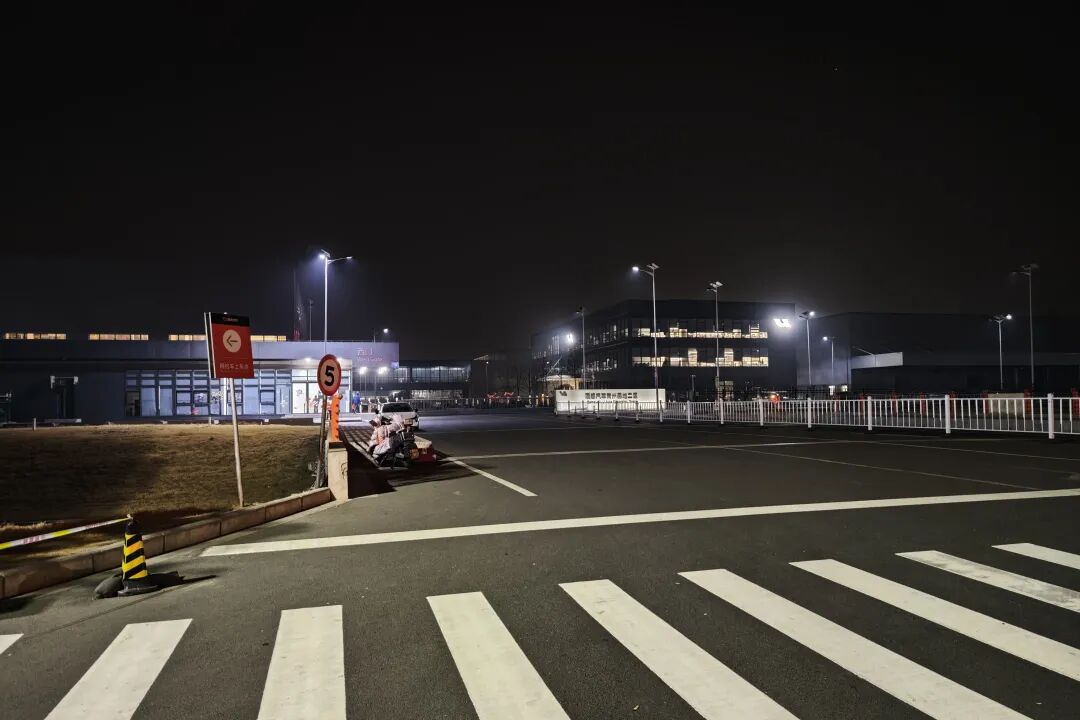
The entrance of Area 2 of Li Auto's Changzhou base
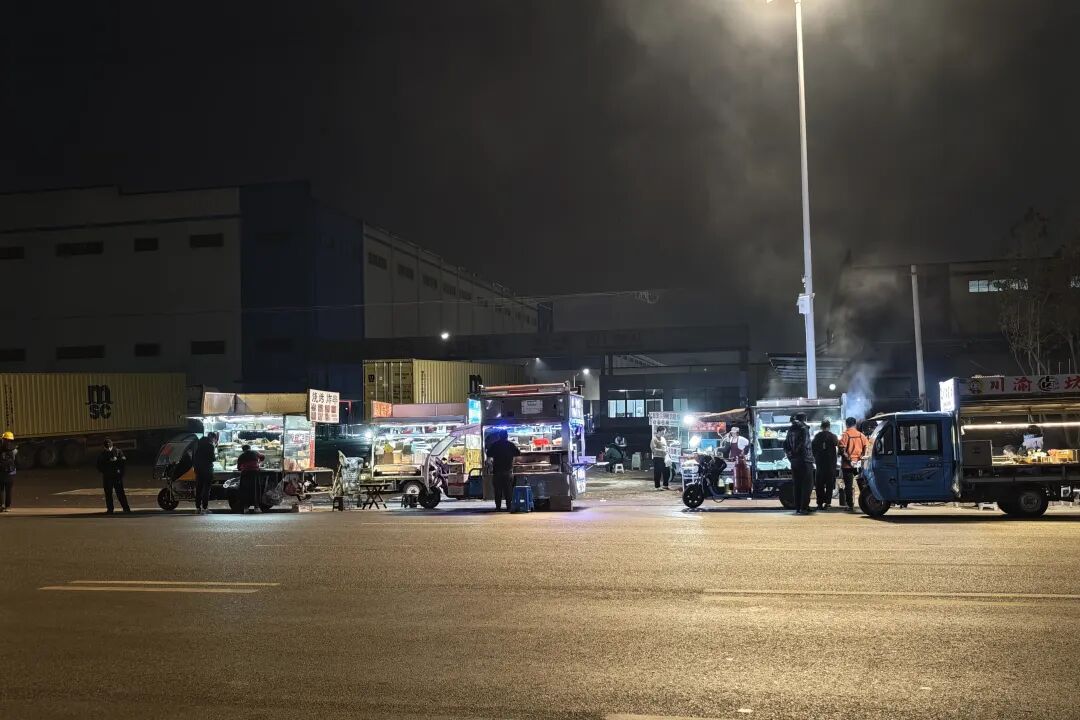
The entrance of BYD's Changzhou factory on the same day
At the entrance of BYD's factory area, there was a bustling crowd. Various snack trucks were lined up in an orderly manner. Many stall owners even set up simple tables and chairs to facilitate the workers to dine immediately. It was full of a lively atmosphere.
Many front - line BYD workers having meals admitted that they often have only one day off a week. "The workshops here mainly undertake export orders, and the production plan is very full. Two workshops can produce at least 1000 vehicles a day."
NO.2 [ The promise of front - line workers' salaries catching up with those in Europe and the United States is in jeopardy ]
Back in 2024, Li Auto became the first new - energy vehicle manufacturer among the new players to achieve annual profitability, with annual sales exceeding 500,000 vehicles. At that time, Chairman Li Xiang "promised" to make the salaries of Li Auto's front - line workers catch up with those in developed industrial countries such as Japan and Germany within three years. That Spring Festival, it had a rather calm time.
Based on the momentum at that time and the expectations for the two new electric models, the i8 and i6, Li Auto set an annual sales target of 640,000 vehicles for 2025. Even though this was a revised figure from the original 700,000, it still showed its confidence.
However, the market quickly gave a different answer. In 2025, Li Auto's annual sales were 406,000 vehicles, a year - on - year decrease of 19%, making it the only new - energy vehicle manufacturer among the new players with a decline in sales.
The sales of the once - popular models, the L7 and L8, were obviously weak. The annual retail sales were 80,700 and 43,300 vehicles respectively, a year - on - year drop of 66% and 79% respectively. Their market share was continuously squeezed by competitors such as Wenjie and Leapmotor.
The decline in sales was directly reflected in the production capacity. As mentioned above, the production lines of the L7 and L8 changed from full - capacity operation to the rhythm of "work three days and rest four". This change was clearly reflected in the workers' incomes.
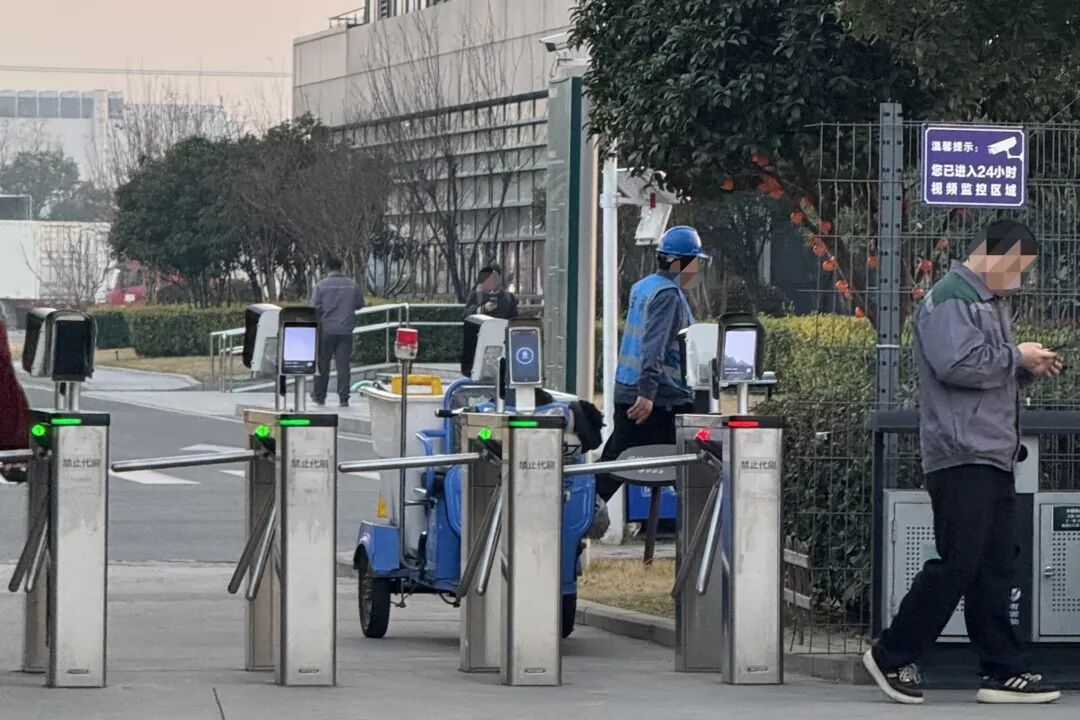
The exit from the North Area of Li Auto's Changzhou factory to the parking area
"The income of our front - line workers is linked to working hours. When the work points decrease, the salary naturally decreases," explained Wang Yuan, the team leader in Area 3 of Li Auto's Changzhou base. Currently, the salary of his position has dropped from easily exceeding 10,000 yuan per month to around 8,000 yuan, and that of basic workers has dropped to around 5,000 - 6,000 yuan.
In Area 2, where there are even fewer production tasks, the decrease in workers' income is more obvious. Calculated on a single - shift basis per day, "work three days and rest four" means that the actual working days of workers per month will be reduced to about 15 days.
As for the year - end bonus, in our contacts with many front - line production workers, we found that, different from the white - collar workers in Li Auto's office building, the year - end bonus for blue - collar workers is paid in the form of the 13th - month salary, that is, an extra month's salary at the end of the year. And this extra month's salary is the basic salary without work points. This means that no matter how the factory performs in a given year, the year - end reward that front - line workers can get is just a fixed and relatively small "guaranteed amount".
The change in income makes some employees start to reconsider whether to stay or leave.
"There are cases of the factory persuading employees to leave now. If you don't leave, you have to keep bearing the pressure of not being able to earn enough work points and a sharp decrease in income. The interns on the production front line are also facing the situation of not being able to become full - time employees," Wang Yuan said in a low voice. The "persuasion to leave" he mentioned is not a formal lay - off but a negotiated departure.
"Those who choose to leave are often those with great economic pressure. After all, the mortgage, children's tuition fees, and daily expenses won't wait for you just because there are fewer orders in the factory."
This pressure doesn't stop at full - time employees. Outside the base of Area 2, Zhang Li (a pseudonym), an outsourced worker, had just finished talking with the police who came to mediate. She revealed that she had signed a third - party contract and was responsible for peripheral reception work. She was assigned to Area 2 of Li Auto two years ago. However, recently, the third - party company has been delaying her salary for several months on the grounds that "Li Auto hasn't settled the payment". For this reason, she has to come to the entrance of Area 2 frequently to ask for her salary.
"The result of the police mediation is to let me wait until the 25th of this month. If they still don't pay, I can only go to labor arbitration."
The police on the left side of the picture are talking with an outsourced worker of Li Auto
In addition to inside Li Auto's factory, a group of supply - chain enterprises such as Changcheng Auto, Bojun, Huichuan, Xinquan, Zhuojun, and Jifeng, which are clustered around it, are also having a hard time. These enterprises chose the surrounding areas to be close to customers and reduce costs. Now, they are sharing the same hardships as the main vehicle factory.
An employee of a seat supplier said bluntly during a break while unloading goods at the entrance of Area 1 of Li Auto's base that since the second half of last year, the shrinking and instability of orders from Li Auto have also put their supporting supply - chain factories into a dilemma of passive waiting and idle production capacity. Many factories have started to arrange workers to take turns on leave.
NO.3 [After spring, will Li Auto's "spring" come?]
The desolate factory area and frequent rotation of leave seem to be the main theme of Li Auto's Changzhou factory before this Spring Festival.
Li Auto isn't without ideas. Facing the reality of a 19% decline in sales in 2025, Li Auto's first move was to adjust the focus of its product strategy.
In the past year, the resource tilt towards electric models didn't achieve the expected results. Instead, it diluted its share in the extended - range market to some extent. The main sales models changed from the full - range of extended - range models before 2024 to the more entry - level models in the extended - range and electric categories, the L6 and i6. In December 2025, the single - month retail sales of these two models were 13,000 and 16,000 vehicles respectively.
Now, Li Auto is refocusing its resources on the extended - range and high - end market. In the electric field, it will only launch one SUV model this year.
It is reported that the new Li L9 will be significantly upgraded in terms of size, chassis, and battery. In terms of intelligence, its self - developed M100 chip, which is claimed to have a cost - performance ratio more than three times that of NVIDIA Thor, will also be mass - produced and installed on this vehicle for the first time.
At the same time, the entire L series will return to the streamlined SKU model, reducing the number of vehicle versions. The core configurations will be newly standard - equipped to improve efficiency and try to clarify the product positioning.
The adjustment of the product strategy is followed by the change of the organizational structure.
Recently, Li Auto merged the first product line and the second product line, and integrated the first - level department "Parts Cluster", which originally belonged to the Intelligent Vehicle Group, into the manufacturing system as a whole and put it under the unified management of Li Bin.
Li Bin is the manufacturing person - in - charge who has been rooted in the Changzhou base since its operation in 2019 and has fully led the implementation of the vehicle manufacturing of the L series models. In the future, Li Auto's choice to let him coordinate the production of the whole vehicle and key parts inevitably implies the intention to connect the key links from R & D to manufacturing.
For local suppliers that have long relied on Li Auto's orders, this transformation means a change in the order structure. In the short term, some outsourced orders may be shifted to internal production, and suppliers will face the pressure of business adjustment. In the long run, for Li Auto, by increasing the proportion of internal manufacturing