Dialogue with science and technology history writer ZHANG Xiaoyu: Compared with AI, we are prehistoric animals.
Three years ago, ChatGPT was released. Today, AI is no longer a new term only discussed by young people in big cities like Beijing, Shanghai, and Guangzhou. Even grandmas in rural areas may know about DeepSeek and chat with Doubao. AI is becoming an infrastructure in our lives, almost as essential as water, electricity, and the Internet. What makes it special is that AI is a technology that directly produces intelligence, and intelligence has always been what humans are most proud of. What will happen to human society if intelligence can be mass - produced at extremely low cost and high efficiency?
Since the release of ChatGPT, discussions about the extent to which AI will replace human jobs have never stopped. In fact, AI is reshaping human life and society in all aspects. To better understand AI and our future, we interviewed Zhang Xiaoyu, a science - history writer and independent scholar who has long been concerned about how technology affects human society. He recently published a new book called The Pre - history of AI Civilization, on the cover of which it is written, "Compared with AI, we are pre - historic animals."
Zhang Xiaoyu studied the history of political thought in college. Later, he went to Germany to pursue a doctorate. At a reading club, science and engineering students often asked philosophy students how they viewed new technologies. Zhang Xiaoyu honestly replied, "We can't. The books we read are all from 2000 years ago, and we haven't considered how to answer these questions under modern technological conditions." This experience led him to study technology, "because I really think technology is important."
We talked about the four core concepts in his book and many of his views that subvert anthropocentrism. For example, AI is not a tool of humans but is likely to be a new civilization; AI will replace 99% of human jobs and completely subvert the current social structure of humans; how the 1% treat the 99% is how AI will treat us in the future... We also discussed how, from the new perspective brought by AI, we can re - understand ourselves, human nature, and human values.
In addition to these abstract concepts and views, we also talked about some beneficial and inspiring attempts in the field of AI that he has observed. Zhang Xiaoyu often communicates with AI entrepreneurs. "As we all know, these people are post - 2000s." As a post - 2000s myself, I also talked with him about the choices of this generation of young people, such as falling in love with AI and the reflection on meritocracy brought about by the development of AI.
Almost at the same time as our interview, Elon Musk "blurted out" in an interview at the Tesla Gigafactory that humanity has entered the technological singularity, and 2026 will be the year when AGI is realized. We can't judge whether the future has "arrived," but as Zhang Xiaoyu wrote in his book, everyone, not just AI experts, in every discipline and field, and even ordinary people, should think about a series of questions regarding AI and humans as much as they can, because this concerns our future, and "if we do nothing, history will surely develop in the worst - case scenario."
Below is the dialogue between Jingxiang Studio and Zhang Xiaoyu:
Sometimes, the operating rules of society are determined by the simplest mathematical laws
Jingxiang Studio: This book mainly focuses on four concepts: emergence, human equivalence, algorithmic judgment, and the civilization contract. Let's start with emergence. It's a concept that helps us understand how we can "create intelligence." Why did you choose such a technological perspective, and how do you understand emergence?
Zhang Xiaoyu: In simple terms, emergence means "simple rules + large scale = system upgrade." For a system, when its scale is large enough, its rules are simple enough, and its diversity reaches a certain threshold, given enough time, it will experience a system leap from a simple system to a complex one.
Emergence is first a biological concept. For example, the evolution from single - celled organisms to multi - celled organisms. From the perspective of a single cell, its best strategy might seem to be to become a cancer cell because cancer cells are immortal. However, in the history of biological evolution, single cells undergo functional differentiation and become specific cells, such as neurons and platelets, and finally form a multi - celled organism.
Another example is ants. The strategy of a single ant is very simple: random walking, trying to cover every path. But for the ant colony, this is the simplest strategy to understand the surrounding environment. The intelligence level of a single ant is very low, unable to recognize individuals, and its cognitive range is limited to a small area around it. But when they form a colony, they seem to have the wisdom of division of labor and cooperation.
Take the evolution of the nervous system as an example. The function of a single neuron cell is very simple: to transmit information. But when there are enough of them and the structure is complex enough, intelligence emerges. It's very likely that artificial intelligence, human intelligence, and the intelligence in the biological world all essentially come from the power of emergence.
Of course, this is a belief, not proven scientific knowledge. But I do know many cutting - edge AI researchers who believe that the intelligence of AI comes from emergence. In the industry, emergence is manifested as the scaling law. It is also an engineering guideline. If you increase the scale of computing power, the performance of the model will improve.
So, emergence is not only a scientific concept that helps us understand how intelligence is generated but also a guiding principle in the industry. Naturally, it is the first and most important concept.
Jingxiang Studio: I was most impressed by your writing that every Chinese person should understand emergence because the reform and opening - up was an example of emergence.
Zhang Xiaoyu: Indeed, this is something that every Chinese person can feel. The market economy is also an emergence in the human social system. Just think about what our lives were like before 1970. It was unimaginable that there would be financial companies, Internet companies, etc. today.
The essence of the market economy is to use money as the simplest signal for the emergence of this complex system. Its rules are simple enough. Everyone doesn't need to discuss ideas, ideologies, religions, or languages. As long as you recognize money, you can operate within the same system, and this system will generate various forms of wisdom and imagination.
Jingxiang Studio: You wrote about the concept of "human equivalence" proposed by Leopold Aschbrenner, a former employee of OpenAI. It refers to how many humans an AI is equivalent to in terms of efficiency and cost in producing intelligence, measured in tokens. You also wrote that "sometimes, the operating rules of society are determined by the simplest mathematical laws," and "human equivalence" is the mathematical law that plays a decisive role in the AI era. Can you explain the underlying logic?
Zhang Xiaoyu: First, why are the operating rules of society determined by the simplest mathematical laws? This is quite simple. For example, in historical records, behind the rise and fall of emperors and dynasties, the simplest mathematical law is the Malthusian trap. In ancient times, the food production of the land increased linearly, while the population increased exponentially. A person in the Qing Dynasty wrote that the population could increase by 128 times in three generations. The exponential growth of the population and the linear growth of food production inevitably led to conflicts. When food production could not meet the population growth, there would naturally be wars, famines, plagues, and uprisings, followed by the change of dynasties.
Behind the various twists and turns in history, it is actually the basic mathematical laws that are at work, and other factors are less important variables. I often say that if you were to travel back in time, you don't need to know which emperor is in power or what policies are being implemented. Just calculate the mathematical relationship, and you can tell whether you are in the early, middle, or late stage of a dynasty.
Similarly, in the AI era, the simplest mathematical relationship is human equivalence. Whether we are chatting or I'm writing, in essence, we are all outputting intelligence. When chatting, we can produce about 200 tokens per minute, and at most 200,000 tokens per day. However, a large - language model can generate 1 million tokens in just one second, and what's more, it only costs one yuan. Of course, in reality, if the content is meaningful, it will definitely take more than one second and may cost a few dollars, but it's still much cheaper than human labor. In Beijing, if you pay me 100 yuan a day, it's hard for me to survive, but a large - language model can do my work for several days for just one yuan.
So, as long as your boss is calculating ROI and we are operating within the capitalist system, you can predict what will happen. All speculations about the AI era are based on this mathematical relationship: AI is incredibly cheap. In terms of ability, according to some test results, all large - language models will reach the level of a doctoral student by 2025. Only about 1% of educated humans have a doctoral degree. So, numerically, it's already a fact that AI can produce more intelligence than 99% of humans at 1% to 1‰ of the cost.
Will we live better after 99% of human jobs are replaced by AI?
Jingxiang Studio: In terms of both cost and efficiency, humans are like "pre - historic creatures" compared to AI. However, we don't say that we are pre - historic creatures compared to steam engines or assembly lines. Compared with previous industrial revolutions, why does AI bring such a strong sense of crisis to humans?
Zhang Xiaoyu: During previous industrial revolutions, there were also discussions among technological philosophers. But for thousands of years in human society, most people have considered mental labor superior to physical labor. Those who use their minds rule, and those who use their strength are ruled.
AI directly produces intelligence, which makes it different from all previous technologies in history. Technologies like the printing press, the Internet, and software engineering in history were all about packaging and transmitting intelligence, not producing it. Our species has always considered itself the most intelligent on Earth, and this is now being challenged.
Secondly, most people overlook a fact. 100 years ago, the pace of technological progress was coordinated with the natural generational replacement rate of humans. For example, if you became a coachman around 1860 and were in your thirties when Benz invented the automobile, although it was slow at first, if you were a rational middle - aged person, you would know that it would eventually replace you. But it didn't matter because if the prototype was made in 1880, it wouldn't be mass - produced and on the streets until around 1890 or 1900, when you would be close to retirement. And your child, growing up, would know that this thing would replace coachmen, so he wouldn't choose to learn this profession.
That is to say, the cycle of technological progress at that time was about 20 years, roughly one generation. By the time the new technology matured, the old generation would retire and the impact would be naturally absorbed. However, today, ChatGPT has reached the level of a doctoral student in 4 years, and it takes more than 4 years to get a doctorate. The rate of technological progress is completely different, and we can't stick to the old ways of thinking.
Another issue is that I think we need to re - understand the history of the entire industrial revolution. In the first two industrial revolutions, the experience was that the more technology advanced, the higher the per - capita GDP growth rate, and it was generally a beneficial thing for everyone.
But there was a turning point after 1970. There is a very famous saying in economic history: "Where is the computer?" In the 1990s, computers could be seen everywhere in daily life, but why wasn't it reflected in the per - capita GDP growth?
This is a very obvious contradiction. When people studied this phenomenon, they found that at the micro - level, different technologies in the industrial revolution had qualitative differences. The technologies in the first two industrial revolutions generally extended the industrial chain. For example, the steam engine, the electric light, the telephone, the refrigerator, and the automobile. When these new products were invented, there were hundreds or thousands of industrial chains behind them, and each industrial chain involved thousands of companies and workers. The industrial chain was constantly expanding, creating new jobs at every step, so it was a inclusive growth.
However, since the 1970s, technologies like automated CNC machines have been shortening the industrial chain, and workers have been displaced from the assembly line. From this perspective, we will find that many of our common - sense beliefs are wrong. I remember in middle school, the textbook said that in the industrial structure of developed countries, the service industry accounted for a higher proportion. But if you think about it, it's not that a higher proportion of the service industry means more advanced. It's because automated machines have displaced workers from the assembly line, and these workers have to turn to the service industry.
In the AI era, this phenomenon is even more obvious. What the machines in the 1970s did to blue - collar workers, AI is doing to white - collar workers today. I think we will soon see a very strange phenomenon: the decoupling of technological progress from the inclusive growth of humans and per - capita GDP.
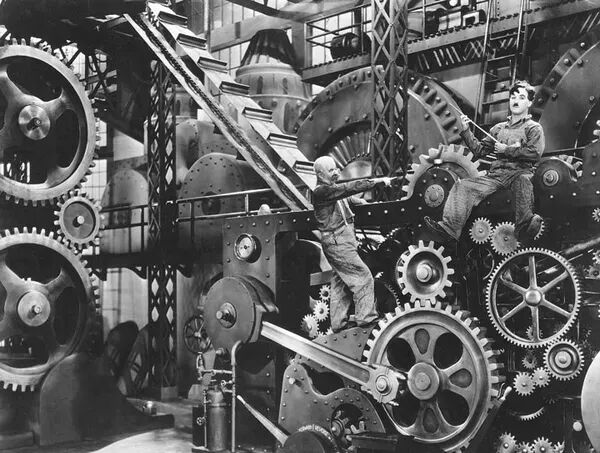
● Image source: Modern Times
Jingxiang Studio: We often say that technology liberates people, but it doesn't seem to be the case?
Zhang Xiaoyu: Compared with the Middle Ages before the industrial revolution, our current living standards are definitely much better. But we can only say that technology wants to liberate people, but people may not want to liberate themselves. That's why there are "bullshit jobs." Many times, bosses don't really think that the work brings much value, but rather that it gives them a sense of power. The inability of people to liberate themselves is a greater tragedy.
Jingxiang Studio: Your view of human nature is also reflected in the concept of "algorithmic judgment." Different from many people who are critical of algorithms, you think that algorithmic governance is much fairer than human governance. There is a passage in the book:
The recommendation algorithm gives each person what they deserve... If we believe that we should exploit and oppress our peers, then it will think that humans should be exploited and oppressed; if we believe that we should fight and kill our peers, then it will think that humans should be treated violently; of course, if we believe that everyone deserves to be loved, then it will think that humans are worthy of love.
Zhang Xiaoyu: When we talk about recommendation algorithms today, there is a concept of being trapped in the algorithm. But to put it bluntly, the jobs provided by the recommendation algorithm are actually quite good. I often say that the top 3% of earners in China are delivering takeaways downstairs in first - tier cities. How do we understand this?
Among China's 880 million labor force, the tax - paying threshold is 5000 yuan, and the number of people paying individual income tax is about 60 - 70 million, accounting for about 7% of the total labor force. If the tax - paying threshold is raised to 8000 yuan, it's only 3%. By registering as a Le Pao rider on Meituan, the average monthly income last year was about 8000 yuan. This means that those "trapped in the algorithm" are already in the top 3% of the system. Intellectuals think that being a rider is hard, but that's because they haven't worked in a factory. If they did, they would find that human - to - human treatment is even more cruel than algorithm - to - human treatment. The recommendation algorithm provides basic employment for a large number of people and may even be fairer than local state - owned enterprises in the 1970s.
The core of algorithmic judgment is this. We shouldn't think that humans treat each other well and that algorithms have ruined the situation. In fact, humans treat each other badly, while algorithms are neutral. They just treat everyone according to their rules.
Jingxiang Studio: Although 99% of human jobs can actually be replaced by AI, is it possible that we should artificially create some jobs?
Zhang Xiaoyu: It's possible. I also advocate for this. There has to be one or two generations to naturally transition and see what the next - generation technology will be like. So, I have a concept called UBJ (universal basic jobs) on top of UBI (universal basic income). For example, a few years ago, when Marco Rubio, the current US Secretary of State, was a senator, the small - and - medium - sized enterprise committee under him issued a report. Concerned about large - scale unemployment caused by automation and artificial intelligence, the proposed solution was for the US to set up a number of state - owned enterprises. Each state in the US has its own public