7-year low-interest rate, pick up a car at an ultra-low price. The price war among automakers has reignited.
Frankly speaking, the automotive market in 2026 didn't start off easily. An obvious evidence is that the halted price war has reignited in another way.
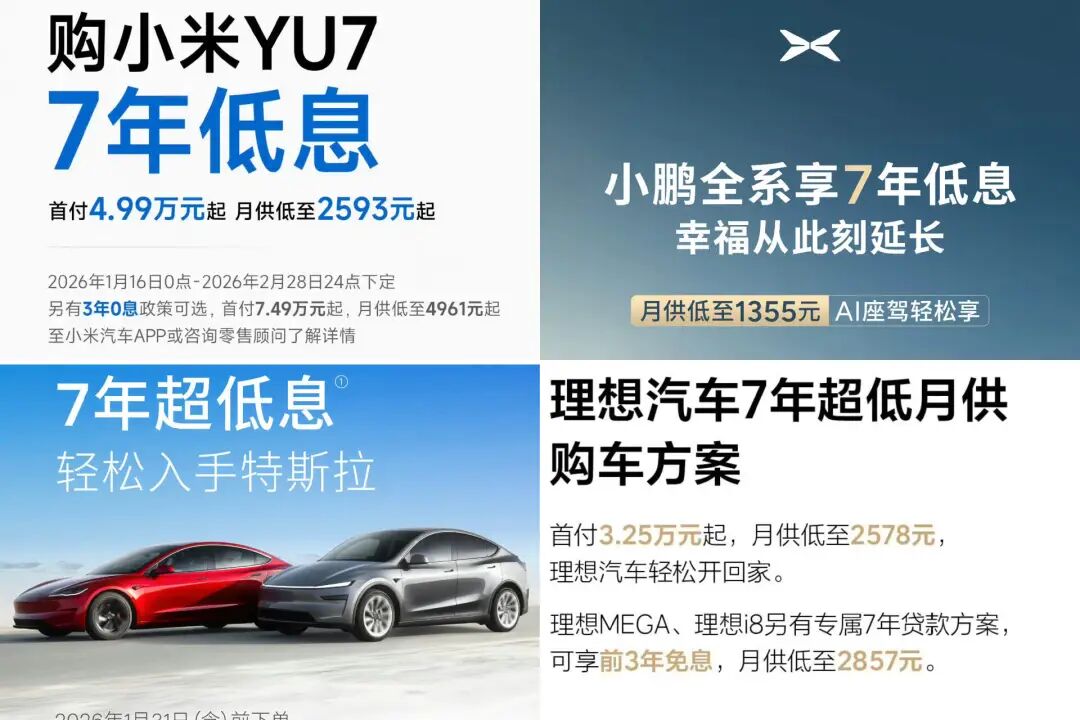
Today, XPeng Motors announced the launch of a 7-year low-interest installment car purchase plan for the entire lineup. The down payment starts from 15%, and the monthly payment can be as low as 1,355 yuan. The event is valid until January 31, 2026.
Before this, automakers such as Tesla, Xiaomi, Li Auto, Dongfeng Yipai, and Geely Galaxy had successively launched the "7-year ultra-long low-interest" approach. This method not only lowers the threshold for car purchase but also eliminates the worry of high monthly payments.
This kind of long-term "7-year low-interest" financial car purchase plan is not common. With just over half a month passed in 2026, major automakers have already resorted to this tactic, and it's highly likely that other automakers will follow this policy.
From the price war to the low-interest war, automakers are once again involuntarily involved in the competition to sell more cars.
01 Avoiding the Price War
The first one to get anxious was Tesla.
At the beginning of the year, Tesla launched an ultra-low-interest financial plan for its domestically produced Model 3, Model Y, and Model Y L models in the Chinese market. Customers can apply for an ultra-low-interest car purchase plan for up to 7 years, with an annual interest rate as low as 0.5%, equivalent to an annualized interest rate of 0.98%. Based on this calculation, the annual interest on a 100,000-yuan loan is only 500 yuan.
Taking the entry-level Model 3 as an example, with a selling price of 235,500 yuan, without any optional extras, the down payment is 79,900 yuan, and the loan amount is 155,600 yuan. The monthly payment is only 1,918 yuan, with an annualized interest rate of 0.5%, equivalent to an annualized rate of 0.98%. The annual principal and interest are only about 800 yuan. Compared with the previous 5-year interest-free plan, the total interest for 7 years is only about 5,500 yuan more.
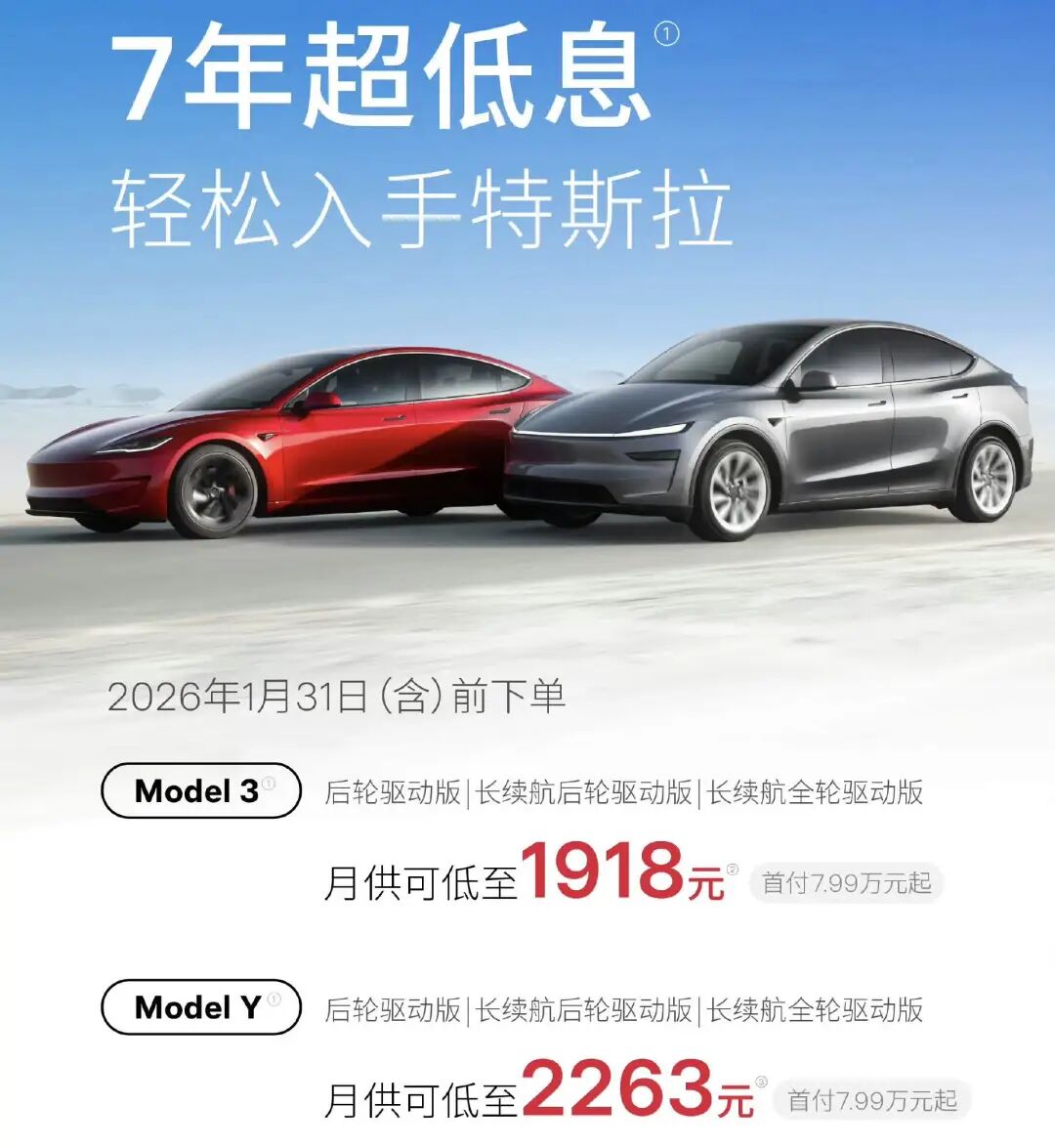
Although the interest is a bit more, the advantage is that there is an additional two-year repayment period, and the monthly payment can be further reduced. Under the 5-year interest-free plan, the monthly payment is 2,594 yuan, but under the 7-year low-interest plan, it is only 1,918 yuan.
Undoubtedly, Tesla's "7-year ultra-low-interest" plan has once again lowered the threshold for car purchase. It is very suitable for those who have a tight budget in the early stage, pursue low monthly payments, and plan to keep the car for a long time. This is also the first time Tesla has launched such a long-term ultra-low-interest policy.
Tesla's approach is obviously much more subtle than a direct price war. It not only maintains its pricing system but also uses more financially-oriented marketing policies to lower the consumption threshold.
Following Tesla, Xiaomi Auto also introduced a 7-year ultra-low-interest car purchase plan.
For the YU7 model, the down payment starts from 49,900 yuan, and the monthly payment can be as low as 2,593 yuan. The event starts at 0:00 on January 16 and ends at 24:00 on February 28. There is also a "3-year interest-free" policy available, with a down payment starting from 74,900 yuan and a monthly payment as low as 4,961 yuan.
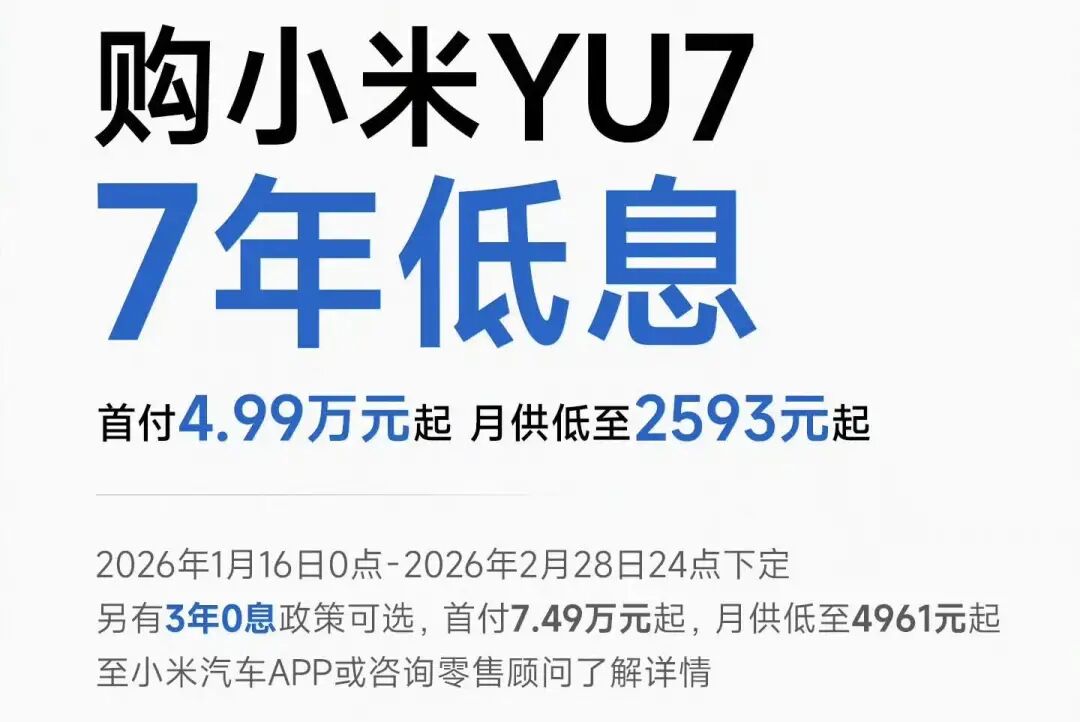
It's undeniable that this move clearly references Tesla. During a live broadcast, Lei Jun also frankly said, "Many Mi fans left messages hoping that we could also provide a similar policy, and we seriously listened to everyone's voices."
Just now, XPeng Motors also announced the launch of a 7-year low-interest installment car purchase plan for the entire lineup: the down payment starts from 15%, and the monthly payment can be as low as 1,355 yuan. The event is valid until January 31, 2026.
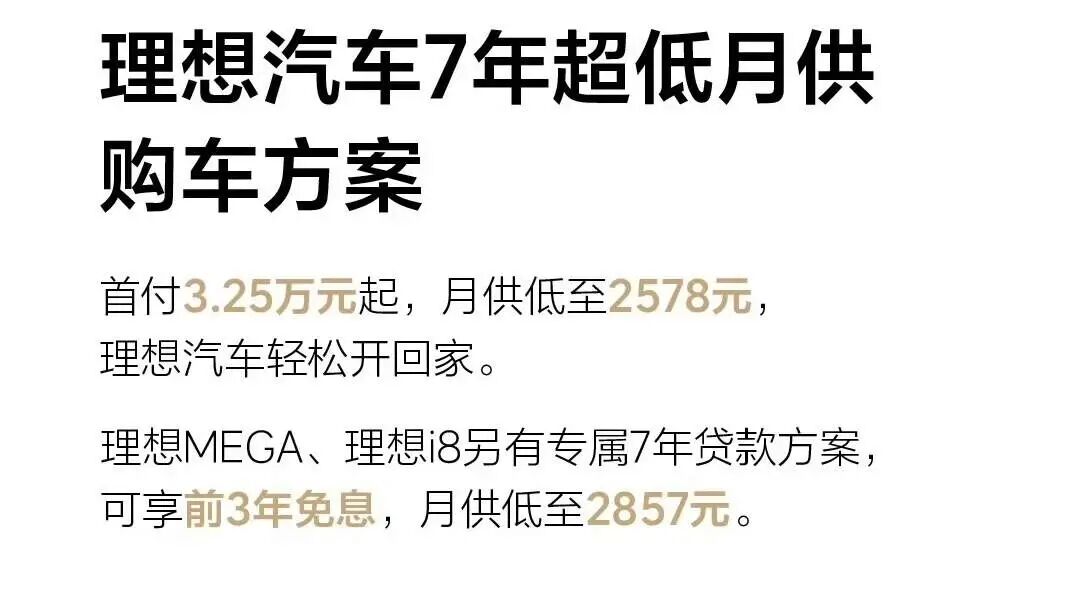
Before this, Li Auto also posted that from January 20, 2026, when purchasing a car, all models can enjoy a 7-year ultra-low monthly payment car purchase plan: the down payment starts from 32,500 yuan, and the monthly payment can be as low as 2,578 yuan. In addition, for the MEGA and i8 models, there is also an exclusive 7-year loan plan, with the possibility of interest-free in the first three years and a monthly payment as low as 2,857 yuan.
The effect was immediate. Within 12 hours of Li Auto's policy announcement, the official website traffic soared by 320%, and the in-store consultation volume increased by 245% compared to the previous period.
Not only new energy vehicle startups, but Dongfeng Yipai also launched a 7-year low-interest campaign for its models. Taking the Yipai 007 series as an example, the down payment is 42,000 yuan, the daily payment is only 42 yuan, and the monthly payment is 1,272 yuan. For the Geely Galaxy M9 model, under the 7-year low-interest plan, the down payment is only 25,800 yuan, and the monthly payment is 1,999 yuan.
With the intensive actions of these automakers, it seems like another round of intense competition is about to start. However, past experience tells us that everything should be viewed from both positive and negative aspects.
A very realistic problem is that as the car loan period is extended, the risk of technological iteration becomes more obvious. Consumers only see the reduction in monthly payment pressure but ignore the uncertainties brought about by the extended time.
Three to five years later, the battery, intelligent driving, and energy replenishment experience are likely to have reached a new level, while you are still repaying the loan for an "old car". Even more seriously, according to the current technological development speed of new energy vehicles, with technological iteration, the residual value of the "old car" will decline more rapidly. Perhaps after a few years, its market price will be lower than the loan balance.
02 2026 Is More Brutal
Whether it's a simple and direct official price cut, a 3-year interest-free, 5-year interest-free, or a 7-year ultra-low-interest plan, in essence, they are all price wars where automakers "sacrifice profits".
According to the latest data released by the China Passenger Car Association, from January 1 to 18, 2026, the retail sales volume of the national passenger car market was 679,000 vehicles, a 28% decline compared to the same period last year and a 37% decline compared to the same period last month. During the same period, the wholesale volume of manufacturers was 740,000 vehicles, a 35% year-on-year decline and a 30% month-on-month decline. Since the beginning of this year, the cumulative retail and wholesale data have decreased by 28% and 35% year-on-year respectively.

Among them, the new energy passenger car market declined by 16% year-on-year and by 52% month-on-month. From these data, it's not difficult to see that at the pre-Spring Festival node, which is usually a peak season for car sales, the start of this year has been particularly quiet.
From the production side, the data from the first to the second week of January shows that the total production of hybrid and plug-in hybrid models was 139,000 vehicles, a 65% year-on-year decline and a 75% month-on-month decline. The overall production capacity contraction is obvious, indicating that automakers are taking a cautious approach to production scheduling at the beginning of the year.
However, against the background of weak sales, automakers have to stimulate market demand to boost orders. Taking Tesla as an example, its delivery volume in the fourth quarter of 2025 was 418,200 vehicles, a 15.6% year-on-year decline and a 15.9% quarter-on-quarter decline; the annual delivery volume was 1.6361 million vehicles, a 8.6% year-on-year decline, the largest annual decline and the second consecutive year of decline in annual delivery volume.
Recently, the global investment institution UBS released a forecast that the retail sales volume of passenger cars in China in 2026 may decline by 2% year-on-year. The report from Morgan Stanley gave an even bleaker conclusion, predicting that the sales volume will drop to 28.5 million vehicles in 2026, a 5% decline year-on-year, and the sales volume in the first quarter of 2026 may decline by 30% - 35% quarter-on-quarter.
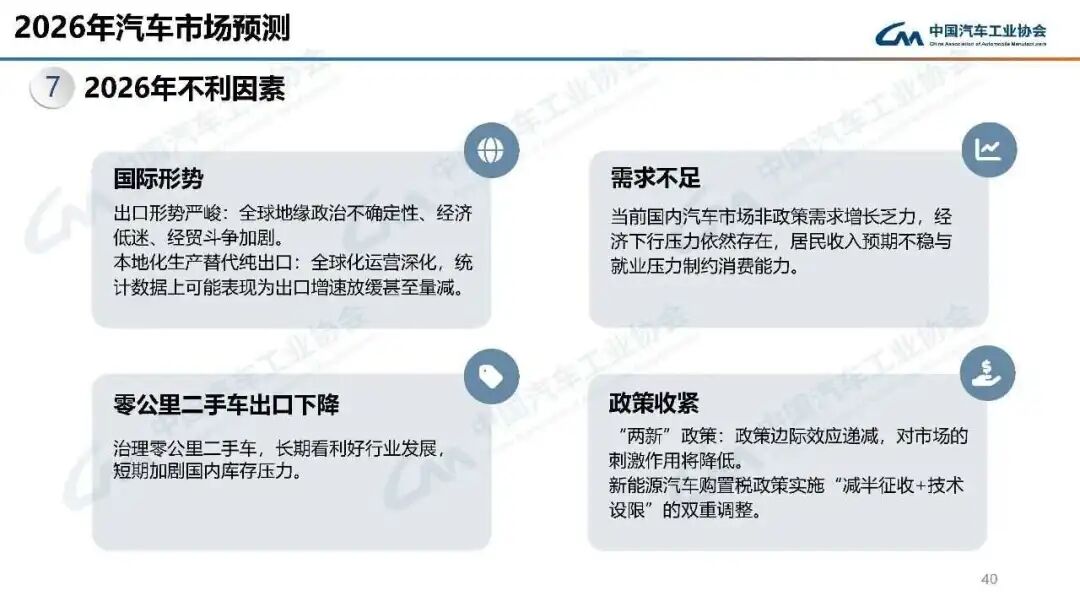
Domestically, Cui Dongshu, the secretary-general of the branch of the China Automobile Dealers Association, predicted that affected by the policy withdrawal, the sales volume of passenger cars in 2026 will drop to 23.8 million vehicles, a 2.1% decline year-on-year. The China Association of Automobile Manufacturers also believes that if the policy continues to support, the market may maintain a 1% - 3% slight increase; if the situation is not good, it may remain stagnant.
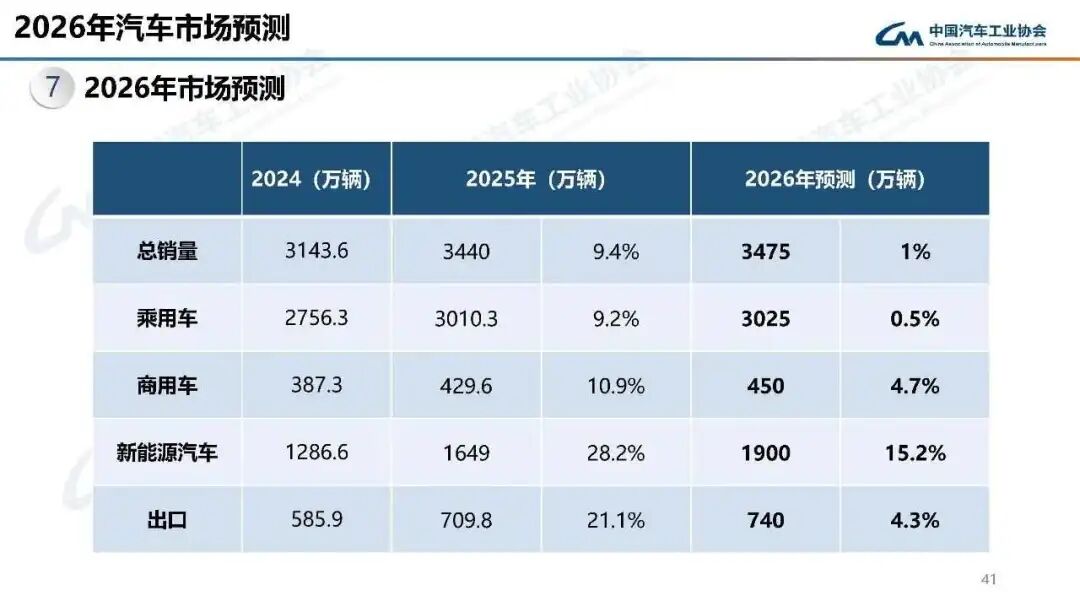
Based on the judgments of various parties, it's not difficult to see that the pessimistic expectations about the trend of the Chinese auto market in 2026 are not isolated cases. In fact, the current debate is not about "whether it will decline" but about "how much it will decline".
As negative growth gradually becomes a consensus, automakers' ambitions have also become more restrained. According to the 2026 sales targets successively announced by major automakers, the total target exceeds 21.55 million vehicles. Although it accounts for 63% of the total domestic sales volume in 2025, the year-on-year increase is only 19%.
Specifically, leading enterprises such as Geely, Chery, and Changan have cautiously set their growth rates at around 14%. Even for new energy vehicle startups like XPeng and NIO, which achieved obvious rebounds in 2025 with continuous record highs in sales and revenue, the management still maintains a high degree of caution regarding sales growth.
In contrast, the targets of joint-venture automakers are even more conservative. GAC Toyota has set its target at 800,000 vehicles, with an increase of only 3.6%, planning to rely on several new energy models to make up for its product shortcomings. SAIC Volkswagen is aiming for a total of 1.2 million vehicles, with limited growth as well.
According to a report by 36Kr, Mercedes-Benz and BMW have recently provided preliminary demand forecasts for 2026 to their domestic supply chains. The annual estimated volume of their domestic models is less than 500,000 vehicles for both, almost returning to their sales levels in China a decade ago.
Of course, there are also "radical" players. For example, Leapmotor, on the basis of delivering 596,600 vehicles in 2025 and doubling its sales year-on-year, has set a target of reaching 1 million vehicles in 2026, with a growth rate as high as 67.5%. Hongmeng Zhixing has set a target of 1 - 1.3 million vehicles, with an expected growth rate of 120%.
After bidding farewell to the rapid development in 2025, the Chinese auto market in 2026 seems to be at a delicate crossroads. Under the competition for the existing market share, it's a brutal battle for market share.
It all depends on who has the "smarter" tricks.
This article is from the WeChat official account “SuperEV-Lab”, author: Wang Lei. Republished by 36Kr with permission.