The battle for AI hardware between Feishu and DingTalk: The fight for the entry point behind voice recording
Five months after DingTalk launched the DingTalk A1, Feishu also entered the battlefield of AI recording devices.
On January 19th, Anker Innovations and Feishu jointly launched an AI recording device, the AI Recording Bean. Anker Innovations is responsible for the hardware, while Feishu provides the software and AI services. The product is priced at 899 yuan.
In fact, since Chen Hang (nicknamed Wuzhao), the founder of DingTalk, returned to DingTalk, the competition between the two sides has become increasingly fierce, from product feature iterations to competing for customers.
Now, the two sides have escalated the competition again, extending the competition dimension of collaborative office from software to hardware.
As leaders in the collaborative office software track, DingTalk and Feishu entered the AI recording device track at different time points. Behind their two different AI hardware products, there is the same strategic intention:
To transform the "voice", which is the most primitive, common, and easily wasted element in corporate office, into digital assets that can be retained, retrieved, and acted upon.
This seemingly AI hardware competition centered around "recording devices" is actually a direct confrontation between Feishu and DingTalk for control of the "corporate office entrance" in the AI era.
Whoever controls the entrance to meeting voice may control the starting point of the entire corporate office workflow. A small AI recording device is not just a tool, but also the "first touchpoint" to the corporate knowledge base, task system, approval process, and even ERP data.
When users get used to using a certain company's hardware to start meetings, generate meeting minutes, and assign tasks, their subsequent collaboration behaviors will naturally flow to that platform's ecosystem. This is the fundamental logic behind Feishu and DingTalk's bets on AI hardware.
So, what are the differences between DingTalk and Feishu's AI recording devices, from hardware parameters to software collaboration? How will Feishu compete with DingTalk in AI hardware?
Hardware Comparison: Card vs. Bean
The entire ByteDance ecosystem has been very "restrained" in its approach to the hardware track. Hardware products such as the Doubao AI phone are mostly developed through cooperation, with ByteDance providing software services while leaving the hardware to its partners.
Feishu's entry into the hardware track follows the same approach. In September last year, Anker Innovations' smart audio brand, Soundcore, launched the AI recorder Soundcore Work overseas.
The product of this joint cooperation can be regarded as the domestic version.
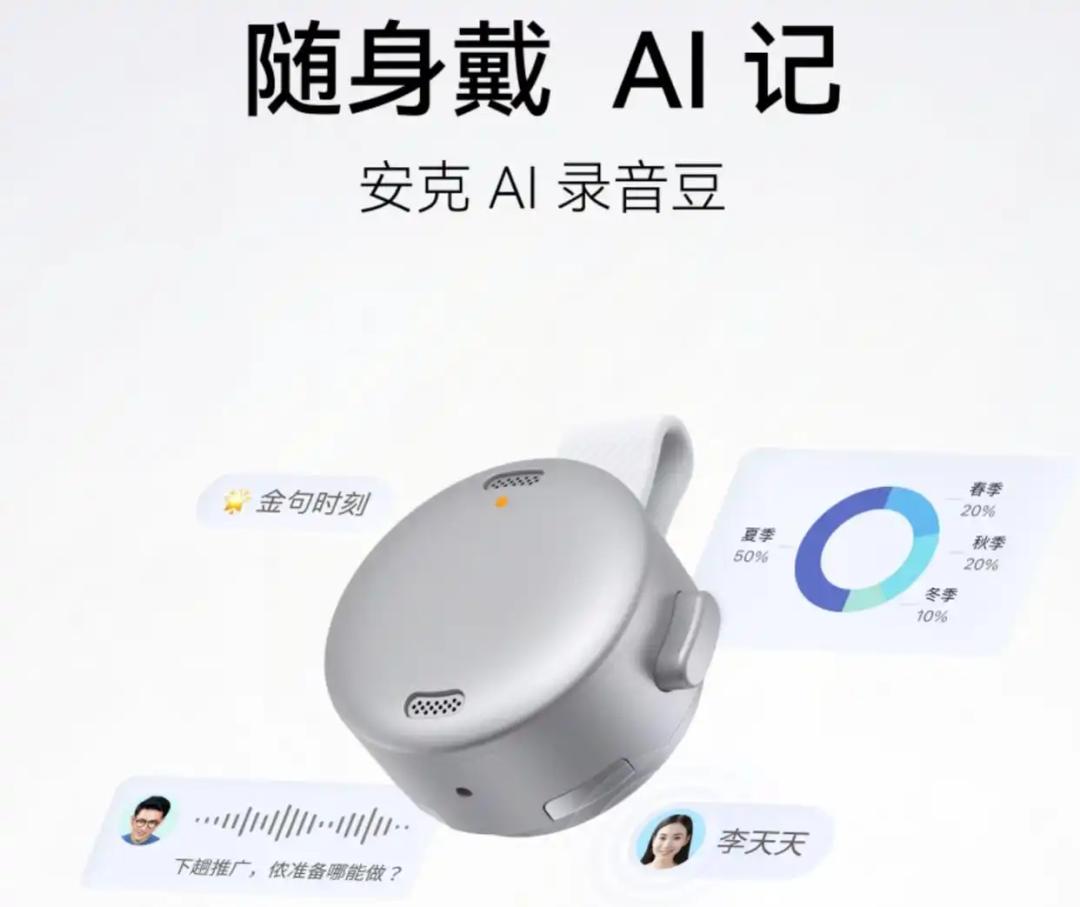
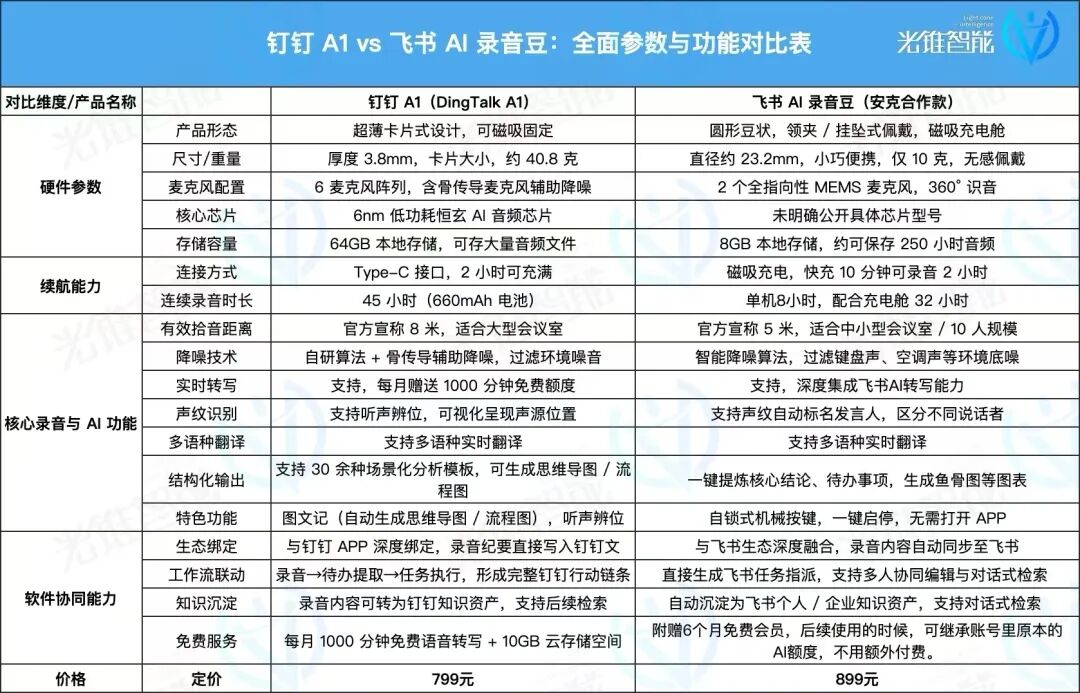
The two products are very similar in appearance. They are different from the mainstream AI recording card form at present and are mainly in the form of a bean, with a diameter of about 23 mm and a weight of 10 grams. They are equipped with a dual MEMS microphone array and support effective sound recording within a range of 5 meters.
It can be seen that its main design is very compact and can be worn unobtrusively. Users can clip it on their collars, wear it around their necks, or attach it to items such as mobile phones and water cups through magnetic patches.
In comparison, the card design of DingTalk A1 is mainly attached to the back of the mobile phone through magnetism. Users can use it at any time, and it is also convenient to store.
However, a larger volume can accommodate a higher-capacity battery. Naturally, making the product smaller will also sacrifice the battery capacity.
So, it can be seen that the continuous recording time of Feishu's AI Recording Bean is 8 hours, and with the charging case, the battery life can reach 32 hours. The battery life of DingTalk A1 can reach 45 hours. At the same time, the official says its effective sound pickup distance can reach 8 meters.
In terms of storage capacity, DingTalk A1 supports 64GB of local storage, while Feishu's AI Recording Bean supports 8GB of local storage. In addition, there is not much difference between Feishu and DingTalk's products in terms of functions such as noise reduction, voiceprint recognition, and multilingual translation.
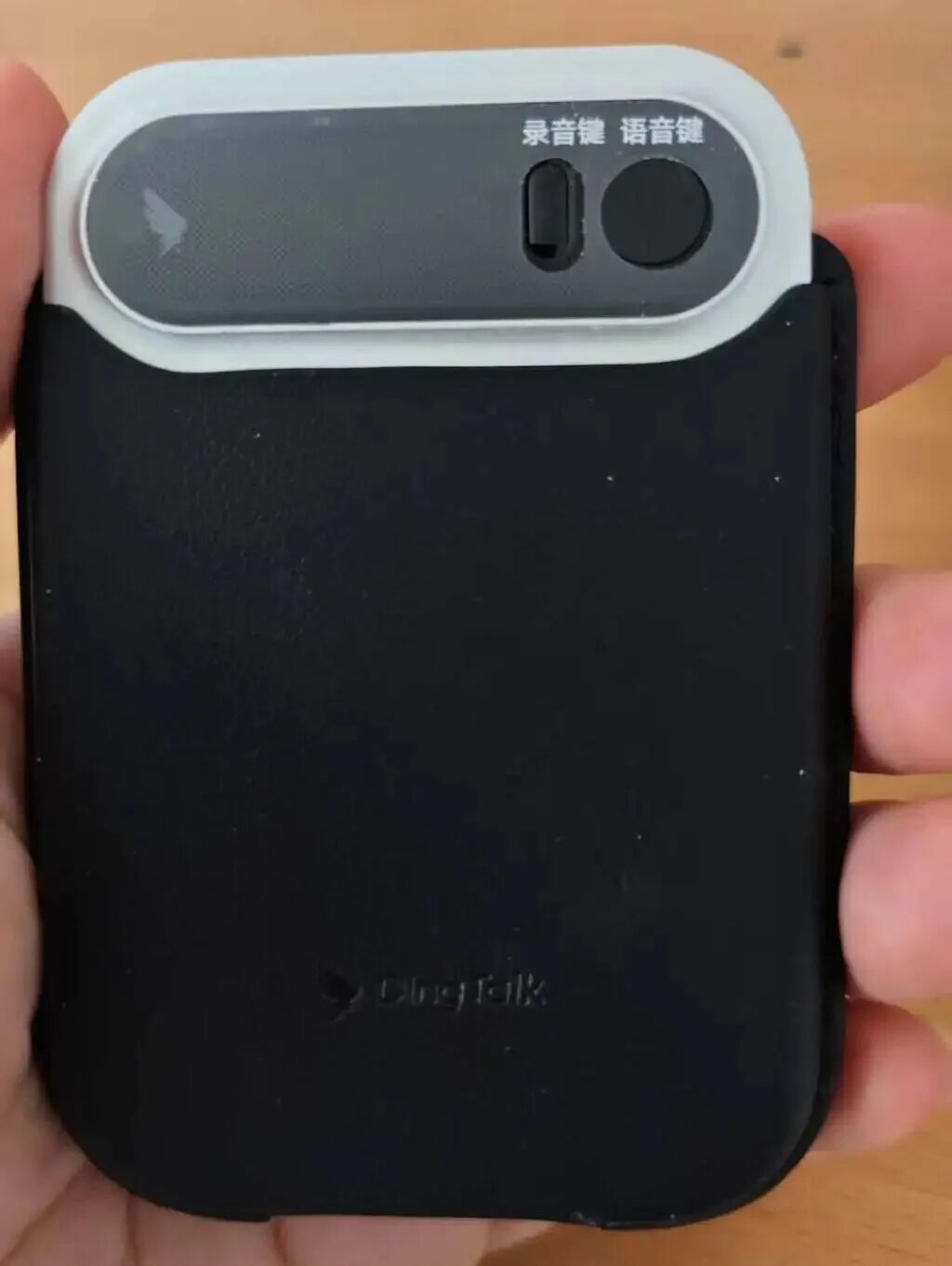
In actual use, DingTalk A1 has two physical buttons, one for recording and one for voice. Press the recording button to start recording, and press it again to stop recording.
The voice button is similar to waking up Siri. When users have any questions, they can directly press the voice button to ask questions, and A1 can directly give some simple answers.
There is only one button on the entire Feishu AI Recording Bean. User evaluations show that pressing it once causes it to vibrate, the indicator light lights up, and recording starts. Pressing it again causes it to vibrate, the indicator light goes out, and recording ends.
In fact, for heavy Feishu users, when using Feishu's Miaoji for recording, they need to first turn on their mobile phones, open Feishu, then find Feishu Miaoji, and click to start recording. The whole process is quite cumbersome.
Using the Feishu AI Recording Bean, users can start recording with just one step, and the whole experience is very convenient.
From the basic parameters, DingTalk A1 has more superior parameters. The parameters of Feishu's AI Recording Bean are at the mainstream level in the current AI recorder market. It is neither top-notch nor has obvious shortcomings, but its core advantage lies in its convenience, compactness, and portability.
Overall, in the collaborative office market, DingTalk was the first to enter the AI hardware track, and its market performance has proven that this product was a right move.
It is reported that the first batch of 1,000 DingTalk A1 units were sold out at the 10th-anniversary launch event, and then they continued to be sold through channels. The official revealed that there are already tens of thousands of users.
The popularity of A1 reflects the urgent need of enterprises and individuals to store, transfer, and transform voice data into data knowledge. Industry news shows that the AI Recording Bean jointly launched by Feishu and Anker Innovations is also a product developed based on market demand.
However, hardware is just a hook for collecting front-end voice data. To truly transform it into personal/enterprise data assets, the experience effect of software collaboration is more important. This is undoubtedly the main battlefield for DingTalk and Feishu.
Hardware is the Hook, Software is the Deep Water Area
Hardware is the hook, and software is the deep water area.
Recording hardware has a natural "entrance attribute". Different from complex systems that need to be installed and deployed, a card or a "bean" can be deployed, and it is usually purchased by individuals or small teams with a short decision-making chain, making it easy to penetrate quickly.
But traditional recording hardware products need to export the recordings or transcribe the voice into text in an independent APP, and finally integrate it into their own workflow. The overall operation is cumbersome and complex.
The most crucial point for DingTalk and Feishu to enter the AI recording hardware field is that they can directly import the recording files into the workflow platform and, based on AI capabilities, directly extract the most core value behind the recording content.
In the promotion of the two products, the most important thing is that they can be deeply integrated with their own ecosystems, support automatic synchronization of recordings to the Feishu/DingTalk knowledge base, generate structured meeting minutes through AI, and support retrieval of historical content in a dialogue form.
So, how does the recording file of the hardware collaborate with the ecosystems of Feishu and DingTalk?
First, there is an interface for the AI Recording Bean on the Feishu platform. After recording, the recording file will be automatically synchronized to the cloud. After synchronization is completed, Feishu will automatically organize the recording information and generate intelligent meeting minutes and a verbatim transcript.
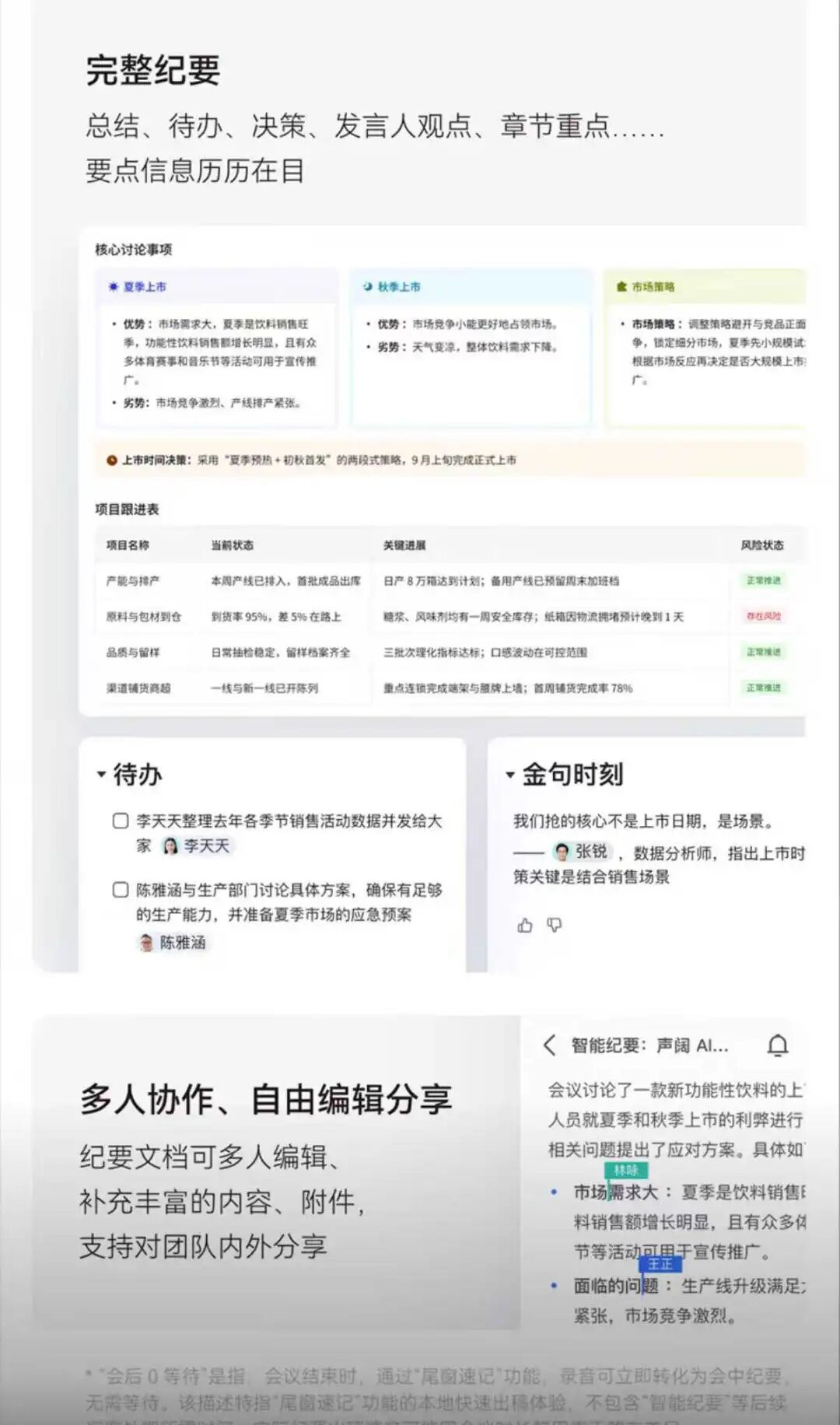
Users who have used Feishu Miaoji know that this is Feishu's strength. It can perfectly distinguish different speakers. Clicking on the timeline of different people can correspond to the relevant text.
In addition, when there is a need to review the content of this recording later, users can directly ask questions through the knowledge Q&A, such as what questions this customer still has about the product. The knowledge Q&A can summarize and answer the content.
In comparison, the focus of DingTalk A1 is to transform the recording into executable task nodes.
For example, after a sales visit, the system automatically extracts key information such as customer needs, pain points, solutions, and quotes to generate structured meeting minutes; after a meeting, it automatically distinguishes speakers, extracts action items and decision points, and marks the responsible person and deadline; during an interview, it automatically records the candidate's professional abilities, communication skills, potential advantages, etc. to form a standardized evaluation report.
The workflow of DingTalk A1 is recording → extraction of to-dos → task execution, forming a complete DingTalk action chain. The recording result is not just precipitated as a text, but can be objectified into to-dos, written into the schedule, filled into the form, and tracked.
It can be seen that the product logic of Feishu's AI Recording Bean emphasizes knowledge precipitation. In contrast, in addition to AI meeting minutes and knowledge precipitation, the key for DingTalk is to connect to-dos, schedules, and AI tables and support collaboration.
In fact, in the AI recorder market, compared with other independent manufacturers, both DingTalk and Feishu have a core competitive advantage. They can rely on top-notch AI large models to provide industry-leading transcription accuracy, semantic understanding, and summarization capabilities. Through deep integration, they can transform the recording content into directly usable "content" with one click and seamlessly transform it into corporate knowledge assets.
At the same time, once users form a usage habit, they will naturally rely on the software ecosystem behind it - jumping from meeting minutes to task creation, associating to-dos with the approval process, and linking knowledge Q&A to the document library.
The Competition between Feishu and DingTalk is Fully Escalated
From software to hardware, the competition between DingTalk and Feishu has reached a white-hot stage in the past year.
At the beginning of the year, after Chen Hang (nicknamed Wuzhao), the founder of DingTalk, returned, he carried out drastic reforms on DingTalk, aiming to rebuild DingTalk with AI. The actions were very radical.
The AI table was the first AI product launched after Wuzhao's comeback. In June, DingTalk announced that its multidimensional table would be completely free and added more than 20 AI field templates. On July 8th, DingTalk officially launched the AI table, targeting Feishu's ace product, the multidimensional table.
The next day, Xie Xin, the CEO of Feishu, announced that Feishu's multidimensional table would be available on DingTalk and WeCom, which was equivalent to attacking the opponent's territory. "The process on WeCom is already completed. DingTalk, you need to hurry up," Lin Chan, the chief business officer of Feishu, shouted at the scene.
At the same time, Feishu announced that the monthly active users of its multidimensional table had exceeded 10 million. In 2020 when Wuzhao left DingTalk, Feishu's daily active users were only 2 million, while DingTalk reached the hundreds of millions level thanks to the dividends of online education and remote work.
Beyond products, the two sides are also engaged in fierce competition for customers.
According to public information, retail brands such as Eve's and Insta360 have migrated from DingTalk to Feishu. Enterprises such as Miniso, Bull, and Pop Mart have even completely switched their back-end management systems to Feishu, while retaining WeCom for CRM management in the front-end in a compatible mode. During the same period, enterprises such as Best Express, Lierda, and Weimai switched from Feishu to DingTalk.
The core of the competition between the two sides stems from the upgrading of enterprise needs: growing enterprises are no longer satisfied with basic functions such as punching in and meetings, but are pursuing "the deep integration of office systems with business scenarios."
DingTalk, with its industry Agent solutions based on Agent OS, has attracted heavy-operation enterprises in manufacturing and logistics. Feishu, with its flexible function adaptation and personal efficiency improvement tools, has won the favor of retail and Internet enterprises. This difference in positioning between "industry adaptation" and "efficiency improvement tools" determines the direction of customer flow.
It can be seen that in the years when Wuzhao was away from DingTalk, Feishu has been rapidly narrowing the market gap with DingTalk and building core competitive barriers in many vertical industries.
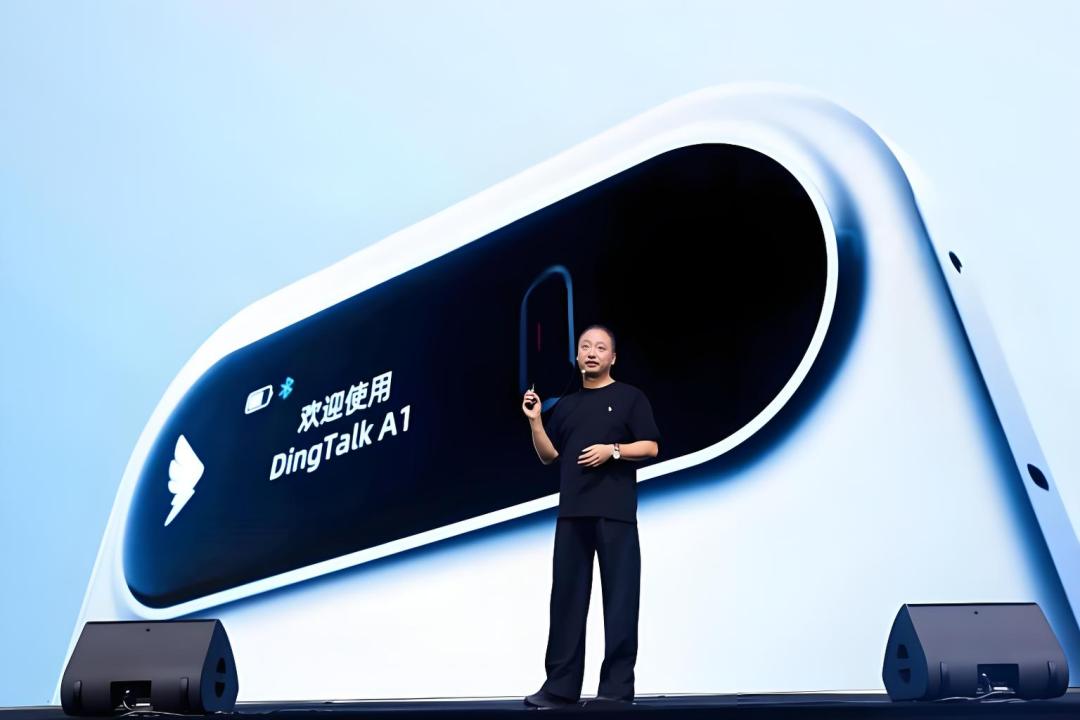
(Wuzhao, the founder of DingTalk)
Data from iResearch shows that the market size of China's collaborative office platform will reach 13.9 billion yuan in 2025. DingTalk leads with a 38.6% share, but the growth rate of its active enterprise users has significantly declined. Feishu, with an annual subscription revenue of 300 million US dollars, is rapidly narrowing the gap.
In fact, the overall growth rate of the entire collaborative office track is gradually slowing down. Both DingTalk and Feishu need to find new "hooks" to truly promote the growth of more enterprise users.
So, what will be the ultimate ecosystem of collaborative office in the future?
"The ultimate form of the office ecosystem is for software capabilities to seamlessly penetrate all scenarios through hardware," a industry analyst pointed out. Both Feishu and DingTalk are building an ecological closed-loop of "software + hardware" through AI recording hardware.
However, this AI recording hardware war is just an appetizer.
DingTalk has shown greater ambition - the DingTalk Real AI Terminal. This device, similar to a NAS, is equipped with Agent OS and can be deployed within the enterprise. It supports complex tasks such as travel price comparison, recruitment screening, and public opinion monitoring, becoming the physical execution carrier of AI Agents.
This product can be understood as an enterprise-level AI host. Many people may wonder why, at this stage when cloud models are so powerful, enterprises still need a host?
In response, DingTalk gave an answer from an enterprise perspective: As the operating environment for Agent OS, this terminal allows AI to securely access the enterprise's internal network, local files, and business systems, and supports the invocation of various tools on computers and mobile phones to analyze real data in the enterprise's real working environment.
This product solves the three core problems of enterprise AI implementation. It breaks through the execution boundary where only APIs cannot reach local, internal network, and old software. It resolves enterprises' concerns about the security and compliance of AI operation behaviors, data flow, and responsibility attribution. At the same time, it realizes physical device control of AI operation tools through the permission and audit system.
Obviously, Wuzhao