Embodied AI in 2026: Emerging from the Capital Frenzy to Achieve a "Value Closed Loop"
2026 is not the year when embodied intelligence reaches its end, but the year that determines the direction of differentiation. Those who can truly enter the real world this year and establish a closed - loop of sustainable evolution capabilities will be qualified to participate in the next - stage discussion on "generalization".
In 2026, embodied intelligence has been pushed to a new critical point.
In the past year, capital in the primary market has poured in, and the financing amount has continuously refreshed the historical records in the field of embodied intelligence.
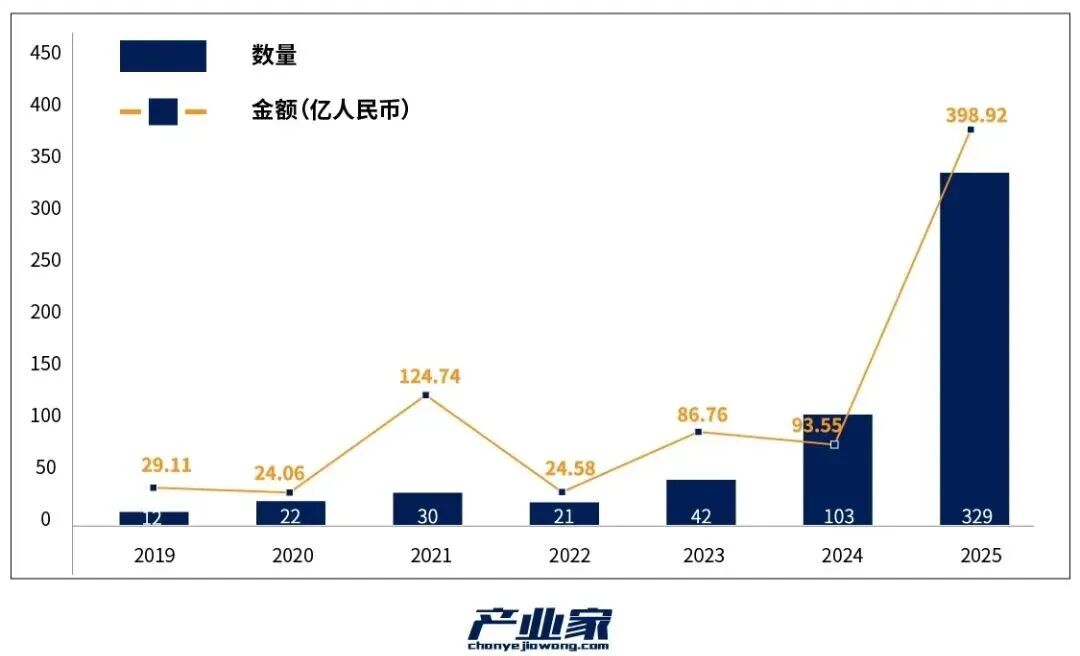
According to the data from IT Juzi, in 2025, there were a total of 329 financing events in the field of embodied intelligence, a year - on - year increase of 219.42% compared to 2024; the financing amount reached as high as 39.89 billion yuan, more than three times the year - on - year increase.
From the appearance of Unitree H1 on the Spring Festival Gala in January, to the inclusion of embodied intelligence in the government work report in March, the opening of the robot marathon in April, and then to the winning bid of ZHIYUAN + Unitree for China Mobile's 124 million yuan procurement in July, which initiated the large - scale commercial orders; finally, the domestic robots made a splash at the CES exhibition... Embodied intelligence painted a special macro - picture in 2025.
Looking at the current situation, in the field of embodied intelligence, money, computing power, and hardware seem to be in place. But in this field, where exactly does the money flow? Who has taken the most chips in this competition?
More importantly, when the "hands" and "feet" have taken initial shape, and when the models start to enter factories, warehouses, and production lines, what exactly can the current embodied intelligence do? And what capabilities are still the "uncharted areas" that money, computing power, and engineering stacking cannot overcome for the time being? Can they be overcome in 2026?
Where does the money in embodied intelligence flow?
According to the financing statistics in the field of embodied intelligence in 2025, the distribution of funds shows obvious hierarchical characteristics.
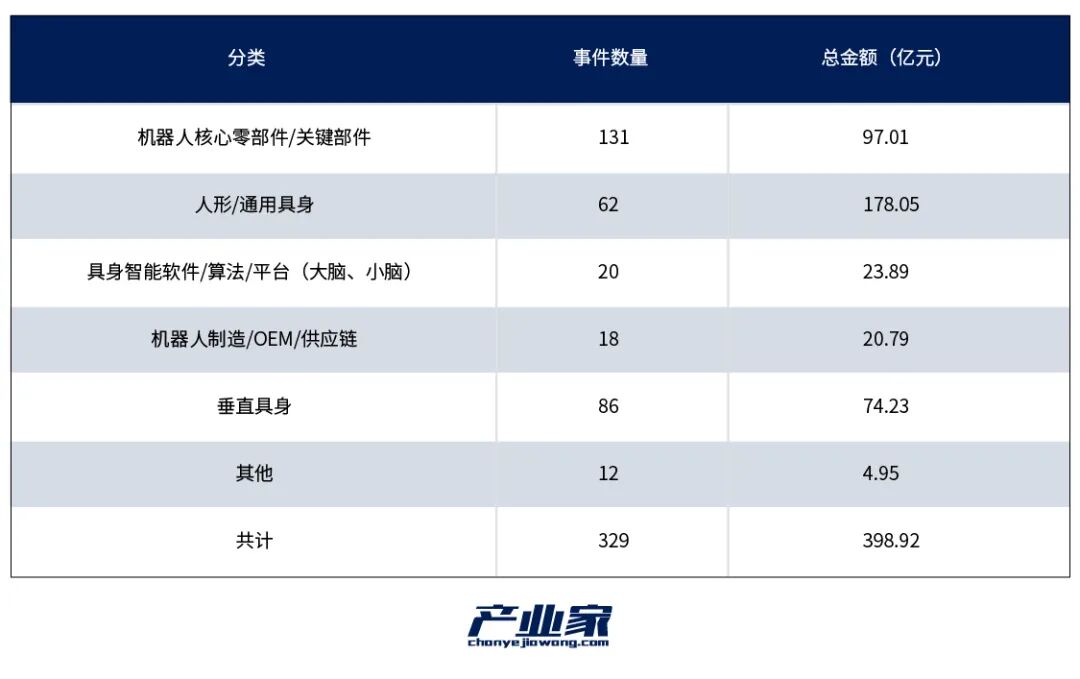
The most bustling area is the key component field, with as many as 131 transaction events, accounting for 40% of the total transaction events.
Companies in this field specialize in dexterous hands, joints, high - density actuators, or electronic skins. There are many involved companies, and it is also the first choice for many embodied intelligence entrepreneurs. With the support of capital in the past year, some companies have quickly emerged.
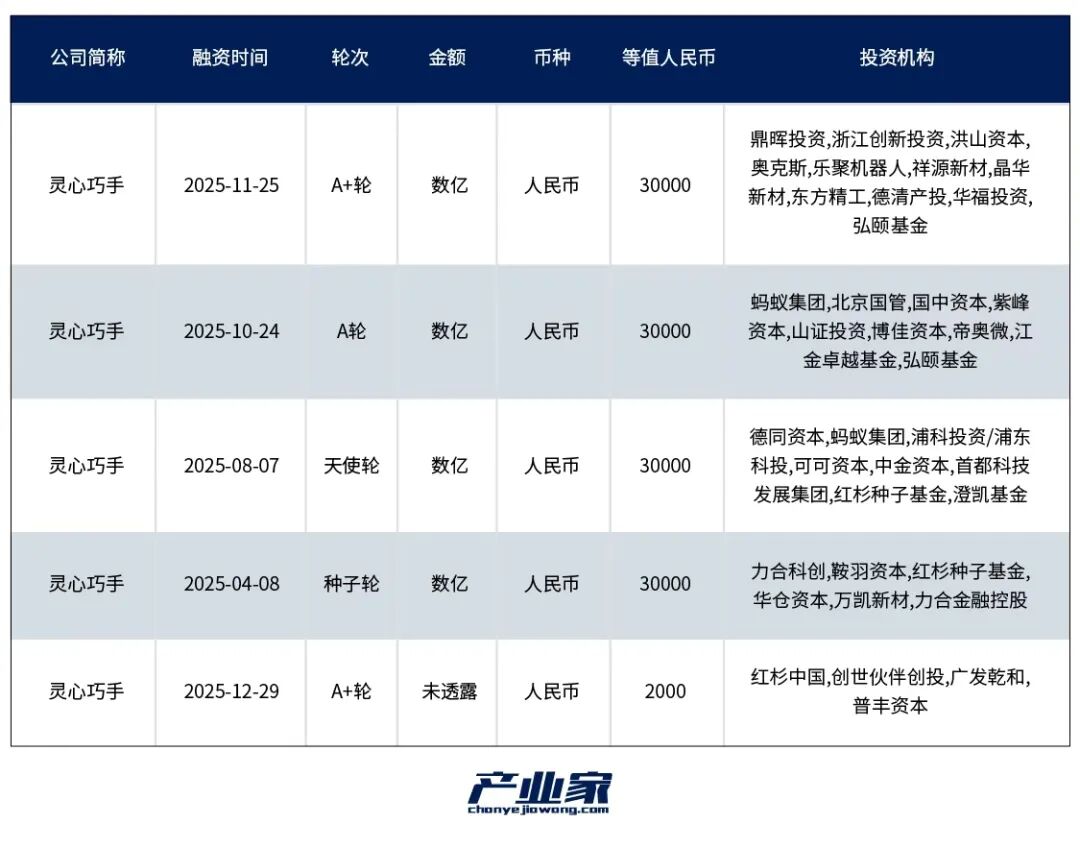
For example, Lingxinqiaoshou completed a total of 5 rounds of financing in the past year, and the investors included Internet giants, industrial funds, and leading capitals.
Compared with the key component field, the number of financing events in the embodied intelligence ontology field is only 62, far less than that in the component field. These manufacturers mainly focus on the hardware - software integrated embodied intelligence ontology, aiming to create a whole machine as flexible as a human being.
However, they show extremely strong capital absorption ability. For example, on December 19th, Galaxy General received a Series B + financing of 300 million US dollars; on October 22nd, Leju Robot received a Pre - IPO financing of 1.5 billion yuan; on June 22nd, Xingdong Jiyuan received a Series A + financing of 1 billion yuan; on September 8th, Independent Variable Robot received a Series A + financing of 1 billion yuan...
This does not mean that all companies are like this.
From the data statistics, the 9 financing events with the highest single - round financing amount took away more than 10 billion yuan of funds.
It can be seen that the funds in this field are highly concentrated in a few leading companies. These companies may conduct multiple rounds of financing within a year, and some even take away billions of yuan in funds, while startups in the middle and tail are facing a "financing drought", and the Matthew effect in the whole sector is obvious.
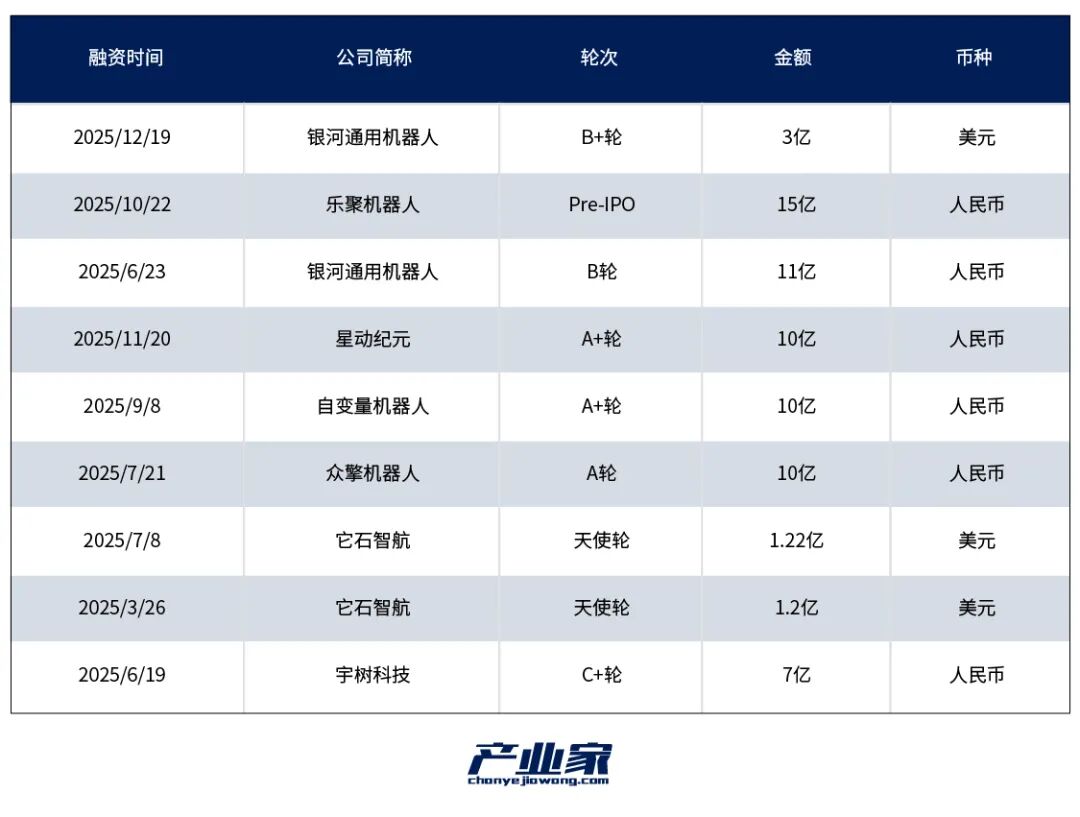
It is worth noting that most of the capital in this field is concentrated in the general robot field. For example, Galaxy General, Leju Robot, and Xingdong Jiyuan involved in the 9 financing events with the highest financing amount.
In addition to these general robots, there is also a group of manufacturers deeply involved in vertical scenarios, which also have excellent performance, and the scenarios are relatively concentrated, mainly in the consumer and industrial scenarios at the C - end.
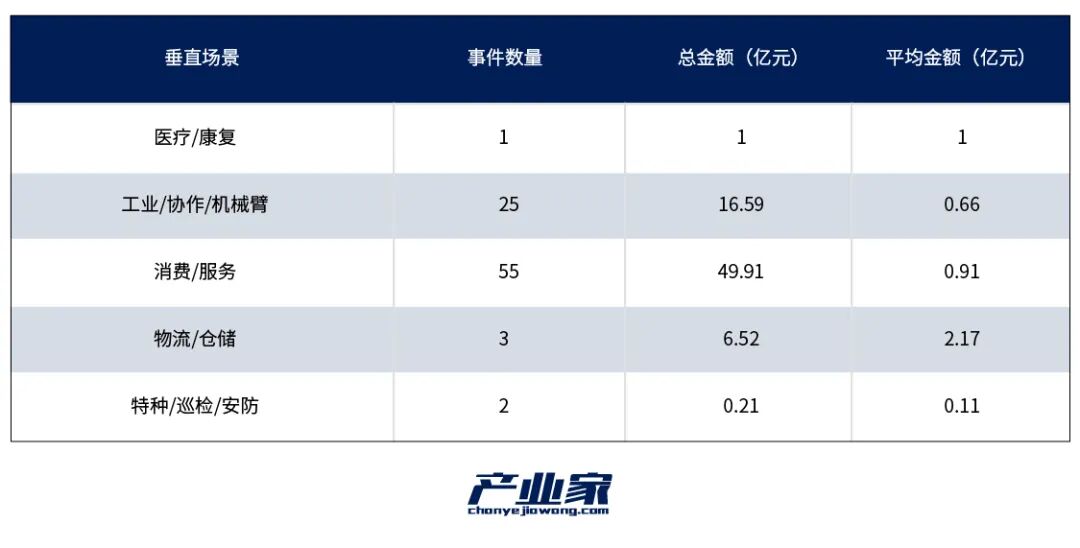
Different from the large - scale financing such as Pre - IPO or Series C in the ontology track, most of the embodied intelligence brain and cerebellum manufacturers focusing on embodied intelligence software and basic models are in the very early stages of the angel round, Pre - A round, or A round, and the number of transaction events and the amount are relatively small year - on - year.
However, since these companies master the core algorithms and basic models of embodied intelligence, they have shown amazing capital - attracting ability at an early stage. For example, the embodied intelligence brain manufacturers represented by Xingyuanzhi Robot received two rounds of angel - round financing within a year, with a financing amount of hundreds of millions of yuan; the embodied intelligence cerebellum manufacturers represented by Langyi Robot also received three rounds of angel - round financing in the past year.
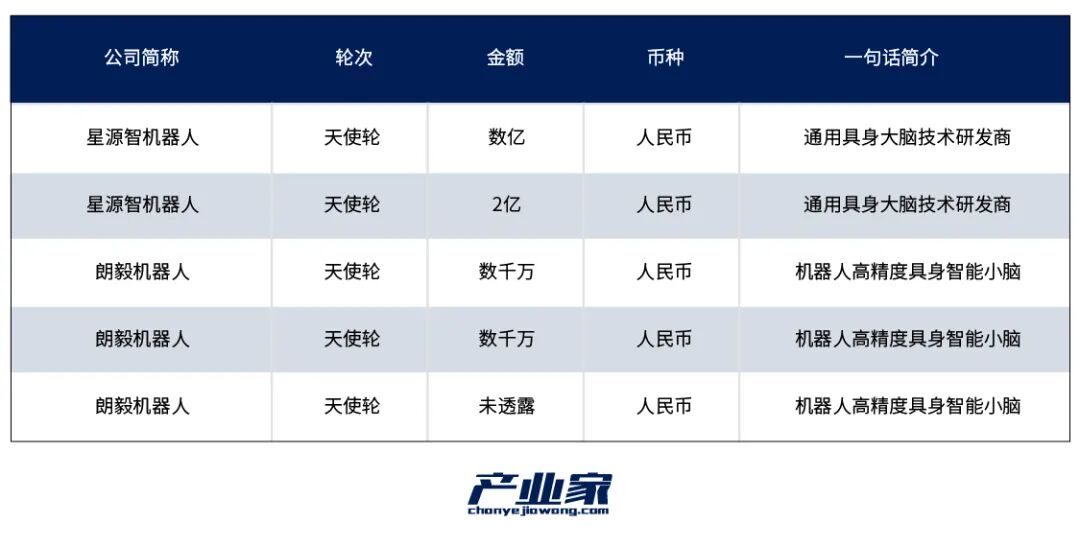
Generally speaking, the "brain" of embodied intelligence attracts the most venture capital; the funds are most concentrated in the "ontology" of embodied intelligence; and the key components and haptics have the most frequent financing and the most participants.
After penetrating the fog, the "meticulous calculation" of capital
Every flow of capital is a prediction and investment in the industrial status of different levels of embodied intelligence.
In the history of the software industry, capital has repeatedly verified a rule. That is, when a company's core ability is not a specific application, but an application - layer product not customized for a single industry, the market is willing to give a very high PS (price - to - sales ratio) valuation before the profit is shown.
Whether it is Microsoft's horizontal replication of operating system and cloud platform capabilities to enterprises, governments, and medical systems, or NVIDIA's expansion from games to data centers, autonomous driving, and medical imaging with CUDA and AI software stack as the core, they essentially follow the same set of business logic: a high - intensity R & D investment in exchange for almost infinite scenario reuse, and the marginal cost rapidly approaches zero as the scale expands.
It is precisely based on such historical experience that capital will continuously invest funds in the so - called "brain" and "cerebellum" manufacturers in the field of embodied intelligence. In the eyes of capital, the end - game of embodied intelligence will not be a "hundred - box war", but closer to a "one - brain - ten - thousand - machines" situation. What capital bets on in this track is essentially the upper limit of the capabilities of embodied intelligence.
However, for embodied intelligence to achieve large - scale commercial implementation, having only a brain is not enough. It must rely on a strong "shell".
It is worth noting that the integrated robot is an extremely capital - intensive heavy - asset track. Take Tesla Optimus as an example. From 2022 to 2024, Tesla's direct R & D investment in Optimus has cumulatively exceeded 3 - 4 billion US dollars. The annual cash - burning rate of Figure AI, a humanoid robot company jointly invested by OpenAI, NVIDIA, and Microsoft, is about 200 - 300 million US dollars.
Therefore, only companies with hundreds of millions of US dollars in financing have the financial resources to establish self - developed production lines, integrate hundreds of suppliers, and bear the high early - stage delivery losses. Naturally, the funds gradually gather towards large companies or manufacturers with a certain foundation.
In addition, another factor is that Internet giants have locked in leading integrated robot manufacturers through direct investment or strategic cooperation, and this "standing - in - line effect" has accelerated the closed - loop of resources.
According to IT Juzi data, the total number of investments made by 8 core large manufacturers throughout the year reached 62 times. Among them, Baidu Ventures ranked first with 13 investments, followed by Lenovo Capital & Incubator Group/Lenovo Star with 11 investments. Guoxiang Capital (SenseTime) and Ant Group tied for third with 8 investments each, forming the first investment echelon. In terms of investment intensity, the estimated total investment of the 8 large manufacturers throughout the year ranged from 1.45 to 3.4 billion yuan.
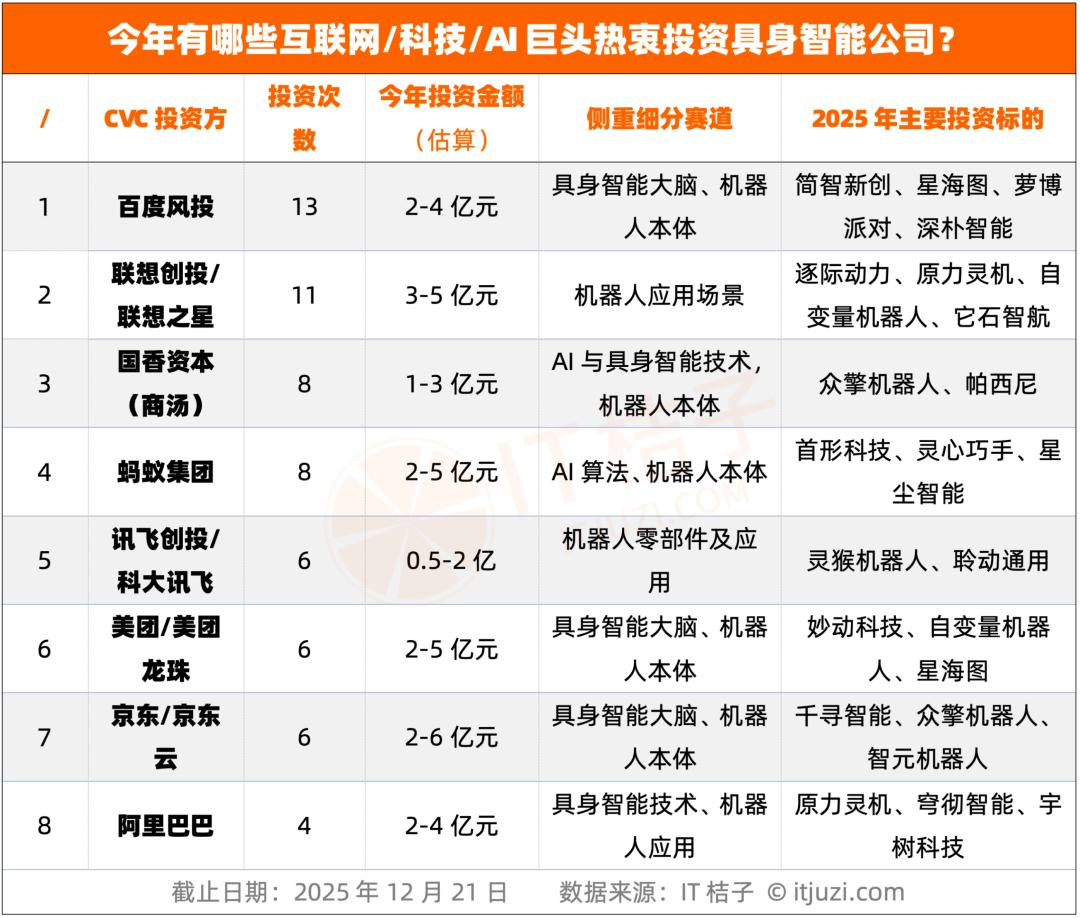
This "standing - in - line effect" forms a closed - loop, that is, large manufacturers provide real scenarios, and ontology manufacturers polish algorithms to generate more data. For small companies without a background, not being able to access high - quality scenarios means being completely abandoned at the starting stage of the "data flywheel". What capital bets on here is which manufacturer can become the "default hardware carrier" in the physical world in the next decade.
However, in the end, no matter which manufacturer wins, high - power - density frameless torque motors, harmonic reducers, and dexterous hands are needed. This rigid demand just makes component manufacturers the safest haven with the lowest risk, attracting a large number of early - stage and manufacturing - oriented LPs (limited partners) to enter the market. It brings high - frequency financing to the key component and haptic manufacturers of embodied intelligence.
In addition, such small - and - refined tasks are more suitable for startup teams in vertical fields, thus presenting a financing landscape like an "army of ants".
Actually, component manufacturers determine whether embodied intelligence can be used on a large scale, stably, and at low cost. In the eyes of capital, this is the link with the lowest risk and the highest certainty in the entire industrial chain.
Generally speaking, whether it is the "general base theory" behind the attraction of venture capital by the embodied brain and cerebellum, the "heavy - asset breakthrough battle" behind the Matthew effect of ontology manufacturers, or the "water - carrier logic" behind the high - frequency financing of key components and haptics, it is capital's search for "long - term compoundable technological assets" after the marginal decline of LLM (large language model). Embodied intelligence happens to have the three elements of a high ceiling, strong engineering barriers, and certain rigid demand at the same time.
Money and computing power cannot buy "certainty in the physical world"
Now, in the field of embodied intelligence, money is in place, and the "hands and feet" of robots have also taken initial shape. So at the time point of 2026, what exactly can embodied intelligence do? And what are the "uncharted areas" that money and computing power still cannot overcome?
Taking the industrial scenario as an example, actually, embodied intelligence has completed the essential leap from 0 to 1.
For example, in the past, robots could only pick up parts in fixed positions. Now, with the cooperation of embodied intelligence and the VLA (vision - language - action) large model, robots can accurately find the part with the smallest scratch in a messy parts basket; thanks to neural network control (end - to - end), the robot's movements no longer have obvious jerks. In soft - contact tasks such as folding clothes and storing trays, the success rate has increased from 30% to over 85%; when facing instructions such as "go and get that easily - broken blue cup", robots no longer need coordinate input, but can directly understand that "easily - broken" means they need to control the grip strength, and "blue cup" is the visual target.
Generally speaking, today's embodied intelligence can already achieve the initial adaptation to unstructured environments, fluid motion brought by end - to - end, and the direct conversion of semantic instructions.
However, the current embodied intelligence still has limitations when facing three types of tasks: long - range logical chains, physical common sense, and extremely precise operations.
For example, a robot can pick up a coffee cup. But if it is required to "go to the kitchen to wash the cup, fill it with coffee, add two pieces of sugar, and send it to General Manager Wang who is having a meeting on the second floor", it will most likely freeze halfway through the execution due to a small disturbance. The current models still lack the long - term planning ability for complex and multi - step tasks.
Moreover, the current embodied intelligence still imitates actions through massive data rather than truly understanding the laws of the physical world. For example, it is difficult to understand common sense such as "do not shake a cup full of hot water vigorously".
For another example, when dealing with tasks such as sewing with a needle and thread and flexible plug - in of tiny electronic components, although the hardware parameters of the existing dexterous hands meet the standards, there is still a millisecond - level delay in the visual - to - haptic feedback closed - loop, and this delay is fatal in precision engineering.
It is not difficult to see that in 2026, embodied intelligence is good at "short - range, local, and error - tolerant" tasks, but still shows immaturity in "long - range, precise, and error - free" scenarios.
These are not single - algorithm or hardware problems, but are due to the lack of high - quality real - world scenario data.
It should be noted that long - tail scenarios are very costly. In an industrial production line, even a 1% failure may mean the shutdown of the entire production line. Although synthetic data can solve the problem of quantity now, it is difficult to cover factors such as light and shadow changes, dust occlusion, motor wear, and material aging. These factors are enough to make a model that performs perfectly