Jensen Huang: Thanks to AI, the salaries of American plumbers and electricians have doubled.
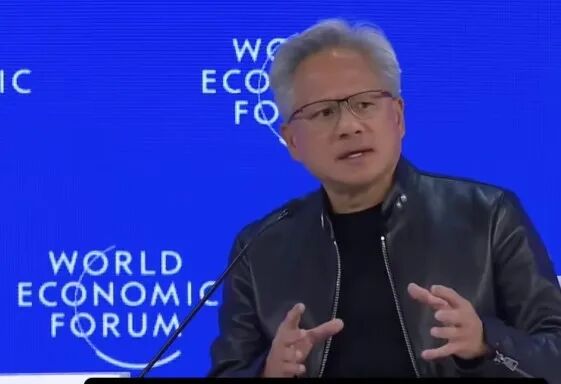
At the 2026 World Economic Forum, Jensen Huang, the CEO of NVIDIA, had a conversation with Larry Fink, the CEO of BlackRock.
The topic of the conversation was the technological evolution of AI, the scale of infrastructure construction, the impact of AI on the job market, and the global economy.
Jensen Huang positioned AI as a profound and fundamental transformation that reshapes the global economic and social structure. It is an unprecedented wave of infrastructure construction in human history. AI will reshape the value of the labor force and provide unprecedented opportunities for the balanced development of the global economy.
Jensen Huang's core argument is that we are in the midst of a fundamental "platform shift."
He compares the current rise of AI to the birth of the personal computer internet and mobile cloud computing, believing that each such shift has completely reshaped the computing stack and given rise to brand - new application ecosystems.
In his view, AI is not just a single application like ChatGPT or Claude, but a brand - new foundation platform on which everything can grow. The fundamental breakthrough of this shift is that computers have for the first time gained the ability to understand "unstructured information."
Past software, such as SQL - based database systems, could only process pre - defined and structured data. In contrast, AI can understand in real - time complex and context - rich unstructured information such as images, sounds, and natural language, and perform tasks based on inferences about human intentions.
This transformation from "pre - recorded" to "real - time generation" is the essential characteristic that distinguishes AI from all previous technologies.
To help the audience better understand the composition of this vast industry, Jensen Huang proposed a "five - layer cake" model.
1. Energy: The bottom layer is energy. Since AI processes and generates intelligence in real - time, it requires energy to do so.
2. Chips and computing infrastructure: The second layer is my area, chips and computing infrastructure.
3. Cloud infrastructure: The next layer up is cloud services.
4. AI models: Further up are AI models. This is where most people think AI lies. But don't forget that to make these models a reality, you must have all the layers below.
5. Application layer: But most importantly, and what is happening right now, is the application layer. The reason last year was an incredible year for AI is, quite frankly, that the AI models made great progress, enabling the application layer above - the final layer that all of us need to succeed - to thrive. This application layer can be in fields such as financial services, healthcare, and manufacturing. Ultimately, economic benefits will be generated here.
The proposal of this model aims to emphasize the depth and breadth of the AI industry and lead to his key judgment on infrastructure construction.
Based on this, Jensen Huang asserted that we are witnessing "the largest - scale infrastructure construction in human history." He believes that the hundreds of billions of dollars already invested are just the beginning, and trillions of dollars will flow into this field in the future.
This is not an exaggerated prediction, but a logical necessity based on the operating principle of the AI platform.
To enable AI to process massive amounts of contextual information and generate intelligence, the global demand for energy, data centers, chip factories, computer factories, and even AI factories will grow exponentially.
He cited the large - scale factory - building plans of partners such as TSMC and Foxconn, as well as the huge investments of Micron, Samsung, etc. in the memory chip field, to prove the authenticity and urgency of this construction wave.
When asked if there is an "AI bubble," Jensen Huang gave an answer based on market supply and demand: The current rental prices of NVIDIA GPUs in the cloud, whether for the latest generation or previous generations, are continuously rising, indicating that the real demand is far from being met.
Therefore, the current huge investments are not irrational speculations, but necessary construction to fill the huge supply - demand gap.
Regarding the impact of AI on the job market, Jensen Huang put forward a view that is completely opposite to the mainstream concerns. He believes that instead of causing large - scale unemployment, AI may lead to a labor shortage in some fields. He explained this logic by distinguishing between the "purpose" and "task" of work.
Jensen Huang took radiologists as an example. Ten years ago, people generally predicted that this profession would be eliminated due to the computer vision ability of AI. However, ten years later, the number of radiologists has actually increased.
Jensen Huang explained that AI automates the "task" of reading X - rays, enabling doctors to complete their work more efficiently and thus devote more energy to activities that better reflect their "purpose," such as diagnosis, communication with patients, and other clinicians.
The improvement in work efficiency allows hospitals to admit more patients, increase their income, and then hire more doctors. Similarly, nurses can free themselves from the cumbersome task of medical record - keeping through AI and spend more time providing human - centered care, which also improves the hospital's admission capacity and efficiency.
He extended this logic and believes that AI will become a powerful tool for professionals in all industries. By automating repetitive tasks, it will enhance their ability to achieve the core purpose of their work, thereby improving the productivity and value of the entire industry.
At the same time, the large - scale infrastructure construction itself will also create a large number of blue - collar jobs related to professional skills, such as electricians, construction workers, and technicians. These high - paying jobs do not require advanced education and contribute to more inclusive economic growth.
Jensen Huang is quite optimistic. He believes that AI has the potential to be a key force in narrowing rather than widening the global technological gap.
The core logic lies in the ease of use of AI. He said that AI is "the easiest - to - use software in history." Users do not need to learn complex programming languages. They only need to issue instructions through natural language to drive powerful AI to complete tasks.
This extremely low entry barrier allows people in developing countries and those without advanced computer science education to participate in this technological revolution.
He further proposed the concepts of "national intelligence" or "sovereign AI" and strongly suggested that each country should build its own AI infrastructure and train its own AI models using its own language, culture, and data.
He believes that a country having its own AI capabilities is like having its own power and transportation networks, which is the foundation of future national competitiveness. This is not only related to economic development but also to cultural inheritance and technological sovereignty.
For Europe, Jensen Huang pointed out that Europe has an extremely strong industrial and manufacturing foundation. Although this may not have been fully translated into an advantage in the software era dominated by the United States.
But in the AI era, especially with the "physical AI" that NVIDIA is currently developing, Europe has a once - in - a - lifetime opportunity.
He encouraged Europe to deeply integrate its strong manufacturing capabilities with artificial intelligence, shift from the mindset of "writing AI" to "teaching AI," and achieve leap - forward development in the fields of intelligent manufacturing and robotics. At the same time, Europe's profound scientific research tradition can also be combined with AI to greatly accelerate the process of scientific discovery. He urged European leaders to seriously address energy supply and infrastructure investment to lay the foundation for the prosperity of the local AI ecosystem.
Full - text translation
Larry:
Good morning, everyone. I'm very glad to be back in the congressional hall again. I hope you all had a great time yesterday and will enjoy today as well. I'm extremely honored to introduce Mr. Jensen Huang to you. He is someone I greatly admire and have been following, and also a teacher in my journey of learning technology and artificial intelligence (AI).
It's amazing to see how he leads NVIDIA. I don't really like to measure myself by comparison, but I like this one. Since NVIDIA went public in 1999 - the same year BlackRock went public...
Jensen Huang:
Oh, my goodness.
Larry:
Yes. NVIDIA has brought a total compound return of up to 37% to its shareholders. Just imagine what it would mean if every pension fund had invested in NVIDIA at its IPO. We could have brought great success to everyone's retirement.
Meanwhile, BlackRock has an annualized total return of 21%. For a financial services company, it's not bad, but it pales in comparison. But this is a powerful proof of Jensen's leadership, NVIDIA's positioning, and also a good indication of the world's belief in NVIDIA's future. So, Jensen, congratulations on this journey. I know we still have many years to go together in the future.
Jensen Huang:
Thank you. Thank you very much. My only regret is that after the company's IPO, I wanted to buy something nice for my parents, so I sold my NVIDIA shares at a company valuation of $300 million. I bought them a Mercedes - Benz S - Class. It became the most expensive car in the world.
Larry:
Do they regret it? Do they still have the car?
Jensen Huang:
Oh, of course. Yes, they still have it.
Larry:
Okay. Now let's get to the point. The core of the debate about AI is how it will change the world and the global economy. Today I want to talk about how AI can add value to the world economy and how it is increasingly becoming a fundamental technology that allows each of us here to use it to improve our lives and the lives of everyone in the world.
We need to discuss how it will reshape the productivity, labor force, and infrastructure of almost all industries, but more importantly, how it will reshape the world and how more parts of the world can benefit from AI. We also need to ensure that the global economy is broadened, not narrowed.
I can't think of anyone who has a clearer view of AI itself and the surrounding infrastructure - the infrastructure that must be built around it. Since many major hyperscale computing companies are using the products created by NVIDIA, and the entire ecosystem revolves around the AI infrastructure and its potential, I think we have a very worthy voice to listen to this morning. So, Jensen, thank you again.
This is his first time at the World Economic Forum in Davos. I know your schedule is very busy. Thank you for taking the time.
Jensen Huang:
Thank you very much.
Larry:
Then I'll get straight to the point. Why do you think AI has the potential to be such an important growth engine? What makes this moment and this technology different from past technology cycles?
Jensen Huang:
Yes. First of all, when you think about AI and interact with it in various ways - of course including using ChatGPT, Gemini, Anthropic's Claude, etc. - and see the amazing things it can do, it's helpful to think back to first principles and consider what's actually happening to the computing stack.
This is a platform shift. A platform is the foundation on which applications are built. This platform shift is like the shift to the personal computer (PC) platform back then, where new applications were developed to run on a new type of computer; it's also like the shift to the internet platform, where a new type of computing platform hosted various new applications; and it's like the shift to the mobile cloud platform. In each platform shift, the computing stack is reshaped, and new applications are born.
In this sense, this is a new platform shift. The ChatGPT you use today is itself an application, but very importantly, new applications will be built on top of ChatGPT, and new applications will also be built on models like Anthropic's Claude. So, it's such a platform shift.
If you realize that AI can do things you could never do before, then it's easy to understand. Past software was actually "pre - recorded." Humans input and describe algorithms or recipes for the computer to execute.
It could only handle structured information, which means you had to input names, addresses, account numbers, ages, addresses, etc., create these structured tables, and then the software would retrieve information from them. We call this an SQL query. SQL is the most important database engine in the world's history, and almost everything used to run on SQL.
Now, we have a computer that can understand unstructured information. This means it can look at a picture and read a text.
These are completely unstructured. It can listen to sounds, understand their meanings, understand their structure, and reason about how to respond. So, for the first time, we have a computer that is not "pre - recorded" but can process information in real - time. This means it can acquire current situational information, environmental information, contextual information, and any information you give it, and then reason about the meaning of this information and your intentions - and your intentions can be described in a very unstructured way.
We call this "prompts," but you can describe it in any way you like. As long as it can understand your intentions, it can perform a task for you.
The important thing about this is that we are reshaping the entire computing stack. The question is, what is AI? When you think about AI, you may think of AI models, but it's crucial to understand AI from an industrial perspective. AI is actually a five - layer cake:
1. Energy: The bottom layer is energy. Since AI processes and generates intelligence in real - time, it requires energy to do so.
2. Chips and computing infrastructure: The second layer is my area, chips and computing infrastructure.
3. Cloud infrastructure: The next layer up is cloud services.
4. AI models: Further up are AI models. This is where most people think AI lies. But don't forget that to make these models a reality, you must have all the layers below.
5. Application layer: But most importantly, and what is happening right now, is the application layer. The reason last year was an incredible year for AI is, quite frankly, that the AI models made great progress, enabling the application layer above - the final layer that all of us need to succeed - to thrive. This application layer can be in fields such as financial services, healthcare, and manufacturing. Ultimately, economic benefits will be generated here.
But importantly, because this computing platform requires all the layers below, it has initiated the largest - scale infrastructure construction in human history. We've already invested hundreds of billions of dollars.
Larry:
Only hundreds of billions.
Jensen Huang:
We've only invested hundreds of billions of dollars. Larry (the host) and I have many opportunities for project cooperation.
Trillions of dollars of infrastructure need to be built. This is logical because all this contextual information must be processed so that the AI models can generate the necessary intelligence to drive the applications at the top.
So, when you think it through layer by layer, you'll find that the energy industry is experiencing extraordinary growth. In the chip industry, TSMC has just announced that they're going to build 20 new wafer fabs.
Foxconn, Wistron, and Quanta are collaborating with us and are building 30 new computer factories. The products from these factories will go into AI factories. So, we have chip factories, computer factories, and AI factories being built all over the world.
Larry:
And memory.
Jensen Huang:
And memory, exactly. Those chip factories. Micron has started investing $200 billion in the United States. SK Hynix and Samsung are both performing very well. You can see that the entire chip layer is growing amazingly. Of course, we're very focused on the model layer now, but excitingly, the application layer above the models is also doing very well. One indicator is the flow of venture capital (VC) funds last year.
Last year was one of the largest - scale years in VC investment history, and most of the funds flowed into so - called "AI - native" companies. These companies are spread across all the major industries in the world, such as healthcare, robotics, manufacturing, and financial services. You're seeing huge investments flowing into these AI - native companies because for the first time, the AI models are good enough to serve as the foundation for them to build applications.
Larry:
Let's dig deeper. Obviously, I believe everyone here is using their own chatbots to get information. But you talked about the popularization of AI being the key. Let's talk about more positive concepts brought about by the popularization of AI in the physical world. You mentioned healthcare as a good example, but what transformative opportunities