Microsoft CEO Satya Nadella: Energy costs will determine which countries can win the AI race.
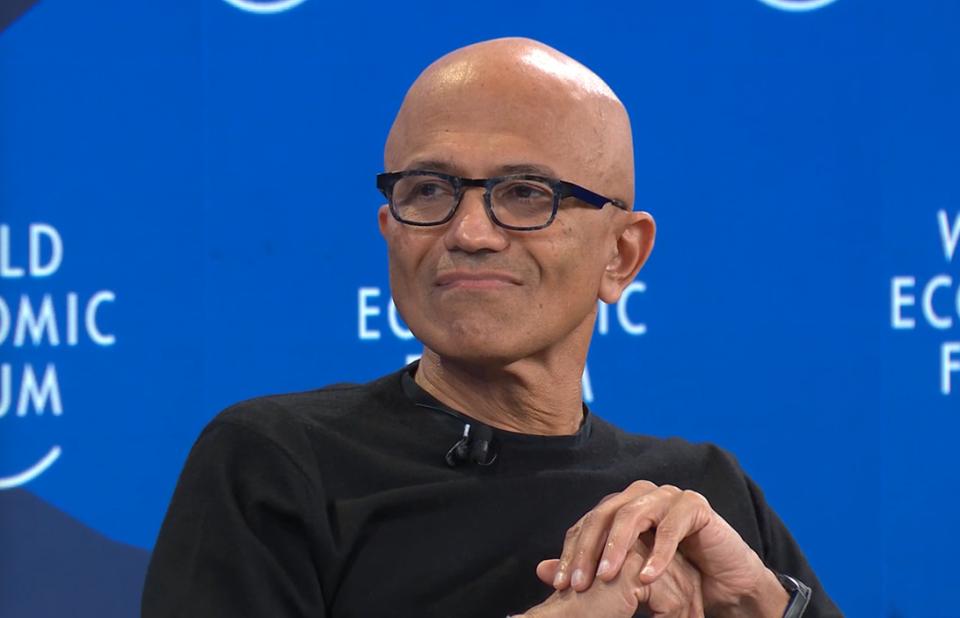
On January 20th local time, at the World Economic Forum held in Davos, Switzerland, Microsoft Chairman and CEO Satya Nadella and BlackRock CEO Laurence D. Fink engaged in an in - depth discussion about the current relationship between AI technology, corporate and social labor structures.
"In this era, the tools we use daily and our work methods will be completely reshaped by AI," Nadella said.
This reshaping is happening at a visible pace: when a junior developer opens Copilot (Microsoft's artificial intelligence assistant), it can generate code in seconds that used to take hours to write; when product managers start using ChatGPT to directly build prototypes, and when Claude launches the Skill function, which can automatically create Word, PPT, and Excel files and even call APIs to complete complex automated processes, we have to admit a fact: AI is no longer just an "auxiliary tool" but has started to take over core tasks that previously required professional skills.
Against the backdrop of such rapid development and takeover, there are more and more doubts and concerns about whether humans will be replaced by AI, which are spreading rapidly across various fields. Especially for programmers, when AI can write code, debug, and refactor, the moat of their professional skills seems to be disappearing.
So, in this world reshaped by AI, where exactly lies the value of humans? And how should enterprises build their competitiveness?
Nadella emphasized that the core value of humans lies in transforming experience, judgment, and business understanding into unique competitiveness that AI cannot replicate. The key for enterprises is not to find "the most powerful model" but to know how to "orchestrate" AI, enabling different tools to cooperate to solve complex problems.
The following is the full transcript of the conversation with Nadella:
01 AI is Taking Over More Complex Knowledge Work
Fink: Today in Davos, I'm very glad to invite Microsoft CEO Satya Nadella. Currently, AI is a topic we can't avoid. It's being hotly discussed in all aspects, including business, technology, and society. It's no longer just a concept but is truly changing the foundation of business and society. You previously mentioned that AI represents a "platform transformation." Can you elaborate on what this means? What key changes will there be in the next few years? Looking back at today five years from now, which trends should we see but haven't clearly recognized?
Nadella: I read your public letter issued before the forum yesterday. There was a great line in it: How can AI truly spread and be popularized worldwide? This is the fundamental question that all of us need to answer.
I believe that there is a main thread behind the current digital revolution: transforming everything in the real world, including people, places, objects, information, and processes, into digital forms, and then using this "digital copy" for analysis, prediction, and optimization. From mainframes to personal computers, then to the Internet, mobile devices, and cloud computing, they are essentially doing the same thing. AI is a continuation of this main thread, but its impact may be more profound than that of the Internet and mobile revolutions.
I often use writing code as an example. Previously, it was a very professional "knowledge - based job," but after the emergence of GitHub Copilot, it can guess what you're going to write in the next line. This proves that AI can understand complex work. Then, it progresses from completing code to helping you write small modules and then taking over entire sub - projects. It's becoming more and more capable. Of course, there are still challenges in making AI maintain logical consistency for a long time, but the direction is clear.
This often makes me think of the 1980s. If someone had said back then that 4 billion people would be typing every day in the future, we would definitely have asked: What do we need so many typists for? But personal computers did create a huge group of "knowledge workers." The transformation brought about by AI is similar: programmers won't disappear, but the definition, tools, and work methods of this profession will be completely reshaped.
This reminds me of a question that Bill Gates used to think about: What are the essential differences between documents, web pages, and applications? In fact, they are all different forms of information. AI makes the conversion between these forms extremely natural. A document can be turned into a website with one click, and a website description can directly generate an application. This ability has been applied in many places. For example, your company, BlackRock, combined Copilot with the Aladdin platform, and some tasks that used to take 12 hours to calculate can now be completed in a few minutes.
02 Two Key Aspects for the Popularization and Implementation of AI
Fink: Efficiency improvement is a good thing, but who will get the "surplus"? Will it go to corporate profits, or will it lead to unemployment and exacerbate the divide?
Nadella: This is the core issue. Currently, people seem to be more enthusiastic about talking about how cool AI technology itself is, but what we really need is to let AI solve practical problems, such as improving people's lives, revitalizing communities, promoting national development, and enhancing the efficiency of all industries. Otherwise, what's the point of all this?
If we can't achieve this, society may no longer support us in consuming scarce resources such as energy to generate so - called "tokens." If these tokens can't improve health levels, enhance the quality of education, improve the efficiency of the public sector, or strengthen the competitiveness of various industries, then the ultimate goal will be difficult to achieve. Therefore, popularization is the key.
So, how can popularization be achieved? We can look at it from two aspects.
On the supply side, each country needs to improve the efficiency of "how many high - quality tokens can be generated per dollar and per watt." This is why technology companies, including Microsoft, are making significant investments, from researching and developing chips to building "token factories" (data centers) globally. In the future, these facilities will be as widespread as power plants around the world, forming a global AI infrastructure network to power the entire economy.
On the demand side, every enterprise must really put it into use. Recall when personal computers first appeared. Jobs called it a "bicycle for the mind," and Bill Gates said it was "information at your fingertips." Both were emphasizing that technology is a tool to amplify human capabilities. Today's AI is such a tool, but its capabilities have been amplified ten or a hundred times. Every knowledge worker can now get almost unlimited intelligent support.
Turing Award winner Raj Reddy proposed long before the rise of generative AI that AI can be a cognitive amplifier or a guardian angel. If we view it from this perspective, when AI helps doctors with record - keeping, medical record entry, and bill coding, doctors can focus more on patients, and the medical system can operate more efficiently, ultimately benefiting both medical staff and patients. This is the shared value that technology popularization can bring. To achieve such a future, real leadership from the public sector and private institutions is required.
In addition, skill training is also crucial. The depth of technology popularization largely depends on the breadth of people's mastery of relevant skills.
The different lessons from the mobile era and the PC era are as follows: in the past, learning Excel or Word might directly help you find a job. Today, the opportunities brought by mobile technology are more driven by the consumer side (such as the creator economy). In the future, the key question will become "how to get a job in fields such as healthcare and finance with the help of AI or make continuous progress in your career." People need to realize that "mastering AI skills can make me a better product provider or service provider in the real economy."
The impact of the popularization of mobile technology on the economy (especially in the "Global South") is already very obvious. But I recently read a study showing that the current application of AI is still severely skewed towards highly educated people and developed economies. Will this exacerbate social differentiation? Can we achieve balanced popularization? And how can we prevent most regions of the world from being left behind? These are undoubtedly major issues we will face.
We are in a special stage. Relying on the already popularized mobile networks and broadband, we can export "tokens" to the world in a more balanced way than in the PC era or even in the early days of smartphone popularization. Nowadays, models and their outputs are almost everywhere. The real question is: What are the meaningful application scenarios?
I often think of a case in early 2023: an Indian farmer used a local - language chatbot based on an early GPT model to learn about agricultural subsidy policies and asked the robot to assist in filling out application forms. The significance of this event is that it restored the initiative to those marginalized due to technological barriers. Therefore, I believe that if properly utilized, AI can also create unprecedented opportunities in the Global South.
Of course, this requires certain conditions: Are there capital willing to invest? Is there an environment that encourages innovation? As a global cloud service provider, we are also investing in regions including the Global South. As long as the environment can attract capital and the demand is real, the next step is how to guide the effective connection between capital and technological demand through policy design.
It's worth noting that in some areas, private capital can participate, but the role of public capital is irreplaceable. For example, in most countries, the construction of power grids is still mainly led by the government and public sectors. Without a modern power grid system, development will be restricted. Although decentralized solutions "behind the electricity meter" are feasible in some countries, their scale is limited and difficult to sustain in the long run. The truly scalable path is to integrate "token factories" deeply into the real economy, connect power grids and communication networks, and achieve seamless flow of intelligence and data. This is the fundamental driving force for global development.
03 Sustainable Growth of AI: Avoiding Bubbles and Ensuring Balanced Distribution of Related Benefits
Fink: Currently, many people are talking about the possible "AI bubble." As investors, the most important thing we see is that the popularization and spread of technology will indeed change demand. The companies or countries with the fastest spread will ultimately be the winners, not just the creators of the technology. What's your view on this?
Nadella: To avoid an AI bubble, in essence, the benefits brought by this technology must be more evenly distributed. A signal to judge whether AI is a bubble is: if we always only talk about technology companies and only focus on the development of the technology itself, then in essence, we are only staying on the supply side.
Ultimately, if AI fails to bring real changes in key areas, for example, if no pharmaceutical company can use AI to accelerate drug trials, promote the launch of new drugs, or even discover breakthrough molecules, and if AI cannot penetrate into core links such as R & D, approval, and the supply chain to play a role, then this technology has not truly taken root in reality.
However, in reality, we are starting to see such cases. This also makes me more convinced that this technology will be built on cloud and mobile infrastructure, spread at a faster pace, drive the productivity curve upwards, and create localized value surpluses and economic growth globally, rather than just short - term growth driven by capital expenditure.
Currently, what we see in developed countries is still more capital - driven growth. But don't forget that although our capital investment is large in the United States, about 50% of it is also distributed around the world. Interestingly, these investments ultimately depend on global demand, and the prerequisite for the real emergence of global demand is the appearance of application scenarios combined with local contexts around the world. This is the complete logic I see.
04 AI Reshapes Organizations: Enterprises Should Focus on Three Dimensions for Transformation
Fink: How will AI change the internal structure of companies? Do large companies or small companies have more advantages?
Nadella: I think all new technologies face a major challenge: when tools and work methods change, companies also have to change accordingly. I remember a few years ago, the CEO of an Italian insurance company told me that when he first joined the industry, the company didn't even have computers. They communicated with agents around the world only through faxes and documents. Later, with the advent of computers, people started using Excel and sending emails, and the entire work process was completely re - engineered. Now that AI has arrived, it's another round of complete change.
In fact, every company is facing the issue of "workflow reshaping." Take myself as an example. Before coming to Davos, I had to prepare for dozens of meetings. In the past, the team would help me collect materials, write summaries, and confirm them layer by layer. Now, all I need to do is open the AI assistant and type in "I'm going to meet someone. Help me prepare a background document," and it can quickly integrate internal emails, customer information, and market trends, generate a personalized briefing in seconds, and send it to relevant colleagues with one click. This not only saves time but, more importantly, changes the path of information transfer from "reporting layer by layer from the bottom up" to "the system synchronizing information to everyone in real - time."
This means that our previous department settings, job divisions, and management processes may all need to be re - thought. Now that technology enables information to flow freely at almost no cost, if the organization maintains its old structure, it will become an obstacle.
So I often say that when an enterprise introduces AI, it's not enough to just buy a set of software or hire a few technical staff. It needs to promote transformation from three dimensions: "concept, ability, and data." In terms of concept, it should be willing to accept change; in terms of ability, people should be able to use AI tools; in terms of data, the company's years of accumulated experience and knowledge should be transformed into "background information" that AI can understand and use. These three points are indispensable, and this is why the progress of different companies and industries in applying AI varies so much.
When it comes to company size, small companies are often more flexible and have less historical baggage. They can directly use AI to build new work processes. Although large companies have accumulated rich data, customer resources, and industry experience, they must overcome organizational inertia and dare to use AI to activate these "sleeping assets." The future competitive landscape may be a two - way squeeze: small companies can quickly scale up with the help of AI, and large companies can truly leverage their data advantages with AI.
05 AI Accelerates Globalization: Three Key Variables Determine a Country's AI Competitiveness
Fink: From a national perspective, do you think the gap between different countries in AI development will widen or narrow?
Nadella: After traveling around the world, one of my deepest feelings is that the gap in the understanding of AI among top - tier talents is rapidly narrowing. Whether in Jakarta, Istanbul, Mexico City, or in Silicon Valley and Seattle, the developers, entrepreneurs, and corporate technology leaders I've met have increasingly similar in - depth thinking about AI applications. This is mainly due to three forces: the popularization of open - source technology, the accessibility of cloud services, and the free flow of knowledge brought about by globalization.
However, from the perspective of a country's overall competitiveness, there are still several key variables. One is energy cost and clean energy supply (AI consumes a lot of electricity); the second is data infrastructure and broadband penetration rate; the third is whether the policy environment encourages long - term investment and innovation. For example, in the financial field, because the United States clearly defined the framework for cloud and AI in regulations earlier, the application of AI in banks and asset management institutions has advanced rapidly. In contrast, Europe is still restricted by issues such as cross - border data in some aspects and is taking a more cautious approach.
Regarding Europe, I'd like to say a bit more. Europe has a world - class industrial foundation, clusters of small and medium - sized enterprises, and a strict tradition of privacy protection. These are all advantages. However, if it focuses too much on discussions like "data must remain within the country" and ignores how to use AI to enhance global competitiveness, it may miss greater opportunities. True "digital sovereignty" should be whether Europe can train AI with European characteristics based on global data and enable European enterprises to master their own unique AI models and capabilities.
06 The Essence of AI Sovereignty: Whoever Controls the Model Owns the Future
Fink: Do you think the concept of "data sovereignty" has been misunderstood?
Nadella: Regarding the issue of "sovereignty," we first need to clarify a premise: Who owns the data itself? In the digital age, this is very important. But what's more worthy of consideration next is what sovereignty really represents.
Take AI for example. I feel that a topic that will be discussed more this year is "corporate sovereignty." If your company's unique experience and knowledge can't be truly transformed into an AI model that you can control, then in essence, you don't have sovereignty. This means that the core value of your company is actually flowing to a model provider without your notice.
Interestingly, people rarely have in - depth discussions about this.