Exclusive interview with the founder of Yanjiwei: After a team of 80 achieved nearly 10 billion in revenue, they aim to deploy AI cameras in farmlands.
Interview | Ou Xue, Yuan Silai, Yang Xuan, Peng Xiaoqiu
Author | Ou Xue
Editor | Yuan Silai
Yang Zuoxing, the founder of BitMicro, is like a tutor passing by you on a university campus.
People are used to calling him "Dr. Yang". Because Yang Zuoxing is a "Triple Qing" doctor who completed his undergraduate, master's, and doctoral studies at Tsinghua University in the 1990s, majoring in nuclear physics.
He is thin, wears glasses, and wears a T-shirt printed with the company's logo. He speaks politely and is approachable.
But he is not just an intellectual.
At many moments, you can catch a glimpse of his rough edges - after all, he is someone who has fought his way out in the business world and made a fortune.
If you hear about Yang Zuoxing's experiences for the first time, many people will feel a sense of incongruity. Because the story is so extraordinary that it even seems a bit unreal.
After graduating from Tsinghua University, Yang Zuoxing didn't stay at the university or research institute. Instead, he moved around several microelectronics companies in Beijing and became a chip designer.
The chip industry basically uses APR (Automatic Placement and Routing) design. Engineers write codes and hand them over to EDA software, which then calls on the ready - made cell libraries of chip manufacturers to design a chip. But in 2011, Yang Zuoxing began to research fully customized chip design, starting from transistors and drawing every unit circuit, every connection, and every layout.
Yang Zuoxing undoubtedly has extremely high talent. He designed an RFID chip with a peak power consumption that was the world's best level at that time.
In 2015, Yang Zuoxing joined Diwei Shishu, the predecessor of Bitmain, as a part - time chip designer. Bitmain's S7 and S9 mining machines became the kings of their era because they used Yang Zuoxing's fully customized methodology.
Bitmain's valuation quickly reached tens of billions of dollars, but Yang Zuoxing left due to equity disputes. Two months after leaving, he founded BitMicro and continued to design mining machines. With a team of more than 50 people, the company achieved sales of 1.3 billion yuan in two years.
That year, Yang Zuoxing was 44 years old.
He earned a fortune beyond others' imagination. But his dream still remained unfulfilled.
Yang Zuoxing has always wanted to make AI chips. He once took his business plan to investors and proposed that he could reduce the power consumption of AI chips by an order of magnitude. The responses he received were always "daydreaming" and "fraud". Yang Zuoxing revised his business plan more than 100 times and met with more than 100 investors, but still achieved nothing in the end.
This is Yang Zuoxing's obsession. He told us a story: During a period when he was deeply involved in lawsuits, without the help of electronic devices, he hand - wrote a 200 - page document and completed the architectural design of the world's first low - power SOC chip using the fully customized chip design methodology.
Making money is no longer an end for Yang Zuoxing, but a means. He once said, "I make computing power chips as a stepping - stone to realize my dream of AI chips. I use the money I earn to support my original AI dream."
In 2020, under the BitMicro Group in Shenzhen, Yang Zuoxing founded Yanji Microelectronics and launched an AI vision brand - CINMOORE. The products are equipped with AI chips designed by Yang Zuoxing himself. "I expect to invest a total of 5 billion yuan, and as of now, I've spent 2.2 billion yuan (since 2021)," Yang Zuoxing told Yingke.
The main products of CINMOORE are wireless, low - power AI smart cameras with "zero installation cost and zero usage cost". Because they are equipped with self - developed chips, the power consumption of CINMOORE cameras is reduced by an order of magnitude compared with similar products, and they also support solar power supply and free 4G data for life.
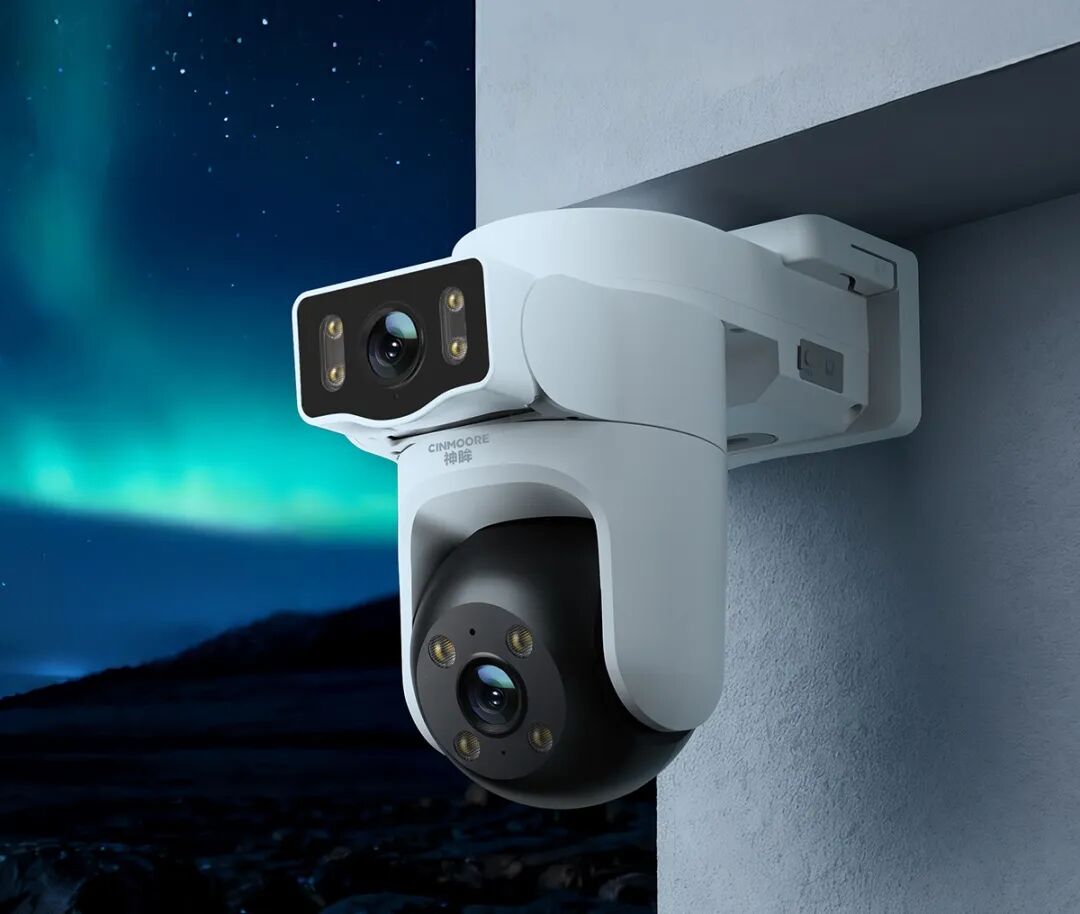
CINMOORE PT - 4 camera (Source/Enterprise)
Yang Zuoxing has started another significant growth in the new track. In 2023, CINMOORE officially started selling on e - commerce platforms and became the number one in the domestic battery - powered camera category in one year. According to data from Lotu Technology, in the first half of 2025, CINMOORE ranked first in both the emerging e - commerce low - power camera and 4G camera categories, with a cumulative sales volume approaching 10 million units.
Currently, the annual global shipment of security cameras is about 300 to 400 million units, of which 90% are wired products. Yang Zuoxing believes that if the proportion of wireless cameras increases to 90%, the market size will grow from the current hundreds of billions to trillions, and the annual shipment is expected to reach 10 billion units in 2035.
But this is also an established industry, with giants like Hikvision and Dahua dominating for many years. CINMOORE has been losing hundreds of millions of yuan every year, and some shareholders still oppose it until now. However, Yang Zuoxing has never wavered. "A disruptive decision of a company often comes from the founder seeing something that ordinary people don't."
From a chip scientist to a brand founder, how did Yang Zuoxing adhere to a technical route that was once rejected by hundreds of investors? How does he understand the future pattern of AI chips? In a highly competitive market full of giants, how can CINMOORE achieve nearly ten - fold annual growth?
In this exclusive interview, Yang Zuoxing systematically explained his technical philosophy, product logic, and industry predictions, and also provided a real footnote for understanding the challenges and resilience of the current Chinese hard - tech entrepreneurship. The following is the main content of the interview:

Reduce power consumption and eliminate power cords
Yingke: CINMOORE claims to have core advantages in multiple fields such as integrated circuits, blockchain, and artificial intelligence. In your opinion, what is the most fundamental technical differentiating advantage of CINMOORE compared with its peers?
Yang Zuoxing: Our most core technology is the "fully customized chip design methodology", which is unique in the industry. This methodology was first developed when we were refining Bitcoin mining machine chips in 2014. By designing every module and unit of the chip according to specific requirements, we achieved an extremely high energy - efficiency ratio.
In 2021, we successfully transferred this methodology to the design of more complex SOC chips for vision and AIoT and developed a corresponding low - power chip series. This is not only an innovation in underlying physical implementation technology but also a full - chain customization concept from IP, chips, products to application scenarios, thus establishing a huge barrier in terms of power consumption and cost.
Yingke: How is this low - power advantage specifically reflected in the products? And what does it mean for AI applications?
Yang Zuoxing: For AI, whether it is visual recognition or large - model inference, the computational volume is very large. For end - side devices such as mobile phones and cameras, power consumption is a matter of life and death. For example, a mobile phone can only accept a continuous high - load power consumption of about 0.6 watts or less, otherwise, the battery life will collapse.
General - purpose chips in the industry can provide a few teraflops of computing power per watt, while our fully customized design can achieve 40 to 50 teraflops of computing power per watt. This means that when other products cannot keep AI functions continuously online due to heating and power consumption issues, our products can. Our goal is to make real - time inference of large models on the end - side possible without burdening the battery. Low power consumption is a prerequisite for AI to truly penetrate into a vast number of end - side devices.
Yingke: The whole chain is self - developed. Does that mean you also produce the chips yourself?
Yang Zuoxing: The production is outsourced to Samsung. We do the most core design and verification ourselves.
Yingke: CINMOORE placed an order for Samsung's 2 - nanometer technology before. Is there any latest progress?
Yang Zuoxing: The global semiconductor industry has gone through three stages, from planar transistors to FinFETs and now to GAA. We have always been a top - level partner of Samsung in its most advanced processes. Samsung can customize processes according to our needs, and we have the largest shipments in advanced processes.
Yingke: CINMOORE aims to make cameras "get rid of wires". What market judgment lies behind this vision?
Yang Zuoxing: When I founded the CINMOORE product line, I expected to invest a total of 5 billion yuan, and as of now, I've spent 2.2 billion yuan (since 2021). Why did I invest so much? Because I believe we can disrupt this industry.
Mobile phones, laptops, and smart cars have all gone wireless. Why do most cameras, as the most basic sensing devices, still have wires? The core reason is power consumption. A traditional camera consumes several to more than ten watts of power, and a battery can't support it for long. Apart from power consumption, the installation cost is the biggest obstacle. For outdoor installation, the comprehensive cost of pole - setting, wiring, and approval can easily exceed 10,000 yuan, and the installation period is measured in weeks. For home installation, it also requires drilling holes and pulling wires, which is both troublesome and affects the aesthetics.
So the mission of CINMOORE is to use technology to reduce power consumption and completely eliminate power cords. When the power consumption of a camera is reduced to one - hundredth or even lower of the original level and the battery life reaches several months or even years, installation will become as simple as sticking a hook - just use magnets, glue, or tie it to a tree.
This will fundamentally change the industry's economic model and user experience, and spawn a market several orders of magnitude larger than the current one. The goal of our next - generation chips is to make indoor cameras only need to be charged once every six months. Combined with low - light solar technology, we will ultimately achieve permanent battery - free operation.
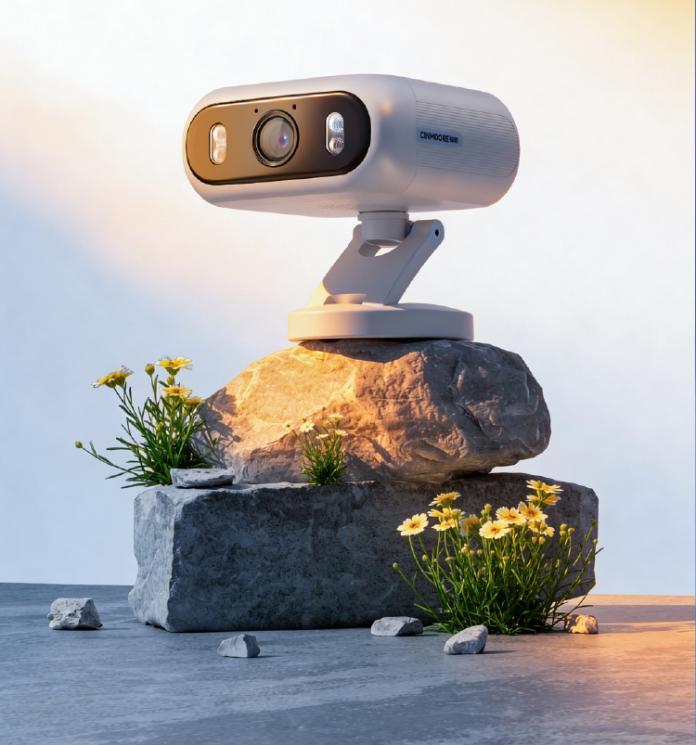
CINMOORE's first solar - integrated camera BC7 (Source/Enterprise)

Doing a vertical chain doesn't mean being closed
Yingke: What is CINMOORE's business model? Apart from hardware sales, what other sources of income are there?
Yang Zuoxing: Our business model is a hybrid one. First is hardware sales, which is the foundation. Second is service income, mainly including cloud storage and future value - added AI services. Regarding cloud storage, our strategy is quite flexible. If users only store some short - segment or event recordings, we may offer it for free; if they need 7 - day or longer cyclic recordings, we will charge a certain fee.
Yingke: CINMOORE's products have a wide range of application scenarios, including security, care, pets, cars, and on - duty monitoring. Are there any key focuses among these segments?
Yang Zuoxing: Our expansion logic is based on two points: first, whether it is important to users; second, whether we have core competitiveness.
We started with home Wi - Fi cameras and outdoor 4G monitors and then expanded to wearable cameras (such as action cameras).
Yingke: There are giants like Hikvision and DJI in the industry. How do you view the competition?
Yang Zuoxing: These giants are very excellent. Their core advantages lie in their outstanding product definition ability and brand influence. Our competition with them is not a head - on confrontation but a differentiated innovation.
For example, in the action camera field, we focus on "unnoticed recording" and "real - time live streaming". Traditional action cameras require you to actively capture wonderful moments, while our products can be worn on the chest or head to automatically record your entire life or sports process for a long time, such as a complete 6 - hour marathon. At the same time, we control the bit rate within the range for smooth live streaming, making sharing more real - time. More importantly, we have brought the price below 1,000 yuan, aiming to make it affordable for more ordinary students and young people.
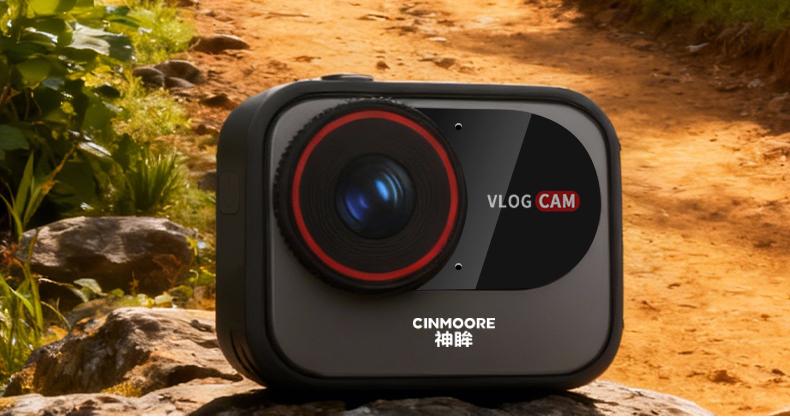
CINMOORE's first Vlog camera (Source/Enterprise)
Yingke: I heard that CINMOORE will open the core of its AI chips to peers to build an open ecosystem. How do you think about this? Aren't you worried about competition?
Yang Zuoxing: On the one hand, our company does vertical integration, from the underlying cell library, IP, chips, products to the cloud. But doing a vertical chain doesn't mean being closed. I've made good chips, and I can also open them to partners.
Why open them? The underlying logic of the business world is competition. Without competition, no one will strive hard. If I only use my chips for our own products, our product team will become slack because they have the best things. Similarly, if the chip team only has one internal user, it won't be able to obtain more requirements, and its motivation to move forward will also be insufficient.
Yingke: CINMOORE's products in the overseas market are different from those in the domestic market. How do you plan your overseas strategy?
Yang Zuoxing: Our strategy is to first focus on the domestic market and then expand overseas. Because China is the world's largest camera market. First achieving a certain scale in the domestic market can greatly optimize the supply - chain cost. At the same time, we can polish the stability and reliability of our products in China's complex and diverse environment. The overseas market, especially in Europe and the United States, has very high requirements for product quality and compliance. If the products are not mature enough to enter these markets, it's easy to fail.
In terms of product strategy, we adopt a "one - country - one - strategy" approach. For example, the US market still mainly uses Wi - Fi