Will GDP growth depend on the number of Tokens? Microsoft CEO Nadella's dialogue at the Davos Forum was full of information...
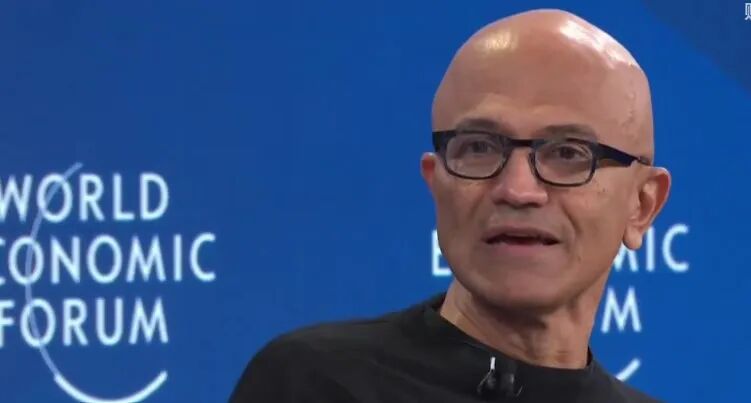
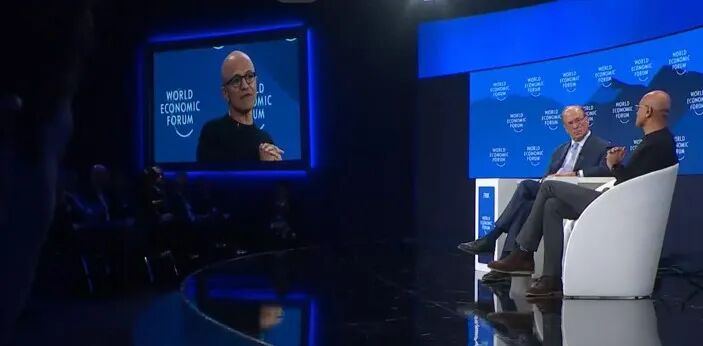
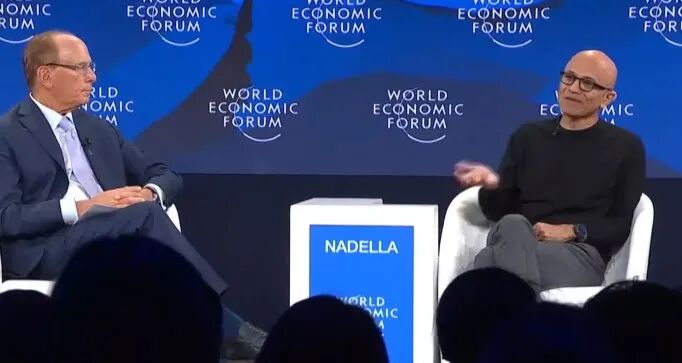
At the 2026 World Economic Forum, Microsoft CEO Satya Nadella had a conversation with BlackRock CEO Larry Fink.
The topic of this conversation was very ambitious. When AI transforms from an "experimental technology" into the "infrastructure" of society, how should we measure it, manage it, and redefine the rules of competition within it?
Nadella first set the tone for the current AI wave, calling it a historic "Platform Shift".
In his view, AI did not emerge out of thin air. In fact, it is a natural continuation of the development of computing technology over the past 70 years. From mainframes, PCs to the mobile cloud, the core of computer development has always been to "digitize the world".
But this time is fundamentally different. Nadella pointed out that the greatest breakthrough brought by AI lies in the "extensibility" and "self - transformation" capabilities of software.
In the past, programmers wrote code. A document was just a document, and a website was just a website. Now, AI endows software with reasoning ability. If you give it a document, it can transform it into a website. If you're not satisfied, it can rewrite the code through reasoning to transform it into an app.
This ability is evolving rapidly. From Copilot, which initially only completed code, to assistants capable of dialogue and interaction, and now to Agents that can take over an entire project 24/7, AI is becoming the "Infinite Minds" beside every knowledge worker.
Nadella borrowed Steve Jobs' metaphor of the "bicycle of the mind" and believes that today's AI is a hundred - fold amplifier of cognitive ability.
Facing the outside world's concerns about the "AI bubble", Nadella's judgment is: "If AI is just a carnival for tech companies, then it is a bubble. If it can spread to all industries like electricity and create real 'Surplus', then it is a transformation."
He emphasized that "Diffusion" is the key to everything. If we consume precious energy but cannot improve healthcare, education, or increase the efficiency of the public sector, then the tech industry will lose the "social license" to use energy.
For this reason, Nadella proposed a new macroeconomic indicator: "Tokens per Dollar per Watt".
He believes that future GDP growth will directly depend on this indicator. Here, Tokens are no longer just simple code units but a new type of commodity.
Whether a country or enterprise can produce more intelligent tokens with lower energy costs and more efficient infrastructure will determine its competitiveness in the global economic landscape.
Therefore, building an infrastructure that deeply integrates the "energy network" and the "computing network", transmitting tokens just like transmitting bits, is an urgent task for all countries.
In this conversation, Nadella redefined "Sovereignty" in the digital age.
For a long time, the focus of discussions in Europe and even globally has been on "data sovereignty", that is, where data is stored and who has jurisdiction over it. But Nadella said bluntly that the physical location of data centers (limited by the speed of light) and encryption technology are just technical issues, not the strategic core.
True "corporate sovereignty" lies in the control of model weights.
Nadella criticized the current proliferation of AI shell companies. He said that if a company simply calls external AI models and cannot distill its own unique, tacit knowledge into a controllable model, then this company is actually leaking its core value to external model providers.
In the AI era, corporate sovereignty means retaining the ability to control one's own destiny. Your unique knowledge must be transformed into your model parameters. The corporate moat also has a new definition: from owning data to owning a "business - savvy model".
The introduction of AI has not only changed the rules of competition but is also reshaping the organizational form of enterprises. Nadella took Microsoft itself as an example to describe the drastic changes in the workflow.
In the past, when he attended the Davos Conference, his team had to prepare briefings layer by layer, and information was reported upwards in a hierarchical system. Now, he directly asks Copilot to generate a conference briefing with a 360 - degree perspective and immediately shares it with all cross - functional colleagues.
Facing this change, Nadella proposed the "iron triangle" formula for enterprise transformation:
Mindset: Leaders must actively think about how to reshape the workflow with AI, rather than using old methods for new things.
Skillset: Employees must learn to use, trust, and manage AI, which requires an upgrade of the entire workforce's skills.
Dataset: Enterprises must conduct "Context Engineering" to ensure that the data fed to AI contains the enterprise's unique background knowledge.
He observed an interesting "barbell effect": small companies starting from scratch can be built 100% based on AI and are extremely efficient. Large companies with deep data accumulation can also explode with huge scale effects if they transform properly.
On the contrary, medium - sized or large enterprises that are slow to act will be defeated by small companies using new tools if they do not follow up quickly.
Looking ahead to the next 5 to 10 years, Nadella believes that the world will not be dominated by a single super - model but will be a "multi - model world".
The core competitiveness of enterprises will no longer be just owning models but the ability of Orchestration. Enterprises need to learn to integrate closed - source models, open - source models, and self - built models, combine their own private data, and change business results through AI orchestration.
Full - text translation:
Larry:
I want to talk about artificial intelligence (AI). I'm really eager to talk about this topic because it's more captivating than almost any other topic today. It concerns the intersection of business, technology, and society. Satya, we're turning AI from something experimental and always talked about in the future into a present reality. It's becoming even more fundamental, not only for companies but also for countries and society as a whole. I think you have an advantage over many others because you're at the forefront of this technological revolution.
So, I have a few questions related to this. You once described AI as a "platform shift". What does that mean? That's the first question. Secondly, where do you think this shift will go in the next few years? Most importantly, the third question, fast - forward a few years, say five years from now, what things that seem unclear today will become obvious?
Nadella:
First of all, Larry, it's great to be back here. I was fortunate enough to read the letter you released for the forum yesterday. In the letter, you mentioned that the real question we all face regarding AI is how to ensure its diffusion can happen quickly. You wrote about how models, data, and infrastructure can be more evenly distributed so that surplus can be created anywhere.
The way I understand this question is that it's actually been the trajectory of computing technology development. Whether it's the past 30 years or 70 years, the core has always been: Can you digitize information about people, places, and things, and then build analytical and predictive capabilities?
Mainframes did this, as did minicomputers, the client - server era, the Web era, and the mobile cloud era. No matter which paradigm or platform, it's a continuous arc, that is, to better understand the world in digital form. Because once you digitize these things, you can use more malleable resources like software - which isn't restricted by marginal - cost economics - to build more insights and capabilities.
In this context, I think AI is at least on the same level as the Web, the Internet, mobile devices, PCs, or the cloud, and may even be more important. Take what's happening in the knowledge - work field of software engineering as an example of where we are now.
My belief in this generation of AI and its capabilities was established when I first saw GitHub Copilot complete code. For a long time, we've always dreamed that software developers could predict the next word or the next line of code, and these models suddenly made it happen.
Then we thought, if that can be done, can we improve the coding process by allowing developers to ask any question and get an answer through a chat session? That was the next step. Then we thought, if that works too, can we assign small tasks to it? That's the Agent mode.
Now, we have fully autonomous agents, and you can hand over an entire project to them, and they can work 24/7. Of course, there's still a long way to go for these systems to maintain coherence over a long period, but they're getting better.
Interestingly, you'll find that software developers still have a great deal of agency in this process. That's why I think it may not be the right way to think of these AI systems as existing independently of human agency.
For example, if in the early 1980s, someone told us that 4 billion people would wake up every morning and start typing, we might have asked, "Why? We have typists, and that's enough." But that's exactly what happened. We invented an entire category called "knowledge work", and people started to really use computers to amplify what we wanted to achieve with software. I think the same thing will happen in the context of AI.
Those core coding jobs won't stay the same forever. The level of abstraction will change. But we'll also regard code as an output just like a document. In fact, since I joined Microsoft in 1992, Bill Gates always asked: What's the real difference between a document, a website, and an application? The answer was the lack of software that could self - transform.
Interestingly, AI finally gives us this ability. I can write a document and then say, "No, I don't want a document. I want a website." AI will convert the document into a website with code. Then I say, "Oh, I don't like this website. I want an app." It will write more code to convert it. This reasoning ability, predictive ability, and the ability to take action and maintain coherence over time are all constantly improving.
Our job is to put this ability into practice. Just as you at BlackRock are doing, combining Copilot with your Aladdin platform and using your data to improve the productivity of the company's decision - making.
Larry:
I can say that in our company, things that used to take 12 hours to calculate now only take a few minutes. We manage $14 trillion in other people's assets and have thousands of different investment instructions. We can now complete these tasks instantly. Without today's technology and AI, we simply couldn't operate at our current scale.
Nadella:
Exactly. So for me, if we can turn the productivity curve around, company by company, country by country, using these tokens, then there will be a surplus anywhere, and that's the real goal.
Larry:
The word "surplus" can also be worrying. Does surplus mean fewer workers? What exactly do we mean by surplus? I link this question to my second question, which is about the diffusion of AI.
For me, the key for any society to realize the value of AI and build a more balanced world is to ensure that AI can be diffused, popularized, and applied globally. Can you describe how this diffusion process will unfold among different economies, companies, populations, and countries?
Nadella:
I think this is the real question. Because the spirit of the current era is more about admiring AI as an abstract technology itself. But as a global community, we must reach a point where we use it to do something useful and change the output of people, communities, countries, and industries. Otherwise, it doesn't make much sense.
In fact, if we can't use these "tokens" to improve health and educational outcomes, increase the efficiency of the public sector and the competitiveness of the private sector in all industries (regardless of size), then we'll quickly lose the "social license" to use the scarce resource of energy to generate them.
So, I think diffusion is everything.
How does this process happen? Let's analyze it from both the supply and demand sides.
On the supply side, what each country needs to achieve is that the "tokens per dollar per watt" must continuously become more efficient and better. Our investments globally are, to some extent, to ensure the existence of supply - from chips all the way to the "token factories" deployed everywhere.
By the way, there won't be just one token factory. It will be the first thing to spread globally, just like electricity. You need an omnipresent energy and token grid to power the rest of the economy.
On the demand side, every company must start using it. Recall when the PC first emerged. Steve Jobs had a great metaphor, calling it the "bicycle of the mind". Bill Gates' metaphor was "information at your fingertips". These two metaphors are great. They made us understand that this is a tool I use to access information and amplify my cognitive abilities.
Now, the tool we have is 10 times, 100 times that. Every knowledge worker now has an "infinite mind". Turing Award winner Raj Reddy had a great metaphor. He said AI is either a "cognitive amplifier" or a "guardian angel".
If you look at AI in this way, then in the global workforce, when a doctor can spend more time with patients because AI is doing transcription, entering electronic medical records, and filling in the correct billing codes, thus better serving payers, providers, and ultimately patients, this is a result that all of us can benefit from.
Ultimately, this requires real leadership from the private and public sectors to ensure diffusion happens. Another thing I want to mention is skills training. The degree of diffusion is strongly related to how widespread people's skills in using this technology are.
Interestingly, the mobile Internet taught us something different from the PC era. I remember growing up in the Global South, there was a direct relationship between learning Excel or Word skills and getting a job. But although the mobile Internet created the same opportunities, it was more consumption - oriented, like the creator economy. It didn't really bring a path of "this is how you get a medical job" or "how to get a financial job".
This situation needs to change. People need to be able to say, "I've mastered this AI skill, and now I can better provide a certain product or service in the real economy."
Larry:
It's easy for us to see how mobile technology and its diffusion have changed the economy, especially in the Global South. But recently I read a research report saying that so far, the application of AI has been severely biased towards well - educated people or developed economies.
Will this cause greater differentiation and polarization? How can we ensure that the diffusion is even? How can we ensure that we don't leave the main parts of society or the world behind? I think this will be a major problem we face in the future.
Nadella:
This is an interesting question. This time, thanks to the infrastructure already established by the mobile network and connectivity, we have the ability to transmit AI "tokens" more evenly around the world than in the PC era or the early days of the mobile era. It took a long time for smartphones to become popular globally, but now the situation is different. These models and their outputs can be obtained almost anywhere.
So for me, the question is which use - cases make sense. I always go back to a demonstration in early 2023: A farmer in a rural area of India was able to use a robot built on an early GPT model (even GPT - 2.5) to query about the agricultural subsidy policy he had heard of in his local dialect, and at that very early stage, it could even show some agency behavior, like "help me