Foreign automakers are making epic-scale investments in China.
In November last year, when General Motors and Tesla issued instructions to their supply chains in an attempt to remove Chinese components from their models produced in North America, the theory of "de - Sinicization of the supply chain" was once again pushed to the forefront of public opinion. Additionally, every time a foreign - owned automaker's factory or model fades out of the Chinese market, many people shout that multinational automakers are leaving.
However, if we shift our focus from the perspective of geopolitical pressure to the local layout of more foreign automaker giants in China, we will see a completely opposite picture:
Toyota officially transferred the decision - making power for the development of its models in China from its Japanese headquarters to its local Chinese team; Volkswagen Group built a 2.5 - billion - euro intelligent connected vehicle R & D center, "Wolfsburg in the East," in Hefei; Mercedes - Benz and BMW publicly announced that they will increase their R & D investment in China by more than 100 billion yuan in the next few years.
The so - called "de - Sinicization of the supply chain" is just a forced choice under political pressure. The real action in the market is actually "deep integration into China." Behind this forced move and the active one lies the core essence of the power shift in the global automotive industry: The politically - driven narrative of "de - Sinicization" is being countered by the market - and technology - driven reality of "deep Sinicization."
Fundamentally, it is due to the fundamental changes in the Chinese automotive industry. It is not just a low - cost manufacturing center or the world's largest market. It is also the "innovation origin" of the new round of the global automotive industry - the electrification and intelligentization of the global automotive industry. Only by deeply integrating here can one enter the future; if one is absent here, one may be left behind in the next era of the automotive industry.
Journey in China
In the 1980s, faced with high tariff barriers, the best entry ticket for multinational automakers was to establish joint - venture factories with local state - owned enterprises. Giants such as Volkswagen, General Motors, and Toyota entered into alliances with groups such as SAIC, GAC, and FAW, and jointly dominated the Chinese auto market for decades.
This was a wonderful and long "honeymoon" era - foreign companies achieved unimaginable sales and profits, while Chinese partners acquired the management, technology, and the prototype of the supply chain in modern manufacturing.
However, the positions of both sides on the "smiling curve" were clearly distinguishable: R & D, brand building, and profit - making were centrally controlled by overseas headquarters, while Chinese partners were locked in the mid - to - low - end manufacturing segment.
The so - called "localization" during this period was limited to the domestic replacement of parts and the simple lengthening of wheelbases. The "brain and nerve center" of the automotive industry was always far across the ocean.
In 2018, the "gunshots" of the China - US trade war shattered the old dreams of multinational giants. "Controllable supply chain" suddenly rose from a management issue to a survival issue, and a wave of domestic substitution swept through all joint - venture factories.
But this was only on the surface. Deeper changes were erupting in the industry like a quiet undercurrent: the catfish effect of Tesla, the emergence of new forces such as NIO, XPeng, and Li Auto, and especially the explosive growth of the penetration rate of new - energy vehicles in China completely rewrote the rules of the game.
Since then, the comfort zones of multinational automakers have been broken, and they have entered a period of passive adjustment and strategic confusion.
Changes came quickly.
Almost overnight, the giants were shocked to find that Chinese consumers were no longer willing to pay for the aura of "German craftsmanship" or "Japanese ingenuity." They were chasing lidar, high - computing - power chips, "color TVs, refrigerators, and big sofas," and the monthly - updated OTA experience.
A "dimensionality - reduction strike" that started with electrification and will ultimately be decided by intelligentization has arrived.
Oliver Blume, the chairman of the board of management of Volkswagen Group, sighed in an interview with German media: "We have been resting on our laurels for too long and have been too slow to respond to changes in the world."
After the simple introduction of products proved to be ineffective, the frustrated and anxious multinational giants finally realized that competition in the Chinese market is no longer just about models but about the entire ecosystem and the speed of evolution.
Faced with the continuous decline in performance and market share, Oliver Zipse, the then CEO of BMW, had to admit: "We need to customize electric vehicles for Chinese customers."
In 2023, they launched the so - called "self - revolution" stage 3.0 - Reverse deep localization.
Although they have realized that the first step in self - rescue is the full - scale "domestic substitution" of the supply chain, after actually starting the implementation, the "generational gap" in cognition and ability has made the giants once again feel a sense of "loss of control" in the Chinese market.
As the most competitive market in the world, the iteration speed of new - energy vehicles in China is usually measured in "months" or even "weeks." The time from concept to market launch of a new car can be compressed to 24 months, and the functions of intelligent cockpits are updated almost quarterly. One year of change here is equivalent to a product cycle in the European market.
From CATL's batteries, Horizon Robotics' chips to Huawei's intelligent ecosystem, China has formed the world's most dense, complete, and fastest - responding intelligent electric vehicle industry cluster. This is not only a cost advantage but also a "terrifying" ability to quickly engineer and scale innovation. Any global - aspiring automotive company cannot maintain its competitiveness without this ecosystem.
More importantly, the number of STEM (science, technology, engineering, and mathematics) graduates produced in China each year far exceeds the total in Europe and the United States, providing a large reserve of high - quality talents for the software, AI, and new - energy three - electric fields.
"The Chinese automotive market is transforming at an amazing speed, and we must adapt faster." The view of Ralf Brandstätter, the chairman of Volkswagen Group China, has become the consensus of global automakers.
There is no turning back; only complete rebirth is possible.
Standing in this huge "innovation melting pot" of China, the giants have launched a comprehensive and decisive "systematic transformation": implanting their decision - making brains, innovation hearts, and supply chain skeletons into China's industrial body without reservation.
Full Integration
In the past, the Chinese division was more of an executor of the headquarters' strategy; after 2023, many multinational automakers have unprecedentedly delegated strategic decision - making power to the front - line.
The most prominent sign is the "earthquake" in personnel appointments. Toyota Motor made an unprecedented decision in its more than 20 - year history in China: appointing Chinese - born executive Li Hui as the general manager of Toyota China, making him the first local leader in charge of its core business in China.
Beijing Hyundai also formed a "Chinese - Chinese combination" consisting of Li Fenggang and Li Shuangshuang to serve as the top management in the Chinese division. This is not just a simple personnel rotation but a declaration of strategic identity: Only local minds that are well - versed in the cruel and highly competitive characteristics of the Chinese market and the unique psychology of Chinese users can better adapt to the ever - changing innovation iterations and market changes here.
Mary Barra, the chairman and CEO of General Motors, publicly emphasized: "Our business in China has a high degree of autonomy, and our team can make decisions as quickly as a local company."
The words "as quickly as a local company" reveal the mystery behind this power shift: speed has become a more important assessment indicator than global coordination.
After breaking the traditional "remote control by the headquarters," the Chinese division no longer needs to make long - term reports to the headquarters thousands of miles away for every product detail and every marketing campaign. Instead, it has become an independent central organization capable of independent perception, judgment, and action.
Following the delegation of power is the rooting of innovation. The huge and high - quality dividend of local engineers enables the "Chinese R & D centers" of multinational automakers to directly take on the most core platform development tasks.
Therefore, the mission of the R & D institutions of foreign automakers in China has undergone a fundamental change: From a "technical translation department" that adapts global models to the local market, it has transformed into a "future - defining institute" that conducts original innovation for the Chinese market and even global trends.
Volkswagen Group put its "100% China R & D" plan into practice, investing approximately 7 billion euros in Hefei to establish its first full - process R & D center outside its German headquarters, covering vehicle development, component iteration, and battery innovation. The development cycle of new products has been shortened by approximately 30%.
Oliver Zipse, the CEO of BMW Group, has elevated the concept of "making China our home" to a strategic level. In China, BMW has built four R & D and innovation bases, three software companies, and the only Skylab human - machine interaction research center outside Germany, focusing on the integration of electrification, digitalization, and the local software ecosystem.
"This doesn't just mean production; it also means placing the wisdom of R & D and the decision - making brain here. The pace of innovation in China is forcing us to redefine the global R & D layout."
Compared with German companies, Toyota's R & D localization is more radical. It has created a unique Chinese Chief Engineer system (RCE), giving local engineers unprecedented product - defining power. In the integrated Changshu Intelligent Electric Vehicle R & D Center (IEM by TOYOTA), the proportion of Chinese members exceeds 80%, establishing a full - chain management model from demand collection to market feedback.
The collective "delegation of power" by multinational automakers in R & D sends a signal: innovation localization is not just for cost - saving but an inevitable choice in a race against time. Only by being in China, the world's fastest - iterating "innovation melting pot," can one forge top - notch technologies and products that are in line with the future.
Beyond R & D, the deepest and most strategically significant integration still occurs at the supply - chain level. The dependence of foreign automakers on Chinese manufacturing has evolved from a simple "purchasing cost advantage" to a full - scale binding to its complete industrial ecosystem, technological explosive power, and extreme manufacturing efficiency. This is reflected in two dimensions:
First, vertical integration and technology acquisition through capital ties. In the past year, foreign giants have been actively acquiring or making strategic investments in local technology companies, core component suppliers, and even dealer networks:
Stellantis, the parent company of Maserati and Jeep, acquired a 20% stake in Leapmotor for 1.5 billion euros, aiming to directly obtain Leapmotor's full - domain self - developed technology;
Mercedes - Benz invested in Qianli Technology under Geely through a digital technology company to obtain a high - level intelligent driving solution that meets Chinese road conditions and the brand's luxury positioning;
The relationship between BMW and CATL has been upgraded from one - way procurement to technological cooperation. They are jointly researching and developing 46 - series large - cylindrical batteries and have also reached cooperation with Alibaba to jointly develop an intelligent cockpit system based on Tongyi large - model;
Ford Motor established a 100% - owned sales company to uniformly manage all its channels in China and directly control user contacts...
These measures are not only to get closer to the local market and consumers but also to quickly internalize the most active innovation factors in the Chinese market - whether it is intelligent driving algorithms, cockpit interconnection ecosystems, or battery material technologies - into their own capabilities through capital and deeply integrate them with their century - old systems.
As Oliver Zipse said, "Our industry is inherently global, and all links are interconnected. We should strive to eliminate barriers rather than create them."
Second, foreign giants are committed to building Chinese factories into "global manufacturing benchmarks." Chinese production bases are no longer standardized production - capacity output units based on the headquarters' blueprints. Instead, they are "lighthouse factories" that integrate supply - chain efficiency, intelligent production technology, and agile management philosophy and provide standards for other global factories in reverse.
Currently, the production base built by BMW in Shenyang has increased the inspection efficiency by 5 times through AI - based quality inspection, with a lidar welding pass rate of 99.8%. It has become a benchmark for production efficiency and quality standards within BMW globally;
The Volkswagen Anhui factory was designed from the start as a "future factory" for pure - electric and highly flexible production. According to a report by the British media Financial Times, the cost of some electric vehicle models produced by Volkswagen in China can be compressed to as low as 50% of those produced in Germany.
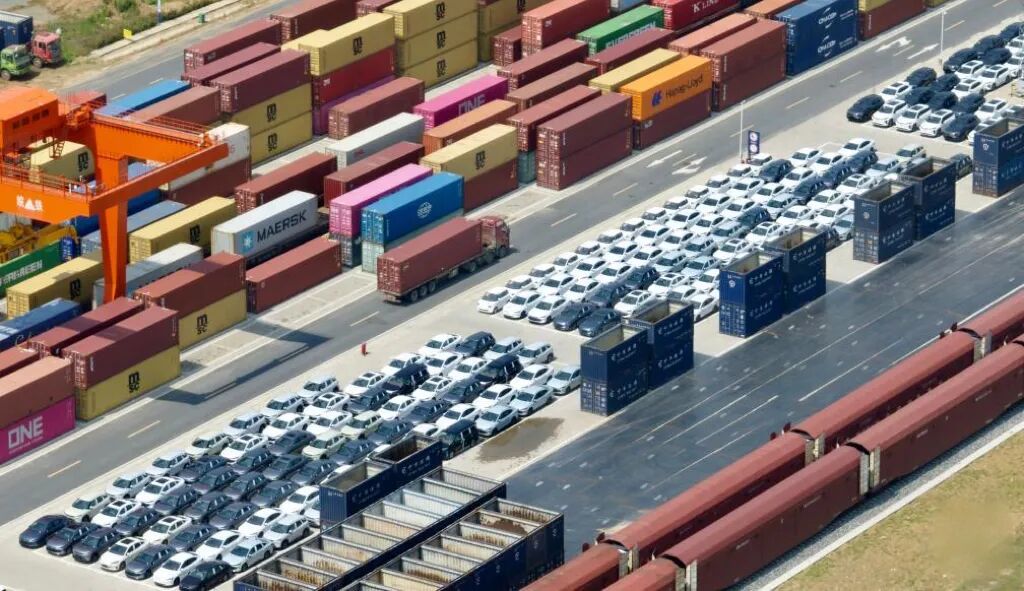
New - energy vehicles waiting to be loaded for export at the Paihe Port Railway Logistics Base in Hefei. Source: Xinhua News Agency
What these factories produce is not only vehicles but also a replicable and exportable "Made in China" system and standards. The "collective revolution" of the giants fully embracing China has also spawned even more disruptive changes upstream of the automotive industry chain - from "in China, for China" to "in China, for the world."
Feeding Back to the World
The strategic orientation of multinational companies upstream of the automotive industry chain is shifting from "relying on China" to "originating from China," and they are trying to leverage their Chinese divisions to drive global business.
The most disruptive sign is the export of production lines. The factory of Schaeffler, a global top - tier automotive parts giant, in Taicang, Jiangsu, not only produces parts but also exports "intelligent production lines." At the end of September last year, the three - in - one electric drive assembly line independently developed and manufactured by Schaeffler's Chinese team was exported in reverse to the production base of a leading European automaker in Hungary.
This means that the intelligent equipment and machine tools that determine production efficiency, process precision, and manufacturing flexibility are now marked with "R & D in China." In the automotive hardware field, China is reversing from a "manufacturing hinterland" to an "innovation origin" and a "solution output end."
And Valeo, the world's second - largest automotive parts supplier, had similar practices earlier.
Gu Jianmin, the chief technology officer of Valeo China, previously mentioned in an interview that the ultra - thin dual - function lighting module led by the Chinese team at the Wuhan Lighting R & D Center has broken through from a height of 30 millimeters to 15 - millimeter mass production and 5 - millimeter technology reserve, and is applied to global high - end models including European luxury brands such as Audi, Mercedes - Benz, and BMW.
"R & D in China, first launch in China, and then promote to the European and American markets. This 'reverse output' model is reshaping Valeo's global technology layout."
The wave of technological "feedback" has also extended to the software field. Bosch, a giant regarded as the technological cornerstone of the German automotive industry, has seen a strategic shift in the role of its Chinese company.
In the past, the main task of Bosch's Chinese software team was to adapt global platform products to the local market; now, the full - stack intelligent driving and intelligent cockpit solutions developed by Bosch China are no longer just "China - specific" but are integrated into the next - generation global vehicle architectures of multinational automakers such as Volkswagen and BMW.
"Bosch is transforming from 'rooted in the local market and serving the local market' to 'based in China and serving the world.'" At the Shanghai International Automobile Industry Exhibition in 2025, Xu Daquan, the president of Bosch China, clearly stated that many of the company's innovative technologies are developed or first applied in the Chinese market and then fed back to overseas markets.
Taking the intelligent mobility field as an example, Bosch's first projects of longitudinal and lateral assisted driving, high - performance cockpit domain controllers with cabin - driving integration capabilities, and by - wire braking were all developed in China. Through the training and iteration of hundreds of billions of kilometers of data in complex Chinese traffic scenarios, as of the end of April last year, Bosch's intelligent driving and control system has helped more than 200 models go global, and its upgraded longitudinal and lateral assisted driving system will be officially mass - produced in the first quarter of this year.
That is to say, in the future, Chinese R & D teams will participate in formulating a part of the "rules of the game" for global automotive intelligentization.
At the Shanghai International Automobile Industry Exhibition in 2025, Olivier Rabiller, the global president and CEO of Garrett, a global leading automotive turbo