The latest report from top Silicon Valley venture capital firm a16z: SaaS is dead. The moats of AI applications come from three aspects.
On January 20th, a16z, a top venture capital firm in Silicon Valley, released an in - depth analysis report on AI applications. The report focuses on the question: Where are the real moats for AI applications?
a16z summarized three key points:
1. Software Replaces Labor
Over the past two decades, the golden rule in the SaaS industry has been to streamline and toolify work processes originally done by humans, and then charge enterprises per user. However, in the view of a16z, this logic is no longer valid. AI applications are entering a new stage: Software is eating labor.
This is a much larger business than the traditional software market. Taking Salient, an a16z - invested company, as an example, the traditional SaaS approach is to sell better management software to debt collection companies to help them save money. But Salient's approach is to directly replace debt collectors with AI. Traditional debt collectors not only have high costs and high turnover rates but also often make mistakes due to emotional and legal knowledge limitations. In contrast, AI debt collectors can be familiar with the complex legal provisions of all 50 states in the US, be proficient in 21 languages, and always maintain stable emotions. As a result, Salient not only reduces costs but, more importantly, helps clients recover 50% more debt.
"Everyone wants to save money, but everyone wants to make more money even more." When software is no longer just a tool but directly delivers results, customers are willing to pay not just a few dollars per user per month in subscription fees but a share based on the results.
2. AI Native Transformation of Traditional Software
Although startup companies are making aggressive attacks, a16z does not think that industry giants will fall easily. The best companies have "hostages" rather than just customers.
Industry giants like NetSuite and Workday have their record - keeping systems deeply embedded in enterprises, making them extremely difficult to replace. For these dominant players in the existing market, AI has become a tool to strengthen their positions. Workday can easily launch an AI background check function and charge each employee $500 for it. Although customers complain, they have no other choice. Therefore, a16z advises entrepreneurs to avoid competing with these giants and look for entirely new incremental markets.
3. Build Walled Gardens with Proprietary Data
As giants like OpenAI and Google continuously enhance the capabilities of large - scale models, the scarcity of the models themselves is decreasing. In today's increasingly commoditized model market, proprietary data has become the only walled garden.
Open Evidence is a typical example. Although ChatGPT can also answer medical questions, Open Evidence has exclusive authorization for core medical literature such as The New England Journal of Medicine. The answers based on this closed - data system cannot be obtained by general large - scale models through public web crawlers. When AI acquires the ability to understand and reason, dormant data turns into gold mines.
a16z believes that the underlying logic of human nature is very simple: Everyone wants two things: to become richer and to become lazier. For enterprises, adopting AI is not only to reduce costs (be lazier) but also to directly generate revenue (become richer). According to Ramp's data, there was a significant jump in enterprises' AI spending in January 2025. This is real productivity improvement.
Different from the mobile Internet era, which simply put computers in people's pockets, the transformation in the AI era is built on the PC, Internet, cloud, and mobile technologies of the past five decades. It targets the 8 billion connected users globally, and its spread speed is unprecedented. Although the outside world's concerns about the AI bubble have never stopped, in a16z's investment portfolio, companies that can build walls with data and directly deliver results in their business are setting the fastest records from 0 to $100 million in revenue, proving the authenticity of this era. For entrepreneurs, it's not the time to worry about giants but the best time to find those undigitized corners and turn labor - intensive work into money - making machines with AI.
Key Takeaways from the a16z Report:
1. Software as Labor is the Largest Increment
The logic of the SaaS industry is undergoing a fundamental transformation, evolving from selling tools to directly delivering work results. In the past, enterprises purchased software (such as Office) per user to assist employees. In the AI era, software will directly replace labor to complete tasks.
2. Proprietary Data is the Only Walled Garden
As the capabilities of large - scale models become more widespread and commoditized, the scarcity of the models themselves decreases, and proprietary data becomes the real moat. Entrepreneurs should use private data to build advantages that general models cannot replicate.
3. Business Model Transformation: From Selling Raw Materials to Selling Finished Products
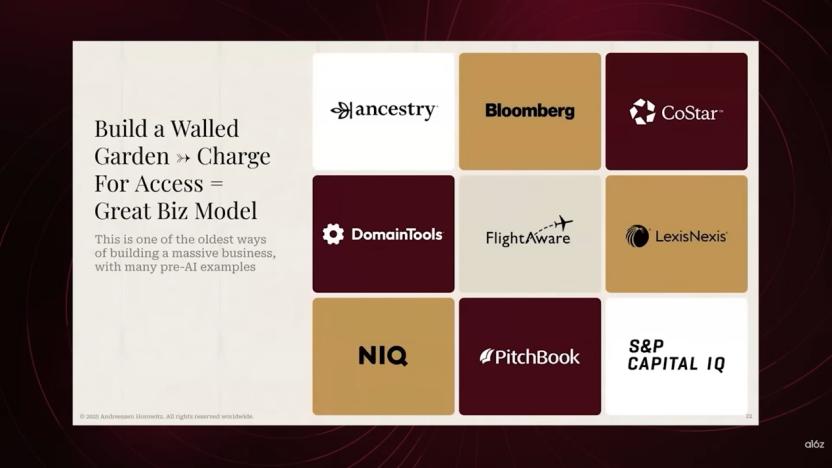
In the AI era, the simple data subscription model (selling raw materials) has limited value. The real value lies in generating finished products using exclusive data. In the past, companies like PitchBook sold data for others to analyze. Now, AI should directly generate complete analysis reports or memos based on the data. This transformation from selling vegetables to selling feasts can increase the product value by 10 times or even 100 times.
4. Giants' Defense: Having Hostages Instead of Customers
Existing software giants (such as Salesforce and Workday) will not be easily overthrown because they have record - keeping systems and customer relationships that are extremely difficult to replace. These customers are more like locked - in "hostages." Giants can use their existing monopoly positions to easily launch AI functions and charge fees compulsorily. Although customers complain, they have no other choice.
5. Vertical Integration Services: The Barbarians at the Gate in the AI Era
Instead of developing a software tool that is difficult to sell to accountants, it's better to directly acquire an accounting firm as a test field. Use AI to significantly improve efficiency and serve thousands of new customers at a lower cost, becoming an AI - driven super accounting firm. This model solves the most difficult problems in traditional software sales: customer acquisition and delivery.
6. AI Reconstructs the Labor Value Equation: Enhancement Rather Than Simple Replacement
Currently, most AI - driven changes are about enhancing labor or solving talent shortages rather than causing large - scale unemployment. The core of business decision - making is the trade - off between cost and value: when AI can work around the clock at a very low cost and with stable emotions, it is actually doing the work that humans are reluctant to do or not good at. In the future, the form of work will not be humans being eliminated but humans shifting to higher - value areas as AI takes over inefficient labor, just as farmers in the past shifted to other occupations.
7. Opportunities in Consumer AI Lie in Aggregation and New Categories
In the consumer application field, besides creating entirely new native categories (such as the voice market where 11Labs operates), "model aggregators" are often more valuable than single models. Just like Kayak in the airline industry, users need a unified interface to access the best capabilities of all models instead of being locked into a single large - company's model. Since large companies are usually limited to their own models, it leaves a huge living space for third - party aggregation platforms.

Original Text of the a16z Report:
1. Macro Perspective: Product Cycles Drive Market Growth
Looking back at the NASDAQ index from 1977 to the present, although the market fluctuates in the short term, the long - term trend has always been upward. The core driving force for this growth lies in product cycles. In the past few decades, we have experienced four major product cycles:
Personal Computer (PC) Era: This was the starting stage.
Internet Era: Connections were established on the basis of PCs, giving rise to infrastructure companies like Cisco and application - layer giants like eBay and Amazon.
Cloud Computing Era: The rise of infrastructure like AWS supported the explosion of application - layer companies such as Workday, Shopify, and Veeva.
Mobile Internet Era: Computers were put into everyone's pockets.
Now, we are in the fifth cycle - the AI Era. This is not a completely new thing that emerged out of nowhere but is built on the popularity of smartphones and cloud - computing infrastructure. If we go back a few decades, with only the ENIAC computer and no cloud computing or mobile devices, AI would only be a display in a museum. Today, most of the world's 8 billion people have smartphones, and the adoption speed of new technologies is unprecedented. We have observed that most of the new revenue in the software field currently comes from AI, whether it is the infrastructure layer or the application layer.
I have a general observation of human behavior: Everyone wants to become richer and lazier. That is, people hope to obtain more economic value with less work. Generative AI is the key to unlocking this demand.
Two years ago, when ChatGPT was first released, people thought it was a novel toy that could write scripts. But now, it has penetrated into enterprises, truly saving people time and money. Taking Ramp, a corporate expense management company, as an example, we can see that forward - looking companies (not just startups but also traditional enterprises with thousands of employees) are actively adopting AI technology. This is not just a steady growth curve but a significant inflection point.
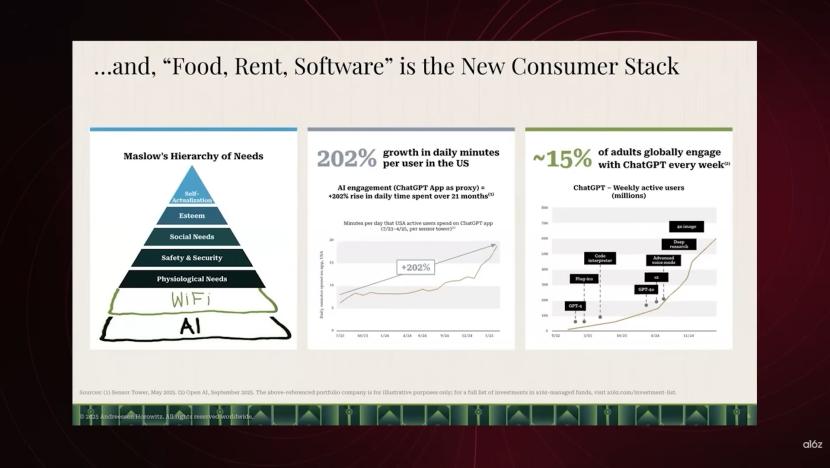
The bottom layer of Maslow's hierarchy of needs was once jokingly called Wi - Fi, and now the next bottom - layer need is actually AI. About 15% of adults in the United States use ChatGPT every week, and it has become a daily tool - from solving daily trivia (such as my wife using it to query legal provisions for a school - bus complaint) to handling complex business logic.
2. Three Major AI Investment Themes of a16z
We have been thinking about: What is defensive? What are the things that giants like OpenAI won't do? Based on this, we have summarized three main investment themes:
AI Native Transformation of Traditional Software:
This refers to the self - innovation of existing software categories using AI. Looking back at history, if you could have invested in cloud - native companies (such as Salesforce and NetSuite) 15 - 20 years ago, you would have reaped huge rewards because the on - premise software giants at that time could not adapt to the subscription model.
But this time, things are different. Existing software giants like Adobe, Salesforce, and Workday are not sitting idle. They are integrating AI into their existing products and charging for these new functions. For example, Workday may use its monopoly position (having "hostages" rather than just customers) to provide a built - in background check function at a high price, and customers will find it hard to refuse. These giants are becoming stronger because of AI, so it is very difficult to compete directly in the existing software landscape.
Software Replaces Labor (Service - as - Software):
This is the area that excites us the most and also the biggest market opportunity. It is a greenfield opportunity.
In the past, software companies sold tools; now, software starts to directly sell work results.
Suppose an ophthalmology clinic spends $500 a year subscribing to Microsoft Office but spends $47,000 hiring a front - desk receptionist. If there is now a software that can complete 90% of the front - desk work (available 24/7 and proficient in multiple languages), the clinic will not be willing to pay only $500 but will be willing to pay a small fraction close to the labor cost (for example, $20,000).
This completely changes the market size of software. We are no longer competing for the $500 software budget but are dividing up the multi - trillion - dollar labor market. These companies usually have no historical baggage and create value in entirely new areas.
Walled Gardens and Proprietary Data
This category refers to enterprises that have proprietary data models and can form deep moats. The core is to use private data to build advantages that general AI models cannot replicate.
In the legal field, you may have heard of Harvey, which serves high - end corporate law firms. But we have noticed another unique market - plaintiff lawyers, such as those handling personal injury or labor - law cases.
The business model in this market is very special: contingency fee. Lawyers charge a certain percentage of the winning amount rather than by the hour.
If it is a corporate lawyer, a 50 - fold increase in efficiency by AI may lead to a decrease in billable hours and thus a reduction in income. But in the plaintiff business, a 5 - fold increase in efficiency means that lawyers can handle 5 times as many cases, and their income doubles directly. This perfectly aligns with the core value of AI.
The Eve we invested in is not just a tool; it is taking over the end - to - end workflow. Eve has launched a voice agent that can automatically contact potential customers, collect evidence, sort through thousands of pages of medical records, and draft claim letters. Eve's defensiveness does not lie in its ability to make calls or write summaries (these are differentiators, not defensiveness) but in its becoming the system of record.
As Eve handles more and more cases, it accumulates private data about case results. It can tell lawyers: "Based on past data, this case is only worth $5,000 and is not worth the effort; while that case may be worth $5 million." This judgment based on result data cannot be obtained by OpenAI or other general models because this data is not public.
In AI investment, we not only focus on differentiation (such as being able to converse in 50 languages) but also on defensibility.
If you compete in the existing software landscape, you will face giants with deep - rooted customer relationships, which is very difficult. But if you can:
Open up a greenfield market and use software to replace expensive and inefficient manual labor;
Build a system of record and accumulate private data by controlling the workflow, forming a positive cycle of "data - insights - value";
Then, you can build real barriers. Just like Eve's practice in the legal field, it not only reduces the marginal cost of handling cases but also guides business decisions through data advantages. This stickiness and network effect are the sustainable growth drivers we are looking for.
3. Thoughts on Unemployment and Technological Replacement
Regarding the impact of large - scale unemployment on society, I don't think this situation will happen soon. Looking back to 1789, 98% of Americans were farmers. Obviously, the appearance of tractors replaced some human labor, but it also prompted these people to switch to other jobs. Frankly speaking, most of the technological changes we are currently seeing are not eliminating jobs.
Take the 3.5 million truck drivers as an example. At some point in the future, we will definitely find a better solution than human - driven trucks - that is, to use AI. The core of business decision - making is the trade - off between cost and value: when the output value is lower than the cost, it is unreasonable to hire humans; but if you can hire AI, the situation changes. When the cost drops significantly while the value remains the same, enterprises will widely adopt AI, but this does not mean large - scale human replacement. It is difficult to predict precisely, but looking back 75 years ago, there were no product managers or designers in software companies. For people in the 1800s, many modern jobs made no sense. Therefore, many of the changes we are seeing now are not direct replacements but enhancements.
Rather than saying that software is eating labor, it is