Feng Dagang in Conversation with Misa, Founder of Rokid: Why Might Mobile Phones Become Accessories of Glasses in Five Years?
Over the past year, AI hardware has returned to the center stage of the technology industry.
From mobile phones, computers to automobiles, from earphones, speakers to various wearable devices, when large models are already able to support the interaction of almost all electronic devices, all hardware manufacturers are trying to become the hardware form that carries AI capabilities.
Is it a more powerful mobile phone? A smarter car? Or a brand-new human-centric computing entry point?
Among these explorations, AI glasses are being pushed to the forefront in a more deterministic way. Different from XR glasses that have been repeatedly tried in the past decade but have always been difficult to enter the mass market, AI glasses are generally expected to carry the next-generation human-computer interaction paradigm: always-on, ready to use, no need to take out the mobile phone to complete information acquisition, shooting and recording, path navigation, instant translation, AI Q&A and environment understanding.
The mobile Internet changed the relationship between "people and information", and large models are rewriting the relationship between "people and the world". And glasses are right at the entry point of this relationship - they are located at the center of human vision and attention.
For many years, Rokid has been thinking and betting along this direction.
Rokid has experienced the years when the AR concept was the hottest, and also experienced the long dormant period after the capital and market cooled down; it has witnessed the rise and fall of the "next entry point" narratives in the industry again and again, and has also borne the cost of a company's long-term investment in an uncertain track.
At present, the smart glasses track shows an obvious differentiation trend: some products still mainly follow the design logic of audio glasses, adding limited model capabilities on the basis of basic voice interaction, belonging to the "light AI" route; while Rokid has chosen a seemingly more arduous route, striving to build a full-stack AI glasses that truly has multi-modal interaction capabilities. From the camera and microphone at the input end, to the display and voice feedback at the output end, to the AI application system supporting large model access and ecological expansion, Rokid's product strategy aims to build a more comprehensive AI terminal experience, rather than the superposition of single functions.
In this special session of the Alibaba Cloud Tongyi Intelligent Hardware Exhibition, Feng Dagang, CEO of 36Kr who has been observing technology entrepreneurship for more than ten years, and Misa, Founder & CEO of Rokid who has been deeply engaged in the smart glasses track for ten years, had an in-depth exchange around the topic of "How Far is the iPhone Moment of AI Glasses?".
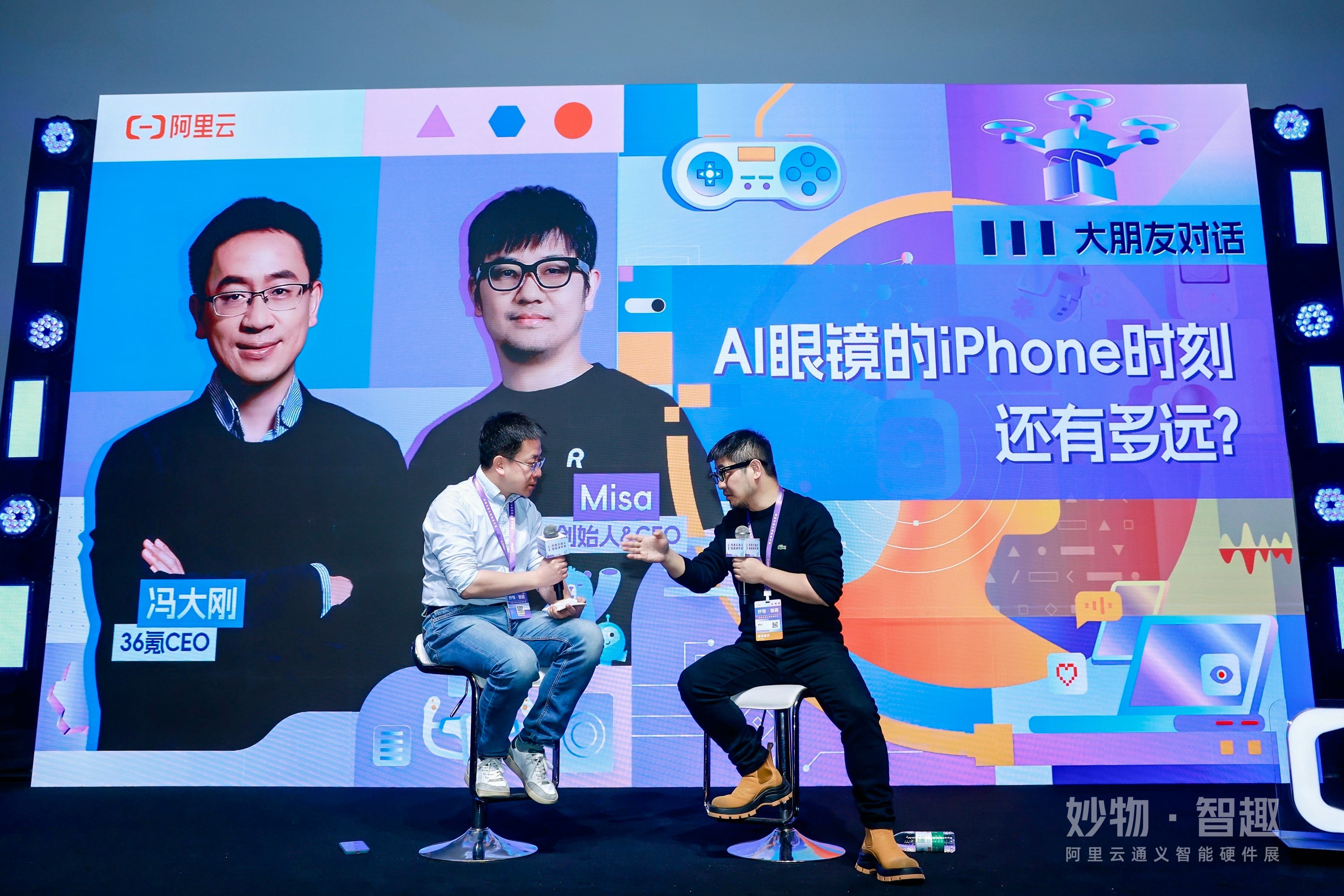
They talked about:
How AI glasses become high-frequency devices: Entertainment products solve the "giant screen" experience, but are usually "nice to have". Rokid pays more attention to high-frequency, long-time wearing and usage, turning glasses into daily devices like watches. That's why they repeatedly emphasize the scenarios of "daily usage duration", "direct message delivery", "walking and cycling navigation", and "one-tap shooting" — these are all paths to turn glasses from toys into habits.
The difference between glasses cameras and mobile phone photography is: The advantage of glasses cameras is not to replace mobile phone imaging, but to capture the moments that mobile phones cannot catch: recording in a more natural, less intrusive, and lower-cost way.
How large models become the infrastructure of products: Large models are the foundation, but whether they can be turned into products depends on the end-side experience and infrastructure: stability, latency, connectivity, interaction, battery life, and engineering reliability. Rokid chooses to access Tongyi Qianwen while remaining open and switchable to other models.
How to ensure that AI glasses can develop its own ecosystem: The Agent Store and third-party capability access (such as vehicle control) they mentioned point to a more platform-oriented attempt: first make the core high-frequency capabilities solid, then let the ecosystem grow on the glasses.
Will the new carrier in the AI era be glasses: Misa's core judgment is very straightforward: the AI era definitely needs a new carrier, and mobile phones will not continue to be the only main device in the next era. There is no consensus yet on whether glasses will be the final form, but it is precisely because the consensus is not settled that startups have a window to place their bets.
The discussion of these questions also explains a question that the outside world is often confused about: why have smart glasses been promoted for so many years, and it seems that they are really going to become popular only today?
The answer may not lie in the glasses themselves, but in the fact that large models have finally filled in the missing puzzle — the "intelligence" in the past was too weak, and glasses could only rely on display and hardware form to tell stories; and when visual understanding, voice interaction, instant Q&A, and environment recognition become available, glasses have a reason to exist independently of mobile phones.
As a result, the industry has entered a new differentiation period: on the one hand, large manufacturers have started to enter the market, using channels, subsidies and ecology to drive sales; on the other hand, long-termist players like Rokid are trying to prove that the success of entry-level hardware does not only depend on marketing investment, but also on products to complete the transition from novelty experience to daily habit.
This also brings the question back to the origin of this conversation:
What exactly does the iPhone moment of AI glasses mean?
Is it the inflection point where sales rise from hundreds of thousands to tens of millions? Is it that the "battery life - display - comfort" impossible triangle is broken through engineering capabilities? Or the emergence of a "killer application" that is high-frequency, rigid-demand, and enough to change daily behaviors?
In an occasion full of slogans and visions like the Intelligent Hardware Exhibition, the dialogue between Feng Dagang and Misa represents long-term observation and judgment on one hand, and ten years of betting and practice on the other. They are trying to find a direction closer to the answer in the noisiest place.
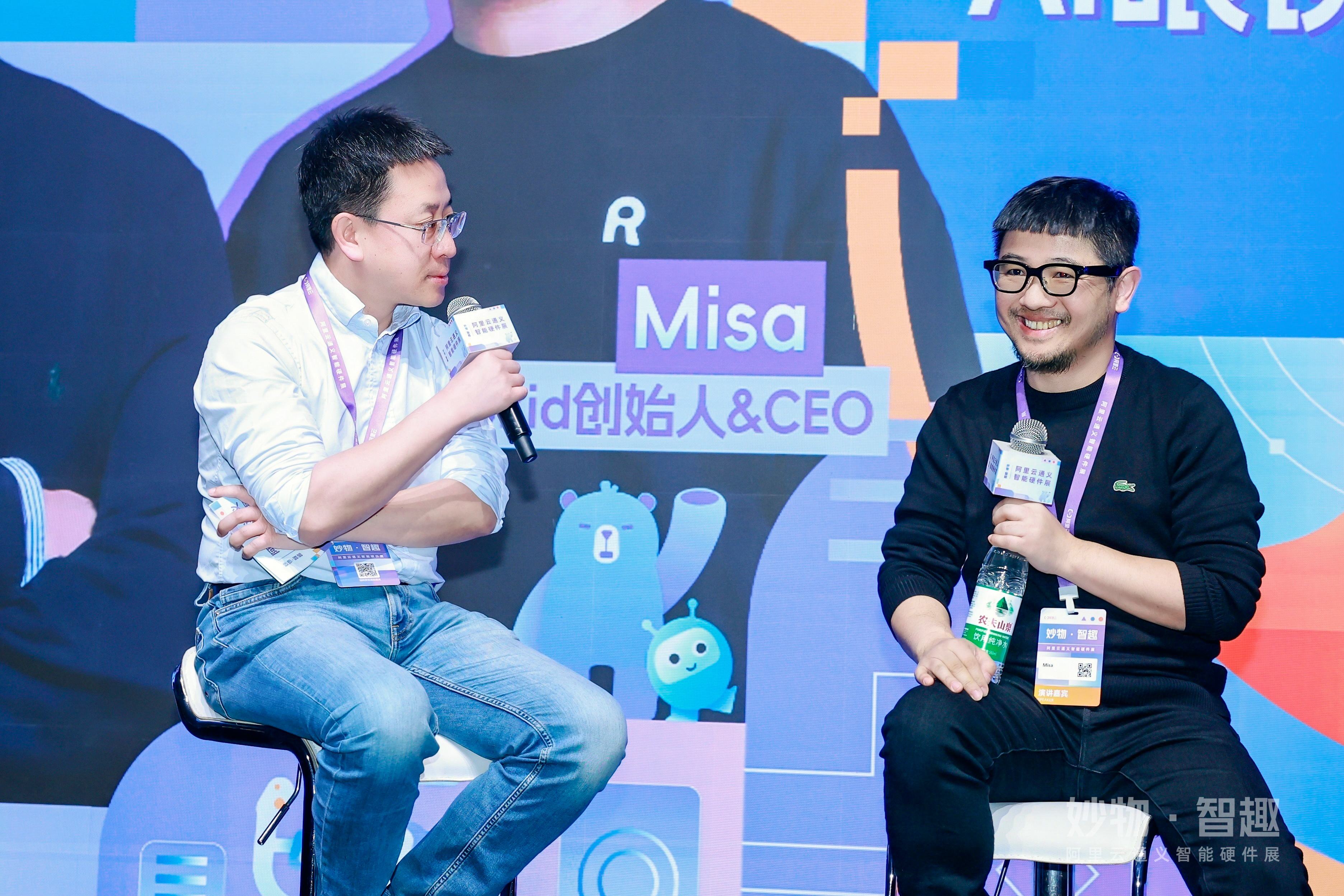
The following is the transcript of the conversation, edited by 36Kr:
Feng Dagang: Today's occasion is a bit like the smart glasses market, noisy but full of vitality. Only by expressing yourself loudly can you be seen by others.
Misa: Yes.
Feng Dagang: Misa is the founder of Rokid. In February 2025, Rokid had a viral moment, when you stood on the stage and said "Today, my speech script is right on my glasses".
Misa: Yes, it's right inside the glasses.
Feng Dagang: As an investor and media person who has been observing hardware for many years, I was very happy that day. I felt that I finally found the answer to the proposition of what smart hardware should do. Did Rokid become popular after that day? What's your feeling after becoming popular?
Misa: We expected smart glasses to explode in 2025, but we didn't expect two things: first, the explosion was so strong; second, we didn't expect that we triggered the explosion. I thought the market would be heated up together by all parties, but I didn't expect that speech to make the entire smart glasses track take off in 2025, which was quite unexpected.
Feng Dagang: How many routes do you think AI glasses are taking?
Misa: The first category is entertainment, such as watching movies and playing games, focusing on the giant screen experience. The second category is light AI, evolved from audio glasses with a little AI capability, represented by Meta Ray-Ban, Xiaomi and Li Auto are also in this category. The third category is full-function AI glasses, which need to have display, microphone, speaker and complete AI capabilities, with complete input and output. There are not many players in this category, and Rokid is currently the most complete one that has achieved large-scale mass production. There are basically three categories: entertainment, light AI, and full-function AI.
Feng Dagang: Which category does the head-mounted product made by Apple belong to?
Misa: It is more like a head-mounted display.
Feng Dagang: How many AI glasses were sold worldwide in 2025?
Misa: Including new products like Meta Ray-Ban, the total is about 5 million units, of which Ray-Ban accounts for more than 3 million units. Among full-function glasses, Rokid accounts for the vast majority, with a market share of more than 70%. It is expected that Rokid will still account for more than half of the market in 2026.
Feng Dagang: Half of the market share is roughly how many units?
Misa: We shipped more than 200,000 units last year, but it was actually only three and a half months. This year, the expected sales of 800,000 to 1 million units is a relatively rational forecast.
Feng Dagang: What kind of user needs do the three different types of AI glasses meet respectively?
Misa: The entertainment category is mainly for giant screen movie watching, which is "nice to have" with low demand. The sales volume of our entertainment glasses Rokid AR Lite is only 1/10 of that of the full-function model, with a daily usage duration of about 1 hour. While Rokid Glass is worn for about 8 hours per day on average, and I basically wear it all day long.
Feng Dagang: Why not 16 hours?
Misa: 8 hours is the average value, some people only wear it when they need it.
Feng Dagang: Is there a universally recognized ultimate capability in the industry that all of us will need in the future?
Misa: There is demand for multimedia content, but it faces an "impossible triangle": it is difficult to unify display performance, battery life, and wearing comfort. If we can make a breakthrough in the next three to five years, the three-in-one product will be the future: you can use the giant screen when you want, use AI assistance when you want, and wear it as ordinary glasses when you want.
Feng Dagang: Why do we need three-in-one glasses? Is it the future? What specific things can it do that mobile phones can't?
Misa: Judging from our current user data, several high-frequency scenarios are very clear. The first is photo and video shooting. Many people think that glasses photography is meant to replace mobile phones, but in fact it is not, it is a supplement. Mobile phones focus on "shooting well", while glasses focus on "capturing the moment", recording moments anytime and anywhere in a more natural way. For example, when taking photos of children or conducting interviews, the other party may feel unnatural when seeing a mobile phone, but glasses are very hidden. The second is information reminder. Like when I am chatting with you now, dozens of WeChat notifications have already floated across my glasses, most of which do not need to be processed immediately, which allows me to avoid frequently taking out my mobile phone and stay more focused. The third is AI Q&A. For short and quick questions, such as asking about the weather or checking materials, you can directly ask the glasses, which is faster than opening a search engine. The fourth is navigation. When walking or cycling, following the instructions in the glasses is much more convenient than holding up a mobile phone. What really differentiates it from mobile phones is that it provides a more natural and more instant "proactive AI service".
Feng Dagang: In the long run, are glasses mobile phone accessories or independent devices?
Misa: They may still be accessories within three years, changes will take place after three to five years, and they will most likely not be accessories five years later. Mobile phones may become terminals for computing, communication and storage, and interaction will mainly take place on glasses. Glasses are also a better carrier for "proactive AI".
Feng Dagang: How long is the battery life?
Misa: Continuous use lasts for about 6-8 hours, and intermittent use can support a whole day.
Feng Dagang: The next question will be a bit sharper. You said Rokid is No.1 in China, but the global annual sales of smart glasses are only hundreds of thousands of units, which is very small compared with the hundreds of millions of mobile phones sold annually. How do you view this?
Misa: First of all, I rarely say publicly that Rokid is No.1, although it is indeed the case in terms of data, but I don't want to trigger discussions like "the industry's No.1 only sells two or three hundred thousand units". I would rather share several dynamic figures: first, this year's Double 11, Rokid's year-on-year sales growth reached 800%, 9 times that of the same period last year. Second, from more than 200,000 units last year to the target of 1 million units this year, that is 400% growth. This growth inflection point is very worth looking forward to. Third, if a single SKU sells 1 million units, in the consumer electronics field, it can already match the sales volume of many mobile phone single products. So although the total volume is still small now, like a "primary school student", it is growing extremely fast and will soon enter the "college entrance examination" stage. I believe that by 2027 and 2028, this industry will reach the 10 million unit level. This year, the entire market (including audio glasses) will exceed 10 million units, which is just around the corner.
Feng Dagang: Let me follow up. We have been saying for many years that "AI glasses are the next entry point". Why do we still have to say "wait another two or three years" today? Is it because the product is too expensive, the functions are not good enough, or we haven't found that "killer" application?
Misa: I think the core is still the market education problem. The real explosion point is actually the maturity of large AI models, which has only happened in the past one or two years. Before large models like Tongyi and DeepSeek became popular, the so-called AI was relatively "stupid". It only took one year from the explosion of large models to our product going viral. You see, half of the people present today may not have heard of Rokid. This shows that market awareness still needs time. The industry was just ignited last year, and this year and next year we will work together to deepen market education, and the 10 million unit scale will come soon. I am very confident personally.
Feng Dagang: Speaking of large models, I know you are accessing Alibaba's Tongyi model today. Why did you choose it?
Misa: There are two main reasons. First, Rokid is a believer in open source, and we will give priority to whoever open sources, which is safer for our startup. When we planned the product last year, the excellent open source options were mainly Tongyi and DeepSeek. Second, Alibaba Cloud's infrastructure support is more stable, so we access Tongyi by default.
Feng Dagang: Since we are talking about Alibaba, we are also at the Alibaba Cloud event today. How do you view the competition between large manufacturers like Alibaba and your startup?
Misa: This question is quite interesting. I worked at Alibaba for four years, and I think the biggest challenge for large Internet manufacturers to make hardware is often not capability, but "persistence". Hardware entrepreneurship is a marathon that requires all-in focus and patience. But large manufacturers have many businesses, and if a project is not a strategic core in the short term, resource investment and team attention may shift. This is the core reason why startups can win — we have no choice but to go all out. Of course, large manufacturers have a strong start with three advantages: media resources, channel subsidies, and ecological collaboration. To withstand the impact, startups must establish a strong brand, solidify basic product skills, and rely on user word-of-mouth and community communication to achieve breakthrough growth. Rokid's user recommendation rate is very high, which does not rely on marketing investment, but on word-of-mouth.
Feng Dagang: