Will Ford purchase BYD batteries to boost its hybrid market? Official response.
Recently, there were reports that Ford Motor is in talks with BYD about a battery cooperation plan. The core of the plan is for Ford to purchase BYD batteries for some of its hybrid models. Currently, the two sides are still discussing the specific cooperation mechanism. One of the proposed plans is that Ford will use BYD batteries in its vehicle manufacturing plants outside the United States.
In response to this news, Ford China told a reporter from National Business Daily: "We have various discussions with different companies in many business areas. We do not comment on rumors or baseless speculations." As of the time of reporting, BYD has not responded to this matter.

Photo source: Photo by Li Xing, reporter of National Business Daily (File photo)
It is worth noting that not long ago, Ford Motor cancelled a cooperation worth tens of billions of yuan with LG Energy Solution, a South Korean battery giant.
On December 19, 2025, LG Energy Solution disclosed that it had received notice from Ford Motor to cancel a power battery procurement contract worth 9.6 trillion won (approximately 45.9 billion yuan). Only the supply of 34GWh from 2026 to 2030 will be retained, and the supply of 75GWh from 2027 to 2032 has been cancelled.
Ford Motor stated that the reason for this decision was the impact of changes in the policy environment and the outlook for electric vehicle demand, which led to the decision to stop producing some electric vehicle models. LG Energy Solution said that the cancelled batch was originally planned to be supplied after 2027, and there is no corresponding operating production line at present. It also said that it will continue to maintain a cooperative relationship with Ford Motor in the future.
It is understood that the value of the cancelled order accounts for 30% of LG Energy Solution's revenue in 2024 and 54.5% of its revenue in the first three quarters of 2025. This is one of the largest order cancellations in the history of LG Energy Solution.
Ford Motor's shift from LG to BYD is closely related to China's leading position in electrification technology. According to the latest research data released by South Korea's SNE Research, from January to November 2025, the global power battery installation volume reached 1046GWh, a year-on-year increase of 32.6%. Among the top 10 global power battery manufacturers, six are Chinese companies, three are South Korean companies, and one is a Japanese company. Among them, CATL and BYD alone account for 55% of the market share, while the combined share of the four Japanese and South Korean manufacturers is 19.5%.
In addition, Ford may have taken a fancy to BYD's lithium iron phosphate battery technology. Compared with ternary lithium batteries, this type of battery not only has a 30% lower cost but also performs better in terms of cycle life and safety. Data shows that in 2025, the global installation volume of lithium iron phosphate batteries is expected to increase by 38% year-on-year to 420GWh, accounting for more than 54% of the total power battery market share. The latest data from relevant institutions shows that from January to November 2025, the installation volume of domestic lithium iron phosphate power batteries was 490GWh, accounting for a market share as high as 78.5%, indicating strong demand and market competitiveness.
It is worth noting that Ford Motor's choice to cooperate with BYD is also related to its latest contraction strategy. In mid - December 2025, Ford Motor announced a strategic adjustment, shifting towards high - return businesses, including increasing investment in commercial vehicles, entering the battery energy storage business, and cancelling some large - scale electric vehicle production plans. Ford Motor will vigorously promote the diversification of powertrain options, including a series of hybrid and extended - range electric models. It is expected that by 2030, the proportion of hybrid vehicles, extended - range electric vehicles (EREV), and pure electric vehicles in Ford's total sales will increase from the current 17% to about 50%.
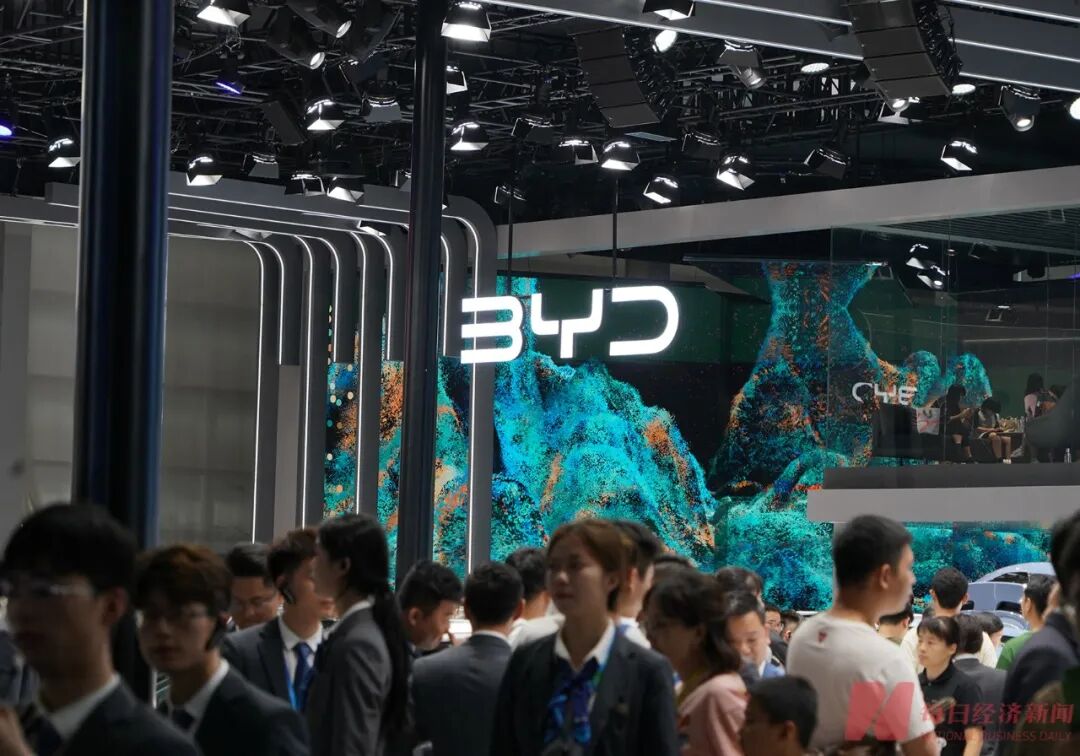
Photo source: National Business Daily (File photo)
Industry analysts believe that if Ford Motor cooperates with BYD, it is essentially a supply - chain replenishment move after its strategic shift, which is of practical necessity. Currently, Ford is reducing its investment in pure - electric models and shifting its focus to the hybrid vehicle market. This strategic adjustment has directly created an urgent demand for highly reliable and adaptable hybrid batteries. BYD has been deeply involved in the lithium iron phosphate power battery field for many years. It not only has the ability for large - scale mass production, but the maturity of its blade batteries in terms of safety, cycle life, and cost control exactly meets the core requirements of Ford's hybrid models. It is an optimal solution for the current supply - chain selection.
Previously, Ford Motor and BYD have had cooperation in the battery field, which also provides a certain basis for the two sides to "rekindle their relationship". As early as April 2021, Changan Ford officially launched the domestically - produced Ford Mustang Mach - E. As the first pure - electric SUV in the Mustang family, the vehicle finalized a cooperation with BYD in the core battery supply link, becoming a typical case of a joint - venture brand partnering with a leading Chinese battery company at that time.
This article is from the WeChat official account "NBD Auto". Author: Sun Tongtong. Republished by 36Kr with permission.