In 2025, the number will exceed 3 million units. The large-scale implementation of urban NOA is accelerating, and Huawei and Momenta have formed a "dual-power structure".
From January to November 2025, the cumulative sales volume of passenger cars equipped with urban NOA function in China reached as high as 3.129 million units. Meanwhile, with the rapid expansion of the industry scale, the market of third - party suppliers for urban NOA presented a "dual - strong" pattern of Huawei and Momenta.
On the afternoon of January 14, 2026, the "Research Report on Urban NOA Automotive Assisted Driving in 2025" (hereinafter referred to as the "report") was officially released at the Information Release Conference of the China Association of Automobile Manufacturers.
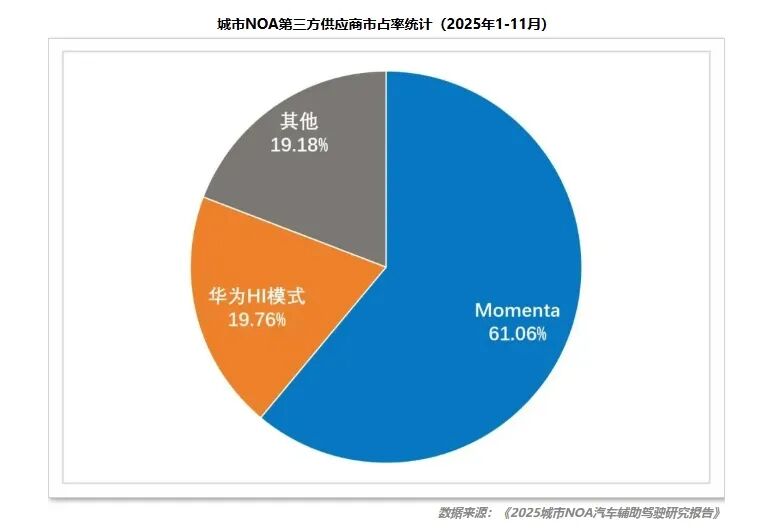
The report shows that from January to November 2025, the cumulative sales volume of passenger cars equipped with urban NOA function in China reached as high as 3.129 million units. Meanwhile, with the rapid expansion of the industry scale, the market of third - party urban NOA suppliers presented a "dual - strong" pattern. Momenta and Huawei significantly led in market share, accounting for about 80% of the third - party supplier market in total.
The report points out that China's urban NOA has entered the second half of large - scale popularization, and profound changes are taking place in the market pattern and competitive factors.
01. The "Dual - Strong" Pattern in the Third - Party Supplier Market Remains Stable, and the "Chinese Solution" Goes Global
2025 was a crucial year for the commercial implementation of China's urban NOA.
From January to November 2025, the penetration rate of passenger cars equipped with urban NOA function accounted for 15.1% of the insured passenger cars, an increase of 5.6 percentage points compared with 2024. This means that in the first 11 months of 2025, for every seven newly licensed cars, one was equipped with the urban NOA function, and an intelligent driving market with a scale of over 3 million units had taken shape in China.
The report points out that currently, the urban NOA market presents a "dual - wheel drive" pattern of self - research by car companies and cooperation with third - parties.
Domestic brands played a leading role in promoting the accelerated popularization of intelligent driving. The report shows that from January to November 2025, domestic brands accounted for as high as 81.1% of the sales volume of passenger cars equipped with urban NOA function.
However, only a few car companies conduct self - research on urban NOA. In order to seize the opportunity in the urban NOA market, most car companies choose to cooperate with third - party suppliers with technology. In 2025, when high - level intelligent driving systems emerged in large numbers, mainstream vehicle brands that were previously lagging in the field of intelligentization also began to make collective efforts. Global well - known automobile brands including BBA, Cadillac, Buick, and Toyota have all implemented the urban NOA function in China. Mainstream brands hope to cooperate with China's leading intelligent driving suppliers to make up for the short - board in intelligent driving technology.
The report shows that from January to November 2025, the installation volume of Momenta's urban NOA was 414,400 units, accounting for about 61.06% of third - party suppliers, leading the market. Among the top 10 global car companies, 8 have cooperated with Momenta. Through the strong cooperation with enterprises in Huawei's HI mode, the installation volume was about 134,100 units, accounting for about 19.76% of third - party suppliers.
According to the data analysis and prediction released by the China Association of Automobile Manufacturers, in November 2025, the installation volume of Huawei's Qiankun Intelligent Driving (Hongmeng Smart Mobility + HI mode) reached 100,000 units, and the installation volume of Momenta was about 90,000 units. In terms of installation scale, Huawei and Momenta have formed a stable "dual - strong pattern".
At present, the first batch of models highly expected by mainstream vehicle brands, such as GAC Toyota's C-HR Pro, Dongfeng Nissan's N7, and SAIC Audi's E5 Sportback, all adopt Momenta's assisted driving system. The first model of the high - end new energy sub - brand Zhijing of SAIC - GM Buick, the Zhijing L7, is the first to be equipped with the "Xiaoyao Intelligent Driving" assisted driving system jointly developed with Momenta and takes the lead in adopting the latest Momenta R6 reinforcement learning large model.
Momenta not only helps these automobile brands catch up with the intelligent driving wave in China but also boosts the sales growth of joint - venture pure - electric models. One hour after the launch of GAC Toyota's C - HR Pro, the orders exceeded 10,000 units, and the deliveries exceeded 20,000 units in three months, breaking the delivery record of joint - venture electric vehicles. According to official data from GAC, in 2025, GAC Toyota's annual sales volume was 772,000 units, and the C - HR Pro contributed nearly 10% of the sales volume, with an annual cumulative sales volume of 70,008 units.
Third - party technology suppliers including Huawei and Momenta have provided the "Chinese solution" for the global intelligent driving industry, attracting well - known automobile brands from countries such as Germany, the United States, Japan, and South Korea to cooperate deeply with Chinese technology companies, which has greatly promoted the global spread of China's intelligent driving technology and enhanced China's voice in the global automotive industry value chain.
02. Why Momenta? Large - Scale Mass - Production Experience and Other Factors Are the Key
At the stage of large - scale implementation of high - level assisted driving, the report points out that algorithms, data closed - loop capabilities, and large - scale mass - production experience have become the core factors determining the market position and development speed of assisted driving suppliers.
The report points out that at present, the end - to - end large model has become the core engine for the iteration of NOA assisted driving technology. Car companies and suppliers have increased their layout of end - to - end technology, forming a diversified competitive pattern. New car - making forces build technical barriers through full - stack self - research. Huawei's Qiankun Intelligent Driving adopts the new - generation architecture WEWA (World Engine + World Action Model), which is a typical generative end - to - end model. Through the collaborative mode of the "cloud - based world engine + vehicle - end world behavior model", it can efficiently output vehicle control trajectories and effectively improve the adaptability to long - tail scenarios. Traditional car companies quickly supplement their capabilities by cooperating with third - party suppliers to accelerate the implementation of technology.
In the highly competitive intelligent driving market, each company's algorithms are constantly iterating and upgrading in innovation, and each has its own advantages. This means that in order to stand out in the third - party supplier market, technological innovation alone is not enough, and systematic capabilities are also required. The one who can provide a more "replicable" solution can quickly adapt to new models of different brands and platforms, thus seizing the opportunity in the fierce market competition.
Momenta, a third - party supplier, takes "reinforcement learning + end - to - end architecture" as its core technical route. Through a product strategy of advancing in two tracks: mass - produced assisted driving (Mass Production) and autonomous driving technology R & D (Scalable Robo), it relies on a large - scale data closed - loop to achieve continuous algorithm iteration.
In terms of technology, the Momenta R6 reinforcement learning large model is the first reinforcement learning large model in China to be truly mass - produced and implemented on the basis of end - to - end. It focuses on enhancing safety and comfort and brings higher - efficiency traffic capacity. Models equipped with the Momenta R6 reinforcement learning large model were officially mass - produced and launched in Q3 2025.
In terms of the cooperation model, Momenta has built a multi - dimensional cooperation ecosystem covering joint technology research and customized solutions with car companies. At present, it has reached cooperation with many mainstream car companies such as SAIC, GAC, BYD, Mercedes - Benz, BMW, Audi, and Toyota. In terms of mass - production scale and efficiency, Momenta has also set industry records. It took 24 months to reach the first 100,000 units, only 6 months for the second 100,000 units, and only 3 months for the third 100,000 units.
Relying on its technological moat and large - scale delivery capabilities, Momenta has built a solid positive cycle of "algorithm, data closed - loop, and large - scale mass - production", enabling it to take a leading position in the urban NOA third - party supplier market.
In the future, driven by both rapid technological iteration and market competition, urban NOA is accelerating the systematic transformation of intelligent driving technology routes, core architectures, and industrial ecosystems. In terms of application scenarios, it is accelerating the extension from highway NOA to urban NOA. In terms of technological transformation, with the end - to - end large model as the core, it is promoting the in - depth reconstruction of the system architecture towards integration. In the industrial aspect, as the vanguard of high - level autonomous driving, it is accelerating the maturity of vehicle - road - cloud collaboration and the regulatory standard system.
This article is from the WeChat official account "AutoR Intelligent Driving" (ID: zhinengqiche). Author: Zhang Xin. Editor: Ling Jiang. Republished by 36Kr with permission.