Über 3 Millionen Fahrzeuge im Jahr 2025: Die Skalierung von City NOA beschleunigt sich, und Huawei und Momenta bilden eine "Doppel-Obermacht-Struktur".
From January to November 2025, the cumulative sales volume of passenger cars with the urban NOA function in China reached an impressive 3.129 million vehicles. Meanwhile, in the market for third - party urban NOA technology, a duopoly between Huawei and Momenta has emerged amidst the rapid expansion of the industry.
On the afternoon of January 14, 2026, the "Research Report on Automated Driving Assistance with Urban NOA in 2025" (hereinafter referred to as the "Report") was officially presented at the information release of the China Association of Automobile Manufacturers.
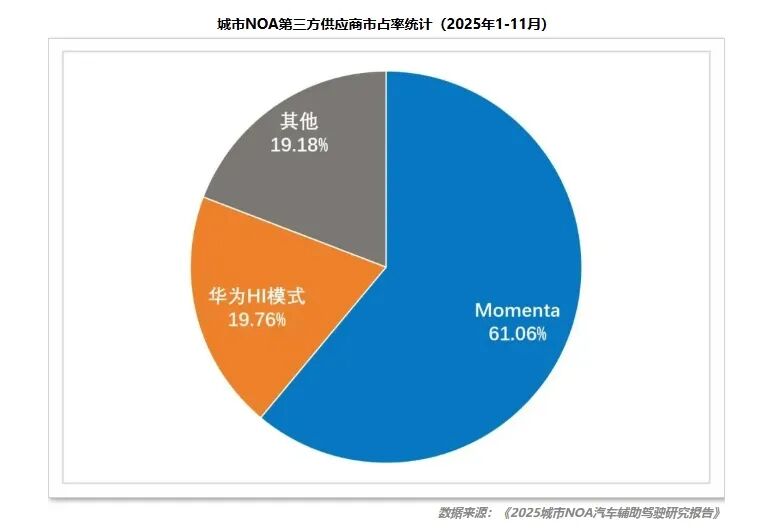
The Report shows that from January to November 2025, the cumulative sales volume of passenger cars with the urban NOA function in China rose to 3.129 million vehicles. Amidst the rapid expansion of the industry, a duopoly has been established in the market for third - party urban NOA technology, with Momenta and Huawei holding significant market shares and together accounting for about 80% of the third - party market.
The Report points out that urban NOA in China has reached the second half of mass dissemination, and the market structure and competitive factors are undergoing profound changes.
01. The Duopoly in the Third - Party Market Remains Stable, and the "Chinese Solution" Goes Global
The year 2025 was a key year for the commercial introduction of urban NOA in China.
From January to November 2025, the penetration rate of passenger cars with the urban NOA function was 15.1% of registered passenger cars, representing an increase of 5.6 percentage points compared to 2024. That is, in the first 11 months of 2025, every seventh newly registered vehicle was equipped with the urban NOA function. A market for intelligent driving assistance systems with a scale of over 3 million vehicles has been established in China.
The Report points out that the current urban NOA market features a two - pillar model of self - development by automakers and cooperation with third - party providers.
Chinese brands have taken the lead in accelerating the dissemination of intelligent driving assistance systems. The Report shows that from January to November 2025, Chinese brands accounted for 81.1% of the sales volume of passenger cars with the urban NOA function.
However, only a few automakers develop urban NOA independently. To gain an edge in the urban NOA market, most automakers choose to cooperate with technologically strong third - party providers. In 2025, when there was a boom in high - quality intelligent driving assistance systems, mainstream automakers that had lagged behind in digitalization in the past also began to get involved. Well - known global automobile brands such as BBA, Cadillac, Buick, and Toyota have introduced the urban NOA function in China. Mainstream brands hope to bridge their technological gaps through cooperation with leading Chinese intelligent driving assistance system providers.
The Report shows that from January to November 2025, Momenta equipped 414,400 vehicles with the urban NOA function, accounting for about 61.06% of third - party providers and ranking first. Eight of the world's top ten automakers cooperate with Momenta. Huawei's HI model has achieved an installation volume of about 134,100 vehicles through strong corporate partnerships, accounting for about 19.76% of third - party providers.
Based on the data analysis of the China Association of Automobile Manufacturers, it is estimated that the installation volume of Huawei Qiankun Intelligent Driving (HarmonyOS Mobility + HI model) reached 100,000 vehicles in November 2025, while Momenta equipped about 90,000 vehicles. In terms of installation volume, Huawei and Momenta have formed a stable duopoly.
Currently, the first - batch vehicles that enjoy great trust from mainstream automakers, such as the GAC Toyota BOZZ 3X, the Dongfeng Nissan N7, and the SAIC Audi E5 Sportback, all use Momenta's driving assistance system. The first vehicle of SAIC - GM Buick's premium electric mobility brand Zhijing, the Zhijing L7, is the first to be equipped with the "Xiaoyao Intelligent Driving" driving assistance system jointly developed with Momenta and uses Momenta's latest R6 Deep Reinforcement Learning model for the first time.
Momenta has not only helped these automobile brands keep up with the Chinese wave of intelligent driving assistance but also boosted the sales volume of joint - venture electric vehicles. More than 10,000 orders were placed within an hour after the GAC Toyota BOZZ 3X entered the market, and more than 20,000 vehicles were delivered within three months, setting a new delivery record for joint - venture electric vehicles. According to official GAC data, the annual sales volume of GAC Toyota in 2025 was 772,000 vehicles, with the BOZZ 3X contributing significantly with about 10% or 70,008 vehicles sold.
Third - party technology providers such as Huawei and Momenta offer a "Chinese solution" to the global intelligent driving assistance system industry, which has prompted well - known automobile brands from Germany, the United States, Japan, South Korea, and other countries to engage in in - depth cooperation with Chinese technology companies. This has greatly promoted the international presence of Chinese intelligent driving assistance system technology and improved China's position in the global automotive industry.
02. Why Momenta? Mass - production expertise and other factors are decisive
At the stage of mass introduction of high - quality driving assistance systems, the Report has pointed out that algorithms, data feedback ability, and mass - production experience have become the central factors for the market position and development speed of driving assistance system providers.
The Report points out that the end - to - end deep - learning model is currently the central engine for the further development of NOA driving assistance technology. Automakers and providers are increasingly relying on end - to - end technology, leading to a diverse competitive environment: New automakers are building technological barriers through self - development of full - stack systems; Huawei Qiankun Intelligent Driving uses the latest WEWA (World Engine + World Action Model) architecture model, a typical generative end - to - end system that can efficiently generate lane plans and improve adaptability in rare scenarios through the cooperation between the cloud - world engine and the vehicle - world behavior model; traditional automakers are accelerating technological implementation through cooperation with third - party providers.
In the highly competitive intelligent driving assistance system market, algorithms are constantly evolving and each has its own strengths. This means that technological innovation alone is not enough to gain a foothold in the third - party market. Systemic capabilities are also required. Those who can offer a "reproducible" solution can quickly adapt to different brands and platforms of new vehicles and thus gain an edge in the highly competitive market.
The third - party provider Momenta pursues a technology strategy based on "Deep Reinforcement Learning + End - to - End Architecture". By simultaneously developing mass - production driving assistance systems (Mass Production) and autonomous driving technology (Scalable Robo) and continuously improving algorithms through mass - data feedback, Momenta has achieved a strong competitive position.
Technologically, Momenta's R6 Deep Reinforcement Learning model is the first end - to - end model actually used in mass production in China. It places special emphasis on safety and comfort and enables more efficient driving. Vehicles equipped with Momenta's R6 Deep Reinforcement Learning model entered mass production in the third quarter of 2025.
In terms of cooperation models, Momenta has established a diverse cooperation ecosystem with automakers, including joint technology development and customized solutions. Momenta has already cooperated with many mainstream automakers such as SAIC, GAC, BYD, Mercedes - Benz, BMW, Audi, and Toyota. In terms of mass production and efficiency, Momenta has also set industry records: It took 24 months to produce the first 100,000 vehicles, only 6 months for the second 100,000 vehicles, and only 3 months for the third 100,000 vehicles.
Thanks to its technological competitive advantages and mass - delivery ability, Momenta has created a solid cycle of "algorithms, data feedback, and mass production", enabling it to maintain its leading position in the third - party urban NOA market.
In the future, driven by both rapid technological development and market competition, urban NOA will accelerate the systematic transformation of the technological approach, core architecture, and industry ecosystems of intelligent driving assistance systems: In terms of application scenarios, the expansion from highway NOA to urban NOA will be accelerated; in terms of technological transformation, the end - to - end deep - learning model as the core will drive the in - depth reconstruction of the system architecture towards integration; in terms of the industry, as the vanguard of highly automated driving, the coordination between vehicles, roads, and the cloud and the maturation of the legal and standards systems will be accelerated.
This article is from the WeChat account “AutoR Intelligent Driving” (ID: zhinengqiche), written by Zhang Xin and edited by Ling Jiang. Published by 36Kr with permission.