The Chinese mobile phone market has been turned into a "war of attrition".
On January 14th, IDC released the final data for the Chinese smartphone market in 2025: the annual shipment volume was approximately 285 million units, a slight year-on-year decline of 0.6%. This is in sharp contrast to the 5.6% year-on-year growth momentum in 2024.
In 2025, the "national subsidies" in some regions were exhausted ahead of schedule, and the effect of flagship product iterations on stimulating replacement demand was limited, leading to a contraction in the overall mobile phone market.
Nevertheless, several key trends emerging during the industry's downward cycle are still worth noting: The high-end market pattern has become solidified, and competition in the mid-range has intensified. Meanwhile, external cross-border forces are pouring in, forcing traditional manufacturers to expand their business boundaries and undergo self - innovation.
The competitive landscape has thus become more complex. On one hand, Apple has established a solid high-end barrier through its ecosystem. On the other hand, domestic manufacturers are trying to find new growth paths through technological diversification and ecosystem building during the window period when AI phones have not yet formed a decisive advantage.
We attempt to review the Chinese smartphone industry in 2025 through the evolution of the industry pattern, technological advancements, and the key strategies of major manufacturers.
01 Changes in the Pattern: Huawei Reclaims the Top Spot, and the Gap Among the Top Five Narrows
In 2025, the biggest change in the Chinese smartphone market was that the competition became increasingly intense.
IDC data shows that the top five smartphone manufacturers in terms of shipment volume in the Chinese market in 2025 were, in order: Huawei, Apple, vivo, Xiaomi, and OPPO.
A key feature is that there was no significant gap among the top five, with market shares all above 15%. The difference in shipment volume between the first and the fifth was only about 3.3 million units.
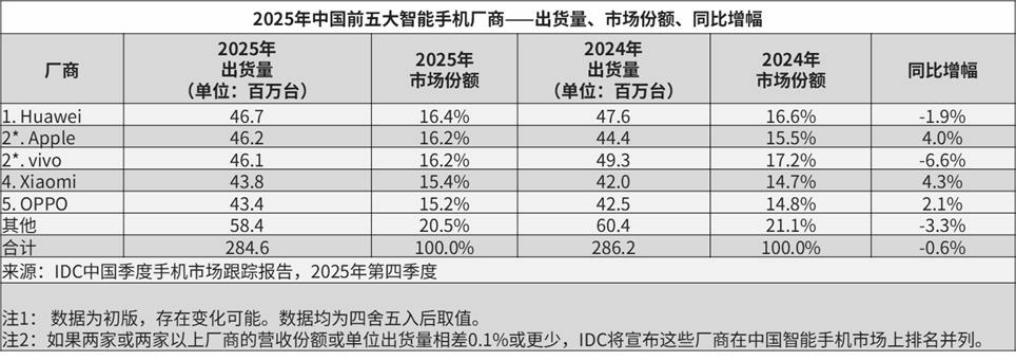
Another notable feature was that the rankings of the top five completely changed.
After a five - year hiatus, Huawei reclaimed the top spot.
After experiencing a chip supply disruption, a forced contraction in the overseas market, and a loss of domestic market share, Huawei made a comeback thanks to its profound accumulation in chips, operating systems, and ecosystems.
Although it reclaimed the top spot, its shipment volume decreased by 1.9% compared to 2024. Its ascent to the top was partly due to the overall contraction of the market, and its leading advantage was slight. It will not be easy for Huawei to regain the significant market lead it had a few years ago.
Apple ranked second with a shipment volume of approximately 46.2 million units, a year-on-year increase of 4%, and a market share of 16.2%.
The upgrades of the iPhone 17 series in display technology, imaging systems, performance, and heat dissipation constituted its main selling points, further consolidating its appeal in the high - price segment.
In terms of price, the standard version of the iPhone 17 was priced the same as its predecessor, but with increased storage capacity. It also introduced 120Hz adaptive high - refresh rate technology to this basic model. Coupled with the price advantage of the iPhone 16 under the influence of Double Eleven, national subsidies, platform subsidies, and price cuts, Apple accounted for 21.1% of the market share in the fourth quarter of 2025.
vivo's shipment volume was approximately 46.1 million units, a year-on-year decrease of 6.6%. Its market share tied with Apple for second place, ending its four - year streak of leading domestic shipments.
This situation of intense competition among the top players reveals a harsh reality: the Chinese mobile phone market has completely entered an era of peak growth and stock competition.
At this stage, Lu Weibing, the president of Xiaomi, believes that "when everyone is very close, unless someone makes a serious mistake, it will be a war of attrition. Don't expect a quick victory."
Specifically for domestic giants such as Huawei, Xiaomi, OPPO, and Honor, 2025 was a year of significant strategic divergence.
Huawei is still "running alone in the uncharted territory." The commercialization effects and moat value of the pure - blood Hongmeng operating system, which was fully rolled out in the second half of 2024, have begun to stand out, and its system fluency and security have been widely recognized.
However, it also faces challenges in terms of application ecosystem compatibility. For example, some users encountered temporary incompatibility issues with certain functions of mainstream applications after upgrading from Hongmeng 4.3 to 5.1.
It will not be easy for Huawei to regain the significant lead over other manufacturers as it did five years ago.
Xiaomi continues to charge into the high - end market and bets on the "smartphone, car, and home" ecosystem. In 2025, the Xiaomi 17 series skipped "16" and aimed to target the high - end segment above 4,000 yuan by fully competing with the iPhone. In 2026, increasing the average selling price (ASP) of mobile phones was listed as the primary operational goal. As for the impact of Xiaomi's cars on mobile phone sales, it will take more time to verify.
OPPO and vivo, once proud of their offline channel advantages, are increasingly under pressure due to the impact of e - commerce and national subsidy policies, as well as the rapid store - opening campaigns of competitors.
OPPO continues to strengthen its imaging capabilities in the Find X series but is relatively conservative in the implementation of system - level AI. vivo has a relatively stable market base but lacks a presence in the ultra - high - end market (above 6,000 yuan), and users can't find a compelling reason to buy its products.
2025 was a year of transformation for Honor. On one hand, the new leader proposed the Alpha strategy, aiming to transform from a smartphone manufacturer to an AI terminal ecosystem company. On the other hand, through a relatively frequent product launch schedule, it gained some market share with mid - and low - end models. The uncertainty of the grand vision of the AI ecosystem and the urgent concern about market share are the realities that Honor must face simultaneously.
02 Market Segmentation: Intense Competition in the Mid - Range, Solidified High - End Market
Shifting our focus from manufacturer competition back to products and the market itself, the performance of the mid - range and high - end markets in 2025 presented a stark contrast.
The mid - range market (usually referring to the 2,000 - 4,000 yuan range) is a key battlefield for most brands to consolidate their market base and compete for the largest user base, making it the most "intensely competitive" area.
In 2025, brands accelerated the application of flagship technologies to mid - range models: Xiaomi's Redmi K90 offered a flagship chip, a metal middle frame, and a telephoto lens in the 2,500 - yuan segment. OnePlus 15, with the slogan of "Ultra Performance," brought a 165Hz ultra - high - refresh - rate screen and other gaming experiences to the sub - 4,000 - yuan price range. Honor took large - capacity battery technology to a new level.
However, these innovations still fall within the scope of "cost - performance competition" and "specification race," with severe homogeneous competition. This not only reflects the high maturity and rapid response ability of the domestic mobile phone industry chain but also highlights the huge growth pressure faced by manufacturers in the mid - range market.
The high - end market (usually referring to products priced above 4,000 yuan or $600) remained solidified.
Although vivo's X300 was the first to feature the Dimensity 9500 chip, iQOO 15 and Honor Magic 8 were equipped with top - of - the - line Snapdragon platforms, and OPPO's Find X9 Pro was the first to offer an 8K ultra - clear imaging function co - branded with Hasselblad... These products, despite being well - equipped and full of technological appeal, still struggled to fundamentally shake up the domestic high - end market pattern.
This phenomenon has persisted for years, in sharp contrast to the frequent changes in the rankings of high - end brands in the new energy vehicle market in recent years.
The core difference is that the new energy vehicle industry achieved a fundamental reconstruction of the power system through "electrification" and then opened up a new battlefield in "intelligence," resulting in a core technological transformation that could disrupt the traditional pattern.
In the current high - end mobile phone market, there has not yet been a disruptive technological breakthrough with universal appeal. Most innovations are limited to hardware parameter upgrades, imaging module optimization, and minor functional improvements, making it difficult to break through the deep - rooted brand image and system - level technological barriers established by Apple (self - developed chips + iOS ecosystem) and Huawei (Kirin chips + Hongmeng ecosystem).
Importantly, this situation of "intense competition in the mid - range and difficulty in breaking into the high - end" may continue.
In 2026, the cost of core components such as global memory chips continued to rise, directly squeezing the profit margins of mobile phones. Based on the forecasts of multiple institutions, the shipment volume of the Chinese smartphone market is expected to continue to decline slightly by 2% - 3% in 2026, with the total volume hovering below 280 million units.
Facing certain cost pressures and uncertain demand, manufacturers such as Xiaomi, OPPO, and vivo have adjusted their shipment volume targets and component procurement orders for 2026 to varying degrees, with cuts ranging from 10% to 20%. The cuts are mainly focused on mid - and low - end product lines with thin profit margins and fierce competition.
Even without supply - chain issues, from the consumer side, given the trend of excessive basic performance and rapid dissemination of technology, Goldman Sachs previously predicted that the mid - range market would collapse, and IDC also expects a reduction in the market share of the mid - price segment.
In this situation, finding incremental differentiators is crucial. There are two main paths: one is to accelerate overseas expansion; the other is to seek new breakthroughs in AI and capture a share of the high - end market through differentiation.
03 Technological Evolution: The Mobile Phone Enters the "Joint Definition" Era
Looking back over the past two years, AI phones have evolved from a "marketing concept" to a "true intelligence" exploration. In the early days, the AI capabilities of most manufacturers were limited to plug - in voice assistants or some intelligent agents that could only handle simple instructions after the opening of large - scale models.
In 2025, with the breakthrough in lightweight technology for end - side large - scale models, AI phones officially entered the era of ecosystem integration.
Currently, two differentiated technological paths are worth noting: one is the "AI - defined hardware" model led by Internet technology companies; the other is the "hardware - integrated AI" model led by traditional mobile phone manufacturers.
The representative of the first path is Doubao.
The cooperation between Doubao and ZTE was a major event in the mobile phone industry in 2025. Through cooperation with mid - and small - scale mobile phone manufacturers, large - model companies deeply integrated their capabilities into the underlying mobile phone systems.
Under the core logic that the model is the operating system, the mobile phone hardware is the carrier, and the real core is the large - model ability that integrates the end and the cloud and enables natural interaction.
For example, the Nubia M153, which is deeply integrated with the Doubao large - model, no longer requires users to open specific apps but can directly understand user intentions through "visual + voice" multimodal interaction. The market response, with the first - batch products selling out quickly, indicates that some users are looking forward to a "smarter and more proactive" interaction experience.
The representative of the second path is Honor.
Since the iPhone 4 laid the foundation for the modern smartphone form, the industry has witnessed form innovations such as foldable screens and curved screens, but there has not been a disruptive breakthrough in interaction forms.
Manufacturers represented by Honor are trying to combine AI capabilities with hardware innovation and the concept of "embodied intelligence" to explore changes in the physical form of mobile phones. Honor's concept of the "Robot Phone" is an example of this thinking.
Although the paths are different, both models are trying to create new value by reconstructing the human - machine interaction paradigm at a time when hardware specifications have reached a saturation point.
Similar to the process of new energy vehicles moving from "electrification" to "intelligence," the smartphone industry is moving from an era dominated by single mobile phone manufacturers in product definition to a new stage where large - model companies, mobile phone manufacturers, and even more ecosystem partners jointly participate in and define products.
04 Boundary Expansion:
New and Old Forces, New and Old Consensus
Expanding industrial boundaries was a prominent feature of the smartphone industry in 2025, mainly manifested in two aspects: first, traditional mobile phone manufacturers were exploring second and third growth curves, increasing business complexity; second, cross - border new forces were entering the market, bringing new variables and uncertainties to the industry.
Specifically, the cross - border explorations of mobile phone manufacturers blossomed in 2025:
Xiaomi: The revenue from its smart electric vehicle business reached 28.3 billion yuan in the third quarter of 2025, a year - on - year increase of 197.9%.
Honor: It established an independent new AI business department. The robot products it developed set new industry records in terms of movement speed and other indicators, exploring the deep integration of AI and hardware.
OPPO: It was reported that OPPO had initiated a project for handheld intelligent imaging devices, with the product concept modeled after GoPro and DJI action cameras.
vivo: It made arrangements in the fields of MR (mixed reality) and humanoid robots and has launched the head - mounted device vivo Vision.
In addition, AI glasses have become a new direction that almost all leading manufacturers are focusing on.
It is not difficult to find that, leveraging their product - definition capabilities, supply - chain management experience, and the reusability of flagship technologies such as imaging accumulated in the consumer electronics field, mobile phone manufacturers are trying to seize the window period of the new technological revolution and find growth in emerging sectors.
Compared with the proactive cross - border moves of mobile phone manufacturers, the entry of external forces has also had a profound impact on the industry pattern.
In the past decade, the mobile phone market was mainly an arena for traditional hardware manufacturers. However, in 2025, Internet and AI giants represented by ByteDance began to strongly intervene as cross - border players. It is reported that in addition to cooperating with ZTE, ByteDance is also seeking cooperation with more companies such as Transsion, Lenovo, and vivo.
For large - model companies, the core purpose of entering the mobile phone market is often not hardware profits but the strategic competition for the next - generation interaction entrance and core application scenarios. As a personal computing center, the mobile phone is one of the best carriers for the large - scale implementation of end - side large - model technology and for obtaining user data and user time.
This cross - border "hardware - software combination" has had a profound impact on the industry: it may force leading mobile phone manufacturers to further increase their R & D investment in AI; it also provides an opportunity for "small - scale" manufacturers under market - share pressure to "turn the tables" with top - notch AI capabilities.
However, the entry of new forces is not without challenges.
The mobile phone industry requires comprehensive competitiveness across the entire value chain. It is relatively easy for new forces to achieve single - point breakthroughs, but building a systematic and sustainable industrial competitiveness is still a long - term task.
Looking back, 2025 was a crucial turning point for the domestic mobile phone industry, a period of exploration during the contraction phase.
A new consensus is emerging in the mobile phone industry: the era of single - device competition is coming to an end, and the systematic competition centered on cross - device collaboration, scenario - based intelligent services, and data closed - loops is just beginning.