Musk Spent $1.6 Billion to Secure His Services for 5 Years: Unveiling the Second-in-Command at Tesla, the Tough Guy Who Sleeps in the Factory
No family, no house, only one mission – this is Tom Zhu. Awarded over 520,000 stock options, he must stay for five years and achieve KPIs such as cumulative deliveries of 20 million vehicles.
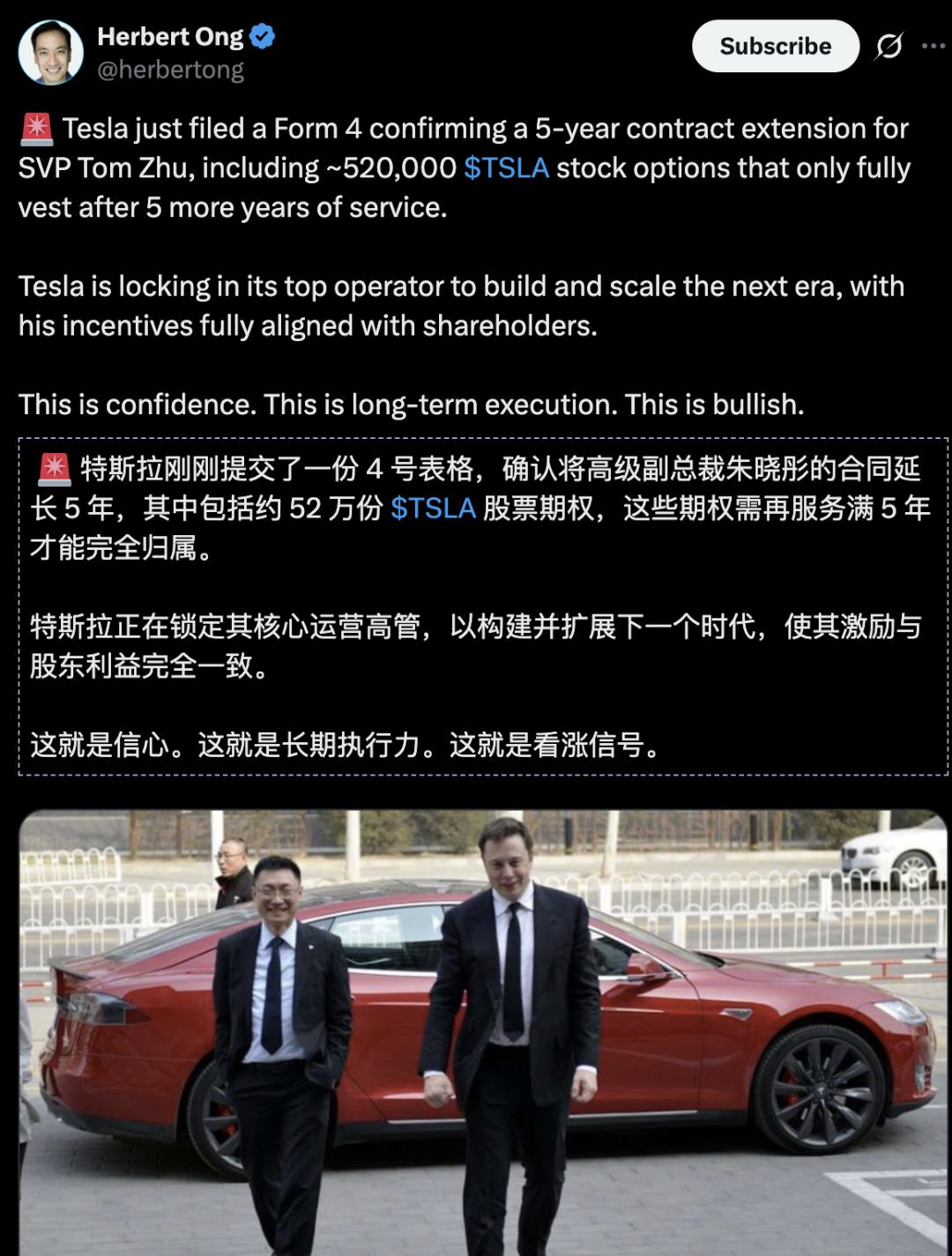
Recently, Tesla disclosed a significant equity incentive plan to the U.S. Securities and Exchange Commission:
It granted over 520,000 stock options to Tom Zhu, the Senior Vice President of Global Automotive Business, currently worth $233 million.
The significance of this equity incentive has long transcended the scope of compensation.
It sends a clear signal to the outside world: Tesla not only has Elon Musk's vision but also Tom Zhu's execution; not only has a grand plan but also someone to turn it into reality.
If Tesla is a ship, Elon Musk is the captain steering the course, while Tom Zhu is the chief engineer ensuring the perfect operation of the engine.
Without Tom Zhu, Tesla's dominance would not be possible.
Currently, Tom Zhu is the Senior Vice President of Automotive at Tesla, also in charge of the Asia-Pacific (APAC) region, including relevant responsibilities as the President of Greater China, as well as global manufacturing and part of the sales operations. He oversees all of Tesla's car factories: Shanghai, Berlin, Fremont, and Texas.

Worth $233 million, redemption requires "staying for five years"
According to the Form 4 filing submitted by Tesla to the U.S. Securities and Exchange Commission (SEC), Tom Zhu was awarded 520,021 stock options with an exercise price of $435.80 per share.
To fully redeem them, he must serve at Tesla until at least March 5, 2031.
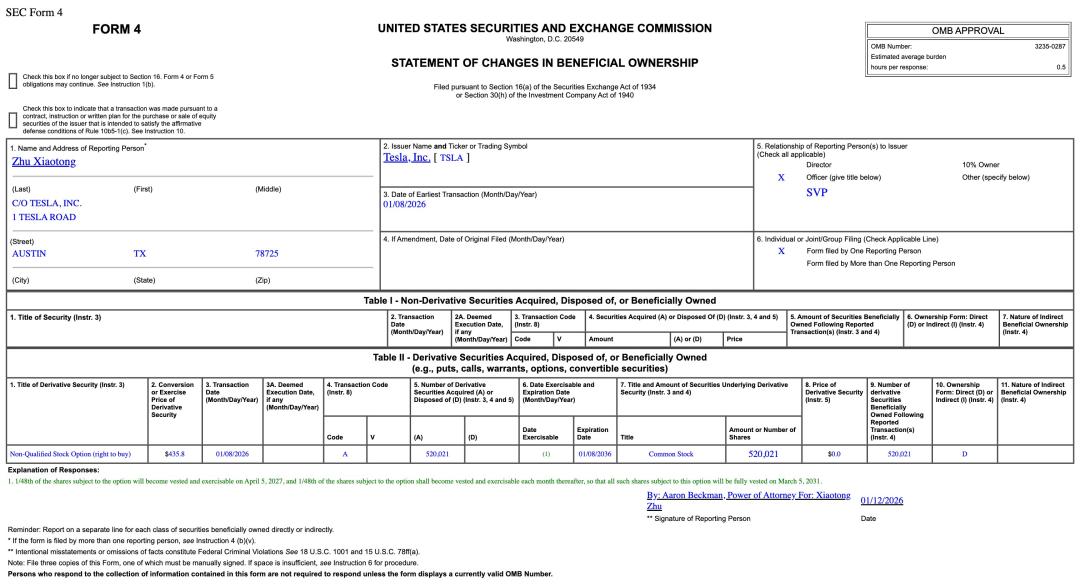
Considering that Tesla's current stock price has been hovering between $445 and $450, these options are currently worth over $233 million.
If the company achieves the market - value target set in Elon Musk's 2025 compensation plan in the future, Tom Zhu will join the ranks of billionaires through this incentive.
Although the current stock price is similar to the exercise price, making this incentive seem "neither profitable nor loss - making," it actually reflects its deeper intention - it's a bold bet, a firm wager on the company's long - term value.
From this stock option incentive, it's obvious that Tesla is making talent reserves for its next - stage ambitions - an indispensable piece of the puzzle is Tom Zhu.
Elon Musk's 2025 compensation plan has sent a signal:
Tesla not only aims to reach the top position in global market value but also to achieve an unprecedented production target.
This goal means that execution will become the core battlefield.
Tom Zhu's "strong implementation ability" and "willingness to take on tough challenges" are exactly the weapons the company needs most.
His presence will play a crucial role in Tesla's high - stakes global bet.
Sandstorms, railway tracks, and wildness: The non - typical executive's origin
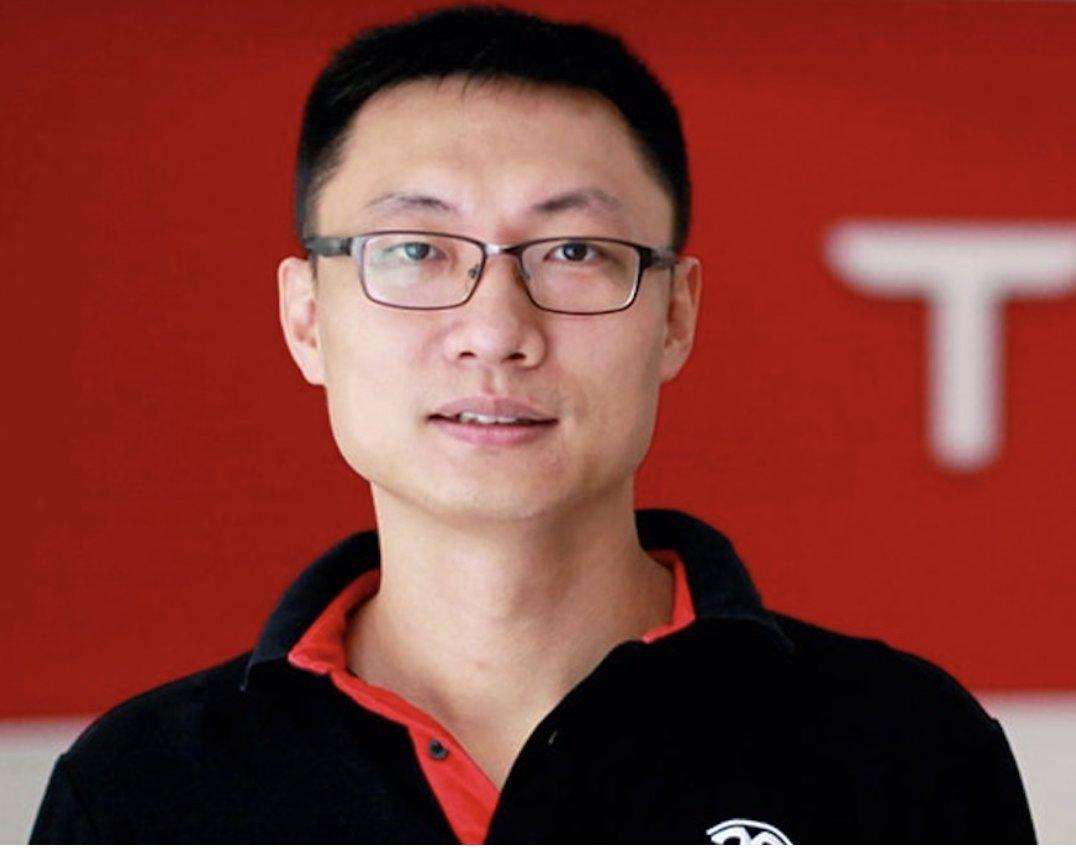
Tom Zhu was born in Shenyang, China, and holds an MBA from Duke University. However, after graduation, instead of going to Wall Street or Silicon Valley, he went to Sudan.
During his tenure at Kaibo Engineering, he was in charge of a $500 million Sudanese irrigation project, a $162 million Nigerian railway project, and built bridges, hospitals, and power grids in Uganda...
His daily work involved combating sandstorms, shortages of supplies, and cultural conflicts.
In Africa, he learned a simple but harsh principle:
Excuses can't build bridges.
It was this "leading - from - the - front" style that allowed him to knock on Tesla's door in 2014 with zero automotive experience -
Because Elon Musk doesn't look for automotive professionals but for strong individuals who can get things done even when the odds are zero.
In April 2014, Tom Zhu joined Tesla and was initially given a daunting task: building the Supercharger network.
At that time, Tesla's entry into the Chinese market was a disaster. "Range anxiety" severely dragged down sales, and the company's reputation was on the verge of collapse.
While his colleague Robin Ren was acting like a diplomat, negotiating among government agencies, Tom Zhu was running around on the streets.
He advanced the construction of the charging network with military precision, personally negotiating with property managers of shopping malls and hotels, and often supervising the installation work late at night.
The turning point came in December 2014.
Tesla's sales in China plummeted, and the organization was in chaos. Wu Bixuan, the President of Tesla China who had taken office with high - profile just nine months ago, suddenly resigned.
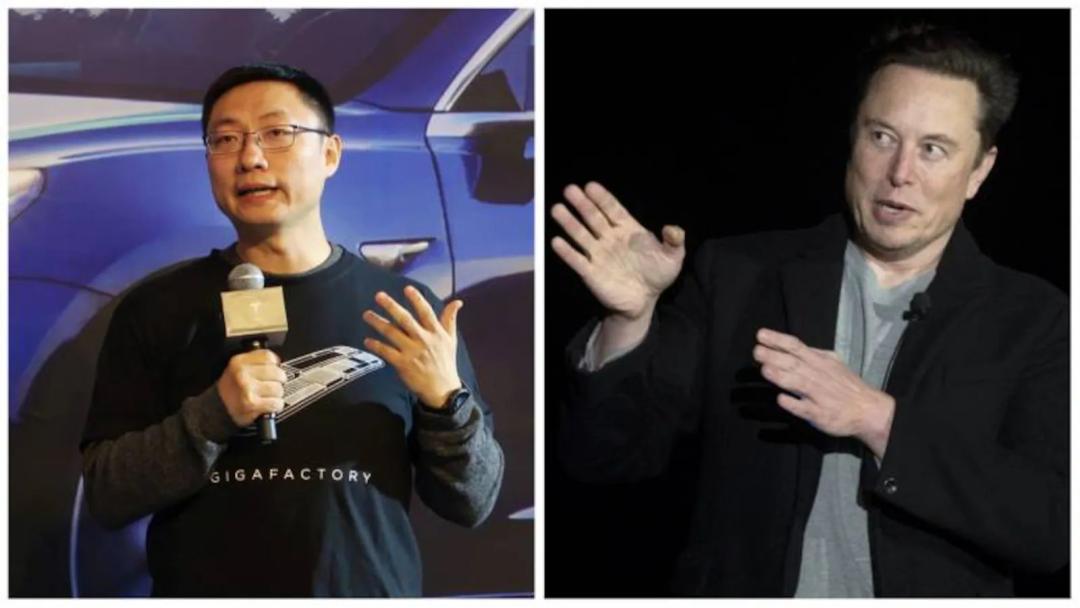
Elon Musk urgently changed the leadership and, without being restricted by convention, handed the keys to Tesla's entire Chinese business to the person who was building the charging stations.
Tom Zhu accepted the position and immediately discarded red tape and fully immersed himself in execution.
Desert sand, railway tracks, and wildness: The non - typical executive's origin
Tom Zhu was born in Shenyang, China, and holds an MBA from Duke University. However, after graduation, instead of going to Wall Street or Silicon Valley, he went to Sudan.
During his tenure at Kaibo Engineering, he was in charge of a $500 million Sudanese irrigation project, a $162 million Nigerian railway project, and built bridges, hospitals, and power grids in Uganda...
His daily work involved combating sandstorms, shortages of supplies, and cultural conflicts.
In Africa, he learned a simple but harsh principle:
Excuses can't build bridges.
It was this "leading - from - the - front" style that allowed him to knock on Tesla's door in 2014 with zero automotive experience -
Because Elon Musk doesn't look for automotive professionals but for strong individuals who can get things done even when the odds are zero.
In April 2014, Tom Zhu joined Tesla and was initially given a daunting task: building the Supercharger network.
At that time, Tesla's entry into the Chinese market was a disaster. "Range anxiety" severely dragged down sales, and the company's reputation was on the verge of collapse.
While his colleague Robin Ren was acting like a diplomat, negotiating among government agencies, Tom Zhu was running around on the streets.
He advanced the construction of the charging network with military precision, personally negotiating with property managers of shopping malls and hotels, and often supervising the installation work late at night.
The turning point came in December 2014.
Tesla's sales in China plummeted, and the organization was in chaos. Wu Bixuan, the President of Tesla China who had taken office with high - profile just nine months ago, suddenly resigned.
Elon Musk urgently changed the leadership and, without being restricted by convention, handed the keys to Tesla's entire Chinese business to the person who was building the charging stations.
Tom Zhu accepted the position and immediately discarded red tape and fully immersed himself in execution.
The miracle in Lingang: Saving Tesla in 10 months
The real game - changing battle was in Lingang in 2018.
On that occasion, Tom Zhu saved Tesla from financial collapse.
At that time, Tesla had obtained permission to build a factory in Shanghai.
The timeline required by Elon Musk was generally considered a fantasy: transforming a muddy wasteland in Lingang into a world - class car factory in less than a year.
Tom Zhu took on this task, which was regarded as a "daydream" by the industry.
He moved into a public rental housing just 10 minutes away from the construction site, with a monthly rent of less than 2,000 yuan.
It wasn't to save money but to be the first to arrive at 6 a.m. and the last to leave at dawn every day.
Employees recalled that they often saw him in his iconic outfit: a crew cut, the standard - issued high - visibility Tesla vest, and safety boots.
Even when a typhoon flooded the construction site, he climbed onto the roof with the workers and scooped water out with buckets...
Then, a miracle happened:
In January 2019: It was still a muddy field;
In October 2019: The first batch of trial - produced cars rolled off the production line.
What the industry usually takes 2 to 3 years to complete, Tom Zhu achieved in 9 months.
A super - factory with an annual production capacity of hundreds of thousands of vehicles was built, shocking the industry.
The Shanghai Gigafactory quickly became Tesla's "cash cow," with both manufacturing efficiency and gross profit margin exceeding those of its U.S. factories.

By 2022, the Shanghai Gigafactory had become a powerhouse.
• Over 750,000 vehicles per year
• 65% cheaper than U.S. factories
• One vehicle rolls off the production line every 5 seconds
Leaving and then returning
By the end of 2022, Elon Musk realized that the high efficiency of the Shanghai factory was not just a local exception but a culture that needed to be promoted externally.
Tesla's factories in Austin, Texas, and Berlin, Germany, were continuously losing money, and the mass production of the Model Y and Cybertruck was delayed.
Instead of hiring a consulting firm, he directly "recruited a general for battle."
When Tom Zhu arrived in Texas, he was accompanied by a group of his most loyal deputies from Shanghai, known as the "Zhu's Army."

This scene had a sharp cultural contrast, and he was ready to inject the discipline of Lingang, Shanghai, into the heart of Tesla's U.S. factories.
In April 2023, Tom Zhu was officially appointed as the Senior Vice President of Global Automotive Business, becoming Tesla's global number - two person, second only to Elon Musk.
However, the story didn't end in the comfortable office in Austin.
By mid - 2024, competition in the Chinese market had become even more intense.
Local competitors were aggressively eroding Tesla's market share.
Tom Zhu chose to return to Shanghai and take charge again.
As soon as he took over, he launched two powerful moves:
Promote the expansion of sales channels to third - and fourth - tier cities to explore new growth opportunities;
Radically restructure the sales team, cutting inefficient links with the same iron - fisted approach as in 2014.
This is not a demotion but a new mission.
Tom Zhu is the person who will always appear at the most critical moment on the battlefield.
The grand blueprint: A production capacity of 100,000 Optimus robots
Tom Zhu's ten - year bet is not only about his personal financial freedom but also about whether Tesla can truly transform from a car company into an AI robot platform.
In 2026, Optimus will reach a critical moment for mass production.
According to the plan, the Gen3 mass - production version will be released in the first quarter, a production line with an annual capacity of 100,000 units will be launched by the end of the year, and the goal of one million units will be targeted in 2027.
This is not about making a toy but redefining the future labor market.
The upgrade of Optimus Gen3 is revolutionary:
It is about 173 cm tall and weighs 57 kg, 10 kg lighter than the previous generation.
The most core breakthrough is the dexterous hand - with 22 degrees of freedom, approaching the 27 degrees of freedom of a human hand.

Equipped with the