The 2025 Mobile Phone Battle: Huawei Wins in Sales Volume, Apple Holds on to Profits, and Xiaomi, OPPO, and VIVO Are Caught in the Middle
The mobile phone market in 2025 can be described in two words: competition and differentiation.
In the global market, Apple and Samsung remain the absolute main players. According to IDC data, the overall global market achieved a 1.9% growth, and the total shipment volume increased to 1.26 billion units. Among them, the two giants, Apple and Samsung, with shipment volumes of 248 million units (a year - on - year increase of 6.3%) and 241 million units (a year - on - year increase of 7.9%) respectively, together took nearly 40% of the market share and the vast majority of the industry's profits.
The market performances of the last three players showed obvious differentiation. Xiaomi, in third place, shipped 165 million units, and its market share slightly dropped to 13.1%. Vivo's shipment volume slightly increased by 2.7%, and its ranking rose to fourth. OPPO's shipment volume declined by 2.7%, and its ranking dropped to fifth. Both Vivo and OPPO had a market share of around 8%.
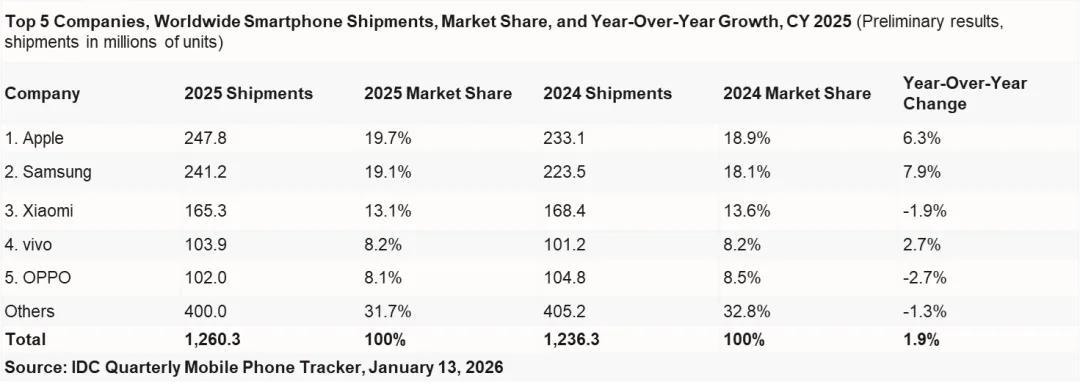
Shipment volumes and market shares of the top five global mobile phone manufacturers in 2025. Source: IDC
In contrast, the Chinese market was more exciting and more brutal, with the rankings completely changing.
In 2025, the shipment volume of the Chinese smartphone market was 285 million units, a slight year - on - year decrease of 0.6%. In this slightly declining "red ocean" market, a fierce battle for the throne was taking place.
Huawei is back: Its market ranking went from sixth in 2023, to second in 2024, and then in 2025, with a shipment volume of 46.7 million units and a market share of 16.4%, it narrowly defeated Apple (which shipped 46.2 million units with a 16.2% share), returning to the top of the Chinese market for the first time in five years.
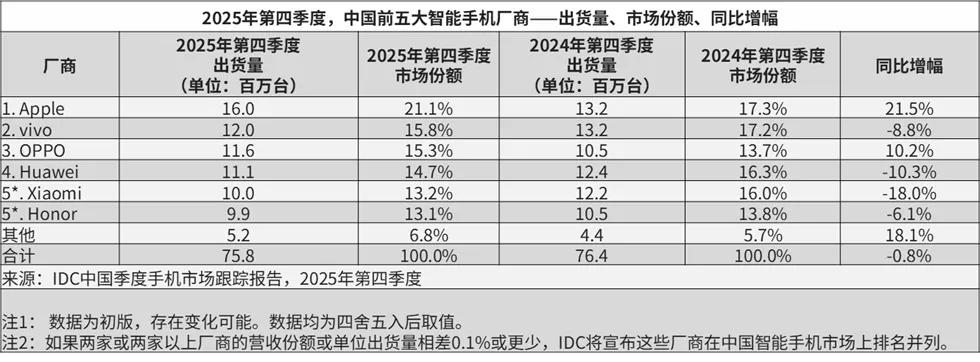
Apple firmly holds the high - end market: Although it lost the annual championship, Apple strongly rebounded in the fourth quarter, with a single - quarter market share as high as 21.1%, indicating its appeal in the high - end market.
The landscape of "MiOV" is being reshaped: Vivo (with 46.1 million units shipped and a 16.2% market share) dropped from first place last year to third, but the gap with Huawei and Apple was already very small; Xiaomi (43.8 million units shipped, 15.4% share) and OPPO (43.4 million units shipped, 15.2% market share) ranked fourth and fifth respectively.
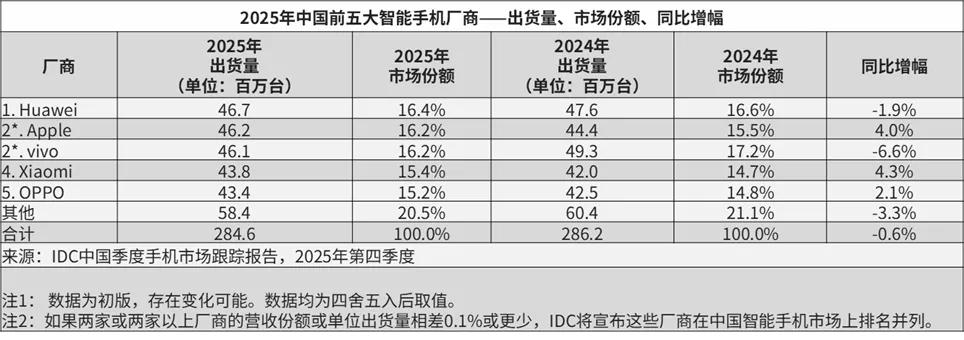
Source: IDC
Looking back at 2025 as a whole, the positions of Apple, Samsung, and Huawei became more stable, while the market shares of Xiaomi, Vivo, and OPPO were being squeezed, with the differentiation intensifying.
What is the logic behind this "competition" and "differentiation"? This article attempts to explore through the following three questions:
What exactly are Huawei and Apple competing for in their "throne battle"?
What are the gains and losses of Vivo, Xiaomi, and OPPO respectively in the gaps between the giants?
In 2026, under the cost storm and technological variables, who can survive?
The "Huawei - Apple" competition: The fourth quarter is the turning point
In the Chinese mobile phone market in 2025, the main players were undoubtedly Huawei and Apple.
This year was Huawei's first full fiscal year after coping with external challenges and with the continuous recovery of its supply chain, and it was also the year when Apple encountered the greatest resistance in the Chinese market. Eventually, Huawei (with 46.7 million units shipped) narrowly defeated Apple (46.2 million units shipped), regaining the annual sales championship in the Chinese market.
The gap was only about 500,000 units.
This was equivalent to a 0.2% market share. In the overall market environment where there was a 0.6% year - on - year decline, any tiny advantage was hard - won. Looking back at 2025, this competition was full of ups and downs:
In the first three quarters, it was Huawei's "blitzkrieg". Riding on the success of the Mate 70 series, nova series, and Pura 80 series, it advanced triumphantly. Especially the later Pura 80, although it didn't contribute much to the shipment volume, its greater value was that it snatched many female users and the young group from iPhone with its breakthrough in imaging. Huawei's market rankings in the first two quarters were second and first respectively.
At this time, Apple, which was in a new - product window period, was obviously in a passive position, ranking fifth in both the first and second quarters.
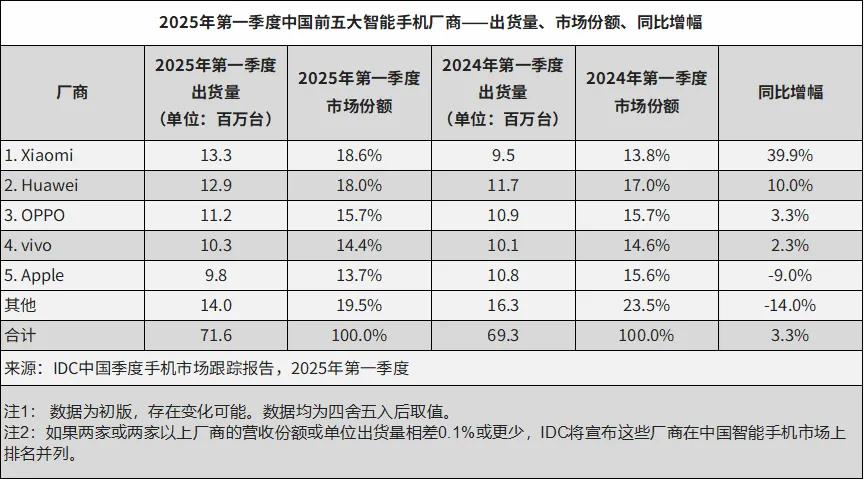
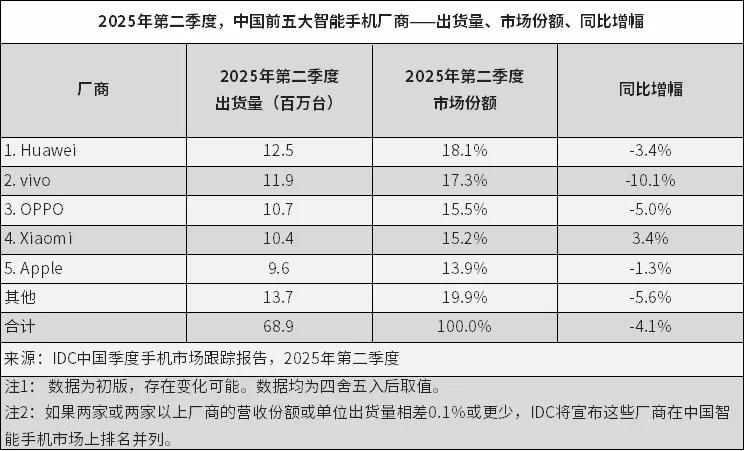
At the end of the third quarter, with the release of the iPhone 17 series in September, Apple launched a "counter - attack", and the situation began to reverse. Apple rose to second place, and Huawei dropped to third.
Although the outside world had mixed reviews on the innovation of the iPhone 17, this time Apple chose to "increase the quantity without increasing the price". The capacity increased, but the price remained the same, and the appearance of the Pro series also changed. Coupled with the brand inertia and the stickiness of the iOS ecosystem, it strongly rebounded at the end of the third quarter.
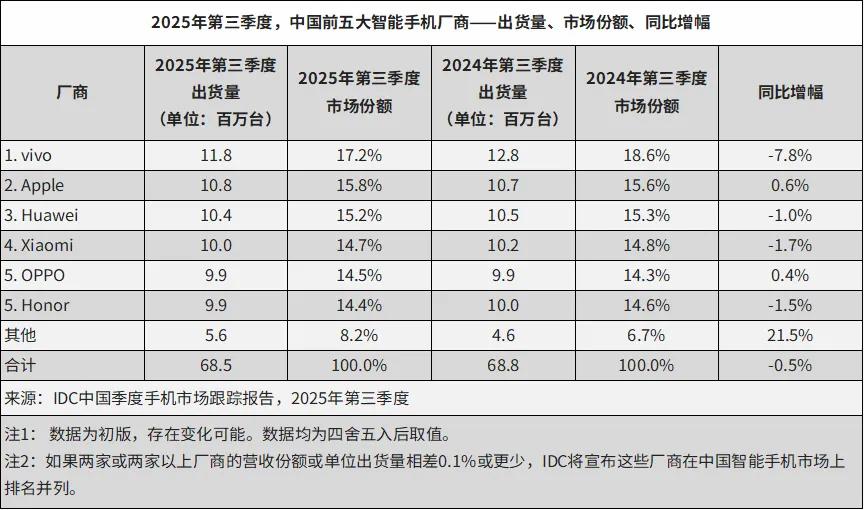
The fourth quarter was the final "hand - to - hand combat". Both sides were extremely determined. Huawei launched the Mate 80 and the foldable Mate X7, and Apple rarely cut prices, which attracted many consumers who were holding back their purchases. Apple shipped a total of 46.2 million mobile phones throughout the year, among which 16 million were sold in the fourth quarter, and its market share soared to 21.1%. Huawei's ranking continued to decline this quarter.
Source: IDC
However, looking at the whole year, Huawei still maintained its advantage with a more diverse product line (straight - screen + foldable) and the support of its brand influence.
So, why did Huawei win?
The mass - production of its self - developed Kirin chips was the biggest contributor. It was like having a foundation for building a building. With a stable supply of high - end flagship models like the Mate 70 and Pura 80, Huawei dared to take bold actions.
The gradual maturity of the HarmonyOS ecosystem also played an important role. With the accelerated commercialization of HarmonyOS NEXT (pure - blooded HarmonyOS), Huawei connected mobile phones, tablets, in - car systems, and PCs. This "Internet of Everything" experience has become an important reason for users to choose and stay with Huawei.
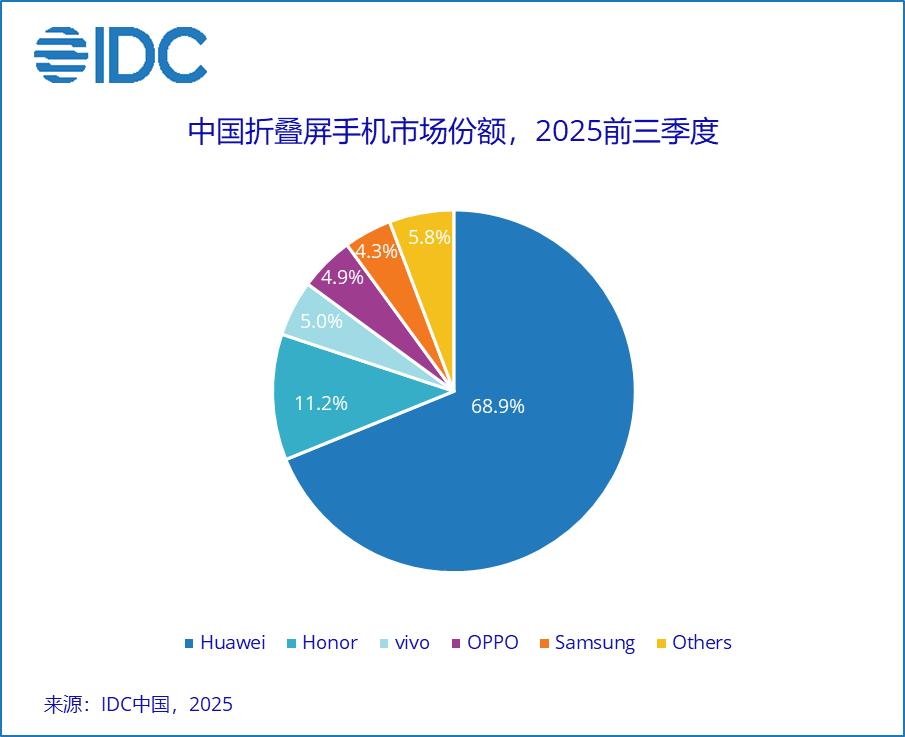
In addition, the foldable - screen market cannot be ignored. In the first three quarters of 2025, Huawei captured 69% of the domestic foldable - screen mobile phone market. Other manufacturers, such as Honor, only had an 11% share, and Vivo, OPPO, etc. had even single - digit shares.
This means that in the ultra - high - end market above 6,000 yuan, for every 10 foldable - screen phones sold, 7 were from Huawei. For Huawei, this not only brought high profits but also enhanced its brand image, making consumers feel that "Huawei is more innovative than Apple". Apple's absence in the foldable - screen market allowed Huawei to dominate this niche market.
Source: IDC
Although Apple lost the first place, it still managed to sell 46.2 million units without a foldable - screen phone and with a lagging AI function (the domestic version of Apple Intelligence was launched late), indicating that the iPhone's basic user base was stable and Apple's brand appeal was still not to be underestimated. A Counterpoint report showed that in the first half of 2025, Apple's share in the global market for phones priced above $600 reached 62%.
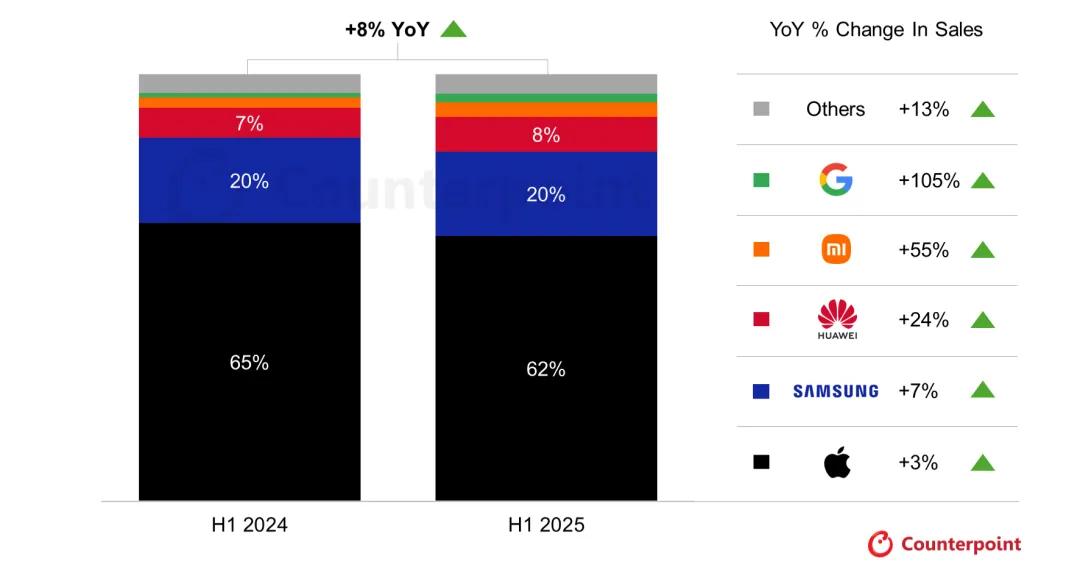
Unit sales share of the global high - end (>$600) smartphone market (by OEM). Source: Counterpoint Research
In 2025, Huawei won the "annual championship", and Apple won the "Q4 championship". Huawei won with its momentum and innovation, while Apple won with its foundation and profits. The deeper barrier lies in the ecosystem. Huawei's HarmonyOS native applications and Apple's iOS are becoming moats to lock in their respective users.
The survival battle of MiOV: Obstacles in high - end market and global competition
While Huawei and Apple were in a close - range fight at the top of the pyramid, how were Vivo, Xiaomi, and OPPO faring?
The answer is: The competition was unprecedentedly fierce, and each company was struggling to survive in the gaps.
IDC data best illustrates the situation: In 2025, Vivo's annual shipment volume decreased by 6.6% year - on - year, the largest decline among the top five; although Xiaomi had a slight annual increase of 4.3%, its shipment volume in the fourth quarter plummeted by 18%, a larger decline than Huawei's; OPPO had a slight annual increase of 2.1%, with little change.
If we use one word to summarize the year 2025 for these three companies, they are: stable, aggressive, and trapped.
Vivo's performance can be summarized as "rising globally but falling domestically": Its global market share remained stable at 8.2%, firmly holding the fourth place; but in its domestic home market, its ranking dropped from first to third.
However, looking deeper, although its Q4 shipment volume decreased by 8.8%, its annual market share still remained at 16.2%. This shows that under the squeeze of Huawei and Apple, although Vivo lost the annual championship, it was still in the same competitive echelon as Huawei (16.4%) and Apple (16.2%).
The reason for Vivo's "stability" is, of course, its solid "basic user base" in the domestic market: The iQOO (e - sports) and Y series (cost - effective offline models) targeted niche and sinking markets, and the X series established itself in the mid - to - high - end market ($4,000 - $6,000). In the first half of 2025, Vivo was the only brand among the top three manufacturers (Huawei, Xiaomi, and Vivo) in the $4,000 - $6,000 price range to achieve a share increase, with its share rising from 8.8% to 14%.
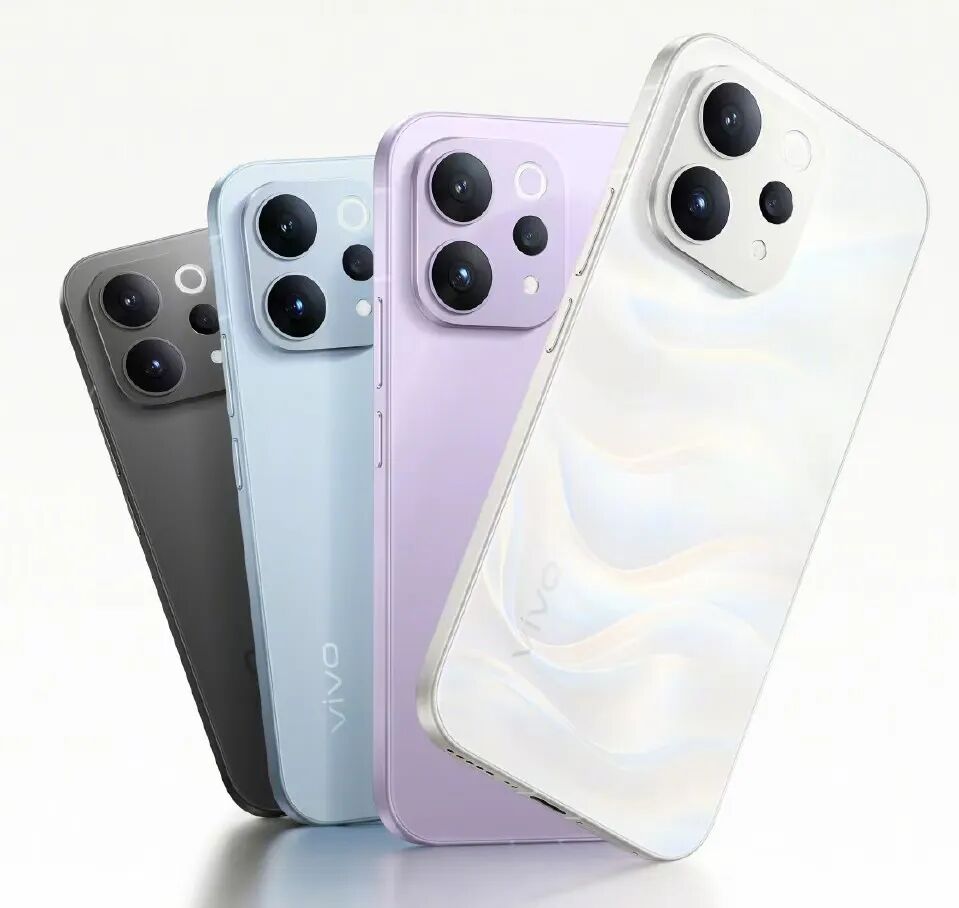
Source: Vivo's official corporate Weibo
However, Vivo's hidden concerns are also obvious: There is an obvious ceiling for high - end development, and global risks are concentrated: Vivo lacks a presence in the ultra - high - end market above $6,000, which directly limits its brand premium and profit margin; moreover, Vivo's current global growth depends on the Indian market, and geopolitical risks need to be monitored.
Based on the views of multiple interviewees, Vivo's strategy is more defensive than offensive. In a stable industry period, it can do well with its channel and product - diversification strategies, but when the industry undergoes major changes, this "stability - seeking" approach may lead to missed opportunities.
Next, let's look at Xiaomi. Its keyword is "aggressive", but it still needs to work harder on high - end development.
Xiaomi's global mobile phone shipment volume decreased by 1.9%, but its ranking remained stable at third. In the domestic market, it took the first place in Q1 thanks to the "national subsidy" bonus, but it lacked stamina and ranked fourth for the whole year.
Xiaomi's "gain" lies in its global layout. In emerging markets such as Latin America and the Middle East, Xiaomi made great progress and ranked second. This offset the pressure in the domestic market to a certain extent.
However, Xiaomi's "loss" is also obvious: The achievements of its high - end mobile phone business are limited to the domestic market, and it still relies on mid - to - low - end models in the global market.
In the domestic market, the ASP (average selling price) of Xiaomi's mobile phones increased, but the overall global ASP was still under pressure. For example, the ASP of its smartphones in Q2 2025 decreased by 2.7% year - on - year, partly because it relied on mid - to - low - end models like Redmi for sales overseas. This shows that Xiaomi's high - end development