Can the $830 billion unicorn no longer tell new AI stories after dipping its toe into advertising?

Schematic diagram
Text | Xiaojing
Editor | Xu Qingyang
Sam Altman once said in an interview, "Advertising plus AI makes me extremely uneasy. I think advertising is the last resort for our business model."
However, at the beginning of 2026, at around midnight on January 17th Beijing time, OpenAI announced that it would officially start testing the "advertising plus AI" model that makes Altman so uneasy.
In the next few weeks, ChatGPT will initiate advertising tests in the US market first, and at the same time, launch a low - cost monthly subscription package called ChatGPT Go for $8 in key global markets. This is only one month after OpenAI initiated a "Code Red" internally.
Facing the high expectations of capital with a new round of financing targeting a valuation of $830 billion, OpenAI must find real payers in the real market for the trillions of dollars in computing power costs before the implementation of AGI.
01
"Restrained" Advertising
OpenAI, which has just started testing advertising, still maintains a considerable degree of restraint. It has also made some minor innovations by leveraging the advantages of AI. After all, according to Altman, this is the "last resort" of the business model.
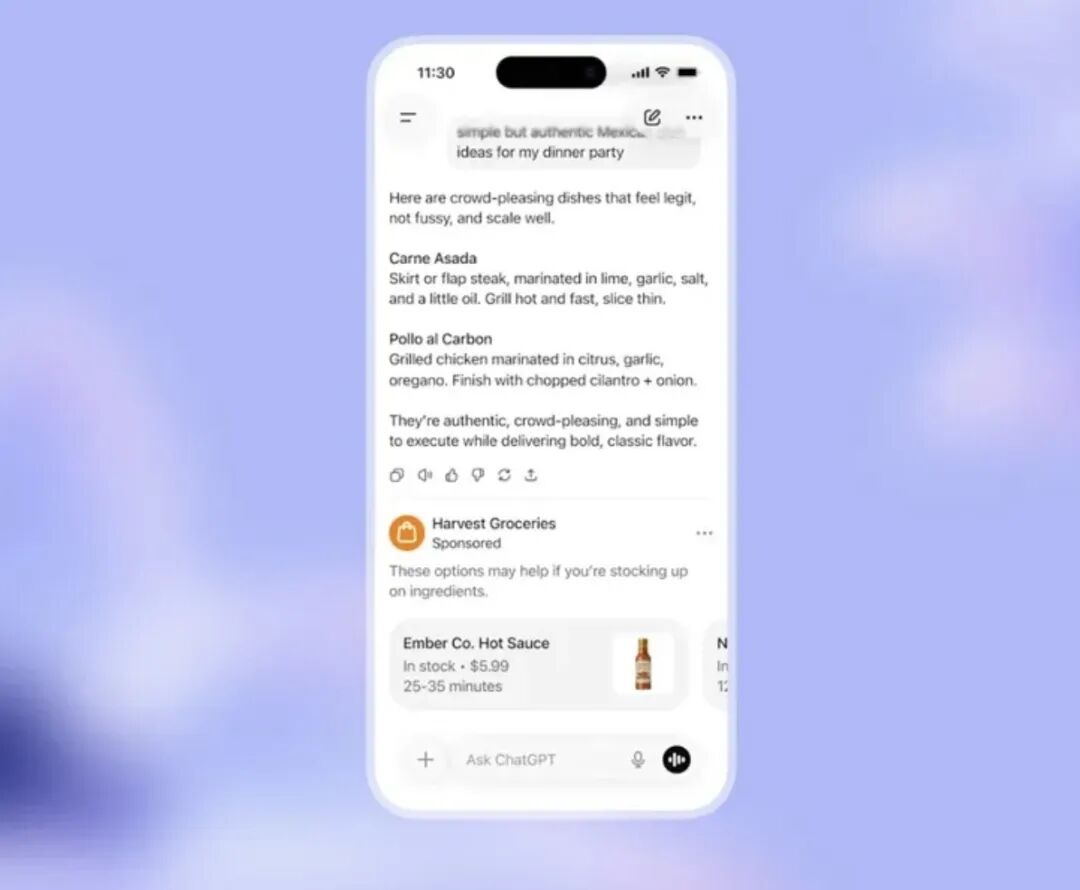
OpenAI Tests Advertising
ChatGPT Displays Ads in the Form of "Conversation Nodes" at the Bottom
Ads Are Not in the Answers but at the End of the Text
During the testing phase, ads will not be crudely inserted into the answer text. Instead, they will be presented in the form of "conversation nodes" at the bottom and will only be triggered when the model determines that they are highly relevant to the user's current needs. For example, when a user asks for a cooking plan for a Mexican - style dinner, after ChatGPT provides a detailed recipe, it will attach a one - click shopping prompt for ingredients from sponsors at the bottom of the page.

OpenAI Tests Advertising
Ads Support Users to "Follow - up Question"
Users can directly consult the platform for details about the ad content and even complete various inquiries related to purchase decisions within the conversation interface.
Don't Disturb "High - end Users" for Now
This advertising test is mainly targeted at free users in the US and the newly launched ChatGPT Go subscription group (monthly fee of $8).
ChatGPT Plus, Pro, and enterprise - level users will continue to enjoy a completely ad - free and pure usage environment. OpenAI hopes that through such hierarchical operation, it can provide sustainable free services for a wider user group while ensuring the experience of high - end users.
02
The Ambition to Become a "Platform"
ChatGPT's subscription revenue accounts for 60% of its total revenue. Since its launch in 2022, the weekly active user count of ChatGPT has rapidly grown to nearly 900 million. According to OpenAI's estimates, the user count is expected to reach 2.6 billion by 2030.
However, as of October 2025, only about 5% of weekly active users paid for the $20 or $200 monthly subscription services. The vast majority of users did not contribute direct revenue.
How to obtain real commercial value from the remaining 95% of users? OpenAI's solution is a lower - price strategy and an advertising strategy. OpenAI's user structure has also been precisely divided into a "four - layer pyramid".
ChatGPT Go for $8
This tier targets the middle - user group who think the $20 subscription price is too high but cannot tolerate the functional limitations of the free version. ChatGPT Go offers 10 times the usage quota of the free version and also unlocks core functions such as GPT - 5.2 Instant, while still including advertising services. This "payment + advertising" hybrid monetization model essentially replicates the mature profit - making path of the streaming media industry.
ChatGPT Plus with a Monthly Fee of $20
When the lower - tier versions are filled with ads, the value of the Plus version is further highlighted. It is positioned as a professional and pure space equipped with the GPT - 5.2 Thinking deep - reasoning engine and the Codex programming intelligent agent. By artificially creating a dual difference between "advertising interference" and "reasoning depth", OpenAI has successfully attracted high - value users to this paid tier.
ChatGPT Pro with a Monthly Fee of $200
This is the top of the product pyramid, offering a super - large context window (196K and above) of GPT - 5.2 Pro and the priority to experience new functions. Its positioning has long gone beyond the scope of a tool and has become an entry point for productivity privileges for high - end users.
If even the $8 monthly fee is difficult to convert users, there are still free users at the bottom of the pyramid, who will be covered by advertising.
This hierarchical strategy has long gone beyond the scope of simple tool pricing and is a typical platform - level traffic operation concept.
In addition to the ChatGPT client for ordinary users, OpenAI also has a traditional API business for developers and offers enterprise - customized deployment (Enterprise/Team versions), deeply penetrating high - value vertical fields such as code development, healthcare, financial services, and legal consulting.
This part of the business is regarded as OpenAI's core "moat". Although the customer decision - making cycle is long, it has extremely high user stickiness and customer unit price. The continuous prosperity of the developer ecosystem essentially allows programmers and enterprises around the world to share the marginal cost of its computing power research and development.
So far, the subscription business accounting for 60% of the revenue, the traditional B - end API business, and the new advertising business have become the new three pillars of OpenAI's revenue structure.
03
How Much Incremental Revenue Can Advertising Create?
As the "second growth curve" that the current capital market values the most, how much money can it actually earn? According to OpenAI's internal prediction, the revenue from the new advertising business alone is expected to exceed $10 billion in 2027. By 2030, the revenue target from non - paying user groups (through advertising placement and transaction sharing) will be as high as $110 billion.
Through early interface cooperation with retail giants such as Walmart, Shopify, and Target, OpenAI hopes to transform itself from an "intelligent Q&A tool" into a new platform in the AI era.
According to publicly available media information, OpenAI is preparing for a new round of financing with a target amount of up to $100 billion, which is expected to push its valuation from $500 billion at the end of 2025 to $830 billion.
Obviously, an AI efficiency tool alone cannot support a valuation of $830 billion, but a platform with a complete user ecosystem and traffic distribution capabilities has the potential to reach this "830 - billion - dollar" mark.
Some commentators say that behind OpenAI's "face - slapping" and hasty turn towards advertising is the helplessness under huge financial pressure. Even though OpenAI's annualized revenue exceeded $20 billion at the end of 2025, its capital consumption rate has reached an astonishing level.
In the first half of 2025, the operating loss was as high as $8 billion. There are even market rumors that the single - quarter loss in the third quarter of 2025 might have exceeded $12 billion. For a technology company in the growth stage, such a "burn - rate" has almost refreshed the industry record.
At the same time, as a unicorn enterprise that ignited the generative AI wave, it has to continue to bet big on the Scaling Law path.
OpenAI has clearly promised that between 2025 and 2029, it will invest approximately $115 billion in computing power construction and data center building. In the long - term plan, the scale of the AI infrastructure investment blueprint outlined by Altman is as high as $1 trillion to $1.4 trillion.
But is advertising really just a helpless move?
04
Is the "Original Intention" of No Ads an Impossible Dream?
The paths taken by Google and Meta have proven that "no ads" is just an unachievable "utopian story" for tech giants in the early stages of entrepreneurship. Altman is just retracing this path.
Early Google was a company with an engineer's obsession for purity. Co - founders Larry Page and Sergey Brin once publicly declared that search engines should not be driven by advertising, otherwise they would lose their neutrality.
The original AdWords ads were carefully placed on the right side, and they were not even allowed to use pictures, only plain text, for fear of ruining the clean search page.
However, a business turning point in the late 2000s changed all that. When Google realized that the mobile - device screen was only the size of a palm and there was no room for the right - side sidebar, the original "restraint" had to give way to "survival".
To increase the click - through rate, Google started a series of "boiling the frog in warm water" experiments: first, it removed the background color of the ad slots to make them look more like natural search results; then, the number of ad slots increased from 1 to 3, and even 4. By 2016, Google completely removed the right - side ads and concentrated all its efforts on the center of the user's line of sight.
Today's commercial story has gone even further - if you search for "the best mattress" on Google, you can hardly see real review websites on the first three screens; they are all manufacturers that have paid to buy the top positions. The once "guide" has finally become the most powerful "product - promoting salesperson" under capital pressure.
Meta's story follows a similar script.
When Mark Zuckerberg first created Facebook on the Harvard campus, it was once a pure social land that rejected advertising. When the first advertising order came in, to avoid ruining the user experience, he even insisted that the ads must be "social". Early Meta ads just quietly lay in the corner of the page, like a polite onlooker.
The real turning point occurred on the eve of Meta's IPO in 2012. Facing revenue pressure, Meta decided to insert ads into the user's core "news feed". This was a highly controversial decision: ads began to disguise as your friends' status updates, mingling among baby photos and party notifications.
With the acquisition of Instagram and the introduction of algorithmic logic, this radical approach has evolved into a "data - harvesting" operation. The most well - known business example is Meta's "micro - targeting" technology - it can even target ads based on your current emotional state (such as whether you've just broken up or been promoted).
In an internal meeting, Meta's executives once proposed to make ads so "seamless" that users can't tell whether they are ads or part of their daily lives.
In the second half of the era when the traffic dividend is exhausted, the company that can more aggressively squeeze user attention will be able to show a more beautiful curve in the financial report. This is the growth reality that all tech companies have to face.
In contrast, this "restrained" advertising test by OpenAI may very likely evolve into an absolute pillar in OpenAI's revenue structure in the future.
Of course, this should also be the result that OpenAI hopes to see the most. After all, advertising can create a conversion funnel at the broadest base of the pyramid, which seems to be the business model with the least ceiling.
It was the same in the PC Internet era and the mobile Internet era. Will the story be different in the AI era?
Big brother Google looks at the once - passionate "stubborn little brother" and smiles, saying, "Welcome back to the mortal world."
Special translator Wuji also contributed to this article
This article is from the WeChat official account "Tencent Technology", author: Worth Paying Attention To. It is published by 36Kr with authorization.