Feishu BeyondClick: Chinese consumer brands are entering a "new cycle" in their global expansion, transforming hit products into a systematic approach and turning growth into compound interest.
In the past year, consumer brands going global have most acutely felt the tangible increase in their cost structures.
The "2025 MeetBrands List Report of China's Emerging Consumer Brands Going Global" jointly released by BeyondClick, a professional marketing service sub - brand under the Feishu Shennuo Group focusing on e - commerce and brand expansion overseas, and Ipsos shows that the cost per click (CPC) of Google Ads has increased by 10% year - on - year, and the cost per lead (CPL) of Meta has soared by 20%. The logic that "growth can be achieved by simply pouring money into advertising" is no longer working. Every click from users is a direct query and demand for brand value.
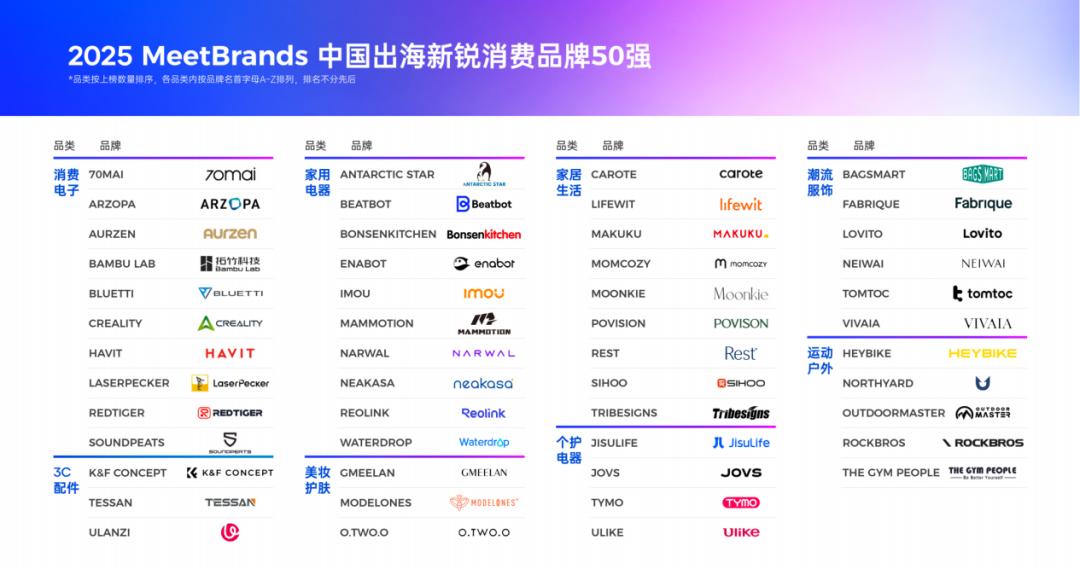
Based on more than 10 years of global advertising data accumulation, combined with its full - link marketing capabilities and cross - regional operation experience, BeyondClick has acutely discovered that "the survival logic of brands going global is shifting from relying on external dividends to building internal systematic capabilities." In the "2025 MeetBrands Top 50 Emerging Chinese Consumer Brands Going Global" list released in the report, we observed that the emerging consumer brands going global that have survived the brutal screening and successfully "evolved", despite their different backgrounds, show many commonalities in strategy and thinking. This may constitute the "coordinate system" to help Chinese brands going global navigate through different cycles.

2025 MeetBrands Top 50: 16 Brands "Graduate", 33 Emerging Brands "Debut"
Behind the changes in the "2025 MeetBrands Top 50 Emerging Chinese Consumer Brands Going Global" list lies a microcosm of the structural upgrading of the entire overseas expansion industry. The entry or exit of many brands is not due to the survival of the fittest in the competition within the same category, but rather the change in the rules of the game.
Portrait of "Graduated" Brands: Annual Overseas Revenue of $500 Million, Global Layout Becomes a Hard Requirement
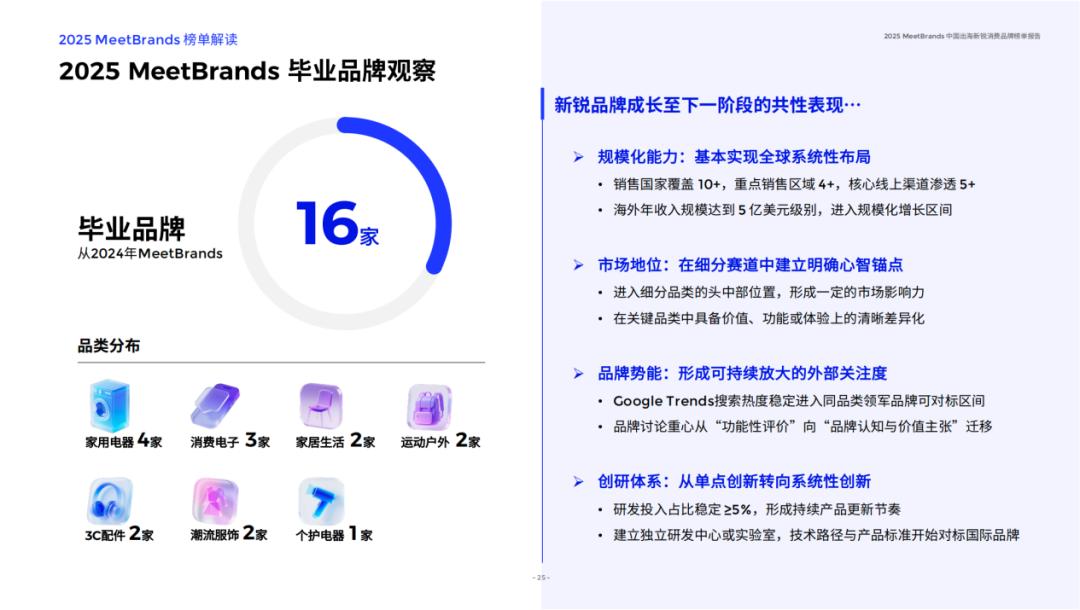
First of all, it's worth noting the 16 "graduated brands", including CATLINK, TORRAS and other brands, which have completed the leap from "emerging" to "benchmark". When BeyondClick reviewed these leading brands, it found a clear "global golden line" that outlined the basic portrait of these brands: the report depicts that these brands have an annual overseas revenue of up to $500 million, cover more than 10 countries globally, have basically completed a systematic localization layout, entered the leading camp of niche categories, and started to reverse - output brand standards as category definers. "Their 'graduation' marks that the first echelon of Chinese brands going global has officially transformed from 'overseas - oriented brands' to 'global brands'."
Rise of Emerging Brands: Technological Premium and Scenario Occupancy Replace Low - Quality Traffic Competition
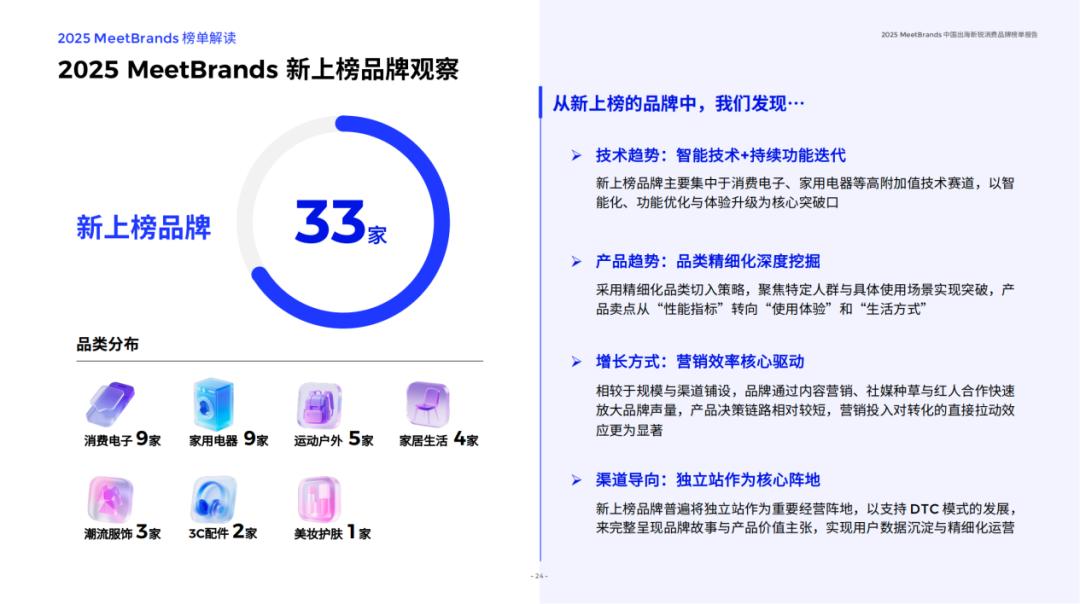
The 33 newly listed emerging brands have the characteristics of "new category leaders", with their revenues jumping from tens of millions of dollars to hundreds of millions of dollars. "Technological premium and scenario premium are replacing traffic dividends as new breakout points."
Firstly, there is a soaring "power - related" presence. From the perspective of category distribution, "power - related" categories such as consumer electronics (20%), household appliances (20%), and personal care appliances (10%) account for nearly 50% in total. Relying on China's mature hardware supply chain and the engineer dividend, these brands solve pain points through functional innovation. The premium of "hard technology" remains the most certain path for going global at present.
Secondly, there is the rise of "scenario - based" products. The report shows that the proportion of categories that emphasize usage scenarios, such as sports and outdoor products and niche home products, has increased significantly. Such brands are more likely to establish differentiated value and support brand premium and repurchase. In contrast, categories such as trendy clothing and beauty and skincare products, which rely too much on aesthetic dividends and traffic advertising, are starting to encounter growth bottlenecks and are the first to feel the chill of going global in the context of high advertising costs.
Regional Division of Labor: The Pearl River Delta as the "Hardware Silicon Valley", the Yangtze River Delta as the "High - ground for Brand Operation"
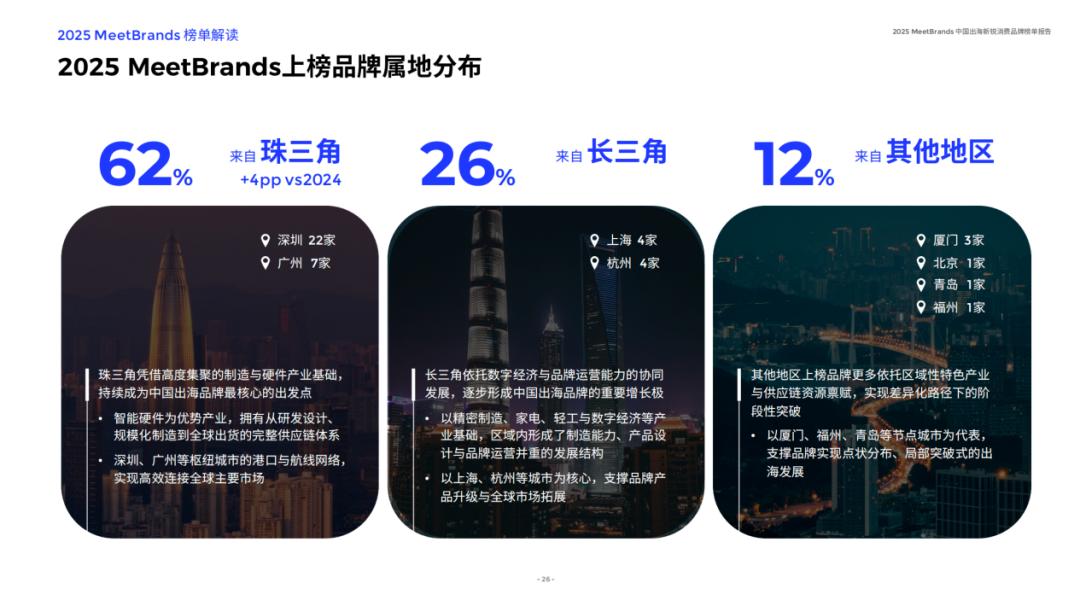
The Pearl River Delta remains the "engine" for going global, contributing 62% of the listed brands, and its proportion is still increasing compared to 2024. Among them, Shenzhen's flexible supply chain as the "Hardware Silicon Valley" supports the high - frequency iteration of consumer electronics brands.
The Yangtze River Delta region has become the "high - ground for brand operation", with the proportion of listed brands reaching 26%. Relying on the rich talent and e - commerce genes in Jiangsu, Zhejiang, and Shanghai, it has made steady progress in fields such as precision manufacturing, household appliances, light industry, and the digital economy, and pays more attention to brand quality and user relationships. "The going - global of Chinese consumer brands is shifting from 'point - based breakthroughs' to 'regional collaboration', forming a more resilient cluster ecosystem."
Invisible Thresholds for Emerging Brands: Four Capability Traps Slow Down Growth
In addition to the hard indicators of revenue scale, the report also reveals the "invisible capability thresholds" of many mid - tier brands going global, which have become the main reasons for their growth stagnation.
For example, over - reliance on low prices and traffic leads to stagnant profits and repurchase rates; the lack of local narratives causes overseas consumers to "see but not trust"; over - reliance on a single market or channel magnifies external fluctuations into operational risks; and the disconnection between digital investment and business leads to data fragmentation, slow decision - making, and an imbalance between input and output. BeyondClick believes that only by crossing these invisible thresholds can brands evolve from the growth stage to emerging brands.

Path to Breakthrough in Brand Capabilities: Cross the "Capability Trap" and Move Towards Long - term Globalization
As the overseas expansion environment enters the stage of "quality screening" from "scale expansion", the D - MES evaluation system used in the list has undergone a key upgrade in 2025 to more effectively evaluate the long - term effectiveness of the brand's comprehensive potential and help Chinese brands going global cross the "capability trap".
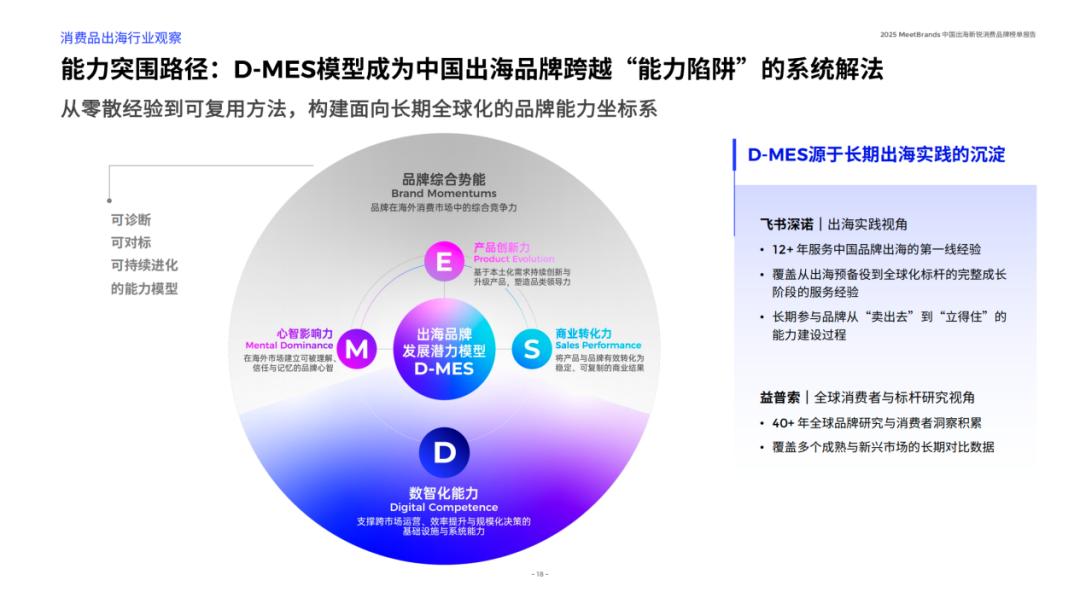
The D - MES model is derived from the long - term overseas service practice and brand research of BeyondClick and Ipsos, covering four aspects: the brand's digital capabilities, influence on consumer mindsets, product innovation and evolution, and business conversion capabilities.
Digital Capabilities: Embed AI Agents into Core Business, Upgrade Digital Tools to "Decision - Making Brains"
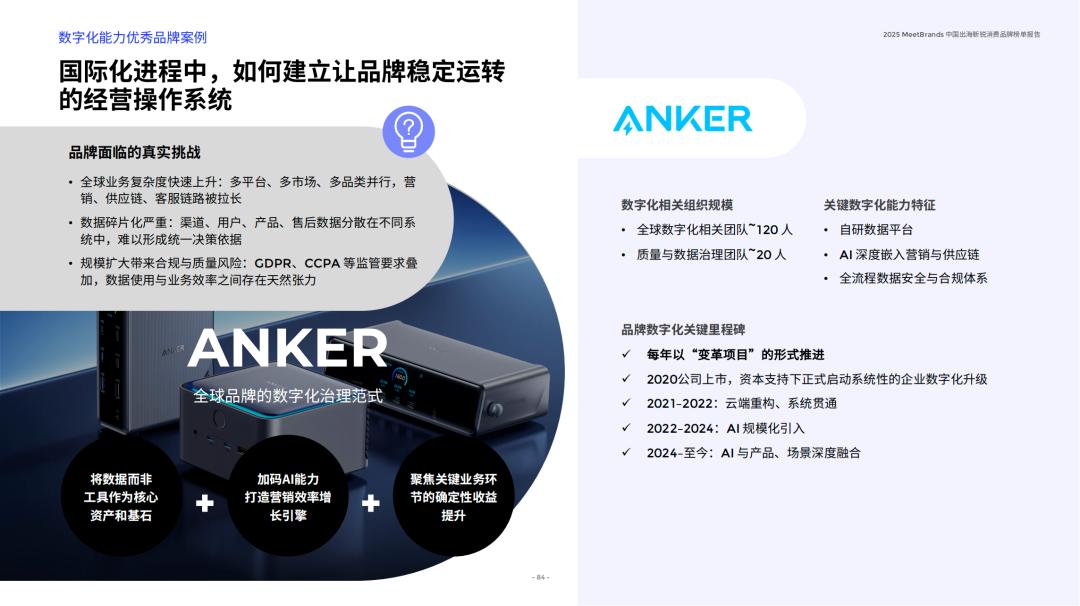
Digital capabilities are the brand's "invisible" but most solid moat, testing the infrastructure and system capabilities of brands going global to support cross - market operations, efficiency improvement, and large - scale decision - making. In the model upgrade in 2025, the D - MES model pays more attention to the degree of digital embedding in core business processes, strengthens the evaluation of the maturity and business suitability of AI applications, and differentiates between exploratory digital applications and systematic capability building.
Brands leading in this dimension show two common characteristics: on the one hand, they use tools such as AI and multi - model attribution to gain insights into the real conversion path, enabling data - driven optimization of advertising, content, and channels to be replicated; on the other hand, they regard digital construction as a long - term strategy, formulate clear plans and investment mechanisms, and allocate full - time teams to promote implementation. Among them, Anker remains the paragon of digital capabilities. The report reveals that Anker has a global digital - related team of about 120 people and is accelerating digital transformation in the form of "transformation projects" every year.
Mindset Influence: Solve the Mismatch of "High Awareness, Low Trust", Deep Localization is the Key
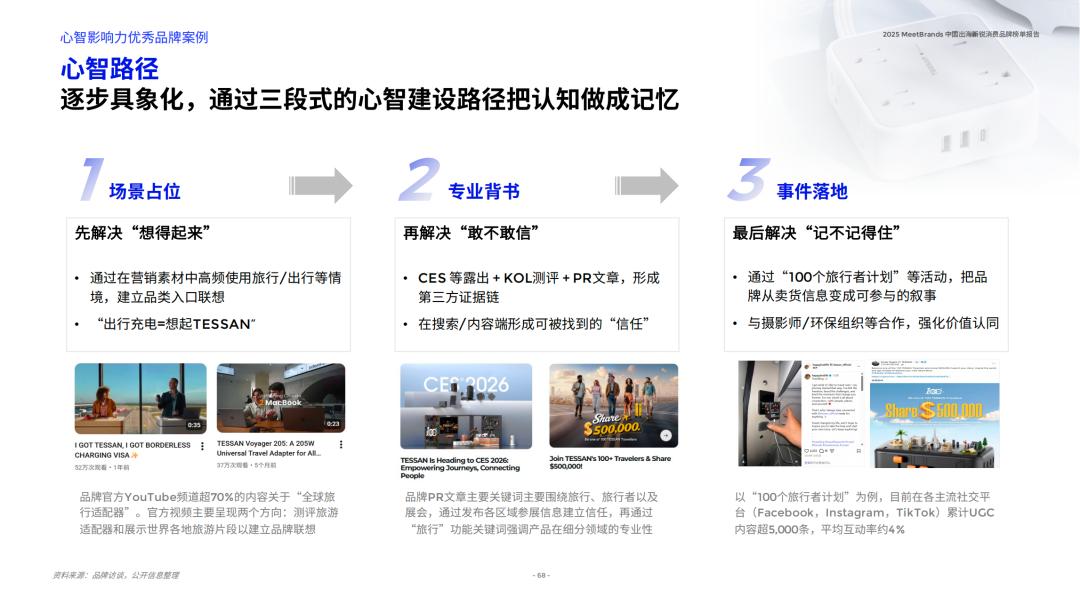
Currently, global consumers' emphasis on brand transparency, real reviews, and social responsibility is constantly increasing. The mindset influence indicator in the D - MES model introduced a longer - link overseas consumer portrait in 2025, focusing on the awareness path, decision - triggering points, and sources of trust to evaluate whether the brand has established a local presence and a clear mindset positioning overseas.
Surveys show that overseas consumers generally know Chinese brands, but still have doubts about quality, after - sales service, and cultural values. In the 2025 MeetBrands Top 50 list, the breakthrough strategy of the 3C accessory brand TESSAN is worth learning from. In a category with low user emotional connection, TESSAN did not compete on "charging speed" and other popular selling points. Instead, based on the mindset characteristics of overseas consumers, it deeply bound the brand to the travel scenario and used it as an entry point for local operation. TESSAN adjusted its narrative strategy according to the cultural preferences of different regions. For example, it emphasized professionalism and a sense of technology in North America, environmental protection, minimalism, and durability in Europe, and relied on local social word - of - mouth fission in Asia to integrate into the local consumers' life narratives and cultural values.
Product Innovation and Evolution: Reject Parameter Competition, Use Data to Verify "Real Pain Points"
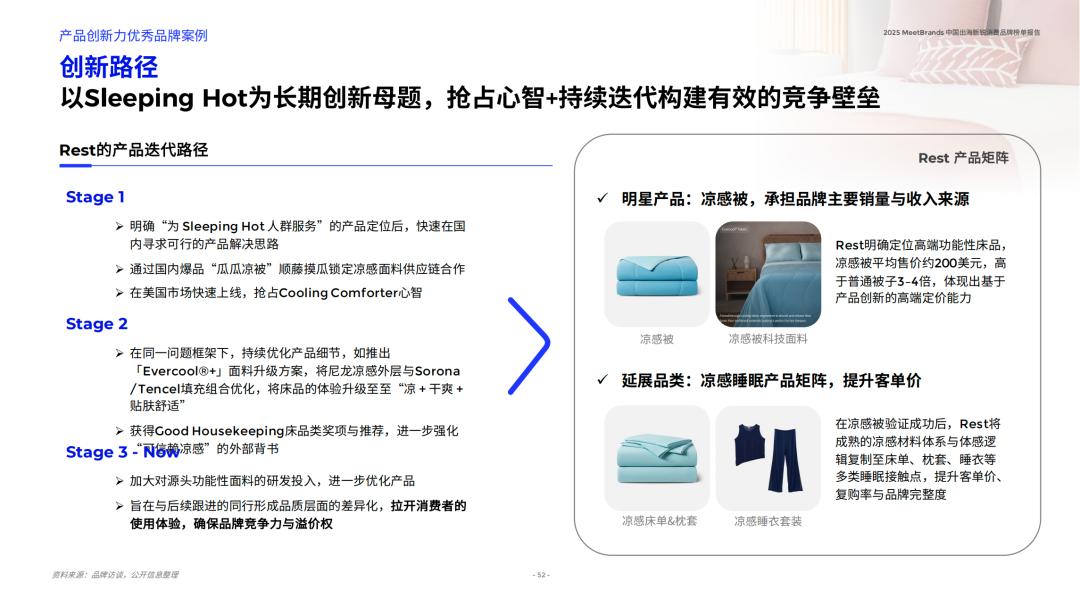
In terms of product innovation, the D - MES model pays more attention to its strategic positioning in the brand development stage and whether it has replicability and extensibility, rather than simply "competing on parameters". BeyondClick believes that instead of piling up function parameters that users can't perceive, brands need to dig out pain points through real - market data and solve them in products.
The listed bedding brand Rest provides a viable example. Through consumer surveys and reviews of similar products, Rest identified the high - frequency pain point of "hot sleep" and jointly developed the "Cooling Comforter" with the supply chain. It not only successfully obtained a considerable premium of 3 - 4 times compared to ordinary quilts but also improved the repurchase rate and brand integrity by expanding the product category matrix. It can be seen that product innovation that bids farewell to low - quality competition and involution needs to be based on objective consumer data insights, rather than a flash of inspiration.
Business Conversion Capabilities: Accelerate the Layout of Offline Channels, Emerging Markets Contribute Main Increment
Currently, the key to business conversion capabilities is no longer simply occupying mature markets such as Europe and the United States or laying out online e - commerce, but rather having the ability to expand across multiple regions and operate through all channels. Based on this, the D - MES model also emphasizes the incremental value and long - termism of business conversion, pays more attention to the local operation logic and organizational collaboration methods of brands at different market stages, and strengthens the evaluation of emerging market expansion strategies to judge whether the growth is sustainable in the long term.
In terms of channel layout, there is an obvious trend of "shifting from virtual to real". According to the long - term observation of BeyondClick, the report shows that almost all listed brands have built independent websites and settled in multiple online channels, and many brands have also entered global e - commerce platforms such as Amazon; at the same time, most brands have also laid out offline channels (such as Walmart, The Home Depot, Best Buy in North America). Offline is becoming a new battlefield for emerging brands going global to build consumer trust.
In addition, mature markets such as Europe and the United States are no longer the only growth engines. The emerging brands listed this time have increased their layout in emerging markets such as Latin America, the Middle East and Africa, and Southeast Asia. The breadth of globalization has increased significantly. Although the average order value in these regions is slightly lower, the competition is less intense, and the growth potential is huge. For example, the penetration rate of social e - commerce in Southeast Asia is extremely high, which is suitable for Chinese brands good at content and influencer marketing; the Middle East has a large newborn population and has a strong demand for categories such as mother and baby care; Latin America is