With the world's largest export volume, Chinese cars are selling like hotcakes overseas.
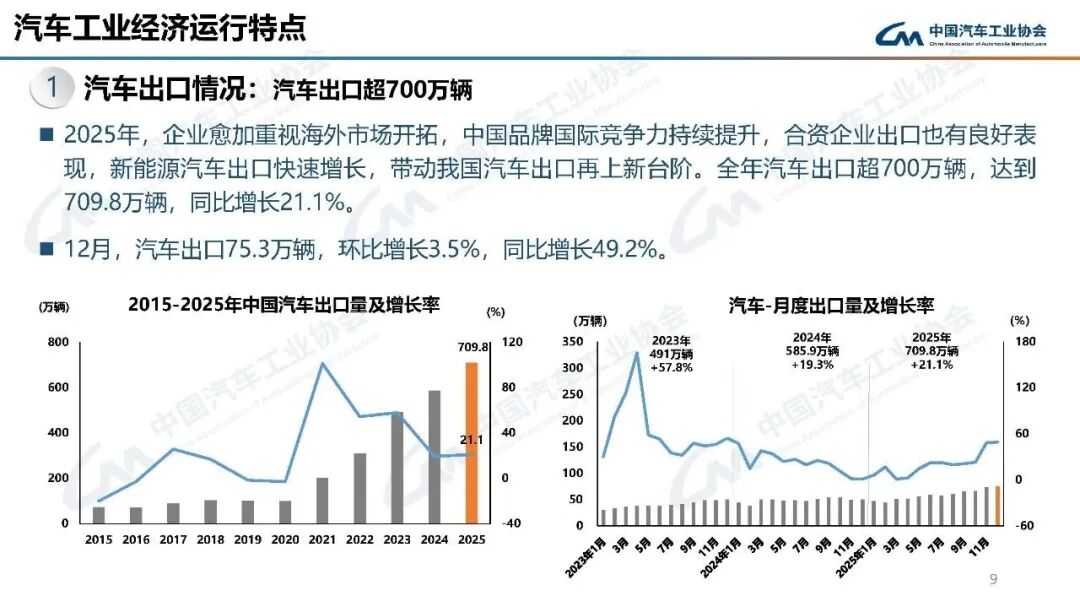
Recently, the production and sales situation of the automotive industry released by the China Association of Automobile Manufacturers shows that in 2025, China's automobile exports exceeded 7 million vehicles, reaching 7.098 million vehicles, a year-on-year increase of 21.1%, making China the world's largest automobile exporter.
China's automobile exports have ranked first in the world for three consecutive years. The China Association of Automobile Manufacturers pointed out that in 2025, enterprises paid more attention to exploring overseas markets. The international competitiveness of Chinese brands continued to improve, and joint-venture enterprises also performed well in exports. The rapid growth of new energy vehicle exports drove China's automobile exports to a new level.
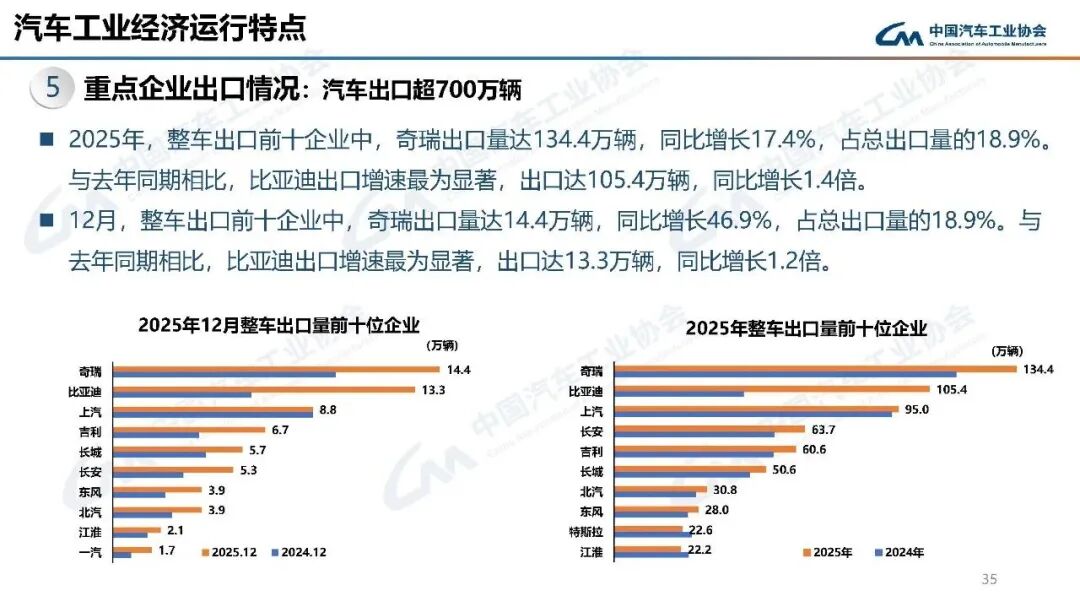
Specifically, among the top ten enterprises in terms of complete vehicle exports, Chery exported 1.344 million vehicles in 2025, a year-on-year increase of 17.4%, accounting for 18.9% of the total export volume, ranking first among complete vehicle export enterprises. BYD became the biggest dark horse, with exports reaching 1.054 million vehicles in 2025, a year-on-year increase of 1.4 times. Compared with the same period in 2024, BYD's export growth rate was the most significant, and its ranking rose from sixth to second.
The pattern of automobile exports is also changing. In 2023 and 2024, Russia was always China's largest export destination for automobiles. In 2025, China's exports to Russia declined. According to data from the Passenger Car Association, from January to November 2025, China exported 513,078 vehicles to Russia; in the same period in 2024, this figure was 1,059,990 vehicles. Instead, Mexico became China's largest export destination for automobiles, with a total export volume of 573,453 vehicles from January to November 2025.
In recent years, automobile exports have been soaring. Looking forward to 2026, Gong Min, the head of UBS's China auto industry research, said that in the past few years, the "going global" strategy led to an additional sales volume of about 1 million vehicles per year. In 2023, there was an additional sales volume of nearly 2 million vehicles because of the change in the Russian market and the withdrawal of Western automakers, resulting in an extra sales volume of nearly 2 million vehicles. "We believe that this year, there will be an additional overseas sales volume of 1.5 million vehicles, which is stronger than in the past few years. Part of the reason is the pressure from the domestic market, and the other part is the influence of the scale expansion of various automakers, the establishment of some channels and brand awareness, and even overseas production capacity."
Outstanding Exports of New Energy Vehicles
In recent years, China's automobile industry chain and supply chain have been continuously improved, the industrial structure has been continuously adjusted and upgraded, and the scale of automobile exports has also been gradually expanding. In 2023, China exported 4.91 million vehicles, surpassing Japan for the first time to become the world's largest exporter.
Starting from the position of the world's largest exporter, Chinese automakers have accelerated their pace of going global. In 2025, China's automobile exports reached a new high, with the annual export volume reaching 7.098 million vehicles, firmly holding the top position in global exports. In the export structure, new energy vehicles and traditional fuel vehicles have shown different trends.
Source: China Association of Automobile Manufacturers
Cui Dongshu, the secretary-general of the Passenger Car Association, pointed out that with the transformation of the domestic new energy vehicle market from subsidy-driven to market-driven, the market competitiveness of Chinese new energy vehicles has increased significantly. China's new energy vehicle exports have witnessed explosive growth since 2021 and then entered a period of continuous high growth.
In 2025, the export of new energy vehicles reached 2.615 million vehicles, a year-on-year increase of 100%; the export of traditional fuel vehicles was 4.483 million vehicles, a year-on-year decrease of 2%.
One obvious characteristic of new energy vehicle exports is the strong growth rate of plug-in hybrid vehicle exports. In 2025, the export of pure electric vehicles reached 1.646 million vehicles, a year-on-year increase of 66.7%; the export of plug-in hybrid vehicles was 969,000 vehicles, a year-on-year increase of 2.3 times.
China Merchants Bank previously pointed out in a research report that similar to the domestic market, in markets with certain conditions, compared with relying on traditional fuel vehicles or pure electric vehicles as the main product strategy, Chinese automakers using PHEV as the market entry point can not only effectively avoid direct competition with international automakers, but also have greater independent pricing power in the PHEV category with the first-mover advantage. Therefore, self-owned brands will also have better performance in terms of profits.
As the export volume increases, automakers are further stepping up their efforts to explore overseas markets. Judging from the export situation of enterprises, among the top ten enterprises in terms of complete vehicle exports, eight enterprises achieved positive export growth.
Among them, Chery retained the first place in export sales. In 2025, Chery's export volume reached 1.344 million vehicles, a year-on-year increase of 17.4%, accounting for 18.9% of the total export volume.
Chery is one of the earliest domestic automakers to explore overseas markets. In 2025, Chery upgraded its globalization strategy to "In somewhere, For somewhere, Be somewhere", shifting from product export to brand export and ecological export.
Another dark horse in going global in 2025 was BYD. Its export sales exceeded 1 million vehicles for the first time, reaching 1.054 million vehicles, a year-on-year increase of 1.4 times. Its export sales ranking rose from sixth in 2024 to second.
In 2025, BYD not only explored emerging markets such as Iraq but also put its passenger car factory in Brazil into operation. In December 2025, BYD's export volume was very close to that of Chery. In that month, BYD exported 133,000 vehicles, while Chery's export volume was 144,000 vehicles.
Ranked third in export sales was SAIC Group, with an export volume of 950,000 vehicles in 2025. In 2025, SAIC officially launched its overseas strategy 3.0 - the Glocal strategy, that is, a combined strategy of "global + local". It actively builds a local system ecosystem and global automobile brands, promoting the upgrade from "product export" to "value chain export".
Source: China Association of Automobile Manufacturers
Changes in the Export Pattern
It has become a consensus for Chinese automakers to go global, and they jointly promote the prosperity of automobile exports. However, the automobile markets in different countries around the world have different characteristics. While Chinese automakers explore these markets according to local conditions, they also face challenges.
In 2025, there were significant changes in China's automobile export destinations. From January to November 2025, Mexico replaced Russia as China's largest export destination for automobiles. "In the change of the automobile export structure from January to November 2025, Mexico rose to the first place in exports, and the exports to the UAE increased." Cui Dongshu pointed out.
According to the data disclosed by the Passenger Car Association, the top 10 countries in terms of the cumulative total of complete vehicle exports from January to November 2025 are as follows: Mexico with 573,453 vehicles, Russia with 513,078 vehicles, the UAE with 465,539 vehicles, Brazil with 285,122 vehicles, the UK with 280,760 vehicles, Australia with 278,381 vehicles, Belgium with 275,764 vehicles, Saudi Arabia with 265,762 vehicles, the Philippines with 236,466 vehicles, and Kazakhstan with 188,218 vehicles.
Compared with the rapid growth in exports to Mexico and the UAE, China's exports to Russia declined significantly year-on-year. From January to November 2024, China's exports to Russia exceeded 1 million vehicles, while in the same period in 2025, it was 513,000 vehicles.
"Russia's import rules are constantly adjusted according to supply and demand. In 2024, Russia's automobile sales reached the highest level in recent years, so the decline in 2025 was inevitable." Cui Dongshu pointed out that since 2023, Russia suddenly became China's largest export market for automobiles, which was another major change in China's automobile exports after 15 years. In 2008, Chinese self-owned brands performed well in the Russian market. However, with Russia's policy of imposing huge tariffs on Chinese automobiles, many Chinese automakers withdrew from the Russian market that year. The decline in the first half of 2025 was somewhat similar to the trend in 2009, but the situation has improved at present.
In addition, in terms of new energy vehicle exports, the EU market is another important market. According to the data disclosed by Cui Dongshu, in terms of pure electric vehicle exports, from January to November 2025, the export volume of pure electric vehicles to the EU market reached 580,000 vehicles, ranking first.
The EU is the main market for China's pure electric vehicle exports, but previously, China's automobile exports to the EU were affected by factors such as tariffs. On January 12 this year, the Ministry of Commerce released a notice on the progress of consultations on the China-EU electric vehicle case. The notice pointed out that it is necessary for China and the EU to provide general guidance on price commitments to Chinese exporters of pure electric vehicles to the EU so that Chinese exporters can adopt a more practical, targeted, and WTO-compliant approach.
Cui Dongshu believes that in the initial stage of the implementation of the price commitment mechanism, some automakers may experience short-term fluctuations in sales due to adjustments in product pricing and structure. However, as automakers adapt to the new rules, the local production capacity is released, and the product competitiveness is improved, the sales volume of Chinese electric vehicles in the EU market will gradually recover. It is expected that from 2026 to 2028, China's exports of electric vehicles to the EU will maintain an average annual growth rate of about 20%, becoming an important engine for the growth of the global electric vehicle market.
From Russia to Mexico, from the UAE to the EU... China's automobile exports have exceeded the 7 million-vehicle mark, not only consolidating its position as the world's largest automobile exporter but also achieving breakthroughs in multiple regional markets. At the same time, the China Association of Automobile Manufacturers pointed out that in 2026, Chinese automakers going global may still face certain risk factors, such as the uncertainty of global geopolitics, the economic downturn, and the intensification of economic and trade struggles; as well as the replacement of pure exports by local production: with the deepening of global operations, the export growth rate may slow down or even the export volume may decrease in statistical data.
As the requirements for Chinese automakers to go global shift from single-product competition to full-industry chain ecological competition, Chinese automakers still need to gradually resolve risks and deeply cultivate the global market through local production, technology output, and ecological construction.
This article is from the WeChat official account "Times Finance APP" (ID: tf - app), author: He Qing. It is published by 36Kr with authorization.