After the birth of Qianwen, Wu Jia, the person in charge, responded to 15 key questions for the first time.
Text | Deng Yongyi
Editor | Su Jianxun
On January 15th, the Alibaba Xixi headquarters campus was teeming with people.
One year after the DeepSeek Moment, the trend of large models has already changed. A few days ago, Tang Jie, the founder of Zhipu, clearly stated when discussing with Lin Junyang, the technical leader of Qwen, and Yao Shunyu from Tencent: After DeepSeek, the Chat war is over, and the next is the Agent war.
Alibaba is waging this obvious war.
In November 2025, when Qianwen was first launched, Alibaba depicted this scenario to the outside world: An AI assistant, connected to products such as Taobao, Gaode, Flash Sale, and Alipay, evolving from Chat to a truly useful tool to complete tasks of higher difficulty.
Alibaba, marching in haste, now urgently needs a victory in the new battlefield.
Qianwen is another large - scale collaborative operation at the Alibaba Group level after Taobao Flash Sale and Gaode Street - Scanning List. Before the press conference, Alibaba had already launched a large - scale publicity campaign: The spotlights projected the huge logo of Qianwen onto the headquarters building in Hangzhou's Xixi campus.
Alibaba officially announced Qianwen's achievements in advance: In two months, the monthly active users of Qianwen's C - end product exceeded 100 million.
The new version 6.0 of Qianwen can be said to be an "avalanche - style" update: It connected to products such as Flash Sale, Taobao, Fliggy, and Alipay all at once, and launched more than 400 new functions.
Now, the general AI assistant has become a game for large - scale enterprises. Yuanbao soared to success with DeepSeek. ByteDance's Doubao, which started early enough, now leads the market, with its daily active users stably exceeding 100 million.
At the moment when Alibaba switches its AI To C focus, Wu Jia, the vice - president of Alibaba Group and the president of Qianwen's C - end business group, clearly defined the positions of "Quark" and "Qianwen" for the first time: Quark is an AI browser and an AI search engine; Qianwen is an AI assistant, more like a person.
"The dialog box will evolve, and the demand for AI browsers and AI search engines will not disappear. Whether it's Quark or Qianwen, they are just different service interfaces for users." He explained, The current AI assistant market is still in a very early stage. Whether the DAU is 80 million or 100 million doesn't make much difference.
The Qianwen team also told us: "The growth of our C - end monthly active users has exceeded our expectations. Everyone is very concerned about how much money Qianwen has invested. In fact, Qianwen has spent far less money than its competitors."
For Qianwen, replicating a cute, approachable, and companion - style assistant is no longer the optimal solution. Qianwen has chosen another path: Connect to Alibaba's huge offline ecosystem, enabling shopping and handling affairs. Moreover, it has to be professional enough.
Currently, the Agent function needs to be invoked through the "Task Assistant" button within the Qianwen app and still adopts an invitation system. It will be fully launched gradually later.
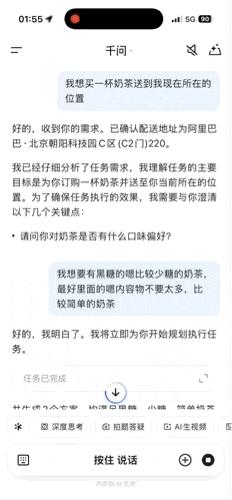
After authorizing permissions for Alipay, Fliggy, Gaode, etc., clicking the Task Assistant allows you to assign tasks to the Agent:
For example, if you want a cup of milk tea, after confirming your needs, Qianwen can directly place an order (it will be delivered to the specified location after you confirm the payment action). "Intelligent Emergence" experienced several scenarios, and Qianwen has already performed smoothly enough. On average, it can give results for a task within 1 - 2 minutes. However, there are still issues such as instability and freezing, and in many cases, human intervention is required.
△Source: Qianwen
Another major featured scenario of Qianwen is for office, education, government affairs, etc., focusing on improving efficiency.
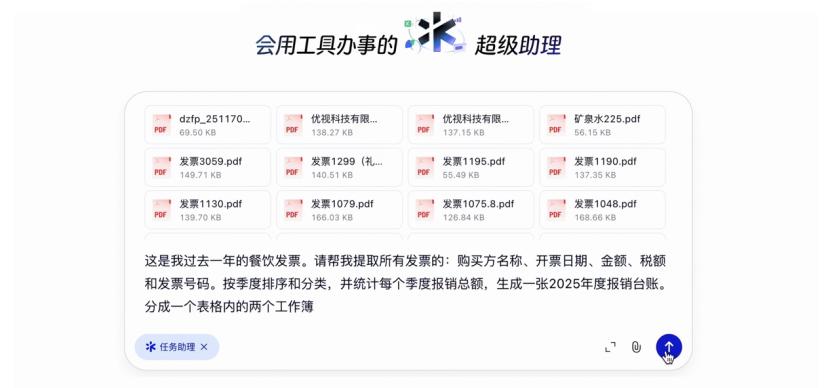
For example, when faced with nearly a hundred electronic invoices in different formats, just say "Help me generate an annual reimbursement ledger", and Qianwen can automatically identify key information and generate a well - structured table;
△Source: Qianwen
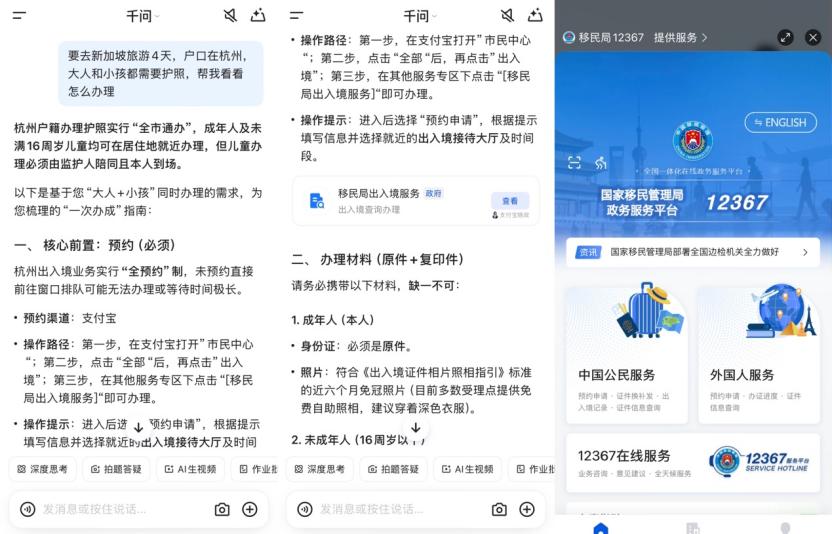
The most refreshing function that "Intelligent Emergence" felt is the one - click passport application: Users don't need to rush between different department websites. Just tell Qianwen "How to apply for a passport with a Hangzhou household registration", and Qianwen can connect to Alipay, interpret policies, sort out the material list, and directly jump to the application entry.
△Source: Qianwen
Qianwen's current exploration is also on an unprecedented path.
Overseas, whether it's Google's Gemini, OpenAI's ChatGPT, or Anthropic's Claude, these model giants don't have offline businesses such as shopping, payment, and travel. Their approach is to connect with manufacturers like Amazon, Paypal, and Uber through APIs and directly call their services.
In contrast, the domestic mobile Internet ecosystem is more independent and closed. Giants like Alibaba, Tencent, and ByteDance all have rich and diverse businesses within their systems. Alibaba's trump card lies in e - commerce, flash sales, maps, and payment - these high - frequency and essential scenarios are all in its own hands.
However, recreating an AI To C entry point is a difficult problem for the complex Alibaba system. The key lies in straightening out the relationships and resources among various businesses and concentrating resources on major tasks when technology is changing rapidly.
In other words, the competition for general AI assistants is no longer just about products and technology. It's about who can truly integrate the huge business forms, resources, and capabilities of giants into an AI assistant.
A person close to Alibaba's senior management told "Intelligent Emergence": If someone can win and do well in the AI To C war, it will be a crucial achievement recorded in Alibaba's history.
Regarding what Qianwen has done in the 60 days since its launch and its future development plans, media including "Intelligent Emergence" had an exchange with Wu Jia, the president of Qianwen's C - end business group, after the meeting.
The following are the main viewpoints of Wu Jia. For the convenience of reading, "Intelligent Emergence" has edited and organized them into 15 core questions:
On the product
1. What is the main development line of Qianwen now?
Wu Jia: We are still focusing on two main lines: improving the model's intelligence level, that is, thinking and execution abilities, and connecting to the Alibaba ecosystem.
What was released today is the first version of Qianwen 6.0. In the next half - year, we will continue to connect to Alibaba's rich ecosystem and expand the boundaries of its service - handling capabilities.
As we all know, it's still difficult to satisfy everyone in life scenarios. In contrast, the standards in office and learning scenarios are more consistent, such as K12 education, university education, and digital office work.
Combining these three aspects and doing well in life scenarios will definitely make it a globally leading product.
2. Will there be conflicts in product philosophy when developing an AI assistant? How to find a balance between the answers generated by large models and accurate reasoning and task - completion?
Wu Jia: We have a concept called "appropriateness". I believe AI should not be equated with minimalism. This is our philosophy.
Just like traditional Internet products, for example, when developing a search engine, we hope for more search queries, but more queries don't necessarily mean satisfaction; when developing an information stream, we may hope for more refreshes.
But in the AI era, will all goals become finding the fastest, most convenient, and most direct path? Actually, it's not quite right.
Especially in the office scenario, some tasks involve long - term processes. For example, when I write a research report, I don't just want the AI to write a first draft for me. I hope the AI and I can complete it together.
We definitely need to provide information to the AI actively. I tell the AI whether these three options are appropriate. The AI says "Yes, this is what you want" after seeing them, but you may then ask "Can you help me modify it?" After many rounds of communication, the problem may still not be solved.
The same is true in life scenarios. Communication between the AI and humans is essential. We can't just set things with the AI and then ignore it.
At present, intelligence is more about improving efficiency, but higher - level intelligence may not necessarily mean completely pursuing efficiency. Ultimately, we still need to deliver results.
The key of AI lies in intelligence, not just the effect. AI should think like a human and provide relatively appropriate solutions.
We don't deliberately pursue more conversation rounds per user. What we value most is the satisfaction and delivery rate of user needs.
The tolerance in the AI era far exceeds that in the traditional era. In the traditional era, interfaces must fit perfectly. If there is an error, it won't work, and the function can't be called.
Now, AI is not that rigid. It doesn't matter if something is missing. But it's very important to make some platform - to - platform connections between the Taobao platform and Qianwen.
Similarly, we don't need to specifically design an interaction interface for the AI because the AI can understand the interface that humans can see and has the ability to act. This is the key.
3. How does Qianwen decide what to do and what not to do?
Wu Jia: Currently, AI is not omnipotent. We still focus on high - frequency and essential needs today. This is very important.
We are in a leading position in the Chinese market today. So in terms of selection, we don't choose to do nothing.
People's perspective is still focused on the difference between developing AI products and traditional products. In the past, when developing traditional products, a project might be divided into dozens of sub - projects, such as satisfaction rate, number of functions, etc.
It's different now. The model's capabilities are there, and in 90% of scenarios, it may achieve an 80% satisfaction rate. So we spend 70% of our energy on improving token capabilities, execution capabilities, and planning capabilities.
An important point for us is to start from high - frequency and essential scenarios, combine the model's capabilities with the Alibaba ecosystem, and abstract user needs. In the first stage, we can see that the thickness, breadth, and influence of the ecosystem are all very good.
We are currently advancing in parallel along three lines. The first is the long - term main line, which is the model and Agent.
From the perspective of user needs, we will take the satisfaction rate of all products in the market for such needs as a benchmark, and then understand them in different levels in combination with these three lines.
Every quarter, we will have a major model version, and we will work with the Tongyi Laboratory to develop this version. This is very important.
Based on this, our Agent capabilities will also be improved. We need to do some post - training to enhance them. This is the second line.
The third is the product line. Overall, we are still in a model driven by technology, data, and the ecosystem, rather than an iterative model of fixing bugs, because we are still in the fast - growing stage of AI capabilities.
For example, in the next version of our life assistant, we will focus on personalization. But translating this requirement, it involves issues related to the model's capabilities.
So, we won't say that in the next version, we will only focus on making food delivery extremely good - we will do it for sure, but we will first improve the capabilities that can be abstracted.
In addition, there are also some experiential functions. For example, as some people have suggested, can we display the pick - up code on the order? We will also develop these open - ended functions.
4. Is there any commercial consideration in Qianwen's product recommendations now?
Wu Jia: We are not commercialized yet. We basically make comprehensive considerations based on factors such as the optimal price and the fastest delivery time.
We currently don't have any commercial customers. In the future, with user authorization, we will bring in the user's context and recommend multiple solutions to the user at the same time, allowing them to switch. This process will take some time for the model to understand your preferences.
In many life scenarios in China, many people have this feeling that AI will definitely move towards recommendation, but it can't be limited to this. There is still a great chance for AI to replace traditional recommendation algorithms.
5. Previously, Alibaba's main AI To C entry point was Quark, and now it's Qianwen. Many users are still confused. How do you explain the difference between Qianwen and Quark?
Wu Jia: Quark is an AI browser and an AI search engine; Qianwen is an AI assistant, more like a person.
The dialog box will evolve, and the demand for AI browsers and AI search engines will not disappear. Whether it's Quark or Qianwen, they are just different service interfaces for users.
This is also a matter of user habits. It doesn't mean that users of AI browsers will abandon Qianwen. Currently, we can see that among PC users, it's a half - and - half split. Half of them like to use Qianwen, and the other half like to open Quark in the browser.
The common point is that all AI functions are provided by Qianwen. I think there's no need to be confused about this.
On collaboration
6. How are resources allocated among different business groups? Yesterday, I tried to order takeout through Qianwen and saw there were red - envelope subsidies. Are the subsidies provided by Qianwen itself? If a transaction is made, how do you share the revenue with other businesses?
Wu Jia: We will provide the subsidies together with other businesses and also need to consider some user feedback.
As for how to share the revenue, we haven't calculated it so precisely yet. Our first goal now is to provide a good user experience and encourage users to use the service.
7. How do you evaluate the impact of Qianwen on existing retail or e - commerce businesses? Once users complete orders through Qianwen, they may not open Flash Sale or Taobao. If they don't open these platforms, how can we sell advertisements?
Wu Jia: We have common business goals. We haven't seen the situation where users who open Qianwen don't open Taobao. I haven't fully confirmed this data yet.
The larger Qianwen becomes, the more incremental living - service volume we will create. In the future, AI will bring a large amount of new living services, not just the existing ones.
Because of its convenience and low threshold, user habits will bring incremental volume. For example, we can't rule out that some people will get used to ordering takeout through our platform in the future, but they will also order from traditional platforms.
8. Are the demands and goals of the Qianwen App for model capabilities the same as those of the base - model team?
Some people believe that