Regaining the title of "the No.1 city in the automotive industry", the heavyweight in the west is making a comeback.
The competition for the title of "No.1 Automobile City" is intensifying.
On January 13th, news from the Chongqing Economic and Information Commission stated that in 2025, Chongqing's automobile industry reached new heights. The annual automobile production volume reached 2.788 million vehicles, a 9.7% increase, firmly ranking first among cities and third among provinces and municipalities. Among them, the production volume of new energy vehicles reached 1.296 million vehicles, a 36% increase, and the scale of the industrial cluster exceeded 800 billion yuan.
This means that after Shenzhen overtook Guangzhou and briefly claimed the top spot in automobile production, it handed over the "baton" again. For Chongqing, after a 10 - year period of dormancy, it returned to the champion's throne.
The competition in production volume is not the whole story of Chongqing's "promotion". Not long ago, the country's first official license plate for L3 - level autonomous driving, "Yu AD0001Z", was issued to Changan Automobile. In the eyes of the outside world, this means that China's intelligent driving has entered a historic stage of large - scale application, and Chongqing is becoming the "leader".
Looking back at the intense competition among automobile cities in recent years, new energy vehicles, as a new species, have undoubtedly played the role of a "game - changer". If we observe Chongqing's double breakthroughs in automobile production volume and intelligent driving, we may be able to catch a glimpse of the clues for the next round of competition.
01
The Return of the King
Whoever seizes the opportunity of new energy vehicles is expected to take the lead in the automobile industry. This "law", which has been repeatedly verified by the change of the "No.1 Automobile City" in recent years, is particularly prominent in Chongqing, which has experienced a "great fall" and then a "great rise".
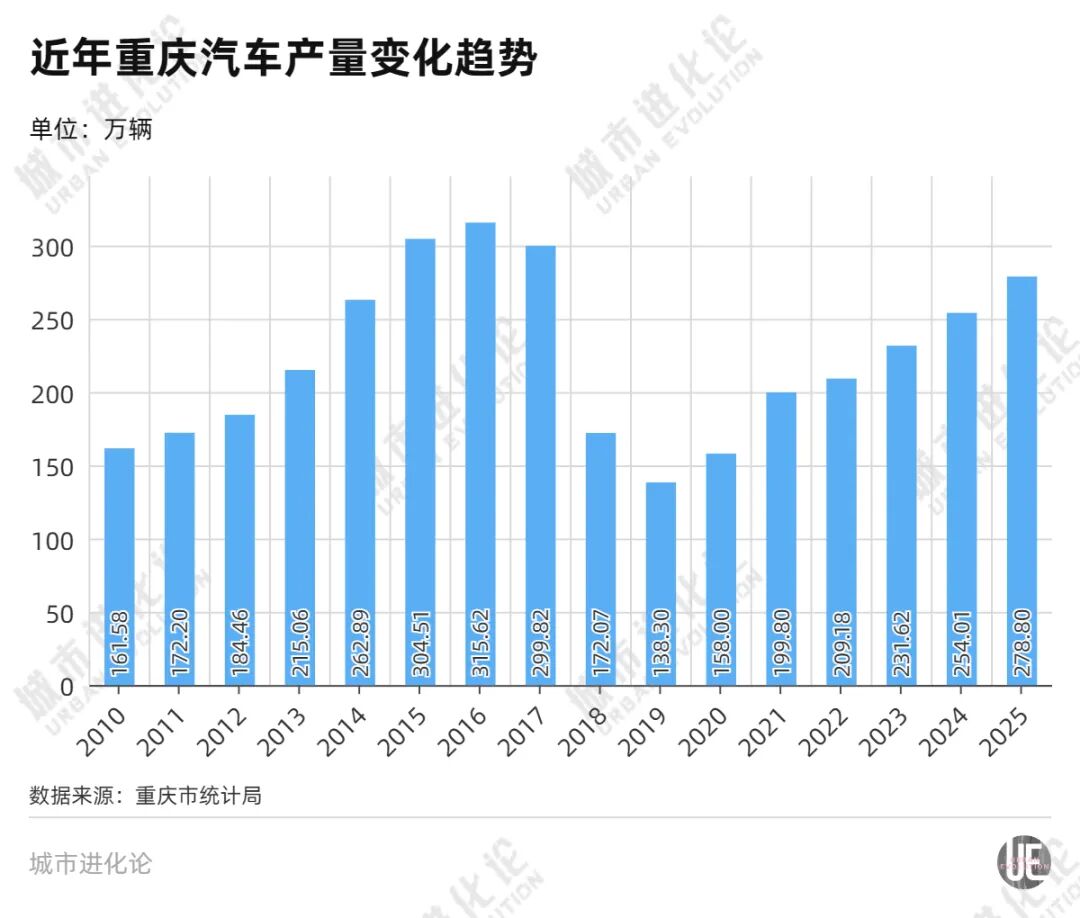
Going back to 2013, Chongqing set the goal of building itself into the "Detroit of China". The following year, Chongqing's automobile production volume reached the top in the country and continued to rise. According to local statistics, it reached 3.156 million vehicles in 2016, making Chongqing the only city in the country to exceed 3 million in production volume.
However, there were hidden crises behind the rapid progress. In 2017, Chongqing's automobile production volume began to decline, dropping to 1.383 million vehicles in 2019, less than half of its peak.
At that time, local scholars analyzed that the overall national automobile market was in a downward trend, and Chongqing faced greater pressure. On the one hand, Chongqing's automobile industry mainly focused on mid - and low - end vehicles, while consumers' preferences were shifting towards mid - and high - end vehicles. On the other hand, some of Chongqing's automobile production capacities failed to keep up with the market development.
A typical example is Changan Automobile, which sold more than 3 million vehicles in 2016. In 2017, along with the city's automobile industry, it reached an inflection point, and its net profit declined year by year thereafter.
During the same period, new energy vehicles began to shake up the original pattern of the automobile industry. Nationally, the sales volume of new energy vehicles exceeded 100,000 for the first time in 2015 and quickly exceeded 1 million just three years later.
In a sense, this was also a dormant period for Chongqing's automobile industry.
As the leader of Chongqing's automobile industry, Changan Automobile announced the "Shangri - La Plan" in 2017, declaring that it would stop selling traditional fuel - powered vehicles by 2025 and achieve electrification of its entire product line, thus starting its "third entrepreneurship". However, the reality was disappointing. By 2020, the national production volume of new energy vehicles increased by nearly 72% to 1.366 million vehicles in three years, while Chongqing's production only increased from 40,400 to 51,100 vehicles.
Turning points came one after another. In 2021, Changan joined hands with Huawei and CATL to launch a new high - end new energy brand, "Avita", and later launched brands such as Deepal, gradually catering to the public's tastes. According to the data it released, its automobile sales volume reached 2.913 million vehicles last year, including 1.11 million new energy vehicles, a year - on - year increase of 51.1%.
Another thing that attracted external attention was the "emergence from scratch" of Seres. Starting from the Fenghuang Electric Appliance Spring Factory in Ba County, Chongqing, Seres first broke the international monopoly in the core technology of automobile springs. In 2003, it cooperated with Dongfeng Motor to establish Dongfeng Xiaokang Automobile Co., Ltd., and in 2016, it transformed into the new energy sector.
Also benefiting from the cooperation with Huawei in 2021 and the launch of the Wenjie brand, Seres gradually entered the first echelon of domestic new energy brands. In 2024, Seres officially entered the profit - making cycle, becoming the fourth new energy vehicle enterprise in the world to achieve profitability. Last year, Seres' new energy vehicle sales volume reached 472,300 vehicles, a 10.63% increase.
02
Crossing the Cycle
Judging from the data, "Huawei" is one of the important reasons for the real transformation of Chongqing's new energy vehicle industry.
Image source: Photor.net_501667010
In the same year when Changan and Seres joined hands with Huawei, Chen Hong, the chairman of SAIC Group, put forward the famous "soul theory".
When asked whether SAIC Group would consider cooperating with third - party companies such as Huawei in autonomous driving, Chen Hong said bluntly, "It's difficult for SAIC to accept a single supplier to provide us with an overall solution. We must keep our'soul' in our own hands."
Since then, the cooperation of automobile enterprises has always been associated with a similar "soul - searching question". As Lu Wenliang, a special researcher in the automobile industry at the Industrial Science and Technology Innovation Center of the Chinese Academy of Sciences' Strategic Consulting Institute, pointed out in an interview, traditional automobile enterprises hope to control the entire supply chain by themselves. This idea is deeply rooted among traditional automobile manufacturers. Especially with the increasing importance of software, automobile enterprises are more likely to have such concerns.
Instead, Chongqing's automobile enterprises, which have experienced the pain of transformation, temporarily put aside their "prejudices" and took the lead.
Seres is the first cooperative automobile enterprise under Huawei's smart - selection model. Zhang Xinghai, the chairman of Seres Group, has also repeatedly emphasized in public that "cooperating with Huawei is a must - do thing".
In contrast, Changan, which is like an "elephant turning around", attracted more attention. In April 2021, Huawei announced that it would cooperate with three automobile enterprises to create three automobile sub - brands, which triggered wide - spread speculation. By the end of the year, in addition to AlphaS, which was a cooperation with BAIC Group, the other brand was Avita.
However, the two enterprises not only got the chance to "catch up" in the era of new energy vehicles.
2021 was also known as the first year of intelligent vehicles in China. The new development momentum characterized by intelligent electrification is building a new track for the next round of competition in the automobile industry. In April of the same year, the Seres Huawei Smart - Selection SF5 was officially launched. It was the first mass - produced vehicle to enter Huawei's terminal sales channels, which also allowed Seres to join the competition for L2+ - level intelligent driving earlier.
The cooperation between Changan and Huawei also brought about a stronger long - tail effect. Not long ago, the Ministry of Industry and Information Technology announced the first batch of access permits for L3 - level conditionally autonomous driving vehicles in China. One pure - electric sedan each from Changan Deepal and BAIC AlphaS was selected to start road - testing pilots in designated areas in Beijing and Chongqing respectively. Among them, Deepal is a new energy brand resulting from Changan's second cooperation with Huawei after Avita.
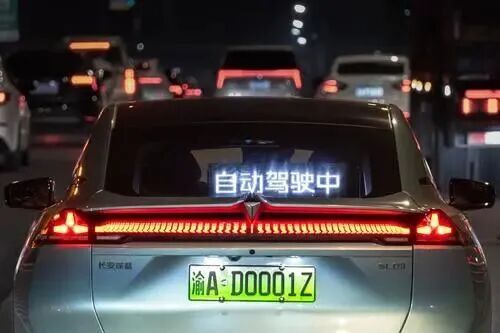
Image source: Chongqing Daily (Photo by Li Yuheng)
In a sense, the next round of competition in the automobile industry is about to kick off. This time, Chongqing has obtained the "entry ticket" in advance.
There is a consensus in the industry that in the past year, new energy vehicle brands faced "fierce" competition. Some automobile brands were deeply troubled by plummeting sales, poor management, and even business "standstills". In the new year, the "elimination round" in the new energy vehicle industry will accelerate further. According to Zhang Yongwei, the chairman of the Automobile Hundred Association, the penetration rate of new L3 - level and above autonomous driving passenger vehicles will achieve a breakthrough this year and is expected to reach 10% by 2030.
03
The Competition Resumes
Chongqing has been waiting for this moment for a long time.
As early as 2018, when Chongqing was in the "pain" of declining automobile production volume, it issued the "Guiding Opinions on Accelerating the Transformation and Upgrading of the Automobile Industry", clearly stating that it would focus on the development of new energy and intelligent connected vehicles, promote the in - depth integration of the automobile industry with advanced manufacturing, information and communication, the Internet, big data, and artificial intelligence, take innovation as the starting point, consolidate advantages, make up for shortcomings, strengthen weak links, improve quality, create brands, and increase efficiency, so as to promote the transformation of the automobile industry from high - speed growth to high - quality development.
In 2024, Chongqing further proposed to build itself into the "Capital of Intelligent Connected New Energy Vehicles". In the eyes of the outside world, Chongqing's driving environment with many mountains, bridges, complex overpasses, tunnels, and rainy and foggy weather is a natural testing ground for intelligent connected vehicles. In 2024, Chongqing was approved as one of the first batch of pilot cities for the "vehicle - road - cloud integration" application.
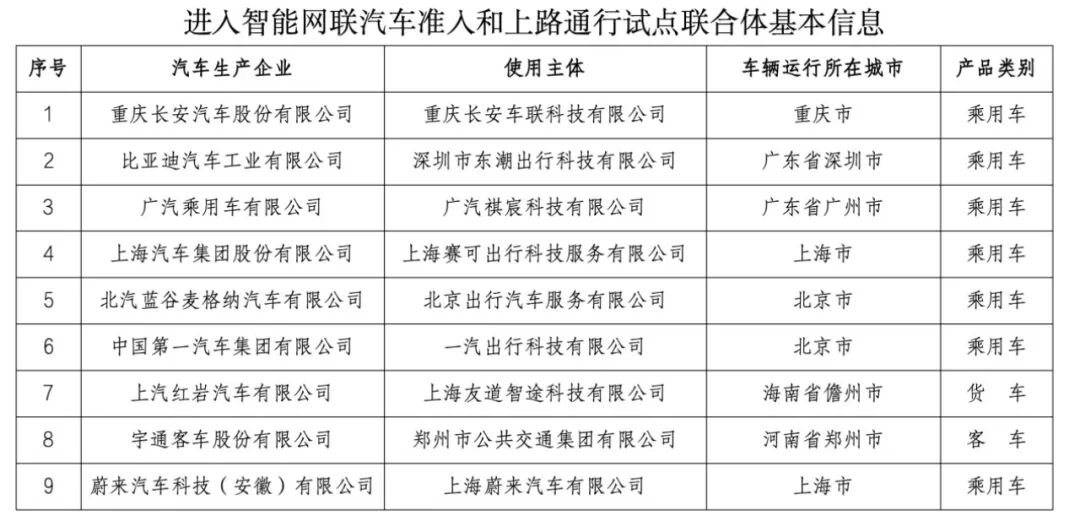
Image source: Website of the Ministry of Industry and Information Technology
Driven by leading enterprises such as Changan and Seres, Chongqing is gradually building an intelligent connected vehicle industry chain and participating in the competition with an ecosystem.
Of course, the competition is also heating up.
Guangzhou is a typical example. Its automobile production volume exceeded that of Chongqing in 2016 and ranked first in the country for seven years until 2024, when it was overtaken by Shenzhen under the impact of the new energy vehicle wave. Similar to Chongqing, Guangzhou also put forward the goal of building a "Smart Vehicle City" and proposed to reach a "trillion - scale" by 2035.
The actions of enterprises are even more aggressive. In November last year, two intelligent driving enterprises, WeRide and Pony.ai, were listed on the Hong Kong Stock Exchange at the same time. The former became the largest IPO in the global autonomous driving industry last year. Earlier, after years of competition for "dominance", GAC Group officially announced an upgraded cooperation with Huawei. The "Huawei - GAC Automobile" may adopt a new brand name, and Huawei will fully participate in and take the lead in product definition, intelligent cockpit, sales and service, and other fields.
Compared with cities such as Shenzhen and Suzhou, which are also targeting intelligent driving, Chongqing's shortcomings are also obvious. For example, the AI industry is the technological foundation for intelligent driving. According to the "Research on the Regional Competitiveness of Artificial Intelligence in China (2024)" report compiled by CCID Consulting, in 2023, Chongqing's overall regional competitiveness in the AI industry ranked only 14th among all provinces in the country, behind central and western provinces such as Anhui and Sichuan.

Some analyses point out that in the core technology fields of AI chips, algorithms, and large - scale models, Chongqing has weak competitiveness, lacking core technologies, innovative achievements, and leading enterprises with national influence. At the same time, there is a shortage of high - end talents, and it faces challenges in attracting and retaining talents. The infrastructure and industrial chain layout in the AI field are relatively weak.
For Chongqing, which has reached the top again, the question at hand is how to further make up for its shortcomings and maintain a leading position in the next round of industrial competition?
This article is from the WeChat official account "Urban Evolution Theory", author: Yang Qifei, published by 36Kr with authorization.