17 Predictions for AI Development in 2026
God Translation Bureau is a compilation team under 36Kr, focusing on areas such as technology, business, the workplace, and life. It mainly introduces new technologies, new ideas, and new trends from abroad.
Editor's note: The AI bubble won't burst in 2026, but the over - glorification will end. This is a crucial year for the transition from the "laboratory" to the "business field": revenue is judged by the ledger, technology is judged by implementation, and victory or defeat is judged by execution. This article is a compilation.
2025 was a big year for AI development: new models emerged one after another, coding agents were widely adopted, and corporate investment increased explosively, all of which became the main themes of the year. It was also a year when self - driving cars shined. Waymo's weekly order volume tripled. It launched driverless operations in several new cities and began to provide highway services. Tesla also launched its robotaxi service in Austin and San Francisco.
So, what will 2026 bring? We invited eight friends to share their predictions, and we added nine more ourselves. We assigned a confidence score to each prediction; a 90% confidence prediction means it should be accurate nine times out of ten attempts.
We don't think AI is a bubble about to burst, nor do we think the emergence of Artificial General Intelligence (AGI) will immediately trigger a so - called "take - off." Instead, we expect the capabilities of models to continue to improve, but it will take time for them to have a comprehensive impact on the entire economy.
1. The capital expenditure of tech giants will exceed $500 billion (75%)
Predictor: Timothy B. Lee
In 2024, the total capital expenditure of the five largest cloud service providers - Google, Microsoft, Amazon, Meta, and Oracle - was $241 billion. And this year, their spending is expected to exceed $400 billion.
This surge in investment is the main reason why many people think there is a bubble in the AI industry. As we reported before, the proportion of tech companies' investment in the total economy currently even exceeds the investment ratio during the peak of the Apollo program or the construction of the interstate highway system. Many people think this level of spending is simply unsustainable.
But I don't agree. Industry leaders like Mark Zuckerberg and Satya Nadella have said that they are building these data centers not to meet some illusory future demand but to rush to fulfill customers' current orders. The American business community is enthusiastic about AI and is paying for new AI services on an unprecedented scale.
I don't think the capital expenditure growth of tech giants in 2026 will be as dramatic as in 2025, but I expect it to continue to grow, and the total annual expenditure will eventually exceed $500 billion.
2. Both OpenAI and Anthropic will achieve their revenue targets in 2026 (80%)
Predictor: Timothy B. Lee
Both Anthropic and OpenAI achieved amazing revenue growth in 2025.
-
OpenAI expects its revenue in this calendar year to exceed $13 billion and end the year with an Annual Recurring Revenue (ARR) of about $20 billion. A leaked internal document shows that OpenAI's goal is to achieve $30 billion in revenue in 2026, slightly more than twice that of 2025.
-
Anthropic expects its revenue in 2025 to be about $4.7 billion. In October this year, the company said its ARR had grown to "nearly $7 billion." The company's goal is to achieve $15 billion in revenue in 2026.
I predict that both companies can reach these goals and may even exceed them. In the past year, the capabilities of AI models have made great progress. I expect that even without updated model capabilities, enterprises still have a lot of room to automate their operations.
3. The context window of cutting - edge models will remain around 1 million Tokens (80%)
Predictor: Kai Williams
Large Language Models (LLMs) have a "context window," which is the maximum number of Tokens they can process at one time. A larger context window allows the model to handle more complex tasks, but it also has higher operating costs.
When ChatGPT was launched in November 2022, it could only process 8,192 Tokens at a time. In the following year and a half, the context windows provided by major manufacturers increased significantly. In November 2023, OpenAI launched a 128,000 - Token window with GPT - 4 Turbo. In the same month, Anthropic released Claude 2.1, which provided a 200,000 - Token window. Google provided a 1 - million - Token window through Gemini 1.5 Pro in February 2024 and then expanded it to 2 million Tokens.
Since then, the progress has slowed down. Anthropic has not changed its default context size since Claude 2.1. The context window of GPT - 5.2 is 400,000 Tokens, which is even smaller than that of GPT - 4.1 released in April last year. And Google's largest context window has also been reduced to 1 million.
I expect the context window to remain relatively stable in 2026. As Tim explained in November, a larger context window will reach the limitations of the Transformer architecture. For most current tasks, a smaller context window is cheaper and equally effective. There may be some models specifically for programming in 2026. These models need to read the entire codebase, so they will have a larger window. But I predict that the context length of general cutting - edge models will basically remain the same next year.
4. The real GDP growth rate of the United States will be lower than 3.5% (90%)
Predictor: Timothy B. Lee
In some corners of the AI circle, 2027 has gained a totemic status. In 2024, former OpenAI researcher Leopold Aschenbrenner wrote a series of widely circulated articles predicting that 2027 would be a "take - off" year. Then in April 2025, a top - notch research team released "AI 2027," which made detailed predictions about the rapid progress of AI. They predicted that the GDP would "soar" by the holiday season in 2027. One of the authors even hinted that this could ultimately lead to an annual GDP growth rate of up to 50% in the United States.
They didn't make specific predictions for 2026, but if these predictions are close to the truth, we should see signs by the end of 2026. If we are on the verge of an AI - driven economic take - off, this should translate into above - average GDP growth, right?
So my prediction is: the inflation - adjusted GDP growth rate in the third quarter of 2026, compared with the third quarter of 2025, will not exceed 3.5%. In the past decade, the year - on - year growth rate of the US GDP has only exceeded 3.5% at the end of 2021 and the beginning of 2022, which was due to the post - pandemic economic recovery. Otherwise, the year - on - year growth rate of the real GDP has always been between 1.4% and 3.4%.
I expect the AI industry to continue to grow at a healthy pace, which will give a moderate boost to the US economy. In fact, the construction of data centers has supported economic growth in the past year. But I expect this supporting effect to be only a fraction of a percent, not enough to push the overall economic growth beyond the normal range.
5. AI models will be able to complete 20 - hour software engineering tasks (55%)
Predictor: Kai Williams
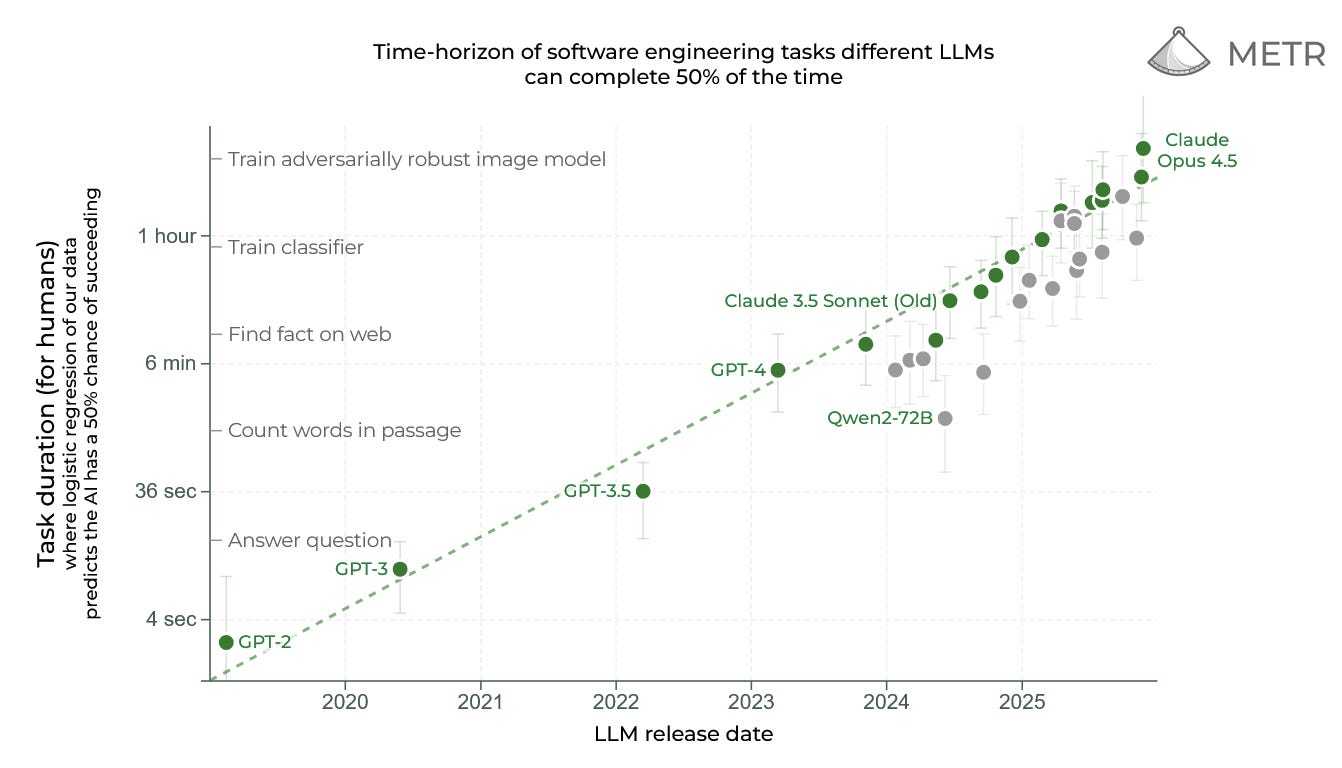
The AI evaluation agency METR released the initial version of this chart in March this year. They found that the length of software engineering tasks that the top AI models can complete with a 50% success rate doubles every seven months. Note that the Y - axis of this chart is a logarithmic scale, so a straight line represents exponential growth.
By the middle of 2025, the release speed of LLMs seemed to accelerate, and the task length doubled in only five months. According to METR's estimate, Claude Opus 4.5 released in November has been able to complete software tasks that humans need nearly five hours to handle with at least a 50% success rate.
I predict that this accelerating trend will continue in 2026. As the first gigawatt (GW) - scale computing clusters are put into use early next year, AI companies will have extremely large computing resources, and coding agents are also accelerating the development process of AI. However, there are also reasons to be cautious. The diminishing returns effect has begun to appear in both pre - training (through imitation learning) and post - training (through reinforcement learning).
Regardless of the result, whether METR's trend line can be maintained is a key question. If the accelerating trend line can be maintained, the most powerful AI models will be able to achieve 50% reliability in 20 - hour software tasks - which is equivalent to half a work - week's workload of a software engineer.
6. The "legal melee" situation at the beginning of the AI boom will end completely (70%)
Predictor: James Grimmelmann, Professor at Cornell Tech and Cornell Law School
So far, AI companies have had the upper hand in those life - and - death lawsuits. The most typical example is that courts in the United States, the European Union, and the United Kingdom have ruled that training models themselves do not constitute copyright infringement. But in other aspects, the courts are beginning to impose substantial operational restrictions. Anthropic paid $1.5 billion to settle the allegation that it trained on content downloaded from a shadow library. Several courts have also ruled or suggested that they must build substantial defenses to prevent the output of infringing content.
I expect this trend to extend beyond copyright: the courts will not directly order AI companies to shut down, but if these companies do not take reasonable measures to prevent obvious damages, the courts will issue huge fines. Maybe a warning example is needed - I bet it will be Perplexity - but I expect AI companies to understand this signal deeply in 2026.
7. AI will not cause any disasters in 2026 (90%)
Predictor: Steve Newman, Author of "Second Thoughts"
People generally worry that AI may ultimately lead to various catastrophic consequences. For example, advanced AI may assist in the manufacture of chemical or biological weapons or launch devastating cyber - attacks. This is not entirely a hypothesis; Anthropic recently found a group using its coding agent tool to conduct a cyber - attack with minimal human intervention. In addition, the advanced capabilities of AI in these fields have begun to emerge.
However, I don't think there will be any major "AI disasters" in 2026. More precisely: there will be no major physical or economic disasters in which AI plays a key boosting role (the scale of which far exceeds previous similar events). For example, there will be no biological, cyber, or chemical attacks with extraordinary influence.
Why? Technology always takes longer than expected to find practical applications, even for malicious applications. And AI model suppliers are also taking measures to make it more difficult for their models to be misused.
Of course, people may be inclined to blame AI for things that would have happened anyway, just like some tech company CEOs blamed AI for the lay - offs caused by over - hiring during the pandemic.
8. Large AI companies like OpenAI and Anthropic will stop investing in MCP (90%)
Predictor: Andrew Lee, CEO of Tasklet
The Model Context Protocol (MCP) aims to provide a standard way for AI assistants to interact with external tools and data sources. Since its launch at the end of 2024, it has quickly become popular.
But the problem is: modern LLMs are smart enough that as long as you give them a description of a regular API, they can directly figure out how to use it. And the descriptions provided by those MCP servers? They are either already solidified in the training data or can be found everywhere on public websites.
Agents that directly access APIs can be more concise, flexible, and can connect to any service, not just those that support MCP.
By the end of 2026, I predict that MCP will be regarded as a redundant abstraction layer that adds complexity without bringing substantial benefits. Mainstream suppliers will stop investing in it.
9. The total global fleet size of a Chinese company's driverless taxis will exceed that of Waymo (55%)
Predictor: Daniel Abreu Marques, Author of "The AV Market Strategist"
Waymo has world - class self - driving technology, extensive regulatory approval, and a mature multi - city operation model. But vehicle supply remains a major bottleneck. Waymo plans to start using vehicles from Chinese automaker Zeekr in the next few months, but tariff barriers and geopolitical pressures will limit the scale of the Zeekr fleet. Waymo has also signed an agreement with Hyundai, but mass production may not start until after 2026. Therefore, its fleet size will only grow slowly in the coming year.
10. The first fully self - driving car will be available for sale to consumers, but it will not be from Tesla (75%)
Predictor: Sophia Tung, Editor of "Ride AI" Newsletter
Currently, many private cars are equipped with advanced driver - assistance systems (referred to as "Level 2" in the industry), but no car can achieve full self - driving ("Level 4"). I predict that this situation will change in 2026: you will be able to buy a car that can run in a driverless state - at least in certain specific areas.
Tensor (formerly AutoX) is one of the companies that may provide such vehicles. Tensor is collaborating with more aggressive young car companies that have delivered vehicles in the United States (such as VinFast) for manufacturing and integration. Although the manufacturing threshold is high, it is not insurmountable.
Many people expect Tesla to deliver the first fully self - driving private car, but I think it's unlikely. Tesla is currently in a very comfortable position. Its driver - assistance system performs well most of the time, and users think it... However, the fact that there is a safety supervisor in the passenger seat of every Robotaxi and even more safety measures during test rides is another example of Musk "over - promising but under - delivering" on technology. This has led many Tesla skeptics to completely deny its self - driving plan, believing that Tesla's current solution cannot achieve true full automation.
But I don't agree. Musk often eventually achieves his grand technological goals. And Tesla's self - driving technology is indeed making substantial progress. In fact, in mid - December, videos of Tesla cars driving on the road without anyone inside began to circulate on social platforms. I think this indicates that Tesla is close to launching truly driverless vehicles, that is, no Tesla employees are needed inside the car.
Before Tesla fans get too excited, it's worth noting that Waymo started its first fully driverless service as early as 2020. However, Waymo didn't expand its commercial service to a second city (San Francisco) until 2023. Waymo's early driverless cars were very cautious and highly dependent on remote assistance, which made rapid expansion unrealistic. I expect Tesla to face the same situation - truly driverless Robotaxis will arrive in 2026, but technical and logistical challenges will limit their expansion speed.
12. Text diffusion models will enter the mainstream (75%)
Predictor: Kai Williams
Current large language models are not the only way for AI models to generate. Another type of generation is "diffusion." The basic idea is to gradually remove the noise from the input. With prompts, diffusion models can transform random noise into clear output.
Once upon a time, diffusion models were the standard way to create image models, but it was not clear how to apply them to text models. In 2025, this situation changed. In February, startup Inception Labs released a text diffusion model for programming.
Compared with standard models, diffusion models have several key advantages. First, they are much faster because they can generate multiple Tokens at once. In addition, according to a study by Carnegie Mellon University researchers in July, they may also be more efficient in learning data.
Although I don't expect diffusion models to replace autoregressive models, I think this field will receive more attention