The stone knocked off the technology.
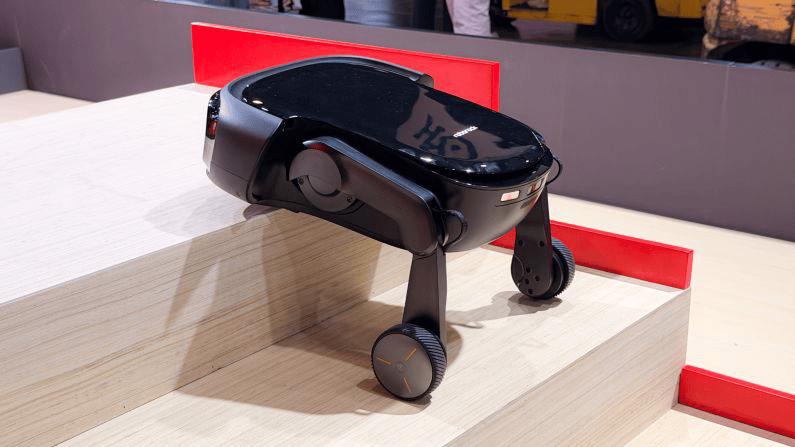
"The fall of the robot has revealed the state of the technology."
This is an evaluation by industry insiders of Roborock's performance at CES this year, and this statement has two meanings.
The first meaning is straightforward. During the on - site demonstration, Roborock's vacuum cleaner robot fell down the stairs, directly exposing the immaturity of the product's stair - climbing ability in front of the camera. The second meaning is more thought - provoking. In the process of new product development, this fall has actually "revealed" what kind of technological path and value orientation a company pursues.
If we look back at the past two years of CES, we will find that Roborock is one of the manufacturers in the vacuum cleaner robot market that doesn't shy away from showing cutting - edge prototypes.
At last year's CES, Roborock attracted a lot of attention with a vacuum cleaner robot equipped with a retractable robotic arm. This "arm" can pick up small scattered objects during the cleaning process, enabling the vacuum cleaner robot to have a primary active interaction ability for the first time, rather than just "passively avoiding obstacles".
This year, Roborock has advanced its ambition to the next level.
At the CES site, Roborock exhibited its latest product called G - Rover: a vacuum cleaner robot equipped with a "wheel - leg structure". Compared with traditional cleaning equipment that relies on a wheeled chassis, G - Rover can perform complex actions such as going up and down stairs and crossing thresholds through the combination of wheel - legs on both sides, and can even complete cleaning while climbing stairs.
This also makes the vacuum cleaner, which was originally a highly tool - oriented category, start to show an obvious trend towards the robot form.
From two - dimensional floor cleaning to three - dimensional space operation; from just having a "brain" to also having "hands" and "feet". However, an accident occurred during the on - site demonstration of this product.
Online videos show that G - Rover lost its balance when trying to climb the stairs and fell directly from the stairs. The staff quickly stepped forward to handle the situation, but this scene was still completely recorded.
Subsequently, Roborock's customer service stated externally that there is currently no vacuum cleaner on sale that can climb stairs. The brand's official website shows that the product is still in the R & D stage, and the launch time has not been determined.
The setback at CES is understandable. After all, such exhibitions are venues for showcasing creativity and cutting - edge technologies, but it still reveals the current situation of the vacuum cleaner robot industry.
As the cleaning demand expands from the floor to real - life home structures such as stairs, it is becoming increasingly difficult to create a generational difference through algorithm optimization alone. Even DJI, with its good reputation in the technology market, did not achieve a breakthrough performance in the consumer market after launching its traditional vacuum cleaner products.
Therefore, established vacuum cleaner manufacturers are starting to shift the competition from having a "smarter brain" to having a "more complex body". Vacuum cleaner robots are starting to grow "hands" and "feet", and may even have more complete mobility and operation capabilities in the future. This trend also brings forward the technological risks.
At the same time, Roborock itself is at a point where the real - world pressure is constantly increasing. At the capital level, Roborock has submitted its listing application to the Hong Kong Stock Exchange for the second time, restarting the previously interrupted IPO process and trying to build an "A + H" dual - financing platform. The purpose of the fundraising is clearly pointed towards international expansion, product R & D, and replenishing working capital.
However, the market's attitude is not so clear. The result of the application becoming "invalid" in June 2025 means that as the industry moves from high - speed expansion to a stage of competing in engineering capabilities, product completion, and long - term investment, how can Roborock shift from scale growth to quality growth?
In this context, the moment when G - Rover fell from the stairs may not just be a demonstration accident of a prototype. It may be more like an inevitable moment of imbalance for Roborock before entering the "three - dimensional cleaning era". The real question is not the fall, but how far it is from mass - producing a deliverable product.
01 Climbing the Stairs That the Old King Didn't Climb
Climbing stairs may not be a technical problem, but more likely a product problem.
As early as 2001, iRobot, the "pioneer" of vacuum cleaner robots, had mastered quite mature stair - climbing technology. A report on iRobot in MIT Technology Review in 2002 mentioned that its stair - climbing robot Morticia, developed in 2001, could move stably on complex terrains.
This was a robot designed for military use. From the mechanical structure to the control system, the whole machine was independently designed and manufactured by iRobot. However, this ability has never been applied to subsequent consumer - grade vacuum cleaner robot products.
In 2015, Colin Angle, one of the co - founders of iRobot, gave a joking answer when interviewed by the media to explain this choice: "Vacuum cleaner robots won't have legs. There isn't enough reason to give them legs, except to make them sexier."
At that time, the key to the success of vacuum cleaner robots was not to challenge complex terrains, but to meet a large, stable, and scalable profitable market demand: to clean the floor as automatically as possible. The ability to climb stairs means exponentially increasing mechanical complexity, control difficulty, and cost risk, while only covering a very small number of home scenarios.
This is an "unprofitable" technological investment that does not conform to the efficiency model of the vacuum cleaner market at that time.
However, this product path is now being broken. Since its inception, the vacuum cleaner robot product has undergone at least four product innovations. Through continuous technological upgrades, it has solved users' cleaning pain points on the two - dimensional plane and is now entering the competition in three - dimensional space cleaning.

Take this year's CES as an example. Dreame Technology launched its concept product Cyber X, which can climb stairs with a "bionic six - legged + crawler" form; MOVA even took "Move Up, Move Beyond" as its theme, demonstrating its product concept for all - scenario cleaning in "water, land, and air".
Whether it's flying, stair - climbing, or equipped with a robotic arm, it can be said that in 2026, several major manufacturers in the industry have carried out product innovation around expanding the usage scenarios of vacuum cleaners. Although it is not easy to mass - produce these new products in terms of delivery stability, in essence, it is a way to show off their strength.
However, no leading manufacturer dares to lag behind because in the technology industry, the iteration of technology and products often brings about changes in the competitive landscape. For example, iRobot's slow product innovation led to it being acquired by a contract manufacturer under the pressure of Chinese manufacturers.
One generation of products has one generation of kings. After multiple rounds of reshuffling, Roborock, which has taken the throne in the vacuum cleaner market, is also feeling nervous.
According to an IDC report, in the first three quarters of this year, the cumulative global shipments of intelligent vacuum cleaner robots reached 17.424 million units, a year - on - year increase of 18.7%. Among them, Roborock topped the global list with a 21.7% share, but did not have a large gap with the second - placed Ecovacs (14.1%) and the third - placed Dreame Technology (12.4%).
Therefore, at the turning point of vacuum cleaner product innovation, whoever can deliver a new - generation breakthrough product first will also determine who can take the lead in the next round of three - dimensional cleaning competition.
02 How Far Is the CES Vacuum Cleaner from Entering the Market?
From the perspective of market demand, data from the Federal Reserve Bank of San Francisco shows that single - family homes are the absolute mainstream in owner - occupied housing in the United States, accounting for about 60% - 70%. Another study shows that about 70% of homes have four or more steps of stairs.
Therefore, in theory, American families do need a vacuum cleaner with "hands" and "feet". It can assist in cleaning hard - to - reach corners or gaps through a robotic arm, solve the problem of cleaning dead - ends, and place items in designated positions, and can also climb stairs with mechanical feet to solve the cleaning problem on different floors.
Compared with the overseas market, the demand in the domestic market may not be as strong. Currently, the proportion of single - family homes and villas in China's overall housing structure is relatively small, accounting for about 1.5% - 3% in urban areas.
After solving the market demand problem, to determine whether a market is large enough, we often also need to look at consumers' actual purchasing power. Take the virtual reality industry as an example. Most people are willing to praise the amazing technology brought by Apple Vision Pro, but the number of people with actual purchasing power is not large.
Currently, the expected retail price of the world's first stair - climbing vacuum cleaner, Ascender, is about 10,500 yuan, far exceeding the general price range of most high - end traditional models, which is between 4,500 and 6,800 yuan. The price of one unit can even buy two high - end models, so it is not cost - effective.
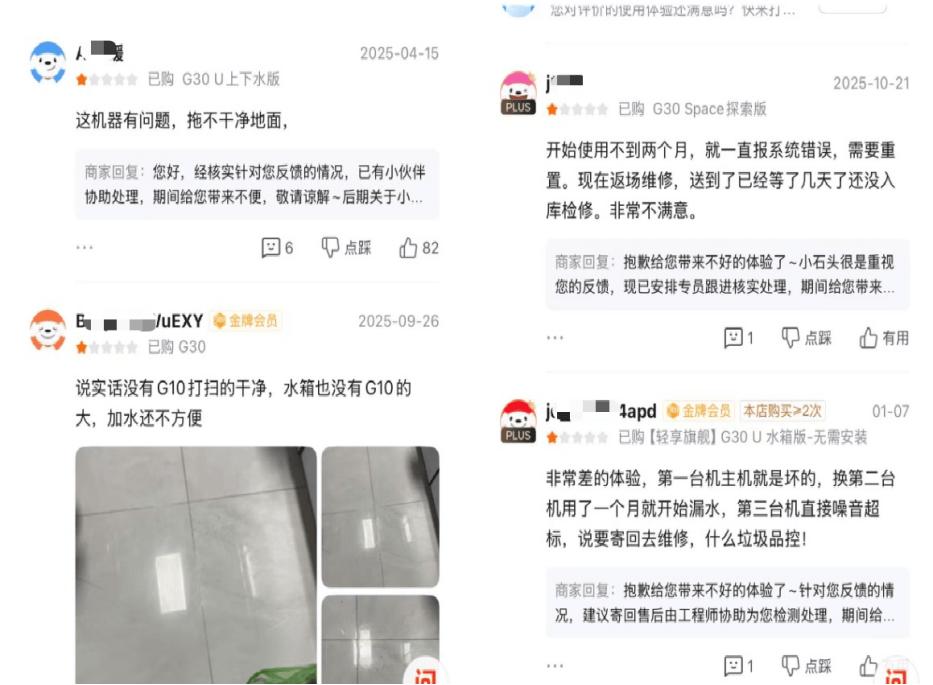
Secondly, there is the issue of the stability of the user experience. For example, after the release of the conceptual product G30 space at the previous CES, on the JD platform, the negative reviews of this product mainly focused on problems such as "low sensitivity", "breaking down after a short period of use", "returning to the factory for repair", and "poor after - sales service".
Perhaps learning from the unstable delivery experience of the previous generation of products, Roborock has adopted a different strategy for the G - Rover, which had a setback at this CES: it said that the launch time of the device has not been determined.
Looking at electronic technology exhibitions like CES or IFA, their essence is more like a platform for expanding channel partners and showcasing technological strength. The creative products released by enterprises may not be mainly aimed at attracting consumers, but rather at letting channel partners and agents see the brand's ability and determination to expand business in the local area. Especially in the US market, offline channels play a crucial role.
Expanding channels in North America is very important for Chinese manufacturers at present. Once channel partners recognize the brand, it is conducive to purchasing other products with high profit and sales volume, and consumers are also more likely to come into contact with and experience the products.
03 Can the Hong Kong Stock Market Revive the "Vacuum Cleaner King"?
In 2021, the highest price of Roborock's stock soared to 1,494.99 yuan per share, and its market value was approaching 100 billion yuan. It became the second - highest - priced stock in the A - share market after Kweichow Moutai and was once called the "Vacuum Cleaner King". As of the close on January 13th, its total market value was only 4.1076 billion yuan, a shrinkage of more than 50%.
At the same time, the trust in Roborock has also declined.
What investors complain about the most is the behavior of Chang Jing, the actual controller of Roborock. While shouting at investors to "be patient", he has successively reduced his holdings and cashed out. From 2023 to 2024, Chang Jing continuously reduced his shares in the company, cashing out a total of 888 million yuan. His shareholding ratio has dropped from more than 30% initially to 20.99% at the end of the third quarter of 2025.
All of the above - mentioned performances may affect its valuation and subscription enthusiasm in the Hong Kong stock issuance.
Perhaps also realizing that the vacuum cleaner business is difficult to support a high - enough valuation, Roborock has also started to explore new growth curves. It has entered the washing machine market and launched a washing and drying set featuring molecular sieve technology, with the high - end models priced at 15,000 yuan.
However, in 2025, there were rumors in the market about personnel adjustments in Roborock's washing machine division, involving core positions such as product and supply chain. Roborock has not made a public response to this yet.
Looking at the industry, there are no shortages of stories of late - comers surpassing the former leaders in the vacuum cleaner robot market. Chinese manufacturers have achieved a reversal in core algorithms, sensor applications, and structural design through continuous and high - intensity R & D investment, gradually gaining an overwhelming advantage in the global market and even starting to lead the technological direction in reverse.
At the same time, new variables are constantly entering the competition.
In 2025, DJI launched its ROMO series of vacuum cleaner robots, trying to transfer its technological accumulation in visual perception and path planning to the home cleaning scenario. In December of the same year, Xlean launched its Qingyun intelligent series of new products, starting from the segmented capabilities such as automatic mopping and sweeping integration. The emergence of these new entrants is continuously raising the technological threshold of the industry competition.
Therefore, history will not simply repeat itself. The stumble of G - Rover at CES may have a far - reaching metaphor beyond just a demonstration accident. It may be more like a reminder to the market that moving from being the "Vacuum Cleaner King" to the next stage is not a linear upward path, but more likely to be a dangerous staircase.
This article is from the WeChat public account "Market Insights", author: Wang Haoran, Gu Nian. It is published by 36Kr with permission.