Chen Kaiming, Founder of Zhefei Aviation: From Stratospheric Intercontinental Cruising to Urban Low-Altitude Takeoff and Landing | Industry Exclusive Interview
Cover source | Provided by the enterprise
Chen Kaiming (CK), the founder of Zhefei Aviation, is in his forties. He has spent over 20 years working with airplanes.
Twenty years ago, while studying aerospace engineering at the University of Cincinnati in the United States, CK got an internship at Gulfstream Aerospace, a top business jet company, and worked there throughout his undergraduate years. Later, when Gulfstream launched the G650 project, CK officially joined the company and didn't leave until 2013.
During his first decade working with airplanes, CK led a team focusing on flight control algorithms and software development, and was deeply involved in the R & D and airworthiness certification of the entire G650 aircraft. He described this process as "fighting a major battle," filled with extreme excitement and pressure, and he deeply understood that the aviation industry must have a sense of awe for life.
"Don't underestimate this (airworthiness certification). A high - safety - level airworthiness process is extremely difficult and will make you feel completely reborn." The airworthiness certification process highly depends on the accumulation of past project experience. There is a significant difference between those who have completely gone through the entire certification process and those who haven't. And airworthiness certification itself is just the starting point for entering the industry.
In 2013, CK returned to China as a technical consultant and assisted the Commercial Aircraft Corporation of China (COMAC) in Shanghai with the R & D and certification of the C919 project. He was deeply involved in the R & D of the core systems of the domestic large aircraft and worked on it for another 10 years until the end of the last task in late 2022.
During the first 20 years of working with airplanes, CK has successful experience in obtaining airworthiness certification for multiple aircraft models from scratch in the R & D, testing, and airworthiness certification processes of such complex systems. In his opinion, the core systems should be the "infrastructure" for China's civil aviation and low - altitude economy aircraft manufacturers. During his previous venture with Pantuo Aviation, CK found that the domestic aviation industry chain was facing a very serious problem: the domestic market could hardly buy mature products for these critical underlying systems, while foreign companies were already planning for the next - generation products.
"At that time, many aircraft manufacturers urgently needed a stable supply - chain cooperation. This was a very obvious problem and also an opportunity." Seeing the lack of system innovation in the upstream of the domestic aviation industry chain, CK founded Zhefei Aviation in 2022, choosing to be an aviation technology company that prioritizes systems to fill the gap in the domestic supply chain and accelerate the progress of advanced air transportation.
"You must view flight as an integrated system, rather than a collection of several functional components. Flight control, energy management, and avionics architecture are the foundation for aircraft safety and mass production."
"Simply put, it's not about making a single product, but a product system that is airworthy." As one of the few domestic aviation system - level suppliers, it is reported that Zhefei Aviation has reached cooperation agreements with several aircraft manufacturers such as Dream Sky and Yifei Aviation to jointly promote the R & D, testing, and test flights of core system products.
Recently, Zhefei Aviation completed a new round of financing of tens of millions of yuan led by Shunwei Capital, with follow - on investments from Pudong Venture Capital, Houxue Capital, and Shangcheng Capital. Including the angel round led by Photosynthesis Venture Capital in February 2025, Zhefei Aviation has received two consecutive rounds of financing this year. It is reported that this is the first layout of these investment institutions in the low - altitude supply chain.
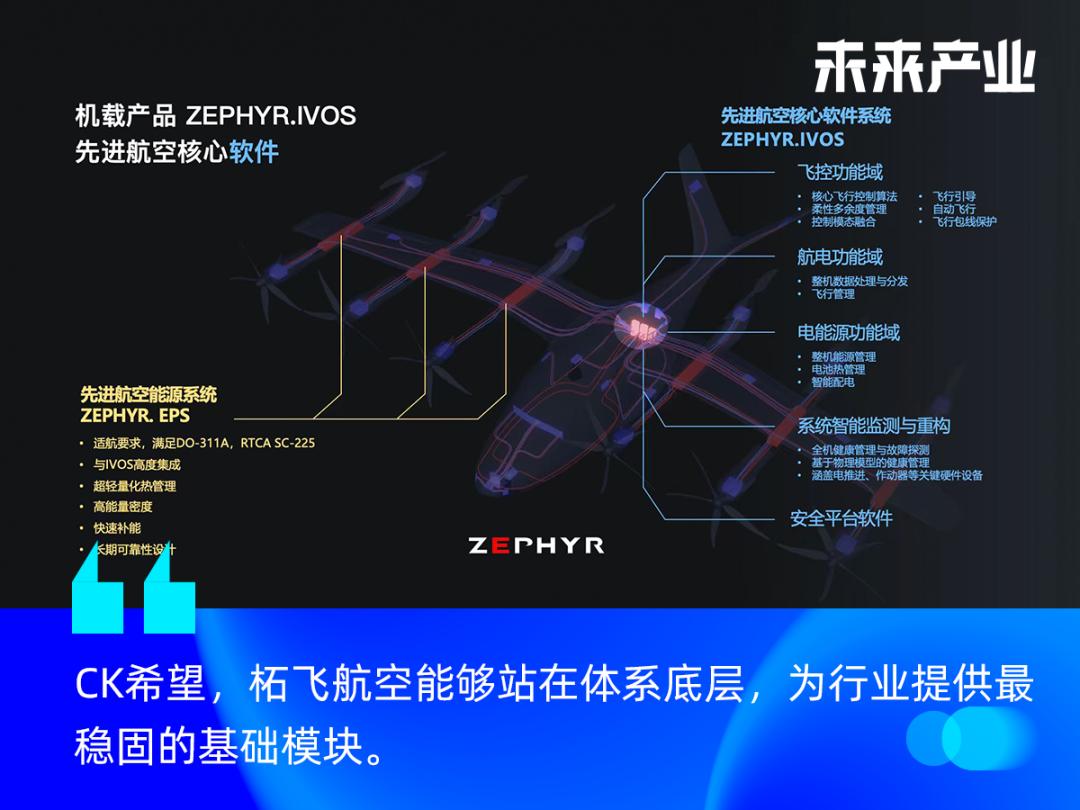
"I'm very glad to see the booming development of this industry. This is a once - in - a - century major change in the global aviation industry. What we are striving to do is to complement the upstream technological foundation. We hope to work with our aircraft - manufacturer partners to do things well and solidly." CK hopes that Zhefei Aviation can stand at the bottom of the system and provide the most stable basic modules for the industry.

"Globally, people with complete experience in flight control system projects are very scarce."
36Kr: You completed a new round of financing at the end of October. Before that, the outside world didn't know much about Zhefei Aviation. Could you first introduce what you specifically do?
CK: Zhefei Aviation was founded in 2022. Since its establishment, we have chosen to be an aviation technology company that prioritizes systems. We don't manufacture complete aircraft but focus on system - level solutions for flight control systems (FCS), energy management systems (EPS), and autonomous driving (Autonomy).
You can simply understand it as us providing the "brain," "heart," and "nervous system" for aircraft. There are also some manufacturers in the market that do flight control, but we don't just focus on flight control. We will consider the entire aircraft system comprehensively to create core value for our customers.
36Kr: Why did you choose to focus on systems rather than complete aircraft? How was this direction determined?
CK: I was once the founder of Pantuo Aviation. Pantuo was working on the ducted - fan configuration at that time and was one of the earliest domestic companies to work on eVTOL. This entrepreneurial experience made me realize that the domestic aviation industry chain was facing a very serious problem: the domestic market could hardly buy mature products for these critical underlying systems, while foreign companies were already planning for the next - generation products.
For large aircraft like the C919, many critical systems come from mainstream foreign suppliers. For small companies, direct procurement from foreign sources is not only unfriendly, but foreign suppliers may not value these small orders. The domestic supply chain at that time mainly served large - scale projects like COMAC, aiming at localization and self - control, while the military industry had its own independent system.
At that time, many aircraft manufacturers lacked stable supply - chain support. This was a very obvious problem and also an opportunity. After careful consideration, we believed that this was a very valuable direction that could truly promote the progress of the industry.
36Kr: It's very similar to the problems the semiconductor industry chain faced before. The underlying innovation in the upstream supply chain is actually a more fundamental and difficult - to - overcome part, and someone needs to take on this task. But why can you do it?
CK: To put it simply, our confidence and ability come from solid project experience. At Gulfstream Aerospace (a business jet brand under General Dynamics in the United States), my small team was responsible for almost all the flight mechanics, simulation, and flight control software on the aircraft and had completely gone through the entire R & D process of modern commercial flight control systems several times. (The Gulfstream G650 series has a range of 14,000 kilometers, a cruising altitude of 15 km, and a maximum speed of Mach 0.925, once being the fastest civil aircraft in the world.)
Later, when serving the COMAC C919 project and some foreign startup projects like Embraer E2, I was deeply involved in the R & D of the core systems of multiple fly - by - wire aircraft models. I have not only gone through the entire process of R & D, testing, and airworthiness certification of such complex systems once, but two, three, or even more times.
Globally, people with such complete experience are very scarce. The teams at Boeing and Airbus are not large. The core members of my team at Gulfstream were only eight or nine people, and similar teams at some large aircraft manufacturers were only dozens of people. I can use this background and experience to provide services for the industry.
36Kr: So investment institutions actually value your past experience in systematic engineering. After all, investment is also about investing in people.
CK: On the one hand, I think investment institutions value the upstream supply chain to promote the progress of the industry. On the other hand, they may think that my personal background is solid, with more than 20 years of in - depth experience in commercial aviation. After background checks, investors found my resume very reliable. Moreover, more than 90% of our team members have commercial aviation backgrounds, with experience spanning multiple sub - fields such as flight control, avionics, energy management, and autonomous driving, and they cooperate closely with each other. Such a team may be very scarce.
We actually completed two rounds of financing in 2025. In early 2025, we completed the angel round led by Photosynthesis Venture Capital, and then completed the second round led by Shunwei Capital, both still in the angel - round stage.
Our methodology and toolchain are at the global leading level. While providing domestic solutions to solve bottleneck problems, we hope to explore the most advanced R & D directions in international advanced air transportation and even achieve overtaking on curves.

"The integration of flight control, energy management, and intelligent driving is a trend and needs to be closely combined with the design of the entire aircraft."
36Kr: You position yourselves not as flight - control suppliers but as "system innovators" for China's civil aviation. How do you understand this system?
CK: Currently, there are many players claiming to do flight control. Flight control is indeed important, but flight control alone is not enough to support a high - quality aircraft product. A complete core - system solution can better meet the needs of aircraft manufacturers for cost control and R & D speed and accelerate the progress of advanced air transportation. At the same time, through our services and solutions, we can also assist aircraft manufacturers in improving the design of the entire aircraft and creating better aircraft products.
36Kr: So it can be understood that just doing flight control is not enough. If everyone works independently and then integrates, the cooperation and integration efficiency will be low. What you advocate is a complete technical platform approach.
CK: Yes, the integration of flight control, energy management, and intelligent driving is a trend and needs to be closely combined with the design of the entire aircraft. The system is the invisible part of the aircraft. You can't see it, but it must be reliable.
In the past, China was a bit behind in traditional commercial - aviation systems, but in the era of electric aviation, everyone is on the same starting line, and there may be business opportunities. China's mature supply chain for automobiles and electronic products, complete and mature process chip ecosystem, and large - scale engineering implementation capabilities will all become potential advantages. As long as we combine system - design capabilities with high - efficiency execution, although we are catch - up players, we may achieve leading in a new track.
36Kr: Back to the specific product level, in the past two years, the low - altitude economy has exploded, and people have realized that the industry needs domestic flight - control systems that are self - controllable. What are the difficulties in achieving this?
CK: The core reason for the poor performance is the lack of experience. Most practitioners have not completely gone through the entire process of designing, developing, and obtaining airworthiness certification for fly - by - wire flight control systems.
You can understand it this way: You need to equip a 2.5 - ton eVTOL with a flight control system, but the complexity and safety requirements of this system are basically equivalent to those of a 50 - ton fly - by - wire aircraft. Your task is to "fit" a 50 - ton aircraft's fly - by - wire flight control system into a 2.5 - ton small aircraft. This is the first challenge.
The second challenge is that the origin of this technology is in the commercial - aircraft field, and the relevant technical standards and airworthiness regulations are all established around commercial aircraft. The first commercial aircraft in China that was developed strictly in accordance with Part 25 (CCAR - 25/CS - 25/FAR - 25) regulations and had a complete fly - by - wire flight control system was the C919, and the C919 only obtained the type certificate on September 29, 2022. This means that the domestic aviation industry has just started in this regard.
The third challenge is the lack of purely domestic solutions for upstream industrial - chain components such as functional - safety chips. This is a reality.
Software is the carrier of these experiences and airworthiness requirements and can even compensate for some weaknesses in the upstream hardware to a certain extent. If the hardware is not good enough, the software can make up for it.
36Kr: So what problems does Zhefei solve first?
CK: The industry lacks a complete and highly reliable flight control software. Our first product is to solve this pain point for aircraft manufacturers.
We provide a standardized industrial product, a complete, commercializable, and packaged product package. This includes our complete system management software and application layer. Of course, it also requires the joint efforts of important strategic partners. AVIC - GE Aviation Systems is one of our important partners.
We can make an analogy: Previously, the drone flight control systems were at the "remote - controlled go - kart" level, while the system we provide is at the "Tesla" level.
In November last year, we officially launched the airworthiness - level flight control system solution Zephyr.IVOS, which has no domestic counterpart and is highly integrated with functions such as flight control, automatic flight, flight management, and energy management. Our flight control system uses an aviation - grade fly - by - wire architecture and redundant fault - tolerant logic and can support multiple configurations such as multi - rotors, compound wings, and tilt - rotors. The system performance is comparable to that of leading foreign eVTOL projects and is basically among the global first - tier. This is a complete and world - class product, not just meeting the minimum airworthiness requirements.
36Kr: The technical problems are solved. What about the standards? How can you truly achieve the "airworthiness level"?
CK: First of all, when designing the flight control system, we need to comprehensively consider the airworthiness (functional safety) requirements at the aircraft and system levels. There are some very special requirements for fly - by - wire civil aircraft, which are reflected in dozens of special conditions or surface - compliance methods. We need to comprehensively consider everything from the system architecture, software architecture, algorithm architecture to the implementation method to fully meet these special conditions. These solutions are generally not taught to others, and few people can consider them comprehensively.
Secondly, in some technical solutions and function implementations, there are a series of unique practices for high - safety - level software, especially flight control software and energy management software, which are not found in textbooks.
Finally, our R & D system follows DO - 178C (software standard), DO - 254 (hardware standard), ARP4754A (system development specification), and AS9100D (quality system standard). Of course, these are just the minimum requirements.
Essentially, for a good product, technology, product, and airworthiness are not separate parts, and there is no question of which comes first. It's a matter of awareness.
For example, a typical misunderstanding in the industry in the past was "relying on flight control to cover everything." People designed the aircraft first without fully considering the characteristics of fly - by - wire flight control or having some design flaws, and then hoped that the flight control system could solve these problems. In reality, some problems can be compensated for by flight control, while others cannot. A better approach is to consider whether to make full use of these fly - by - wire flight control or complex electronic hardware and software at the early design stage of the aircraft.
We hope to promote the construction of China's aviation product ecosystem. That is to say, we expect to provide not only software or hardware but a complete solution for our customers. Especially for eVTOL, which is a very pure "