Growth without increased revenue: Are logistics robots caught in the paradox of scale and profit?
In recent years, artificial intelligence has undoubtedly become the global spotlight. The rapid development of its technology is profoundly driving the transformation of the industrial landscape. More and more AI products are quickly flowing from laboratories to the front - line of industries, moving from technological breakthroughs to real - world scenario implementation.
Among numerous industries, the logistics field has become one of the fastest - growing and deepest - applied test beds for AI. From unmanned delivery vehicles shuttling through streets and alleys, unmanned transport aircraft soaring in the sky, to logistics robots operating efficiently in warehouse centers, AI technology is comprehensively reshaping every aspect of logistics.
In this intelligent picture, intelligent in - field logistics robots, with their revolutionary improvement in warehouse operation efficiency, are becoming an important engine to promote the transformation of the logistics system.
Losses Amid High Growth
What are intelligent in - field logistics robots?
They refer to intelligent devices applied in scenarios such as warehouses, sorting centers, and factories. The core is to combine advanced technologies such as navigation and positioning, motion control, autonomous driving, multi - robot cluster control, and AI to automate key tasks such as material storage, access, handling, and sorting within facilities.
Intelligent in - field logistics robots have diverse classifications, including mobile robots (AMR/AGV), sorting robots, packing and palletizing robots, unmanned forklifts, shuttle vehicles, etc.

The automation of logistics is opening up broad market space and growth opportunities for this robot industry.
According to Sihan Research Institute, the global market size of intelligent in - field logistics robots is growing steadily. It is expected to reach 344.1 billion yuan by 2030, with a compound annual growth rate of 19.5% from 2024 to 2030. The Chinese market size has expanded from 13.9 billion yuan in 2020 to 44 billion yuan in 2024, accounting for 37.2% of the global market. By 2030, the Chinese market size is expected to reach 133.9 billion yuan, with a compound annual growth rate of 20.4%.
Despite the promising market size and growth prospects, enterprises in this track are facing profitability challenges.
Some industry insiders said that in China, only about 5% of enterprises in this industry are really making money. They are running out of cash, losing more money as they take on more projects, and finding it increasingly difficult to raise funds.
The growth expectations of the macro - market are in sharp contrast to the survival pressures of micro - enterprises. By focusing on specific enterprises, such as Kylos, which is in the IPO process, and Geek+ which disclosed its financial report for the first time after going public, we can have a more personal understanding of this challenge.
In early January 2026, Kylos submitted its prospectus to the Hong Kong Stock Exchange for the second time, aiming to be listed on the main board.
In 2014, Gu Chunguang founded Wuxi Kylos Technology Co., Ltd. In 2016, Zhejiang Kylos Technology Co., Ltd. was established as the parent company of Wuxi Kylos Technology Co., Ltd. The company provides products around three core product lines - multi - directional shuttle robots (MSR), autonomous mobile robots (AMR), and conveyor sorting robots (CSR).
According to the prospectus, from 2022 to 2024, Kylos' revenues were 657 million yuan, 551 million yuan, and 721 million yuan respectively, showing a certain degree of fluctuation; during the same period, the adjusted net losses were 117 million yuan, 123 million yuan, and 50.451 million yuan respectively.
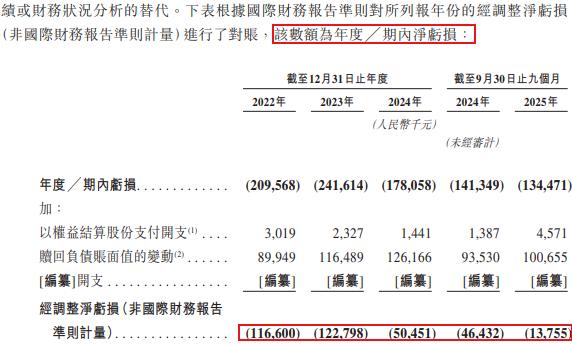
However, the company will achieve profitability through measures such as expanding revenue scale, increasing gross profit margin, and enhancing operating leverage.
Similar financial challenges are also reflected in another enterprise - Geek+, the world's first publicly - listed company for AMR warehouse robots.
Geek+ was founded in 2015 and went public in July 2025. Then in August, the company released its first earnings report since going public.
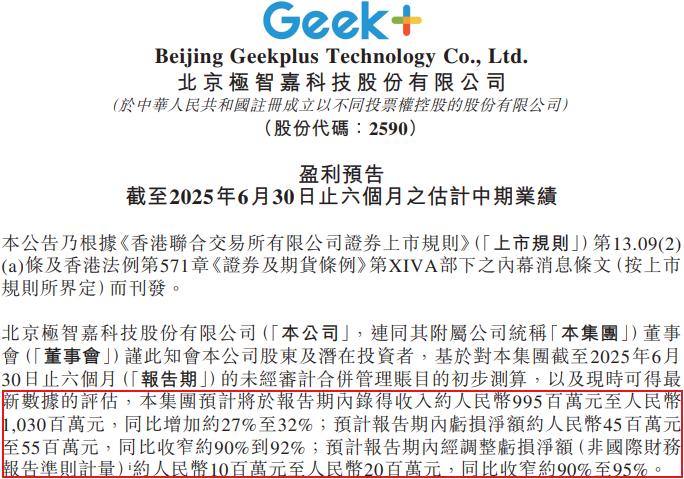
According to the earnings forecast, in the first half of 2025, the company is expected to achieve revenues of 995 - 1030 million yuan, a year - on - year increase of 27 - 32%; it is expected that the net loss of the company during the reporting period will be 45 - 55 million yuan, a year - on - year significant reduction of 90 - 92%, and the adjusted net loss will be 10 - 20 million yuan, also a significant reduction of 90 - 95%.
Before this, Geek+ had also been in a long - term loss state, but showed a clear narrowing trend. According to China.com, from 2021 to 2024, Geek+'s adjusted EBITDA narrowed significantly from - 672 million yuan to - 25 million yuan; at the same time, Geek+'s adjusted net loss rate also showed a significant narrowing trend, and the adjusted net loss rate in 2024 dropped to 3.8%.
From the financial situations of these two representative enterprises, it can be seen that even companies with clear technical routes and leading market shares are still struggling to find a profitable path.
This reflects the current core contradiction in the industry: the rapid expansion of the market has not been synchronously transformed into the general profitability of enterprises. There is an obvious time lag between the scale effect and the release of profits, and enterprises are generally in the stage of "trading investment for market share".
Behind this stage, it reflects that enterprises are facing many challenges in the high - speed development of the industry.
The Predicament of Profitability
When a certain market shows broad growth prospects, it often attracts a large number of enterprises to enter and layout. This is the case in the field of logistics automation, and even more so in its sub - track of intelligent in - field logistics robots.
Differently, the current market pattern of the intelligent in - field logistics robot track is relatively fragmented, and no industry giant with absolute dominance or demonstration effect has emerged yet.
According to Jiemian.com, the combined market share of the top five comprehensive intelligent in - field logistics robot enterprises in the Chinese market is only 12.6%. There are many players in the track, with about 100 comprehensive players, and the homogeneous competition is fierce. Among them, the market shares of the top four in the industry are 4.6%, 2.5%, 1.9%, and 1.8% respectively. Kylos ranks fifth in the industry with a market share of 1.6%, but this ranking is more due to the dividend of the fragmented market pattern rather than the absolute leading core competitiveness.
In contrast, in the sub - track of unmanned delivery, a pattern dominated by Neolix and Jiushi has been formed, and the industry demonstration effect has emerged.
At the same time, the intelligent in - field logistics robot track also faces a strong competitor from the broader logistics ecosystem.
JD Logistics, driven by technology, has built an efficient and visible supply chain system through the deep integration of "Super Brain + Wolf Pack". It not only occupies an important position in the logistics field but also has established remarkable technological and application advantages in the intelligent in - field logistics robot track.
In comparison, this highly fragmented and homogeneous competition pattern deeply reflects that the intelligent in - field logistics robot industry is still in the early expansion stage. The focus of industry competition still lies in sales and project delivery rather than a sustainable business model based on products and services.
At this stage, enterprises are often prone to fall into "parameter competition" and "price competition", with their profit margins continuously compressed, which in turn affects their long - term investment ability in core technology iteration and service system construction.
In addition, there is currently a certain gap between enterprises' profitability and market demand.
Intelligent in - field robots generally have two service models: single - function robot deployment and multi - function integrated system.
It is understood that in the entire industry, single - function robot deployment projects involve less customization and integration work, so the delivery cost is lower, and their gross profit is generally higher than that of multi - function integrated system projects. However, the market size of multi - function integrated system projects is growing faster.
From the perspective of enterprise operation, this structural contradiction further intensifies the difficulty of profitability and also reflects the strategic choices that enterprises generally face: whether to focus on standardized products with higher gross profit but limited growth space or invest resources to explore the system integration market with faster growth but greater profitability challenges - different path choices will directly affect the enterprise's positioning and development potential in the long - term industry competition.
Although there are many challenges ahead, it is undeniable that every industry will inevitably experience a period of strategic wavering and profit - making pain in its early expansion stage. This stage is a necessary process for the industry to move from barbaric growth to mature integration.
The huge market demand and continuous technological evolution still reserve broad imagination and growth space for enterprises with real innovation and perseverance.
This article is from the WeChat official account "Delivery Guide", author: Wu Yan. It is published by 36Kr with authorization.