With a return rate of 30%, are AI glasses the "ugly sons" of big tech companies?
The evolution of smart wearable devices is spreading from wrists and fingertips to the bridge of the nose.
After smartwatches started tracking health data and smart rings became fashionable items, a “battle of a hundred glasses” centered around the nose bridge has begun right in front of us.
The year 2025 is defined as the “Year of AI Glasses.”
In this year, a flurry of consumer - grade products were released. Manufacturers such as Xiaomi and Alibaba (Quark) successively launched new products, propelling the global smart glasses market to grow at a high - speed rate.
Entering 2026, the competition has escalated again as more tech giants have entered the arena.
Google's restarted AI glasses product is expected to hit the market as early as this year. Apple is rumored to be developing related devices, and ByteDance has also recently announced its “Doubao AI Glasses” project.
AI glasses, a once dormant concept, are making a comeback to the center stage with the help of large AI models.
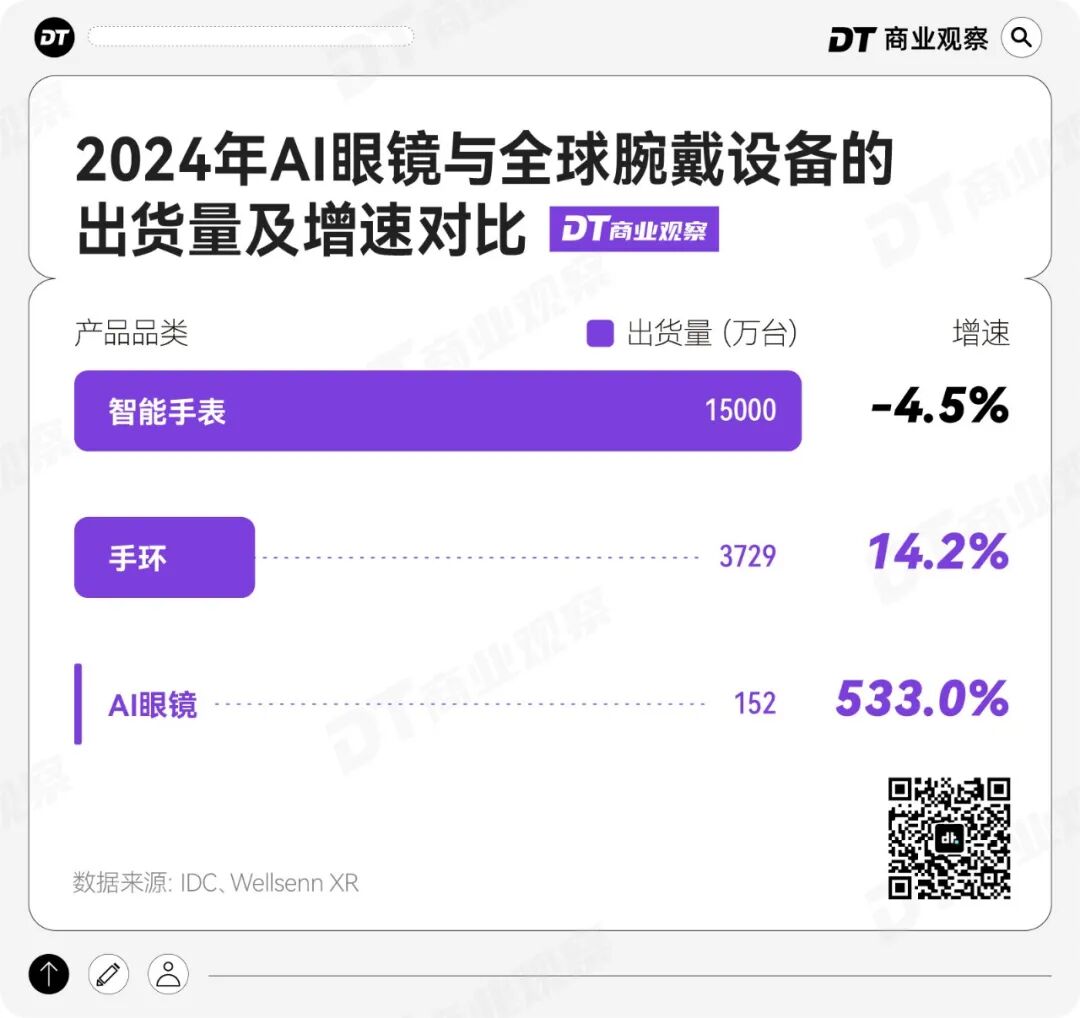
In 2024, the sales volume of AI glasses was 1/125 of that of smartwatches, but it increased by 533% year - on - year
First of all, it should be noted that AI glasses are not currently a clearly defined separate category in the industry. Instead, they are included in the broader category of smart glasses, generally referring to glasses - shaped products with AI functions.
After synthesizing multiple industry reports and brokerage reports, we've concluded that there are currently three main forms of so - called AI glasses -
AI Audio Glasses
In essence, they transform earphones into glasses.
They can be understood as “glasses + earphones + AI,” focusing on high - quality audio, calls, and voice assistants. The core feature solves the awkwardness of wearing both earphones and glasses simultaneously. It is the first step in making tech products a part of daily life and is currently the easiest form to popularize.
AI Shooting Glasses
On the basis of “listening,” a first - person shooting function is added.
The miniature camera on the temple of the glasses allows you to record what you see from the most natural first - person perspective. This has opened up brand - new ways for vlogging and work record - keeping and is currently the most eye - catching category on social platforms.
AI + AR Glasses
AR stands for Augmented Reality. On the basis of the previous two types, a miniature display system is added. The core feature is the ability to overlay virtual information on the real world you see. For example, it can “lay” navigation arrows on the road and “paste” translated text beside real objects.
As the complexity of functions and the diversity of applicable scenarios increase for these three product forms, the prices also rise steadily.
If we only look at the shipment volume, AI glasses are still a niche category at present.
According to an IDC report, the total global shipment volume of wrist - worn devices (smartwatches and fitness trackers) reached 190 million units in 2024. Among them, smartwatches accounted for 150 million units, and fitness trackers were about 37.29 million units. In the same year, the global shipment volume of AI glasses was only 1.52 million units, approximately 1/125 of the total volume of wrist - worn devices.
However, this small base has witnessed astonishing growth.
According to the consulting firm Wellsenn XR, behind the 1.52 million units is a year - on - year increase of 533%. Morgan Stanley predicts that by 2028, the global shipment volume of AI glasses is expected to reach 35 million units, with a compound annual growth rate of 96%.
The market's enthusiasm is also reflected at the consumer end.
During the Double Eleven shopping festival in 2025, on the Tmall platform, the transaction volume of smart glasses soared 25 times year - on - year, making it the fastest - growing category in the entire 3C digital field.
On JD.com, AI glasses, along with popular categories such as AI mobile phones and AI learning machines, were included in the “high - growth camp,” with their transaction volumes increasing by over 100% year - on - year.
Moreover, the “AI glasses” are also highly anticipated within the industry.
The year 2025 is known as the “Year of AI Glasses.” Many media outlets and companies claim that AI glasses are about to have their “iPhone moment.” Not to mention that several major Chinese Internet companies have invested heavily and launched new products publicly...
How did this niche category of AI glasses manage to take the “C - position” in 2025?
Meta sold 300,000 units in a single quarter, and Quark accounted for 15% of the social media buzz
The AI glasses that became the focus in 2025 didn't achieve overnight success. Instead, they went through more than a decade of trial - and - error and transformation.
The story began with an over - idealistic start.
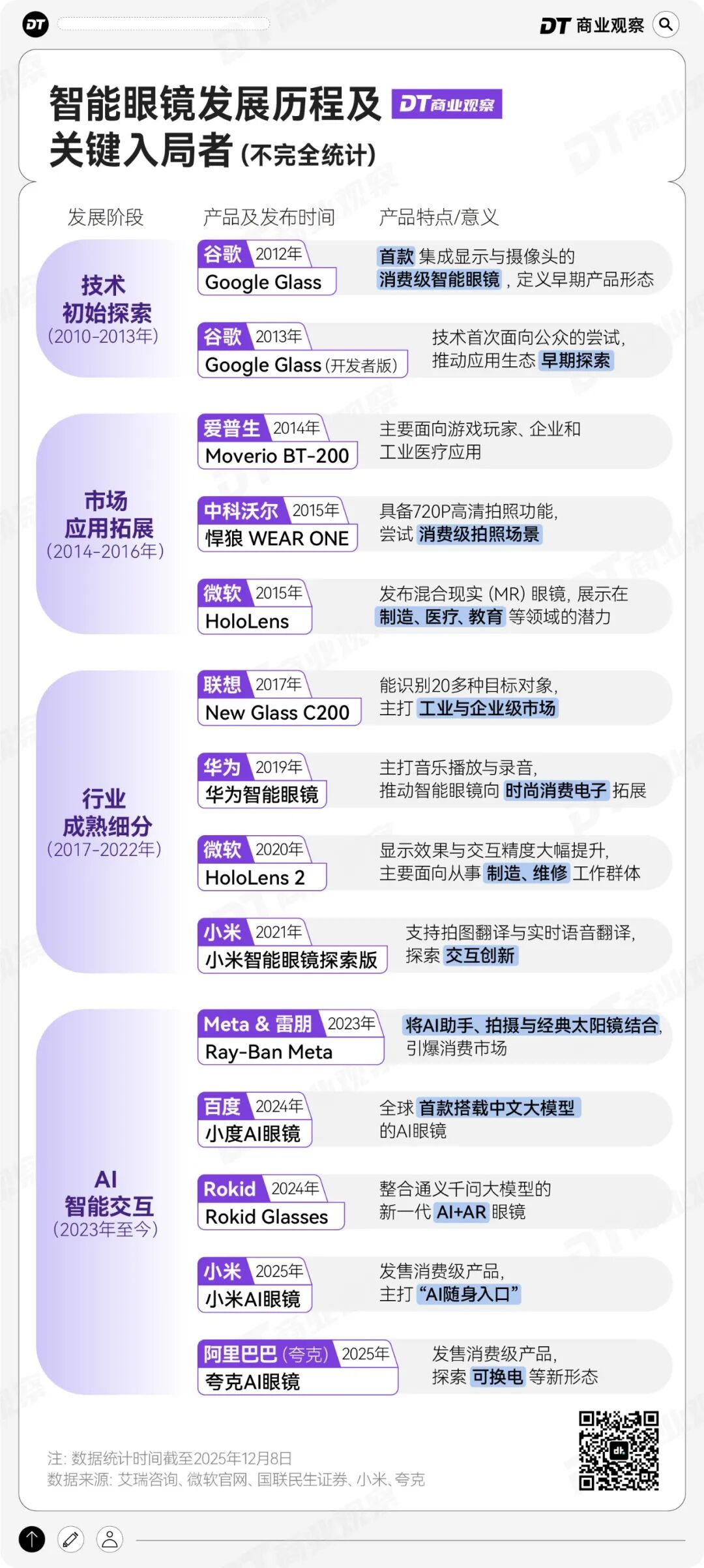
In 2012, Google launched the revolutionary Google Glass, attempting to place a complete smart interface right in front of the user's eyes.
However, after its launch, it received negative reviews such as inconvenience to wear, short battery life, and a high price tag ($1500). There were even widespread concerns about privacy leakage due to the camera.
This forward - looking attempt came to an abrupt end in 2015.
After facing a cold reception in the consumer market, smart glasses shifted to a more practical path: entering the enterprise and professional fields. Microsoft's HoloLens proved its value in factories and operating rooms, while devices from Epson and Lenovo improved efficiency in logistics and inspections.
These explorations verified the practicality of “first - person” interaction but didn't reach the general public.
It wasn't until 2019 that Huawei's smart glasses found a clever breakthrough - defining smart glasses as “wearable earphones.”
It abandoned the radical visual display and instead focused on integrating audio and wearability, giving smart glasses a fashionable appearance and the possibility of all - day wear.
The real turning point came in 2023.
The smart glasses jointly developed by Meta and Ray - Ban followed a simple logic: first, they are a pair of perfect classic sunglasses, and then they are smart devices. This respect for design and wearing comfort led to the sale of 300,000 units in the single quarter after its launch, opening the door to the consumer market.
After the problem of “looking like normal glasses” was solved, the explosion of generative AI in 2024 injected a new soul into this hardware.
Smart glasses are no longer just simple voice remotes. They have evolved into AI entities that can see, hear, and communicate. Baidu and Rokid successively launched glasses integrated with large models at the end of 2024, marking a new stage centered around AI capabilities in this competition.
Many people believe that 2025 is called the “Year of AI Glasses” because technology, products, and business logic have reached an intersection. The breakthrough of large language models enables glasses to conduct more complex real - time conversations and provides an immersive “first - person” experience that mobile phones can't offer.
Seeing this potential, tech giants have invested heavily.
Meta's Mark Zuckerberg believes that it will become the main computing device in the future. Baidu wants to promote its Ernie large model through Xiaodu glasses, and Alibaba has clearly stated that choosing Quark glasses is equivalent to accessing Alibaba's large - model ecosystem.
At the beginning of 2026, ByteDance also announced that its “Doubao AI Glasses” project has entered the shipment preparation stage. The initial product plan is about 100,000 units, mainly targeting Doubao's senior users.
A pair of glasses is becoming a key entry point for tech companies to compete for user and ecosystem control in the next era.
This strategic emphasis directly triggered the social media buzz in 2025.
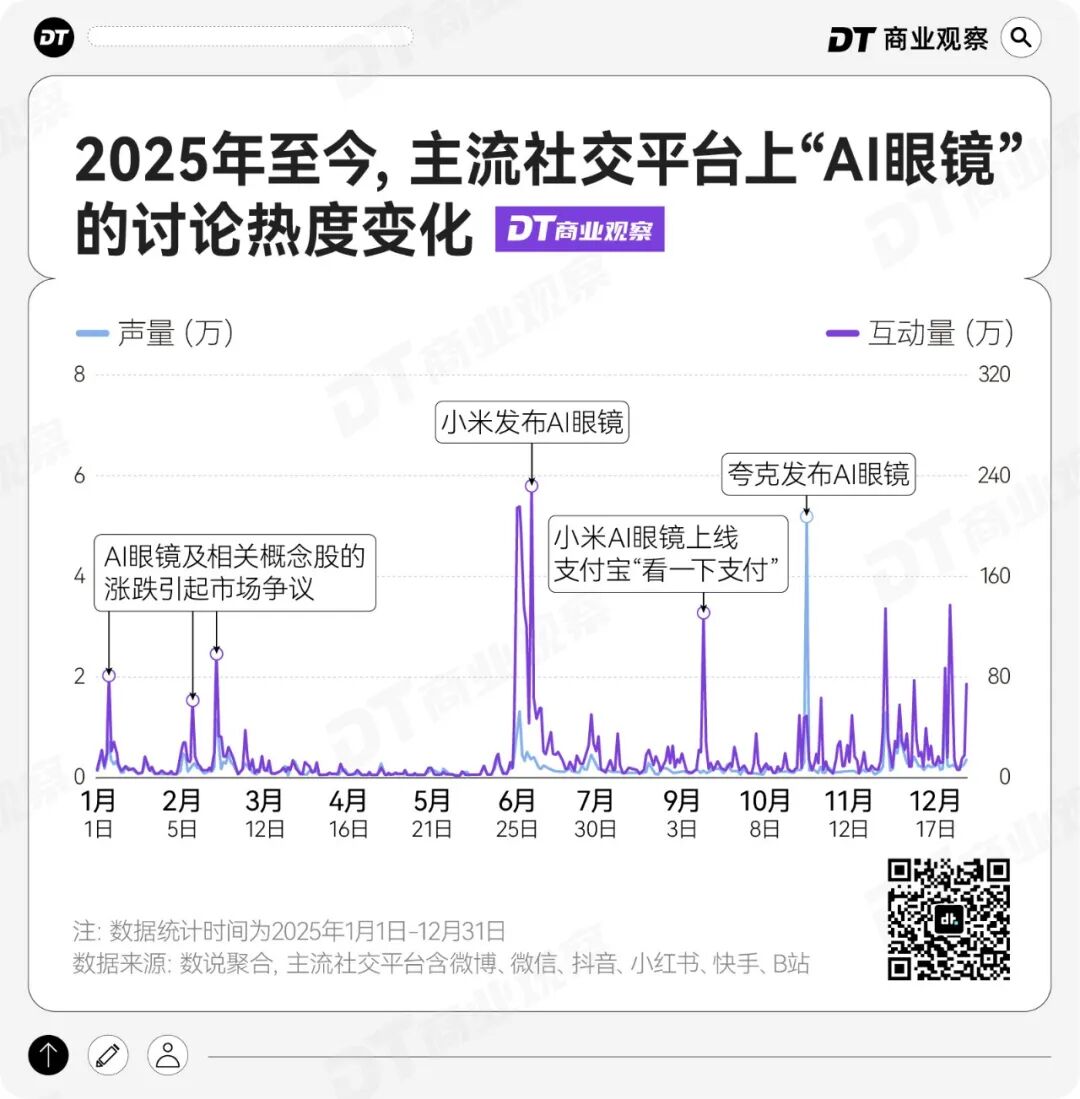
The whole - year discussions fluctuated closely following the key actions of several leading companies.
At the beginning of the year, the capital market's attention to related concept stocks brought several small - scale peaks in the discussion volume.
Then the market entered a lull period. It wasn't until Xiaomi launched its AI glasses in late June that the biggest round of discussions in the first half of the year was truly triggered.
At the end of July, when Xiaomi glasses launched the “Pay at a Glance” function on Alipay, it sparked another wave of discussions on practical scenarios.
And in November, the release of Quark AI glasses became the core event driving up the social media buzz in the second half of the year.
These peaks in the discussion volume driven by fluctuations in the capital market and the launch of new products by giants mean that to some extent, the current popularity of AI glasses doesn't come from broad and spontaneous public demand. Instead, it's more driven by the marketing resources and market expectations of a few companies.
In the overall discussions about “AI glasses,” Quark ranked first with a 15.2% share of the buzz.
However, a closer look reveals an obvious polarization in the public opinion field: ordinary users are more likely to ask “Is the first - person shooting practical?”, while investors are more interested in analyzing “Which sector will benefit?”
The buzz around financial terms such as “limit up” and “sector” is almost on par with that of technology keywords such as “artificial intelligence” and “large model.”
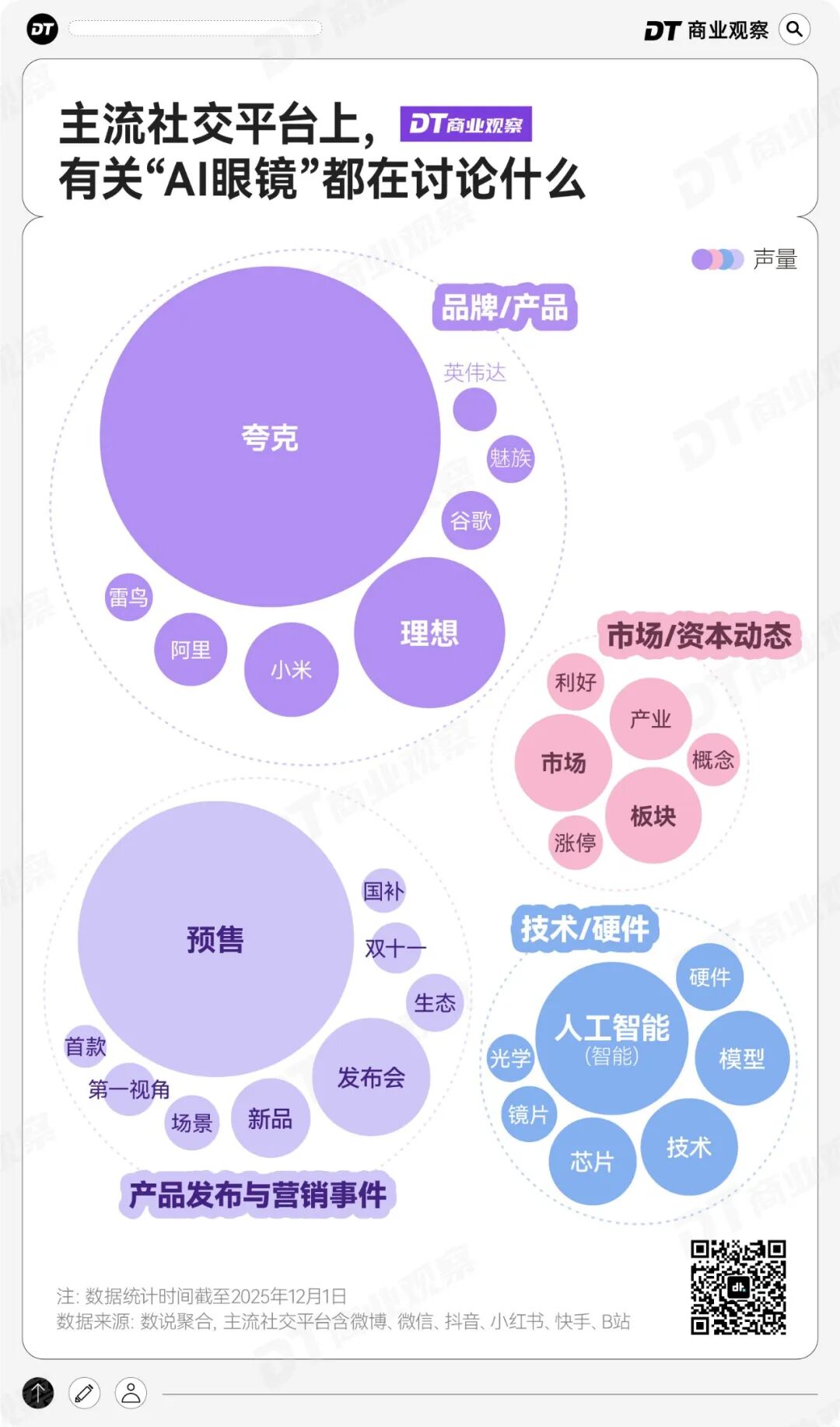
This just shows that at this stage, AI glasses carry dual expectations: for consumers, they are a trendy toy whose practicality remains to be verified; for the capital market, they are an investment symbol related to future track layout.
Each new product launch is simultaneously testing the temperature of the two markets.
Xiaomi and Rokid are selling well, but the return rate of AI glasses is as high as 30%
While the social media discussions about AI glasses are flooded with terms like “limit up” and “benefit,” the sales rankings and user reviews on e - commerce platforms present the real - world tests that the products have undergone in the consumer market.
In terms of sales volume, Xiaomi and Rokid are the current leaders.
With a price tag of 1899 yuan and comprehensive basic functions, Xiaomi has become the top choice for the public to try out new products. Rokid, priced at 4299 yuan, attracts users who pursue cutting - edge technology with its integrated AI + AR experience.
So, what selling points/functions are these hot - selling products promoting?
We've sorted out the hot - selling AI glasses products and their functions on e - commerce platforms. Combining with consumer surveys, we've made several discoveries.
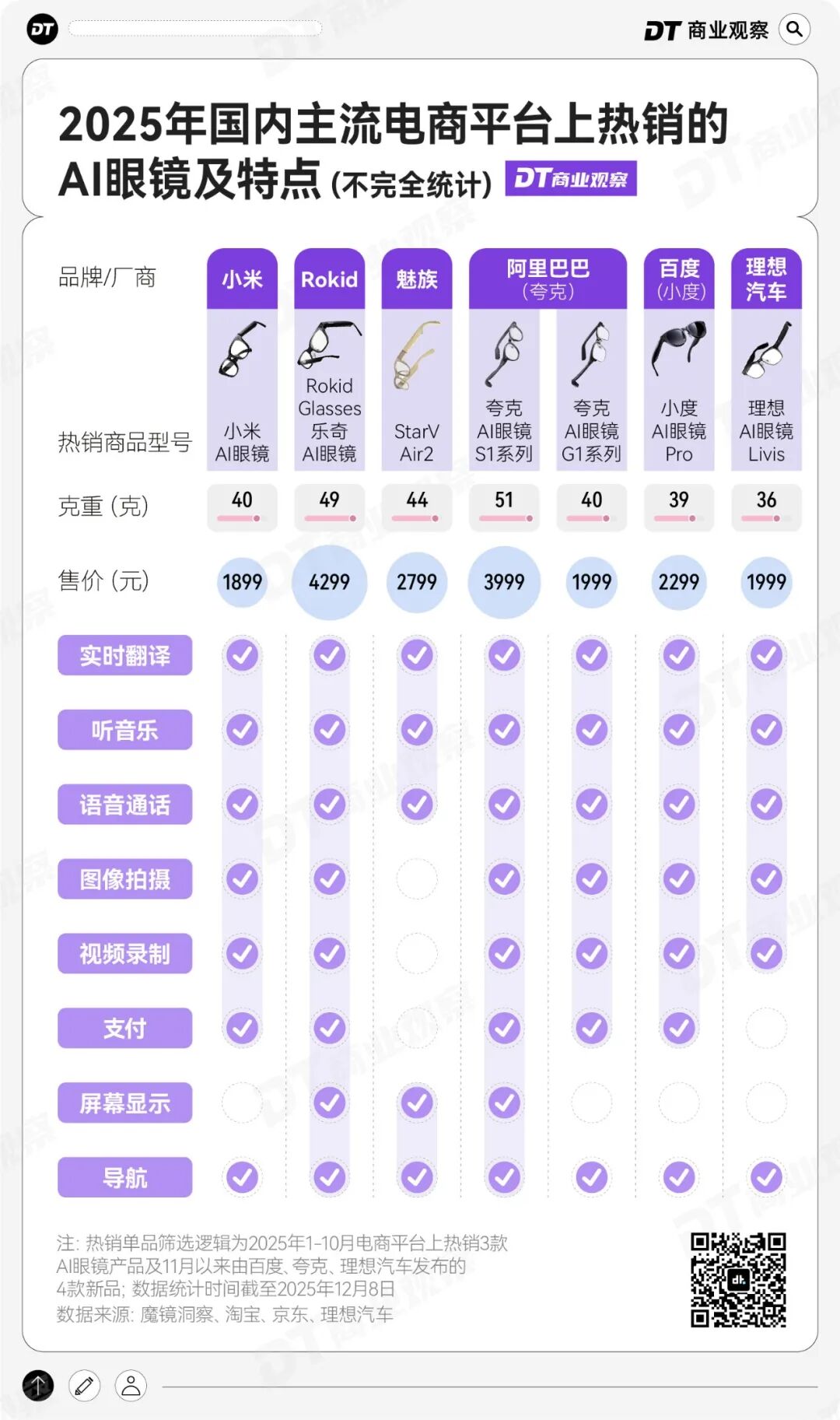
First of all, when looking at the parameter tables of mainstream hot - selling models, you'll find a clear “standard configuration” list: real - time translation, first - person shooting, high - definition calls, and smart voice assistants. These are indeed the functions that consumers are more concerned about.
Some manufacturers try to create differentiation with mobile payment, but consumer surveys show that only 16.8% of people are interested in this feature.
In other words, in terms of functions, no product can make obvious differentiation in the aspects that consumers are more concerned about.
As for the appearance design, the core requirement of consumers remains simple: it should first be a pair of glasses that are comfortable to wear. The key to “comfort” lies in weight.
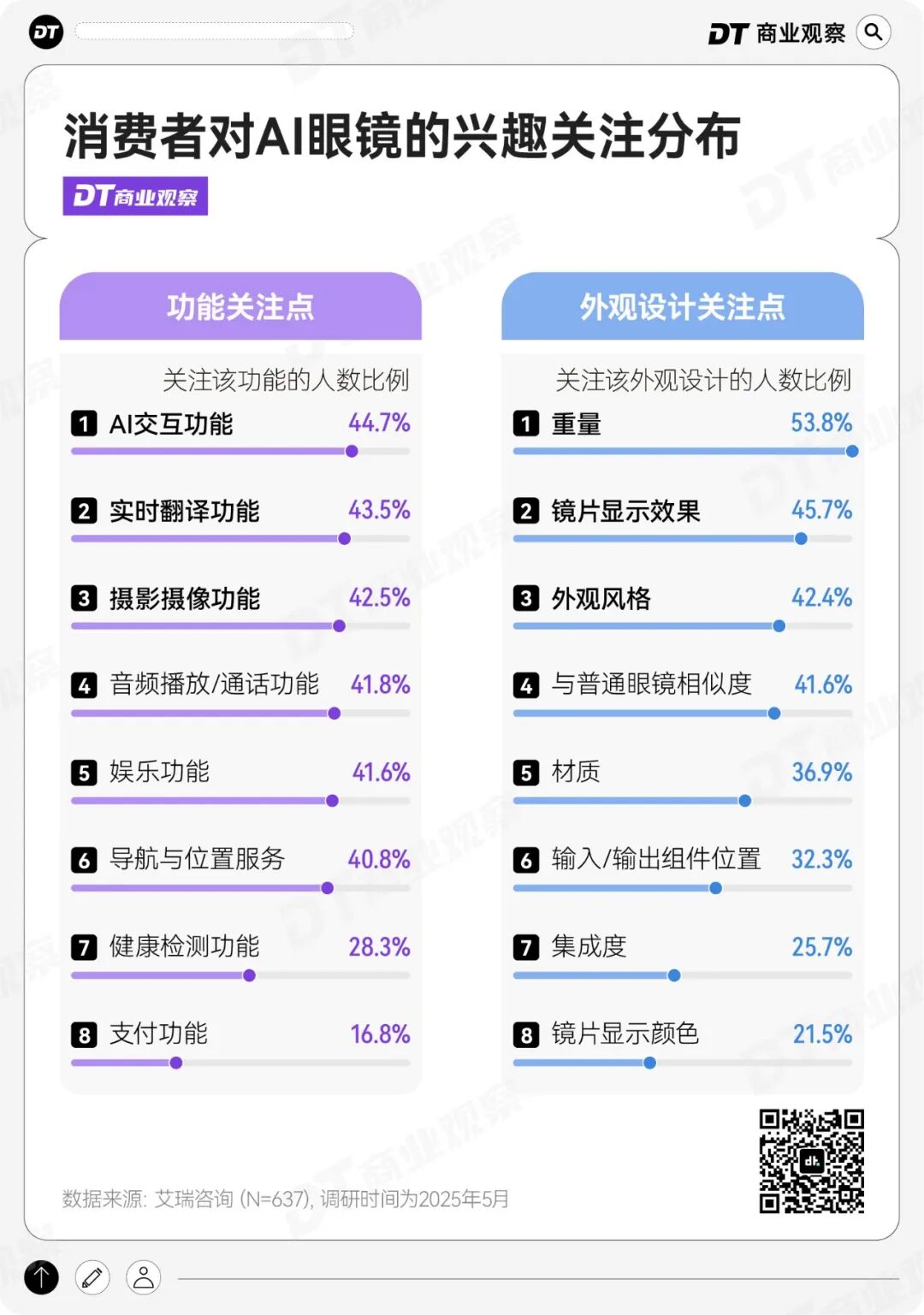
Data shows that more than half of potential buyers prioritize “weight” in their considerations, and the industry also hopes to make glasses lighter.
However, the reality is that the weight of mainstream products hovers around 36 - 50 grams. Even the Ideal Livis, which claims to be “20% lighter than the mainstream industry” (36 grams), is still heavier than ordinary myopic glasses (the frame and lenses of common myopic glasses generally weigh about 20 grams).
This “heavy sense of technology” has become the most common concern for users before purchasing.
It's worth mentioning that when the promotional slogans of various brands mainly focus on some difficult - to - quantify dimensions (such as how powerful the large model is, wearing comfort, the timeliness/accuracy of AI translation, and the quality of voice interaction experience), the real user feedback is mixed.
Taking the Quark and Xiaomi AI glasses products, which currently have the highest social media attention and cumulative sales volume, as examples, users most appreciate the convenience brought by “freeing hands,” such as not having to hold a device when shooting vlogs or not needing to wear additional earphones when listening to music or making calls. “Lighter than expected” has also become a common pleasant surprise.
However, dissatisfaction also occurs from time to time.
According to the monitoring of XR Vision, the average return rate of AI glasses on e - commerce platforms is as high as 30%. On the Douyin platform, which is mainly driven by live - streaming sales, this figure even soars to 40% - 50%.
Specifically, the negative reviews precisely point to several pain points in the experience that still need improvement:
Some users think that the body of the glasses “feels cheaply made of plastic and is prone to scratches”; the image quality of the shooting function drops significantly in low - light environments.
The reaction of the AI voice assistant is also a point of contention. Some people think the