In 2026, where will the live-streaming e-commerce industry head into a more competitive phase?
In an interview video released in the past two days, 21-year-old diving Olympic champion Zhang Jiaqi directly responded to some questions about her live-streaming e-commerce:
"I was very nervous during my first live stream. I didn't know what to say, but I think we should be more daring to try new things." She also said that she accepts some criticisms from the public, but she also needs to make a living.

Image source: "We're Saved"
Her response reflects the picture of an era. In recent years, from actors, singers, and hosts to entrepreneurs, writers, and now sports champions, it seems that everyone is inevitably involved in live-streaming e-commerce.
But if you think about it carefully, in the past few years, live-streaming e-commerce has indeed been a visible and rapid way to accumulate wealth. Top live-streamers can easily achieve billions in single - live - stream sales, and the income of a celebrity from a single live stream may far exceed the salary for a whole movie.
It has created the myth of grass - roots counter - attack and has become the shortest path for various celebrities to "cash in on their popularity."
However, as the clock strikes 2026, beneath the surface hustle and bustle of the industry, undercurrents are surging. The aura of super - top live - streamers is fading, the regulatory framework is becoming increasingly strict, consumers are becoming more rational, and platform rules are being profoundly reconstructed. The golden era when one could "win effortlessly" relying on personal charm and traffic dividends has come to an end, and a more profound and difficult industry transformation is in full swing.
01 The "Watershed" Has Arrived
Now, the development of the live - streaming e - commerce industry seems to have reached a crucial "watershed."
On the one hand, the personal aura of top live - streamers is fading at an accelerating pace. The once - thought - unshakable super - top live - streamer system has exposed its fragility in successive public events.
During a live stream at the end of last year, Yan Xuejing, a first - class actress and a regular guest on the Spring Festival Gala, calculated the living expenses of her son's family: "He needs to earn at least one or two million a year for the family to function properly, but he can only earn a few hundred thousand from a single movie."

Image source: Douyin
This harsh "complaint about being poor" instantly caused an uproar. On January 10th, Yan Xuejing's accounts on multiple short - video platforms were banned from following due to violations of community regulations. The "Tongchu" brand, which had cooperated with her for over a decade, announced the termination of cooperation, replacement of packaging, and planned to pursue economic compensation.
This is just the tip of the iceberg in the industry. Previously, from Li Jiaqi's "Florasis incident" to "Crazy Little Yang Brother"'s false promotion of mooncakes, and then to the "Northeast Rain Sister"'s tapioca starch vermicelli scandal, the "failures" of top live - streamers have occurred frequently.
To date, "Crazy Little Yang Brother" and "Northeast Rain Sister" have not resumed their live streams. Li Jiaqi has significantly reduced the number of his live streams and shifted to behind - the - scenes incubation. Xin Ba has also issued multiple declarations of leaving the live - streaming industry...
It can be seen that over - relying on a single individual in a huge business ecosystem and consumer trust contains great systematic risks. Realizing this, the logic of platform traffic distribution has undergone a fundamental change. "Decentralization of top live - streamers" and "supporting brand live - streaming" have become clear trends.
The annual ecological conference of Douyin's daily necessities and household goods industry in e - commerce released a set of data. In 2025, in Douyin's daily necessities and household goods e - commerce industry, the number of brands starting brand live - streaming increased by 64% year - on - year, and the average daily number of newly released short videos increased by 22% year - on - year.
Platforms are starting to try to cultivate a decentralized and more resilient "grassland ecosystem" to replace the previous fragile pattern that relied on a few "tall trees."
On the other hand, the deep - seated rational awakening of consumers is also rewriting the basic operating rules of the market.
The latest report "New Propositions for a Good Life - Insights into Chinese Consumers" released by Accenture shows that the influence of product features, promotion intensity, and marketing novelty on attracting new customers has increased by about 10 percentage points, while the influence of live - streamer recommendations and celebrity endorsements has significantly declined.
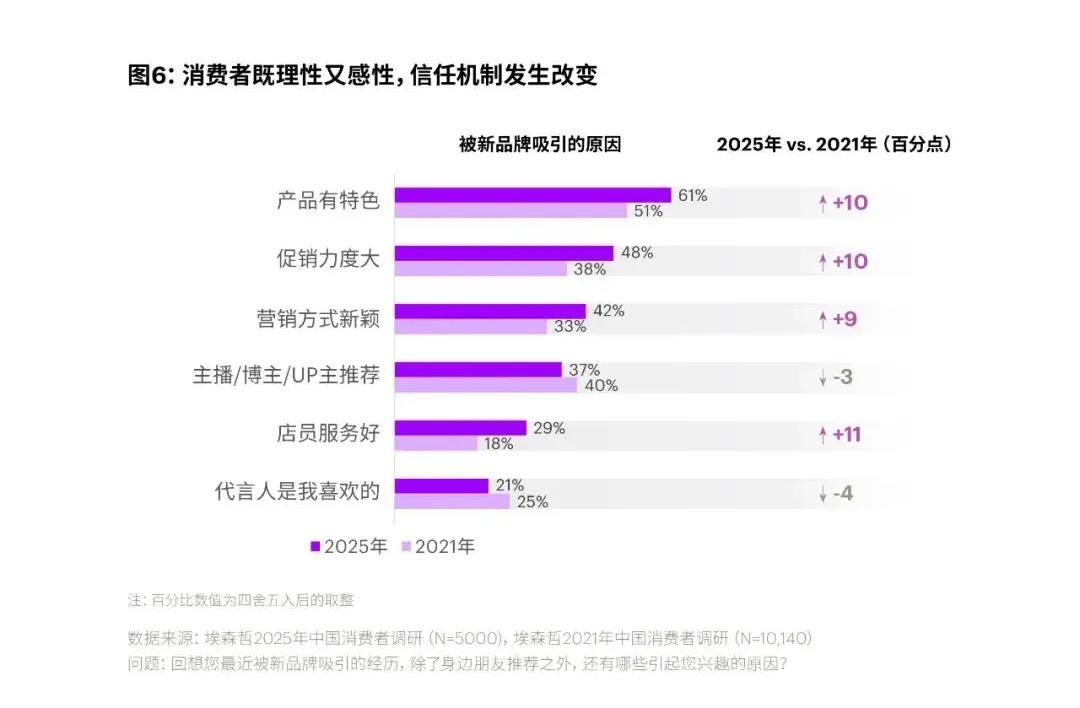
Image source: "New Propositions for a Good Life - Insights into Chinese Consumers by Accenture"
It can be seen that after years of market baptism and even being "burned" several times, some consumers have bid farewell to their early blind pursuit of the "lowest price in the whole network" and the personal charm of live - streamers. The axis of market demand is firmly shifting from the love for the "person" to the rational evaluation of the value of the "product" and the "store" itself.
In addition, the continuously tightening regulatory framework has built a rigid institutional barrier for the standardized development of the industry.
Recently, the State Administration for Market Regulation and the Cyberspace Administration of China jointly announced the "Measures for the Supervision and Administration of Live - Streaming E - commerce." It focuses on four types of entities: live - streaming e - commerce platform operators, live - stream room operators, live - streaming marketers, and service agencies for live - streaming marketers, clarifies their responsibilities and obligations, sets red lines for behavior, and improves the regulatory mechanism.
This increasingly strict regulatory system has actually significantly increased the compliance costs and professional thresholds of the industry, closed the window of the "wild growth" era, and forced all participants to transform towards professionalism, institutionalization, and transparency.
The disintegration of the top - live - streamer myth has educated the market and promoted the rational awakening of consumers; the rational market demand has in turn forced platforms to optimize their ecosystems and called for a fairer institutional environment; and the tightening of supervision has laid the foundation for the standardization and value return of the entire industry.
Together, they are driving live - streaming e - commerce to transform from a "marketing phenomenon chasing traffic" into a "modern retail format that follows the essence of business and serves a rational market."
02 Opening Up "New Battlefields"
The "acceleration" of the expansion of the live - streaming e - commerce market scale has quietly shifted gears in the past two years.
Data from the National Bureau of Statistics shows that in the first three quarters of 2025, the total retail sales of consumer goods reached 36.59 trillion yuan. The proportion of national online retail sales in the total retail sales of consumer goods was 30.84%, and the overall e - commerce penetration rate was 25.02%, hitting a new low in the past four years.
The growth rate of live - streaming e - commerce has also gradually dropped from an explosive 245.9% to double - digits. According to the prediction of iResearch, from 2024 to 2026, its growth rate will stabilize at around 18%.

Image source: iResearch
With the traffic dividend reaching its peak, the pressure of survival and development is forcing all participants to innovate their business models and explore value - growth curves beyond simple product sales. Currently, three clear "evolution paths" have emerged in the industry.
The first path is the in - depth transformation from a "product - selling channel" to a "brand operator." The most prominent trend is that top institutions are starting to heavily invest in self - owned brands and supply chains.
This is actually easy to understand because self - owned brands have always been the key to increasing a company's gross profit margin. Take Dongfang Zhenxuan as an example. Its financial report shows that in the fiscal year 2025, the proportion of GMV from self - owned products of Dongfang Zhenxuan increased from 40% to 43.8%, and the gross profit margin increased from 25.9% in the fiscal year 2024 to 32% in the fiscal year 2025.
This high - profit "cake" has attracted many players. Qianxun has launched "Fengwei Pie" and "Bai Suzhen at the Foot of Qingcheng Mountain"; Meiyouji, where Li Jiaqi belongs, has launched "All Girls"; Sanzhiyang has launched the "Little Yang Selection" APP; Xinxuan has also started to layout origin warehouses... More and more institutions are beginning to realize that controlling the supply chain can gain pricing power, ensure product quality control, and increase profits, and ultimately transform users' trust in live - streamers into loyalty to brand assets.
The second path is the comprehensive upgrade of content form from "shouting - style" to "professional, variety - show - like, and immersive."
Users' excitement threshold for "OMG, buy it" has been significantly raised, and the value of content has been re - defined. Therefore, "knowledge - based product promotion" is no longer exclusive to Dongfang Zhenxuan; it has become a widely - adopted way to build trust.
The Bee Live - stream Room pioneered the "live - stream + short drama" model, naturally integrating products into the plot, which enhanced the viewing stickiness and emotional engagement; more and more brands are going to factories and fields, using origin - tracing live - streams to build product transparency and a sense of quality. Good content is changing from a "traffic hook" to the "core engine" for business growth.
The third path is the shift from "catching fish" in public - domain traffic to "raising fish" in private - domain ecosystems.
Facing the pain points of high costs and unstable conversion rates in public - domain traffic, more and more institutions are starting to build private - domain traffic pools.

Image source: All Girls Membership Service Center
For example, Meiyouji has launched the official WeChat mini - program "All Girls Membership Service Center," where users can click on product links to jump to brand official websites or mini - programs to make purchases; Qianxun has quietly launched the "Qianxun Super Membership" mini - program, trying to attract users through the "fixed - price" and "time - limited and quantity - limited flash - sale" models.
Through membership privileges, exclusive products, and in - depth interaction, brands aim to establish a more direct, stable, and emotionally - sticky long - term relationship with users, completing the transformation from being a "tenant" relying on platform traffic to being a "landlord" operating their own user assets.
These three paths are not isolated from each other but together outline a three - dimensional picture of in - depth value exploration in live - streaming e - commerce.
Building a brand is to create core value; creating good content is to amplify this value; and operating the private domain is to hold and manage the user relationship brought by this value in the long term.
When the industry bids farewell to the myth of high - speed growth, the meticulous operation around the "value" itself will be the key to success in the next stage.
03 Where Is Live - Streaming E - commerce Heading?
The era of "wild growth" where one could "make money just by jumping in" has ended. The competition in the live - streaming e - commerce industry has fully shifted to a battle for the existing market. Facing this red - ocean market that requires meticulous operation and every inch of territory to be fought for, live - streaming e - commerce practitioners in 2026 are naturally looking towards new frontiers with more imagination.
First and foremost is AI. In 2026, artificial intelligence has begun to penetrate all links of the industry and has become the key to reshaping competitiveness.
At the front - end, AIGC can generate copywriting and scripts in batches, and virtual digital humans can conduct 24/7 live - streaming, which not only significantly reduces costs but also creates new content forms and interactive experiences.
In June 2025, Luo Yonghao conducted a digital clone live - stream with the help of Baidu's digital human live - streaming technology. The voice, expression, and tone of his digital human were highly consistent with his own. Eventually, this live - stream achieved an excellent product - promotion result of 55 million yuan in GMV within 6 hours, demonstrating the strong commercial conversion potential of Baidu's digital human live - streaming.

In the middle - end, AI algorithms can be used for intelligent product selection, accurate user profiling, and optimization of personalized recommendation strategies to improve traffic conversion efficiency; in the after - sales service, AI customer service can efficiently handle a large number of inquiries. Data shows that the proportion of digital human live - streaming time in the "Jiaoge Friend" live - stream room reaches 40%, and the response efficiency of AI intelligent customer service has increased by 200%.
Technology is no longer just a gimmick; AI has become the core tool for the live - streaming e - commerce industry to improve operational efficiency.
In addition to AI, top players have more or less also laid out overseas business. Due to the mature domestic model and significant supply - chain advantages, players are driven to replicate live - streaming e - commerce overseas, but their overseas expansion paths show distinct differences.
Huang, the big apprentice of Crazy Little Yang Brother, started live - streaming on TikTok, starting from her old - line entertainment live - streaming. She conducts entertainment live - streams on TikTok in the familiar funny style in China and has squeezed into the top ten popular live - stream rooms.
Meiyouji, where Li Jiaqi belongs, has chosen the "localized operation" path, mainly signing local influencers. Data from Fastmoss shows that MTYN, the Indonesian branch of Meiyouji, has signed 13 influencers, four of whom have over 5 million followers, covering multiple mainstream sectors such as beauty and IT...