Another robotics company is gearing up for an IPO, with a compound annual growth rate of 61%, aiming to become the "first stock in industrial embodied intelligence."
Another industrial embodied AI company is set to go public on the Hong Kong Stock Exchange.
Not long ago, the official website of the Hong Kong Stock Exchange disclosed that Standard Robots has passed the hearing and published its prospectus.
From 2022 to 2024, the company's revenues were RMB 96.275 million, RMB 162 million, and RMB 250 million respectively. In the first nine months of 2025, the company achieved revenues of RMB 188 million, a year-on-year increase of 19.75%.
By sales volume, the company is one of the top four providers of industrial intelligent mobile robot solutions in China, with a market share of 3.2%. If successful, Standard Robots is expected to become the "first stock in industrial embodied AI."
However, like most industrial robot companies, behind the impressive growth curve lies a challenging real - world path. As of the end of September 2025, Standard Robots had only RMB 77.764 million in cash and cash equivalents, and the cash - flow pressure has reached its peak.
Next, we will dissect this company aiming to be the "first stock in industrial embodied AI" and explore the business truth behind its growth story.
Annual revenue compound growth rate of 61%, with functional robots accounting for the majority
In the past three years, Standard Robots' revenues have grown rapidly.
From 2022 to 2024, the company's revenues were RMB 96.275 million, RMB 162 million, and RMB 251 million respectively, showing a year - on - year growth trend with a compound growth rate of 61.3%. In the first nine months of 2025, the company had achieved revenues of RMB 188 million, approaching 75% of the full - year revenue in 2024.
From the perspective of the business structure, the company's revenues mainly come from the sales of robot solutions, including the delivery of complete automation solutions to customers, as well as the individual sales of complete robots, accessories, software, and subsequent services.
From the perspective of revenue composition, most of the company's revenues come from "turnkey" full - line solutions, with the revenue proportion remaining at 86% - 91% for a long time. The remaining revenues come from single robots, accessories, software, and maintenance services.
At the product level, Standard Robots has built a three - tier robot product system around different application complexities:
First, standard robots (unit price approximately RMB 60,000 - 350,000).
This type of product has basic mobile and positioning navigation capabilities and is mainly targeted at system integrators for use as mobile units in automation systems.
Second, functional robots (unit price approximately RMB 100,000 - 600,000).
Based on mobile capabilities, they integrate specific functional modules such as carrying and forklifting, and are directly targeted at end - customers, covering more specific operation scenarios.
Third, embodied AI robots (unit price approximately RMB 450,000 - 1.25 million).
They have a higher degree of freedom and intelligence level. Combined with AGI - related technologies, they are mainly used in high - end and complex industrial scenarios such as semiconductors.
Among them, functional robots are the most important source of revenue.
From 2022 to 2024, their sales volume increased from 725 units to 1,932 units, and the revenue proportion remained stable at 70% - 80%. In the first nine months of 2025, this proportion still reached 68.4%, forming the core pillar of the company's revenues.
While stabilizing the basic market of functional robots, the company is continuously optimizing the product structure and increasing investment in embodied AI robots.
Currently, Standard Robots has developed two core industrial embodied AI products:
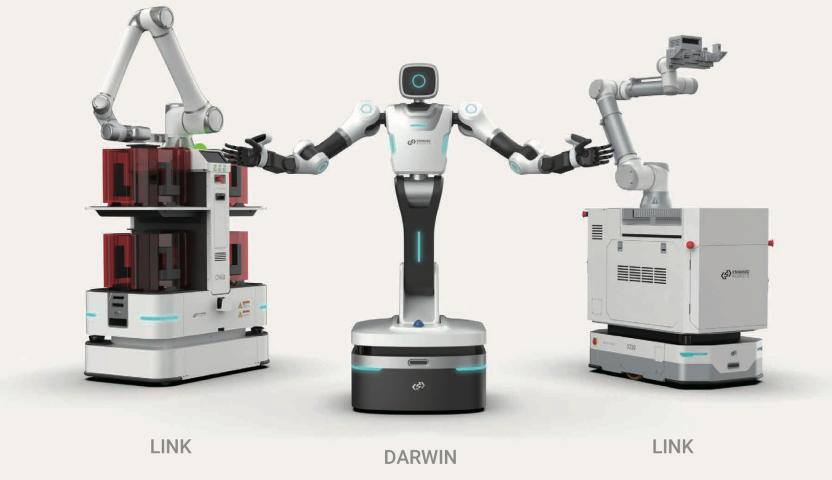
One is the single - arm embodied robot LINK, which can be configured with special end - effectors according to tasks to complete tasks such as grasping, handling, and equipment operation. It is mainly targeted at the precision material handling scenarios in industries such as semiconductors.
The other is the dual - arm wheeled embodied AI robot DARWIN, which has 23 degrees of freedom and an omnidirectional chassis. It cooperates with a multi - sensor system to achieve all - round environmental perception. Through multi - modal algorithms and end - to - end models, it realizes the integration of perception, decision - making, and control, covering a variety of complex tasks from heavy - load handling to fine operations.
In the first nine months of 2025, the embodied AI robots achieved revenues of RMB 15.402 million, showing a significant increase compared with the same period of the previous year, indicating that this product line is gradually entering the stage of large - scale production.
Overall, Standard Robots' current revenue structure still highly depends on functional robots and turnkey solutions, which also determines that the short - term growth certainty of the company mainly comes from the existing and expanding demands of industrial automation.
Only 77 million left on the books, Standard Robots goes public to "replenish blood"
Like most robot companies, Standard Robots has not been able to get rid of the situation of losses.
From 2022 to 2024, the company's adjusted net losses were RMB 124 million, RMB 94.93 million, and RMB 39.34 million respectively, showing a continuous downward trend. In 2025, this improvement accelerated further: the adjusted net loss in the first nine months was only RMB 29.305 million, significantly lower than RMB 52.502 million in the same period of 2024.
The primary reason for the narrowing of losses comes from the continuous improvement of gross profit margin. From 2022 to 2024, the company's overall gross profit margin increased from 12.9% to 38.8%, showing a significant improvement.
Breaking it down, the gross profit margins of both robot solutions and robots and other businesses have increased.
Among them, the gross profit margin of robot solutions increased from 10.2% in 2022 to 35.4% in 2024; during the same period, the gross profit margin of robots and other businesses increased from 33.5% to 73.5%.
Compared with solutions, the improvement in the gross profit margin of the latter is more obvious. According to the prospectus, the increase in gross profit margin is mainly driven by two aspects:
One is the improvement of the cost structure brought about by product upgrades. The company launched a new generation of E - series products at the end of 2022, adopting a more enhanced modular design and continuously promoting the domestic substitution of key components.
As the procurement proportion of core components developed and supplied by domestic enterprises increases, the overall product cost has decreased significantly. For example, compared with the Oasis 300C in 2023, the total bill of materials (BOM) cost of the 2024 version of the Oasis 300E decreased by about 40%, becoming one of the key sources of the increase in gross profit margin.
The other is the increase in the sales proportion of overseas customers. During the reporting period, the company's overseas project sales increased significantly, and such projects usually have a higher profit - margin structure, further boosting the overall gross profit level.
Judging from the data, the company's revenues from regions outside the Chinese mainland increased significantly by 107.5% from RMB 9.8 million in 2022 to RMB 60.4 million in 2024.
Due to long - term losses, the company's operating cash flow has been under continuous pressure.
From 2022 to 2024, the cash flows were - RMB 89.8 million, - RMB 120 million, and - RMB 27.2 million respectively, always in a net outflow state. As of September 2025, the cash and cash equivalents were only RMB 77.764 million.
The relatively tight cash flow is also the core reason why Standard Robots is urgently seeking to list on the Hong Kong Stock Exchange.
This situation is not unique to Standard Robots. Most embodied AI and robot enterprises listed in 2025 are facing the same situation.
For example, Yuejiang Technology, a leading enterprise in collaborative robots, had a net operating cash flow of - RMB 64.918 million in the middle of 2025, and its cash and cash equivalents decreased significantly to RMB 164 million compared with the end of 2024.
From an industry perspective, the robot and embodied AI sectors generally face the problems of long technology implementation cycles and slow commercial returns. Enterprises need to invest heavily in R & D and market expansion for a long time, but it is difficult to form a stable positive cash flow in the short term. Therefore, listing for financing has become an important option to maintain business progress.
What is even more alarming is that the company's unit economic model is under pressure.
Standard Robots' customer acquisition cost increased from RMB 582,800 per customer in 2022 to RMB 892,300 per customer in the first nine months of 2025. At the same time, the average customer transaction value decreased from RMB 353,000 to RMB 252,000.
This combination of "increasing customer acquisition cost and decreasing customer unit price" may drive the expansion of the revenue scale in the short term, but it significantly amplifies the cash - flow pressure and operational difficulty.
Project - based business often means higher upfront capital advances, longer customer payment cycles, and a mismatch between revenue recognition and payment collection, ultimately resulting in a structural dilemma of "increasing revenue but not increasing cash."
In this context, listing for financing is more like a "hemostatic agent" to help the company get through the current stage. What really determines whether Standard Robots can survive the cycle still lies in whether it can gradually build a self - sustaining business model through continuous technology - based cost reduction and operational efficiency improvement.
This article is from the WeChat official account "Silicon - based Observation Pro", author: Lang Lang. Republished by 36Kr with permission.