Six emerging companies in Hangzhou are lining up for IPO.
Unitree Robotics, Coohom, BrainCo, Game Science, DeepSeek, and CloudMinds Robotics—six companies entered the public eye almost simultaneously a year ago and were crowned the "Six Rising Stars of Hangzhou" by the media. They dominated the tech news and became the talk of the town.
So, how are these six Hangzhou tech companies doing now?
The answer is that they are queuing up for IPOs. Four of the six companies are about to go public or are in the process of preparing for it, namely Unitree, Coohom, CloudMinds Robotics, and BrainCo.
However, this has also been a year full of challenges. The huge "moment of glory" has brought about global encirclement and intense competition within the industry.
It can be said that they are at a fascinating yet perilous moment.
This article explores what they have actually done this year, what they have delved deeper into, and what kind of pressure they are under.
Let's take a closer look at the 2025 of the Six Rising Stars of Hangzhou.
01
Capital Landscape: Who's Ringing the Bell? Who's "Counting the Money"?
The Six Rising Stars of Hangzhou can currently be divided into two categories. One category is already at the door of the stock exchange, while the other has plenty of cash on the books.
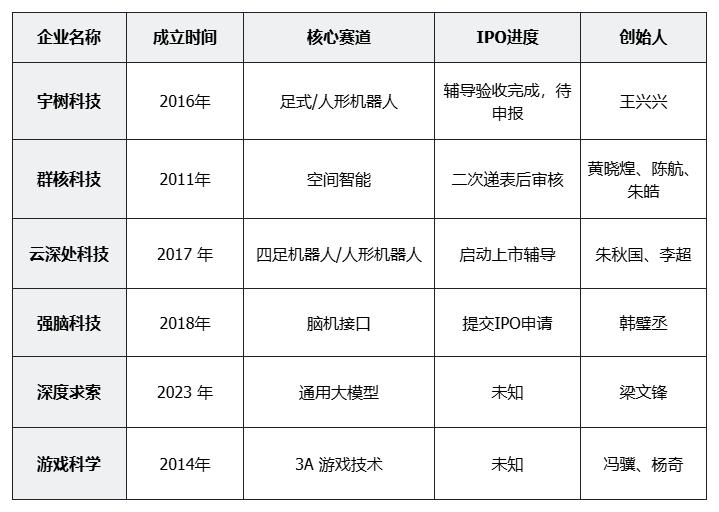
Let's start with the first category. The four companies in the first echelon are all sprinting towards IPOs.
Originally, Unitree was leading the way and was just one step away from going public.
However, today (January 13, 2026), it was reported that BrainCo has submitted a confidential IPO application to the Hong Kong Stock Exchange. Therefore, BrainCo is expected to be the first company among the "Six Rising Stars of Hangzhou" to go public.
On January 6th, BrainCo completed a financing round of approximately 2 billion RMB, making it the second-largest financing in the brain-computer interface field after Neuralink under Elon Musk.
Although BrainCo had not turned a profit by the end of 2024, why are investors willing to pour money into it?
In the brain-computer interface field, which has long been dominated by Elon Musk and Neuralink, BrainCo is the only "top player" from China that can sit at the same table. .
This company, founded in 2015 by Harvard alumnus Han Bicheng, has its own technological approach—non-invasive brain-computer interfaces. By establishing a series of "digital nerves" between the brain and external devices, and more importantly, it has already launched several products directly on the market, ranging from disability rehabilitation to autism intervention.
Due to its safer and more scalable approach, and the fact that the demand in this area is a clear and strong rigid demand, the market, although niche, has strong purchasing power.
As for Unitree Robotics, its guidance status was marked as "guidance acceptance" in November 2025, indicating that its IPO is just around the corner.
At the 2025 Summer Davos Forum, Unitree Robotics founder Wang Xingxing revealed that Unitree's annual revenue has exceeded 1 billion RMB, with the total annual order value approaching 1.2 billion RMB, and the shipment volume exceeding 10,000 units. An even more positive sign is that the company has achieved profitability for five consecutive years.
Through continuous R & D and innovation, focusing on both the B2B and B2C markets, it has achieved large-scale revenue from its high-tech products.
The premise for this is that its products are affordable. In physical stores, the prices of Unitree's Go2 Air and Go2 Pro robotic dogs are 10,497 RMB and 19,999 RMB respectively. You can take a cyber dog home for just ten or twenty thousand yuan.
The original price of its two humanoid robots starts at 99,000 RMB, and after the discount, it's 85,000 RMB. You can get a "cyber celebrity" for less than 100,000 yuan.
CloudMinds Robotics, which has also been deeply involved in the quadruped robot field, has also witnessed explosive growth in this booming market. CloudMinds' revenue doubled in 2024, and its robot shipment volume is expected to reach the 10,000-unit level in 2025. The company raised a total of over 1 billion RMB in three financing rounds last year.
At the beginning of 2026, CloudMinds also started the IPO guidance process. After eight rounds of financing, it has become the third company among the "Six Rising Stars of Hangzhou" to aim for an IPO, following Coohom and Unitree Robotics.
Coohom is also on the verge of going public.
In 2024, it held a 23.2% market share in the domestic spatial design software market, ranking first, and its products cover more than 200 countries and regions.
Coohom focuses on "spatial intelligence" and a "cloud-native 3D design platform," providing services that home furnishing companies are willing to pay for and generating stable and predictable recurring revenue. Moreover, with the arrival of AI, the company has successfully transformed into a spatial model and claims to be the "world's first stock in spatial intelligence."
The second echelon, DeepSeek and Game Science, are the most interesting and also the ones with the most cash on hand.
Game Science became famous overnight and is almost like a "money-printing machine." The single product's revenue exceeded 9 billion RMB, and it has a large amount of cash flow.
Recall the spectacular sales of "Black Myth: Wukong" on its release day. 4.5 million copies were sold on the first day, with each standard edition priced at 268 RMB. Data shows that the game's sales reached 9 billion RMB in just four months. In addition, various derivative products such as limited-edition figurines were sold out as soon as they were launched.
Game Science achieved a large positive cash flow in a very short period, proving that high-quality content can be a highly profitable business.
In 2025, Game Science began to vigorously promote the commercialization of IP derivatives.
Game Science's ambition goes beyond the game screen. In January 2025, its independent derivative brand "BLACKMYTH" was quietly launched, extending the aesthetics of Black Myth to clothing and trendy toys. Then, in September, its first offline flagship store in Hangzhou opened. This move means that Game Science wants to sell a lifestyle and make more money from its fans.
As for DeepSeek , there is no doubt that it remains the "hope of the whole village."
In terms of financial resources, DeepSeek's parent company, Magic Square Quantitative, earned 5 billion RMB last year, so it really doesn't lack money.
On March 1, 2025, DeepSeek released a financial report that shocked the entire industry. The theoretical daily profit of its V3/R1 inference system was as high as 3.46 million RMB (475,000 US dollars), with a cost-profit ratio of 545%. Although the official later explained that the actual profit was far less than this, these figures still left a lot of room for imagination in the market.
More importantly, it has ended the misconception that open-source means burning money. DeepSeek not only leads in technology but also has a profit margin through extreme cost control.
In 2025, the valuation of DeepSeek and the net worth of its founder, Liang Wenfeng, became topics of great interest. Some foreign media once predicted that DeepSeek's valuation could reach as high as 150 billion US dollars, and Liang Wenfeng's net worth might even exceed that of Huang Renxun at that time.
On the capital stage in 2025, the biggest mystery lies with Liang Wenfeng. Will we get an answer to this wealth question in 2026? Let's wait and see.
After looking at the capital side and financial performance, let's return to a more in - depth question: How did they make money? And why can only they make this kind of money?
02
New Product Review: What Have They Delved Deeper into This Year?
Game Science
At the wee hours of August 20, 2025, Game Science made a grand appearance at the Gamescom in Cologne, Germany, unveiling its new game "Black Myth: Zhong Kui," which allowed Chinese games to finally stand on the "golden position" of the world stage for the first time. Meanwhile, the two - minute trailer of "Black Myth: Zhong Kui" on Bilibili has exceeded 14 million views.
Foreign players were also extremely excited. In the comment section of the "Black Myth: Zhong Kui" trailer, many players were using English to explain who Zhong Kui is. They never thought that our games would reach this level. Overseas players were amazed by the dark and mythical texture of Zhong Kui's image (black face, red robe, riding a tiger) shown in the trailer, showing their obsession with this kind of aesthetics.
From this new product, we can see Game Science's "ambition." It doesn't just want to focus on the Journey to the West series but aims to build a broader and more extensive "Black Myth" system based on ancient Chinese mythology and folk legends. There is a huge potential for development in this field, and the gameplay is more diverse.
More importantly, the founder, Feng Ji, resisted the temptation of "taking shortcuts." He said: "Making DLCs is not a bad idea, but we prefer to create a brand - new Black Myth game from scratch." A new universe, new gameplay, new aesthetics, and new technological approaches.
During the years of developing "Wukong," Game Science painstakingly built an industrial pipeline. The most well - known achievements are their ability to quickly transform 3D scans of cultural relics into game assets, as well as breakthroughs in external hair rendering and precise combat animations.
This set of capabilities is their real moat. It means that it might take them 5 - 6 years to develop the first game, but the efficiency of developing the second and third games could increase exponentially.
DeepSeek
At the beginning of the year, R1 became extremely popular and was once called the "Chinese OpenAI." However, the popularity later declined. In 2025, DeepSeek released models nine times. Although the highly anticipated R2 has not arrived yet, it is still adhering to model innovation.
One of the notable events was in October when it launched a new model called DeepSeek - OCR, which features the "Context Optical Compression" technology.
In a nutshell, this cutting - edge technology means that the large model "sees" the text rather than "reads" it.
A 1000 - word article can be compressed into 100 visual tokens. This directly addresses the biggest pain point of large language models: long - context efficiency. This is still a "first in the industry."
On December 1, 2025, DeepSeek released two official models: DeepSeek - V3.2 and DeepSeek - V3.2 - Speciale, targeting daily applications and extreme inference scenarios respectively. This new model has defeated OpenAI and even caught up with Gemini 3. The new feature this time is DSA (DeepSeek Sparse Attention) — sparse attention.
This is still the innovative DeepSeek, figuring out how to generate more intelligence with limited data and computing power.
In 2025, during the DeepSeek Open - Source Week, a total of six core technologies were released, covering core areas such as AI training, inference, storage, parallel computing, and communication optimization, aiming to solve the efficiency and cost bottlenecks in the era of large models.
In the eyes of the outside world, DeepSeek is a "terrible cost - killer," driving down the training and inference costs of large models to rock - bottom prices.
For DeepSeek, having money is not the barrier; saving money is. If competitors follow its cost - saving strategy, they may not be able to match it in the short term. If they don't follow, their competitiveness will decline. This "catch - 22" situation for competitors is DeepSeek's deepest moat.
Because it has adhered to the most difficult and least - noticed underlying path without much money or support from large companies.
Coohom
Coohom is the most easily underestimated among the Six Rising Stars. Many people think Coohom is just "CoolHome." Actually, it wants to be the DeepSeek in the spatial field.
During the 2025 World Internet Conference Wuzhen Summit, Huang Xiaohuang, the co - founder and chairman of Coohom, said, "Similar to DeepSeek, we are more about 'intelligence.' We focus more on understanding and reasoning about space, while DeepSeek focuses more on understanding and reasoning about human language."
There are two "DeepSeeks" in one field, and Hangzhou has half of them.
In the past year, Coohom has done two things that are truly remarkable:
First, it released models. It launched the Spatial Language Model SpatialLM1.5 and the Spatial Generation Model SpatialGen, which can directly generate interactive 3D indoor space designs based on text instructions. Second, it adhered to open - source and once ranked among the top three on the HuggingFace model trend list.
This spatial model makes it possible for machines to "enter" the digital physical world. For machines to understand space, they need to understand spatial relationships, object attributes, and physical parameters and be able to output these data in a structured way. This requires both model capabilities and structured data.
Fei - Fei Li, known as the "Godmother of AI," believes that the future belongs to the era of spatial intelligence. Coohom's transformation is quite impressive.
Why is it the most surprising?
In 2025, a new consensus emerged in the AI industry: The text data on the Internet has almost been exhausted, and the training of large models has reached a bottleneck. Even the scaling law has been put aside by the industry.
The fuel for the next - stage evolution of AI is data from the physical world.
Coohom, founded in 2011, quietly developed 3D rendering tools in the home furnishing industry in the early years and now holds 441 million 3D models and 500 million structured spatial scenarios.
Today, when global giants are all shouting about "spatial intelligence" and trying to make robots understand the 3D world, they find that there is an extreme shortage of high - quality synthetic data. At this time, the data that Coohom has accumulated over 13 years, which was once considered a "cold - bench" asset, has suddenly become a gold mine.
Where did these data come from? They are accumulated over time, and this is its unshakable moat.
Unitree Robotics
Throughout 2025, Unitree not only won industry - level orders but also made a big splash in the consumer market, becoming extremely popular in various scenarios.
On December 31, 2025, Unitree Robotics' first global store officially opened in Beijing, showcasing a variety of star products such as the Unitree Go2 quadruped robotic dog and the G1 humanoid robot. On December 18, six G1 humanoid robots from Unitree Robotics made their debut on stage at Wang Leehom's concert in Chengdu, performing the song "Full Throttle" together.
In 2025, Unitree released a new - generation humanoid robot, Unitree H2, which introduced the "human - face element" for the first time. In the video, the over - one - meter - eight - tall H2 performed a flying kick and a side - kick in mid - air.