One year after Tmall launched its "Fostering Excellence" initiative, new brands have ushered in a golden era.
Text by | Chen Xi
This is a remarkably authentic and highly encouraging summary of the consumer market over the past year that I have ever read.
Yesterday, Tmall released the 2025 Annual New Brand Development Report (hereinafter referred to as the "Report"). It is this Report that makes us feel a strong "temperature difference" in 2025 — while the outside world is still talking about consumption downgrade and tough business operations, Tmall has presented the tangible figures of 150,000 new settled merchants and 276 new brands whose annual revenue exceeded 100 million yuan right on the table.
Specifically: the number of merchants building their brands on Tmall, as well as the number of brands that have achieved transaction volumes exceeding 100 million yuan and 10 million yuan within 3 years of store opening, all hit all-time highs in 2025. The number of brands that broke through 100 million yuan in transaction volume in the very year they opened their stores in 2025 increased by more than 40% year on year.
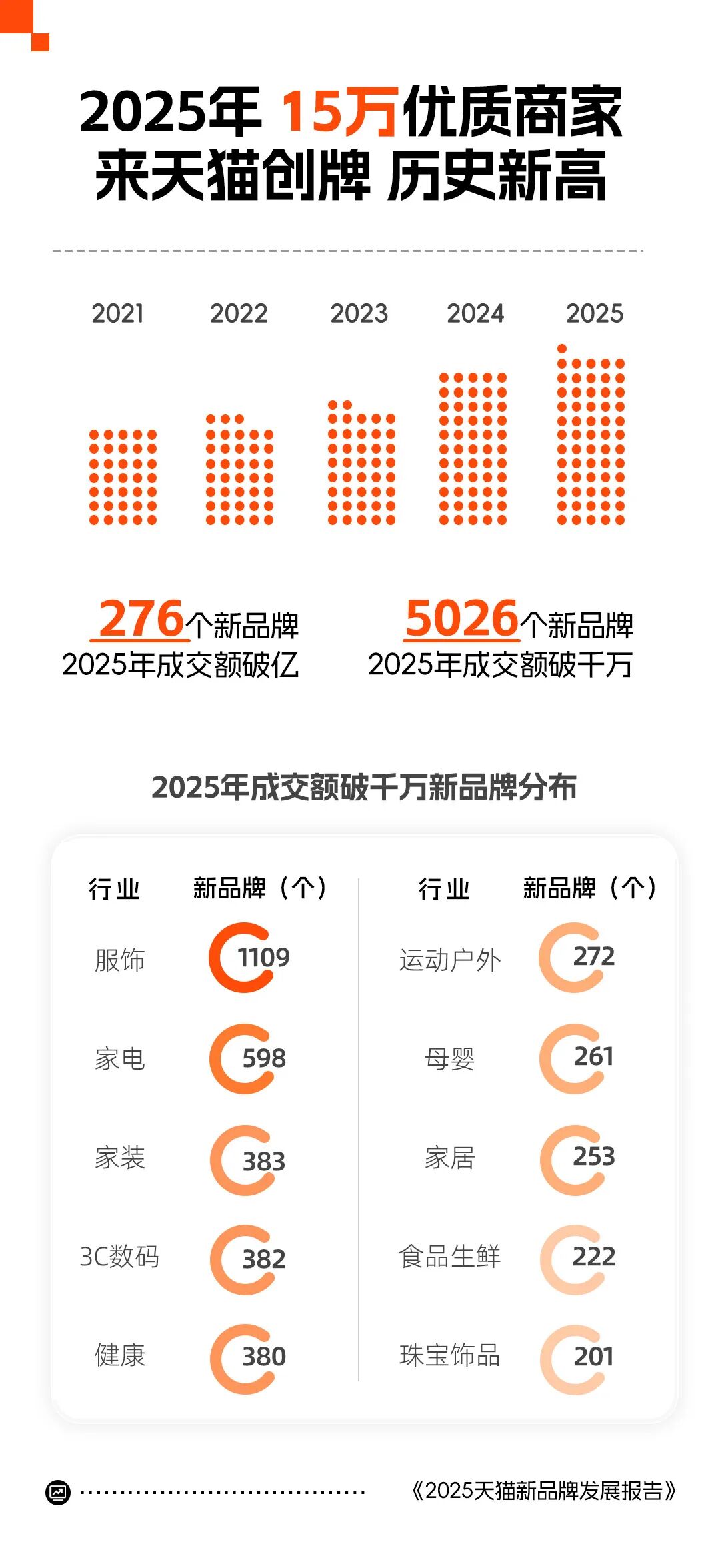
It can also be said that this is a highly valuable data report in the recent consumer industry. In today's era where the entire internet is competing for "public attention volume", this is a list generated based on real money — representing the real choices made by consumers with their wallets.
The Report does not discuss those illusory "mystical traffic theories", nor does it avoid the "involution reality" that makes entrepreneurs anxious.
Instead, it blows away the pervasive "chill" in the consumer industry over the past year and the false "bubbles", revealing the solid yet steaming business texture underneath — the victory of product strength supported by real GMV.
We have sorted out the highly valuable parts of the report. Whether you are a brand practitioner still active in the consumer industry or a consumer who cares about "what good products you can buy", we recommend you finish reading this article.
2025, a Boom Year for New Brand Entrepreneurship
Many people regard 2025 as a "lean year" for consumption, but the data from the Report gives the exact opposite answer: this is a highly prosperous year for new brand entrepreneurship with extremely prominent certainty, the best among the past few years.
This is the most counter-intuitive and thought-provoking part of the entire report. But why does such a strong "perceptual temperature difference" exist?
Because the "logic of making money" has changed. The old bustling model of raising financing through PPT, buying traffic by burning cash, and boosting sales at low prices has indeed cooled down. But businesses that truly have self-sustaining capacity and product barriers are actually doing better as the noise fades away.
The viral spread and widespread shock in the brand circle after the release of this Report exactly confirms this point. People feel encouraged not because they see impressive figures, but because it verifies the business certainty brought by serious brand building.
Peng Han, founder of Xu Cuihua, a cat litter brand selected into the "Top 10 New Power Brands", posted a very emotional moment on WeChat: "This honor is accumulated bit by bit by cat owners across the country with each shovel, and the refreshing experience... It shows that brands that make products with heart are visible to everyone, visible to the cats, and visible to Tmall."
This sentence perfectly points out the path for new brands to achieve breakthroughs at present: spare no effort to polish products.
Peng Han said frankly in the communication that the Report releases a very positive signal — the platform encourages "value competition" rather than "price competition". "This makes us convinced that we do not have to fall into endless price wars. As long as we keep polishing high-quality products, we can survive, and even thrive."
Tongpin shares the same perception. They believe that being listed on "2025 Tmall Top 10 New Power Brands" not only represents honor, but also confirms a kind of industry consensus: "It makes us see that the platform is providing a fairer competition space, allowing new brands to get rid of low-price involution, focus on creating high-quality products that resonate with consumers, and build differentiated brand positioning."
This confidence is not only passed on among founders, but the keen capital market has also sensed the new trend.
Well-known investor Huang Hai lamented that the consumer market is "large enough to support thriving businesses" after reading the report. In his view, even in fields that are regarded as "red ocean" by the outside world such as outdoor sports, 3C digital, home and home decoration, there are still a large number of unmet demands as long as you find the right entry point for micro-innovation.
"The brands on this Tmall list are well worth the attention of the venture capital circle, they are brands that have been verified by the real market." Huang Hai said.
This is exactly the value of the Report for the industry: it is not only a performance report, but also a "vindication" for high-quality brands.
It tells brand entrepreneurs with solid GMV figures: the market is not "cold", it is just more selective. When the tide recedes, players who try to cover up product defects with "flooded traffic" are eliminated, while "good brands" like Xu Cuihua and Tongpin who are willing to accumulate reputation step by step are just ushering in their prime time.
Profile of Winners: Stop Chasing Traffic, Focus on "Value Density"
The "flooded traffic" model no longer works, who are the profitable players now?
Opening the Report, you can see a highly dynamic panorama of consumer brand building. In 2025, there are 5026 new brands whose transaction volume on Tmall exceeded 10 million yuan.
It is not a carnival of a single track, but an explosion across the entire industry — new apparel brands lead the way with a 22% share, followed by home appliances, and nearly 400 new brands have broken through in tracks including home decoration, 3C digital, and health care.
"Heroes do not ask for their origins". The brand building boom is not limited to first-tier brand building hubs such as Guangzhou, Shenzhen and Yiwu, but goes deep into the industrial mechanism of China's manufacturing industry. Furniture brands in Xuzhou (Qingba, Senlaimeng, Mengdongqu), digital accessories brands in Zhengzhou (Kemanzhe, YOEK), and jewelry brands in Xiamen (KERLA) have all risen collectively.
From the top 10 "New Power Brands" in their respective industries that have settled in for less than three years and achieved Tmall GMV of more than 100 million yuan in 2025, we can sum up three main "winner models".
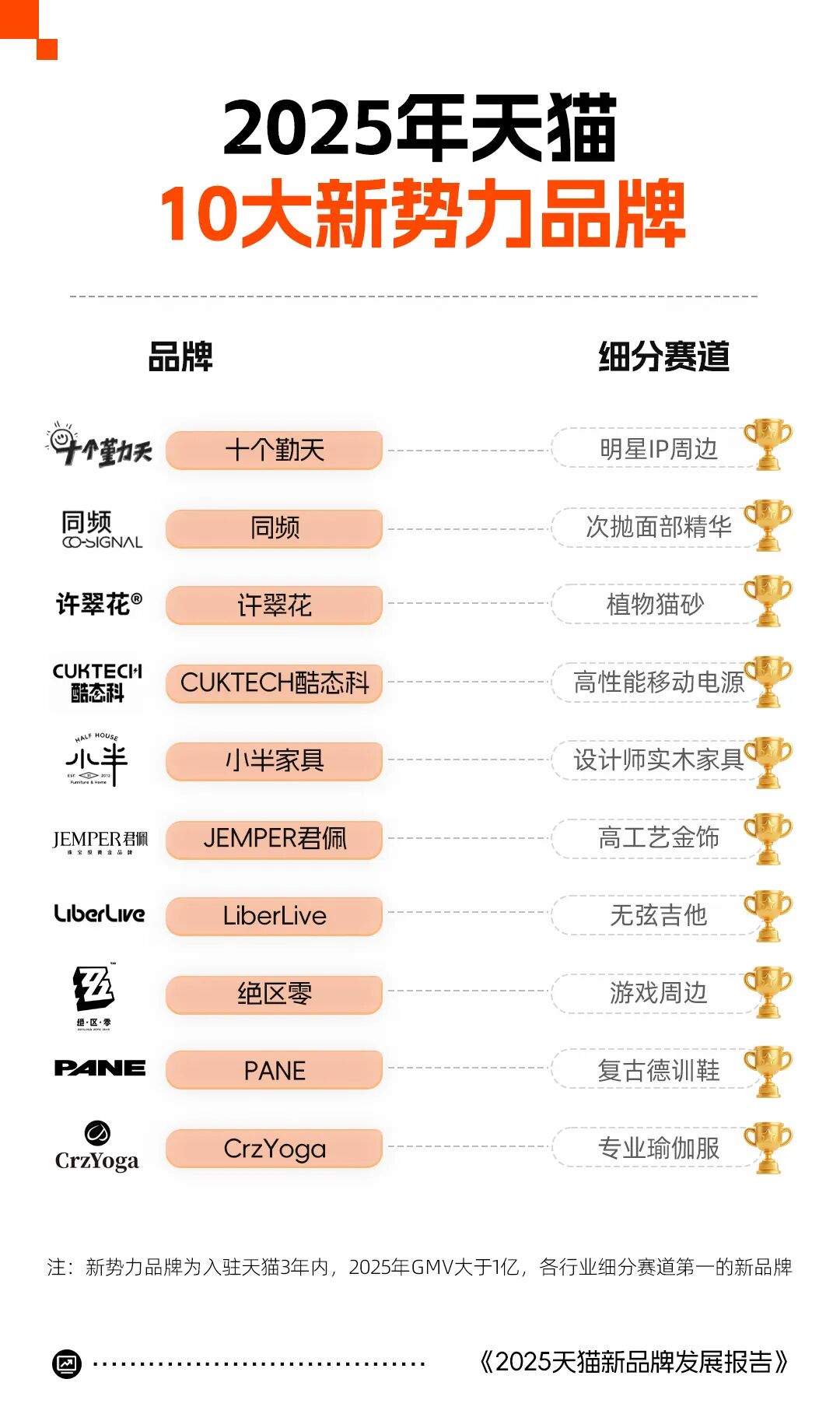
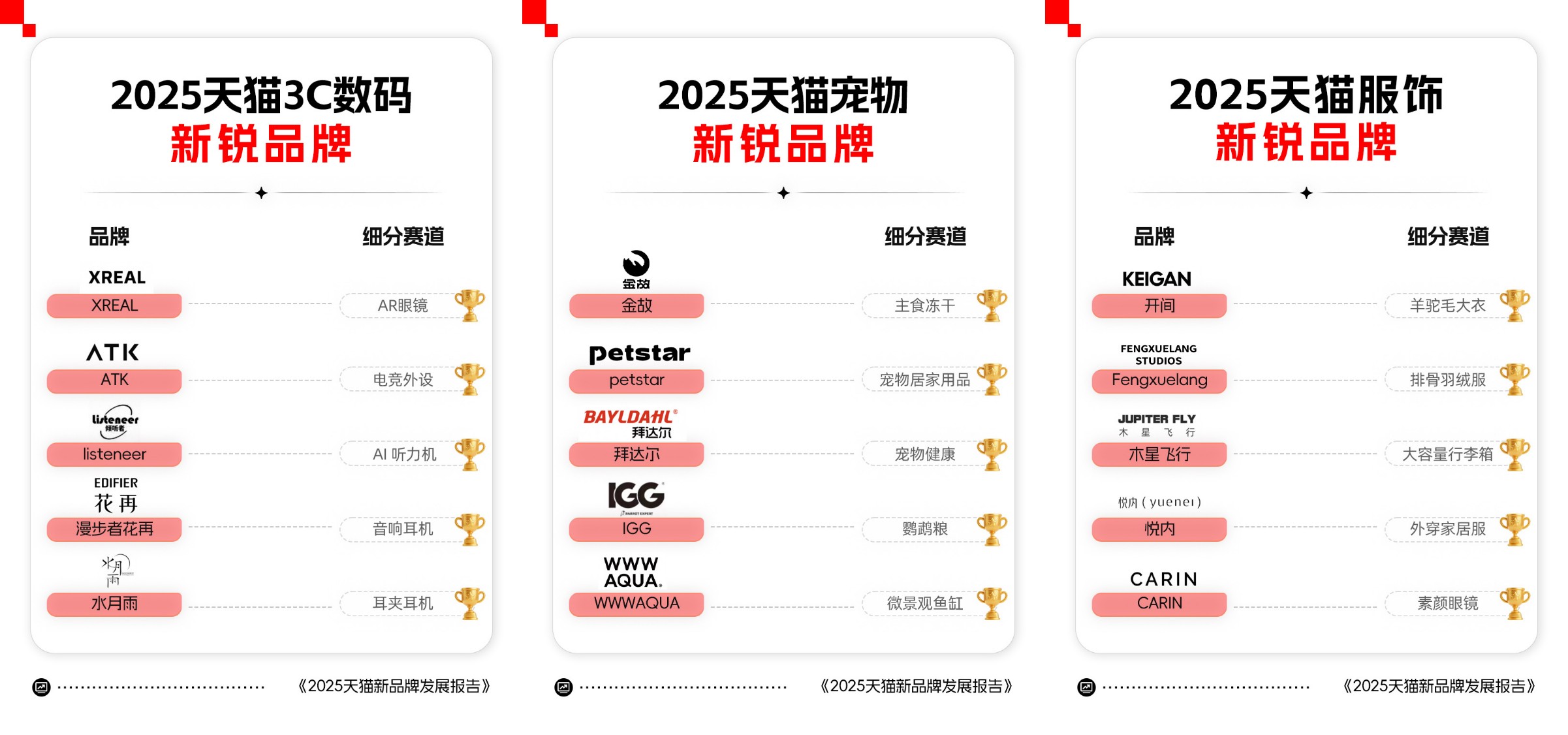
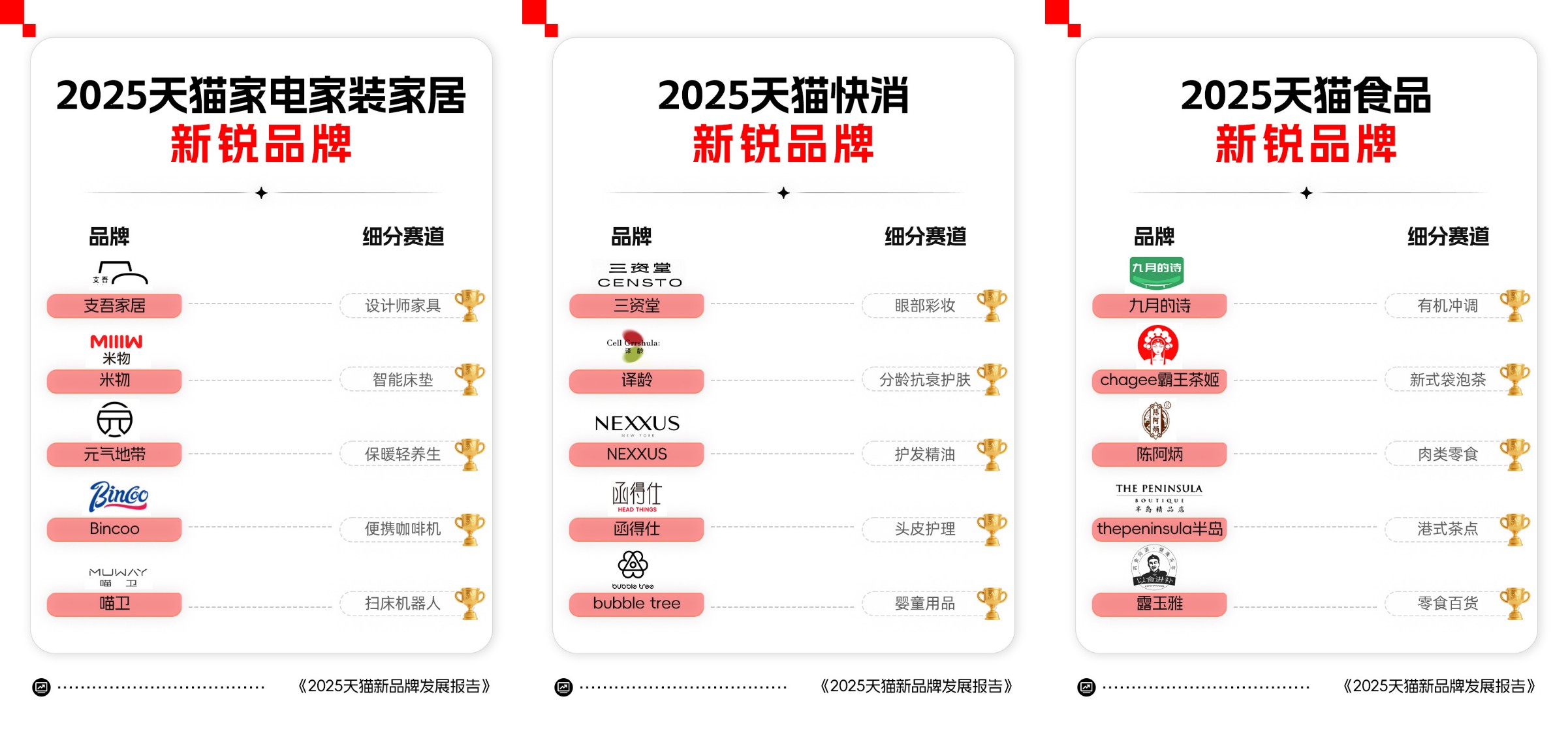
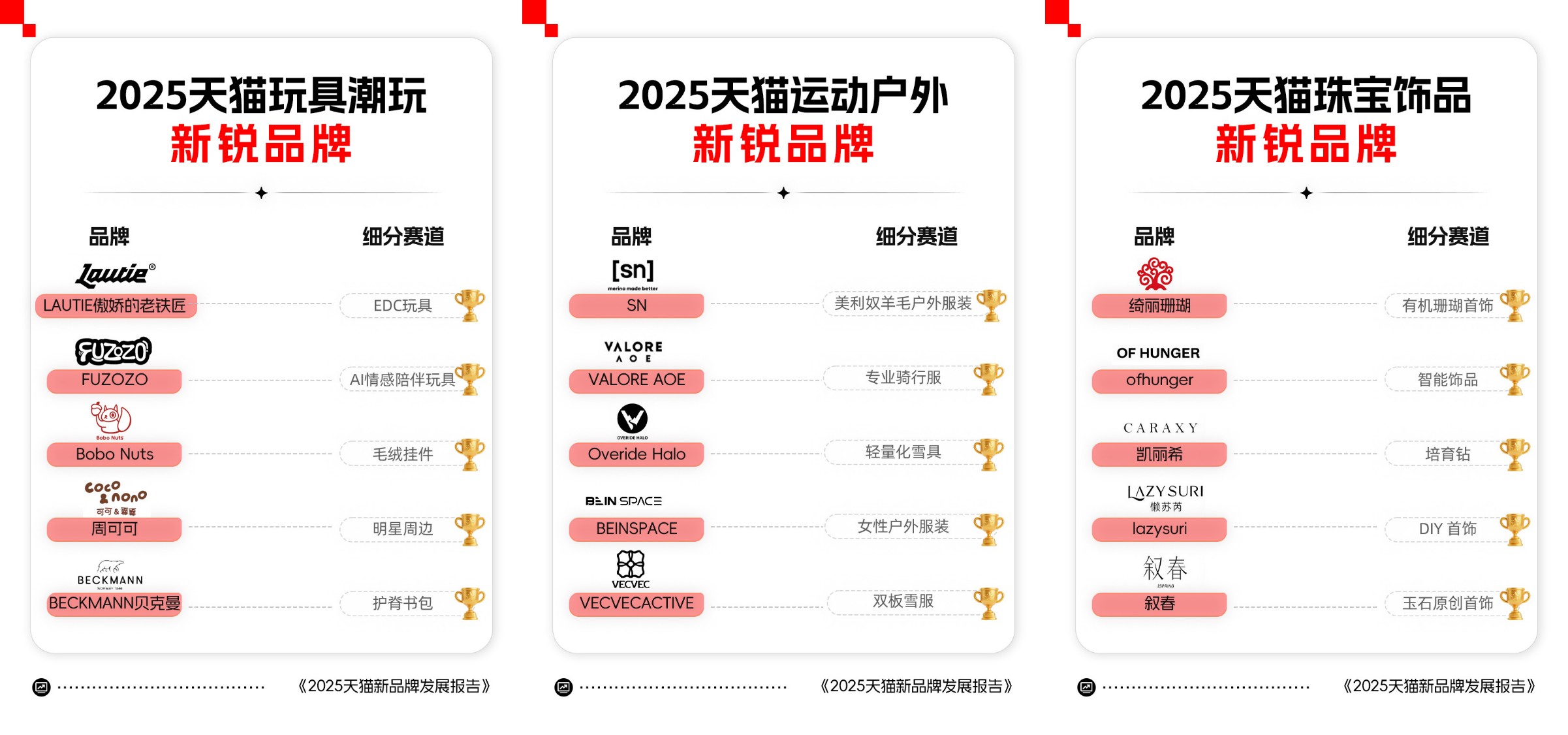
Technology Translator School: Translate "Hardcore Parameters" into "User Perceptible Experience"
The winning model of this school lies in: instead of piling up cold technical parameters, translate R&D capabilities into experiences that users can perceive.
In the seemingly saturated power bank track, CUKTECH did not choose to make generic products, but focused on product polishing and industrial design, relying on brand momentum and off-platform communication. According to Tmall data, it achieved an annual growth rate of over 200% on Tmall only through spontaneous reviews by tech bloggers and word-of-mouth from enthusiasts.
Why could they make this right decision? Eric, CMO of CUKTECH, mentioned the first principle behind the decision: "Combining real user scenarios, giving full play to the team's R&D advantages, translating R&D capabilities into the value users need, and making products naturally fit into users' daily lives."
In the more fiercely competitive beauty track, Tongpin demonstrated a similar strategy.
Tongpin has a core scientific research advantage — Jinhua Bio and its developed recombinant humanized collagen ingredient. Starting from new product R&D, relying on the consumer data insight of the Tmall platform, Tongpin accurately locked in the deep needs of users, took Tmall as the core position, gradually built a controllable communication field, popularized ingredient knowledge, and enhanced brand awareness.
During the 2025 Tmall Double 11 Shopping Festival, Tongpin made full use of the resource matrix of Tmall Hidden New Brands to launch a brilliant combination strategy: strong off-platform content seeding to drive traffic back to Tmall, and large-scale social media placement to boost popularity. According to Tmall data, this strategy of "content first, placement to boost efficiency" achieved remarkable results, and Tongpin ranked first in annual transaction volume among new brands in the single-use essence track.
Pain Point Customization School: Make "Premium Refinement" in the "Red Ocean"
If the technology school breaks through by relying on "technology" and "ingredients", then this school tears a gap in the fiercely competitive red ocean by relying on "innovation" and "extreme adaptation".
Zhou Zhimin, head of domestic e-commerce of Crzyoga, a yoga apparel brand selected into the "Top 10 New Power Brands", mentioned that the brand did overseas business in its early stage and "failed to adapt" when it first entered the domestic market.
The brand found that European and American sizes are not suitable for Chinese people, so it quickly adjusted its strategy, independently developed "Asian sizes" suitable for Chinese people's body shapes and preferences, and matched it with the self-developed Butterluxe series of fabrics, balancing support and comfort during exercise.
Zhou Zhimin mentioned that what attracts them most about building a brand on Tmall is "high-quality and large-scale user base". These highly sticky customers not only contributed to the annual sales of over 100 million yuan, but also promoted the continuous iteration of products in reverse, allowing Crzyoga to achieve a transaction volume of over 100 million yuan in 2025.
Pet brand Xu Cuihua follows the same logic. When the entire cat litter market is competing for "9.9 yuan free shipping", Xu Cuihua spares no effort to polish the "all plant-based" and "dust-free" experience, solves the "hated" problem of "sticking to the bottom of the litter box" for cat owners, and firmly ranks first in the plant cat litter track.
There is also PANE, which stands out in the extremely saturated footwear and apparel market. By tapping into the niche style of "vintage German training shoes", it found growth gaps in the red ocean market. Gao Gao, the founder, said: PANE's breakthrough is not accidental, it focuses on polishing original design and quality, and accurately responds to the current consumers' demand for "long-termist" products.
Their success proves a logic: there is no sunset industry, only sunset products that fail to insight new demands. As long as you can accurately solve those pain points that are ignored by inertial thinking, the red ocean can also turn into a blue ocean.
IP Evolution School: Turn "Traffic" into "Retained Users"
There is also a group of IP entrepreneurs, taking Shige Qintian as an example. It was originally a limited boy group IP derived from the variety show To Be a Farmer. According to the conventional path, the end of traffic is usually live streaming sales or peripheral monetization. But Shige Qintian took an unconventional action: established a real agricultural company, and took the Tmall flagship store as the brand's "second official website" and core operating position.
On Tmall, Shige Qintian is not just selling goods, but turning non-standard agricultural products into standardized branded goods through the Tmall flagship store.
More importantly, Tmall's membership system has become a "reservoir" for the IP to precipitate core users. By converting "casual fans" and "show fans" scattered on social media into highly sticky "brand members" of the flagship store through membership registration and purchase. This makes Shige Qintian no longer subject to the periodic fluctuations of the show broadcast, and has the commercial confidence of independent operation.
Tmall's Preferential Support for High-quality Brands: "Good Money Drives Out Bad Money"
The birth of "winners" is by no means accidental. When new brands successfully break through in the red ocean, another question worthy of in-depth study is: what kind of soil nourishes this seemingly "unexpected" growth?
In 2025, Tmall made an unconventional but extremely sober strategic choice: do not compete on price, only compete on value.
Jialuo, President of Tmall, said at the TopTalk event at the beginning of 2025: "High-quality brands are not only head brands in terms of GMV, but also brands with originality and creativity, that can lead consumer demand, create good products, and achieve long-term sustainable operation and development."
Behind the explosion of new brands is essentially a precise "two-way rush": Tmall is determined to promote "high-quality goods", and the most demanding Chinese consumers represented by 88VIP are exactly willing to buy "high-quality goods". The establishment of this order allows "brands that understand products" to meet "people who appreciate good products".
"The platform has begun to build a closed-loop cognition of 'high-end experience' with us." Peng Han, founder of Xu Cuihua, said that Tmall is more inclined to products with real differentiated value and good user reputation in resource recommendation and content display. This allows brands that insist on using high-quality raw materials and polishing craftsmanship not only to "survive", but also to "thrive".
Eric, CMO of CUKTECH, believes: "This healthy competitive environment gives new brands that focus on value a clear growth path, greatly enhancing our confidence in deepening brand building."
If "not competing on price" is the attitude, then "resource tilt" is the sincerity Tmall shows. For new brands, this not only means traffic, but also "fairness".
Tongpin found that "the free traffic provided by the platform helps us verify the market feedback of products faster." They believe that this mechanism provides a more fair starting line for new brands, allowing brands to get rid of low-price involution, and focus on building more professional and toned differentiated operations.
For the home brand Banxiao, Tmall is no longer just a sales channel, but a "complete brand growth ecosystem".
"The platform's strategy is actually forcing brands to move towards a healthier and longer-term model." The Banxiao team mentioned in the interview that the preferential support measures concentrate resources on merchants with innovative design and brand concepts, which makes competition refocus on the product itself. As long as the brand can accurately define differentiated value, and establish deep connections with users through high-quality content, it has the opportunity to stand out by virtue of "characteristics", instead of struggling in low-price competition.