Nach einem Jahr der Umsetzung von Tmalls „Förderung der Exzellenz“-Initiative treten neue Marken in ihre goldene Ära ein.
Text von | Chen Xi
Dies ist eine selten wahrheitsgetreue und besonders ermutigende Zusammenfassung des Verbrauchermarktes im vergangenen Jahr, die ich je gelesen habe.
Gestern veröffentlichte Tmall den Entwicklungsbericht für neue Marken 2025 (im Folgenden als „Bericht“ bezeichnet). Genau dieser Bericht lässt uns eine starke „Temperaturdifferenz“ im Jahr 2025 spüren: Während die Außenwelt noch über den Verbrauchsabstieg und schwierige Geschäftsverhältnisse spricht, legte Tmall die Zahlen von 150.000 neuen eingetragenen Händlern und 276 neuen Marken mit einem Jahresumsatz von über 100 Millionen Yuan klar auf den Tisch.
Genauer gesagt: Die Anzahl der Händler, die auf Tmall eine Marke gründen, sowie die Anzahl der Marken, die innerhalb von 3 Jahren nach der Geschäftseröffnung einen Umsatz von über 100 Millionen Yuan oder 10 Millionen Yuan erzielen, erreichten im Jahr 2025 ein neues Allzeithoch. Die Anzahl der Marken, die im Jahr 2025 bereits im Jahr ihrer Eröffnung einen Umsatz von über 100 Millionen Yuan erzielten, stieg im Vergleich zum Vorjahr um mehr als 40 %.
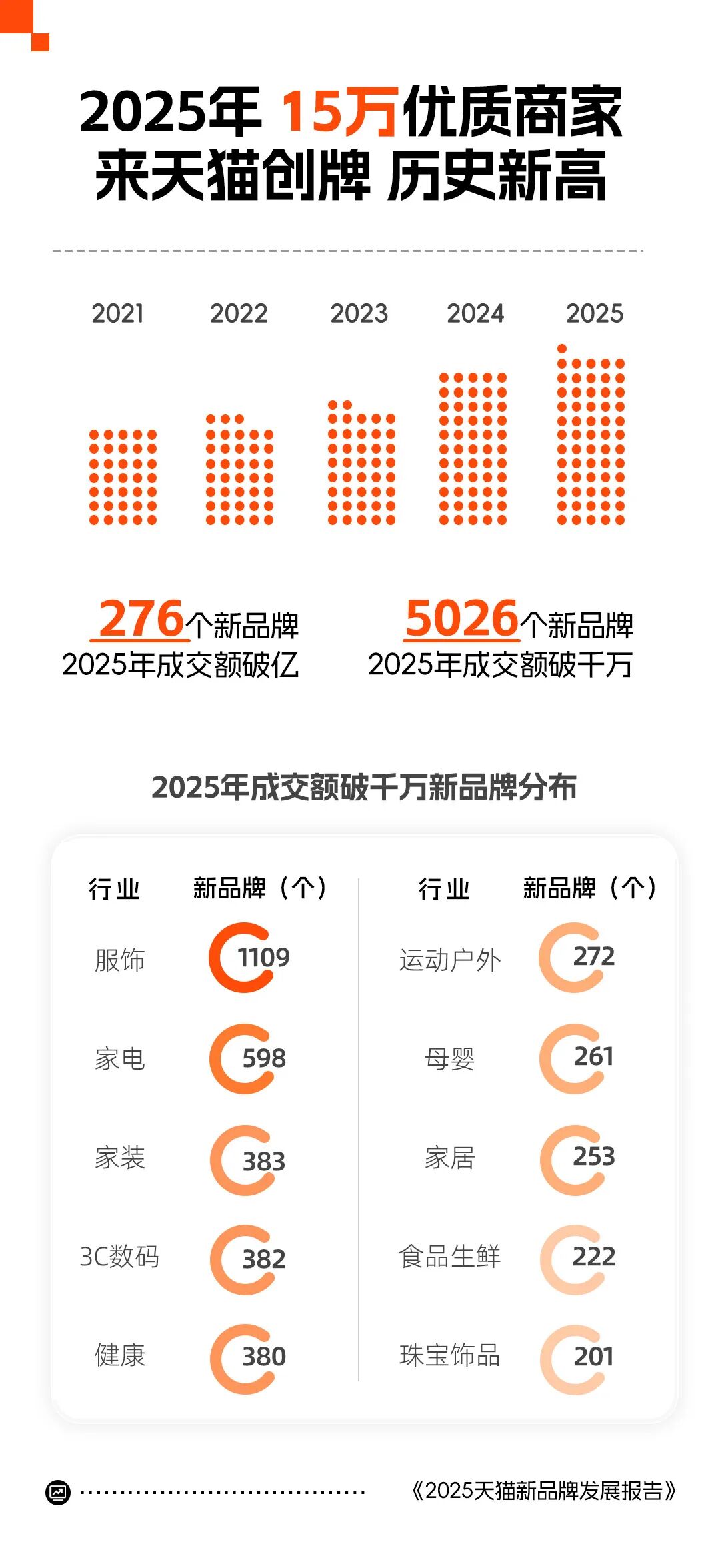
Man kann auch sagen, dass dies ein Datenbericht mit hohem Goldwert in der jüngeren Verbraucherbranche ist. In einer Zeit, in der das gesamte Netzwerk um „Reichweite“ wetteifert, ist dies eine Liste, die auf „echten Geldern“ basiert – sie repräsentiert die echte Wahl der Verbraucher mit ihrem Geldbeutel.
Der Bericht spricht nicht über die leere „Mystik des Traffics“ und vermeidet auch nicht die „Realität der inneren Konkurrenz“, die Unternehmer ängstigt.
Vielmehr vertreibt er die im vergangenen Jahr in der Verbraucherbranche verbreitete „Kälte“ und den falschen „Schaum“ und legt die harte, aber glühende Textur des Geschäfts frei – der Sieg der Produktkraft, die auf dem echten GMV basiert.
Wir haben die wertvollen Teile des Berichts zusammengestellt. Egal, ob Sie ein Markenvertreter sind, der am Spieltisch der Verbraucherbranche bleibt, oder ein Verbraucher, der sich dafür interessiert, „welche guten Dinge man kaufen kann“, wir empfehlen Ihnen, diesen Artikel vollständig zu lesen.
2025: Ein großes Jahr für die Gründung neuer Verbrauchermarken
Viele Menschen halten 2025 für ein „kleines Jahr“ des Verbrauchs, aber die Daten des Berichts zeigen das Gegenteil: Dies ist ein „großes Jahr“ in den vergangenen Jahren, in dem die Gründung neuer Marken sehr „floriert“ und die Bestimmtheit äußerst ausgeprägt ist.
Dies ist der Teil des gesamten Berichts, der sehr „gegen die Intuition“ läuft und besonders interessant ist. Aber warum gibt es diese starke „gefühlte Temperaturdifferenz“?
Denn die „Logik des Geldverdienens“ hat sich geändert. Die frühere „lebhafte“ Szene, bei der man sich auf PPTs für die Finanzierung verließ, Geld für Traffic ausgab und den Umsatz mit niedrigen Preisen steigerte, hat sich tatsächlich abgekühlt. Aber Geschäfte, die wirklich in der Lage sind, sich selbst zu versorgen und Produktbarrieren aufzubauen, leben sogar besser, weil der Lärm verschwunden ist.
Nach der Veröffentlichung dieses Berichts bestätigte die virale Verbreitung und die Erschütterung im Markenkreis genau diesen Punkt. Die Leute fühlen sich „ermutigt“, nicht weil sie schöne Zahlen gesehen haben, sondern weil es die Geschäftsbestimmtheit bestätigt, die durch die ernsthafte Arbeit an Marken entsteht.
Peng Han, Gründer von Xu Cuihua, einer Marke für Katzenstreu, die zu den „Top 10 neuen Einflussmarken“ gehört, veröffentlichte ein sehr emotionales Moment auf seinem WeChat-Moments: „Diese Ehre wurde von den Katzenbesitzern im ganzen Land mit jeder Schaufel und frischen Erfahrungen aufgebaut... Das zeigt, dass Marken, die ernsthaft an Produkten arbeiten, von allen gesehen werden, von den Katzenmeistern gesehen werden und auch von Tmall gesehen werden.“
Er drückte in einem Satz den aktuellen Weg aus, wie neue Marken aus der Masse hervorstechen: Sich voll und ganz den Produkten widmen.
Peng Han sagte offen im Gespräch, dass der Bericht ein sehr positives Signal aussendet – die Plattform fördert „Wettbewerb um Wert“ statt „Wettbewerb um Preise“. „Das macht uns sicher, dass wir nicht in endlose Preiskämpfe geraten müssen. Solange wir uns an guten Produkten festbeißen, können wir überleben und sogar besser leben.“
Tongpin hat das gleiche Gefühl. Sie glauben, dass die Aufnahme in die „Top 10 neuen Einflussmarken von Tmall 2025“ nicht nur eine Ehre darstellt, sondern auch eine Bestätigung des Branchenkonsenses: „Es zeigt uns, dass die Plattform einen faireren Wettbewerbsraum bietet, damit neue Marken sich von der niedrigpreisigen inneren Konkurrenz befreien und sich auf die Herstellung guter Produkte konzentrieren können, die mit den Verbrauchern im Einklang stehen, sowie auf eine differenzierte Markenpositionierung.“
Dieses Vertrauen wird nicht nur unter den Gründern weitergegeben, sondern auch der scharfe Kapitalmarkt hat den Trend erkannt.
Huang Hai, ein bekannter Investor, seufzte nach dem Lesen des Berichts, dass der Verbrauchermarkt „so viel Wasser hat, dass große Fische darin schwimmen“. Seiner Meinung nach gibt es auch in Bereichen wie Sport und Outdoor, 3C-Digitale Produkte sowie Heimdekoration und Haushaltsgeräte, die von der Außenwelt als „Rotes Meer“ betrachtet werden, noch viele unbefriedigte Bedürfnisse, solange man den Einstiegspunkt für kleine Innovationen findet.
„Die Marken, die auf dieser Tmall-Liste stehen, sind für den Risikokapitalbereich sehr beachtenswert, sie sind Marken, die vom echten Markt validiert wurden“, sagte Huang Hai.
Das ist genau der Wert des Berichts für die Branche: Er ist nicht nur ein Leistungsbericht, sondern auch eine „Rechtfertigung“ für gute Marken.
Er sagt den Gründern von Verbrauchermarken mit handfesten GMV-Daten: Der Markt ist nicht „erkaltet“, er ist nur anspruchsvoller geworden. Wenn die Flut zurückgeht, werden die Spieler ausgeschieden, die versuchen, Produktmängel mit „übermäßigem Traffic“ zu vertuschen. Und „gute Marken“ wie Xu Cuihua und Tongpin, die bereit sind, Schritt für Schritt ihren Ruf aufzubauen, haben gerade ihre eigene Hauptbühne erreicht.
Porträt der Gewinner: Nicht um Traffic konkurrieren, sondern um „Goldwert“
Die „übermäßige Traffic-Versorgung“ funktioniert nicht mehr – wer verdient jetzt Geld?
Wenn man den Bericht aufschlägt, sieht man ein sehr ausdrucksstarkes Panorama der Markengründung im Verbrauchermarkt. Im Jahr 2025 gab es insgesamt 5026 neue Marken auf Tmall mit einem Umsatz von über 10 Millionen Yuan.
Es ist nicht die Feier einer einzelnen Strecke, sondern ein Ausbruch der gesamten Branche: Neue Modemarken führen mit einem Anteil von 22 %, gefolgt von Haushaltsgeräten. Auch in den Bereichen Heimdekoration, 3C-Digitale Produkte und Gesundheit sind fast 400 neue Marken erfolgreich hervorgetreten.
„Helden werden nicht nach ihrer Herkunft beurteilt“ – die Welle der Markengründung beschränkt sich nicht auf die hochkarätigen Standorte für Markengründung wie Guangzhou, Shenzhen und Yiwu, sondern dringt tief in die industrielle Struktur der chinesischen Fertigungsindustrie ein. Möbel aus Xuzhou (Qingba, Senlaimeng, Mengdongqu), digitales Zubehör aus Zhengzhou (Kemanzhe, YOEK) und Schmuck aus Xiamen (KERLA) sind gemeinsam aufgestiegen.
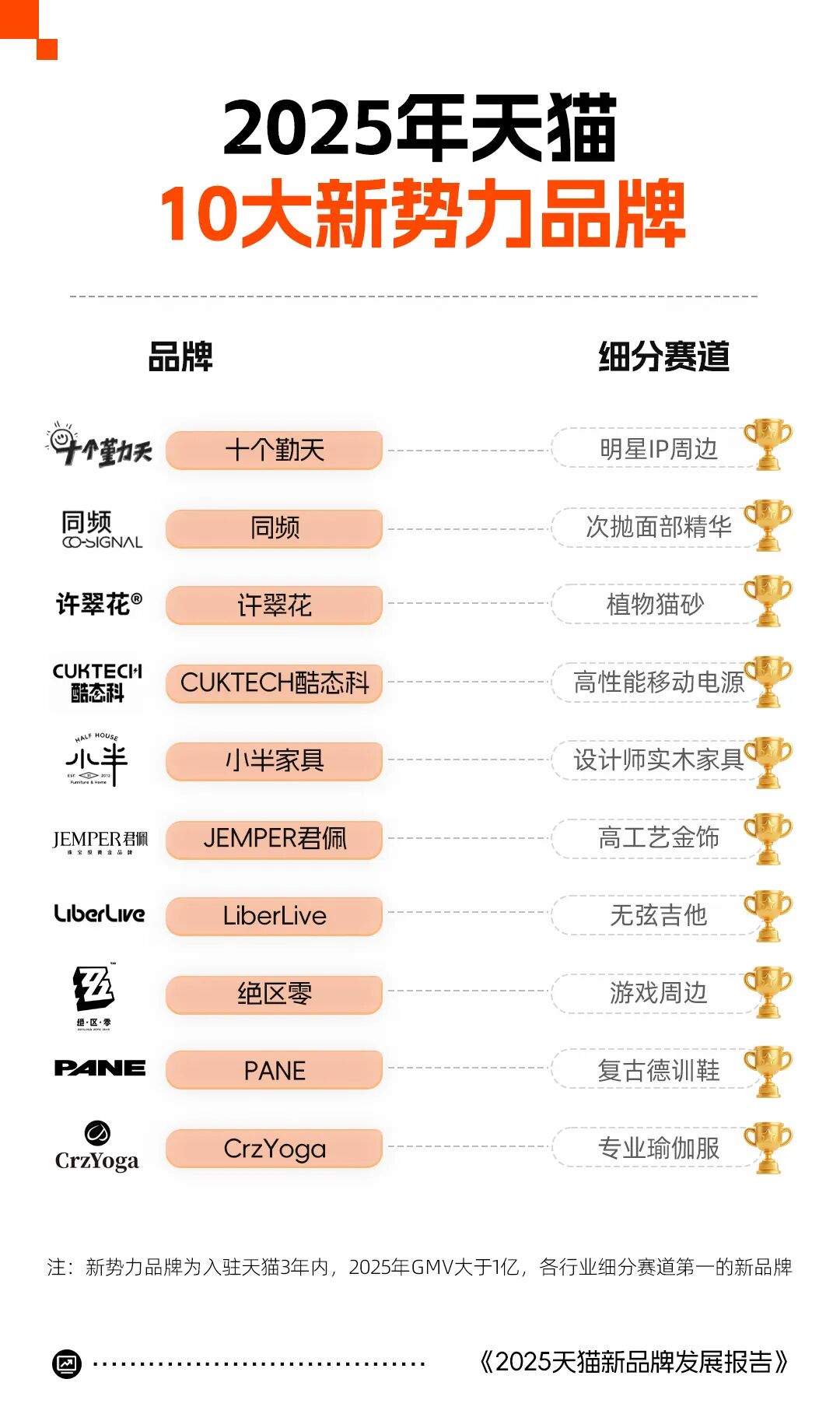
An den „Top 10 neuen Einflussmarken“, die seit weniger als drei Jahren eingetragen sind und deren Tmall-GMV im Jahr 2025 über 100 Millionen Yuan liegt, lassen sich drei Hauptmodelle für „Gewinner“ erkennen.
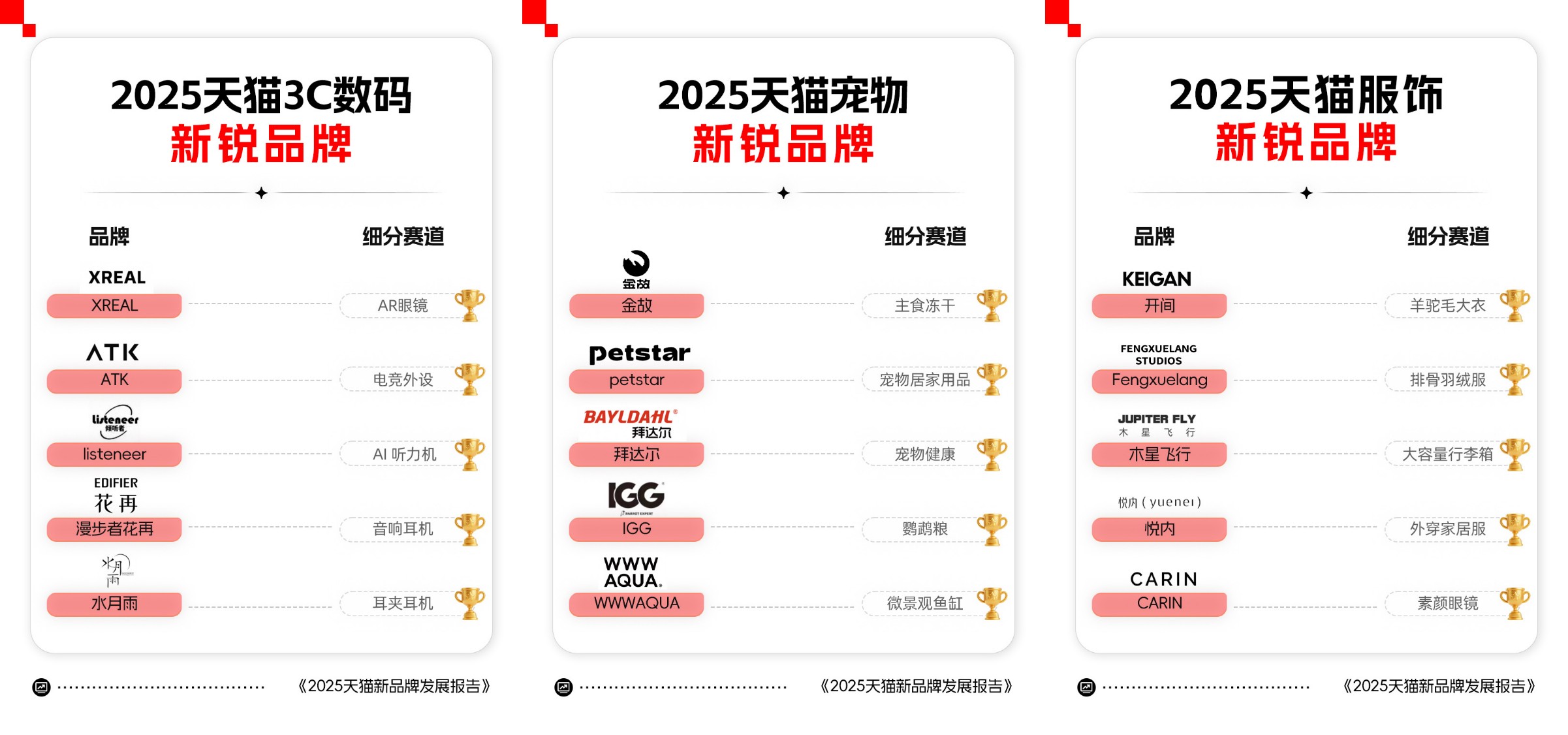
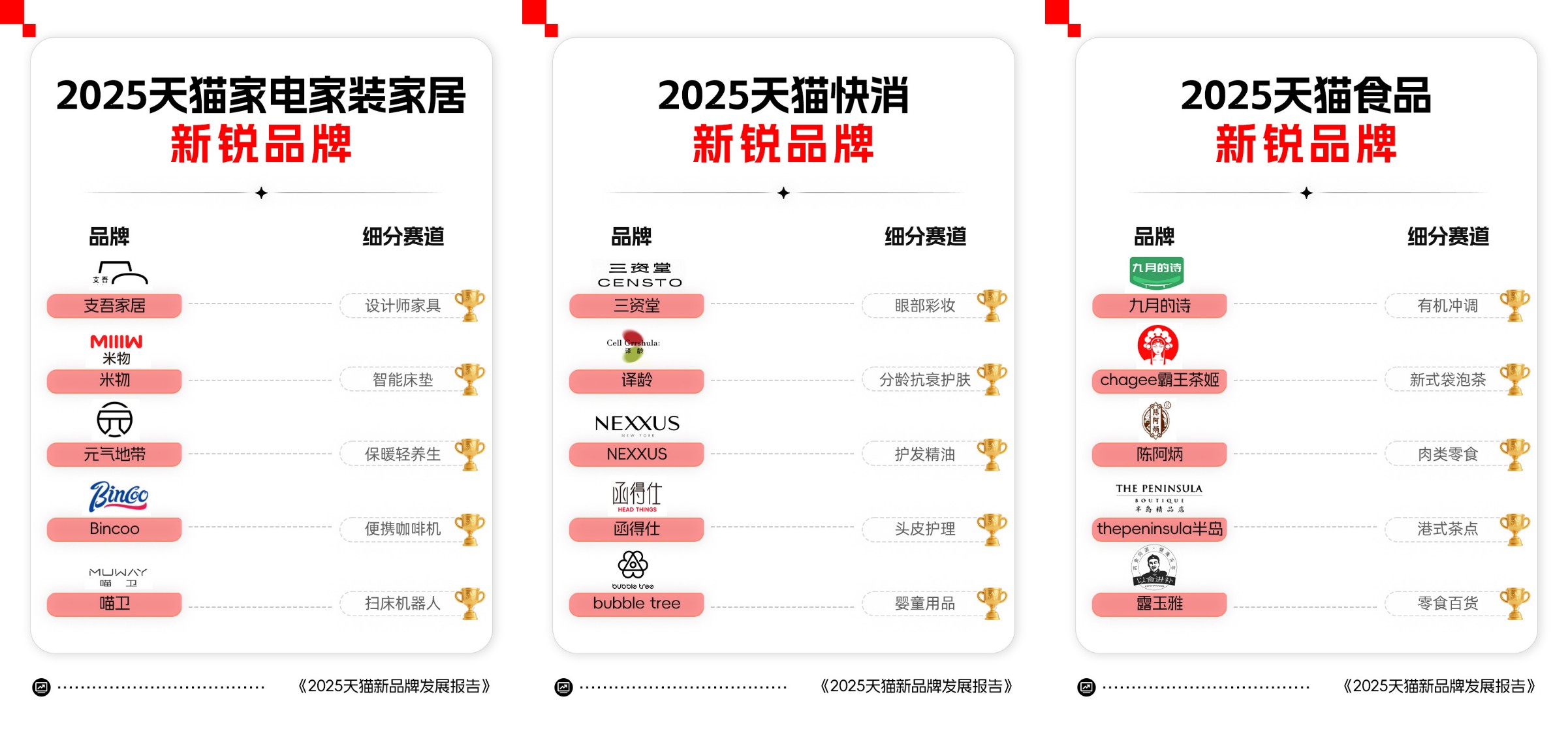
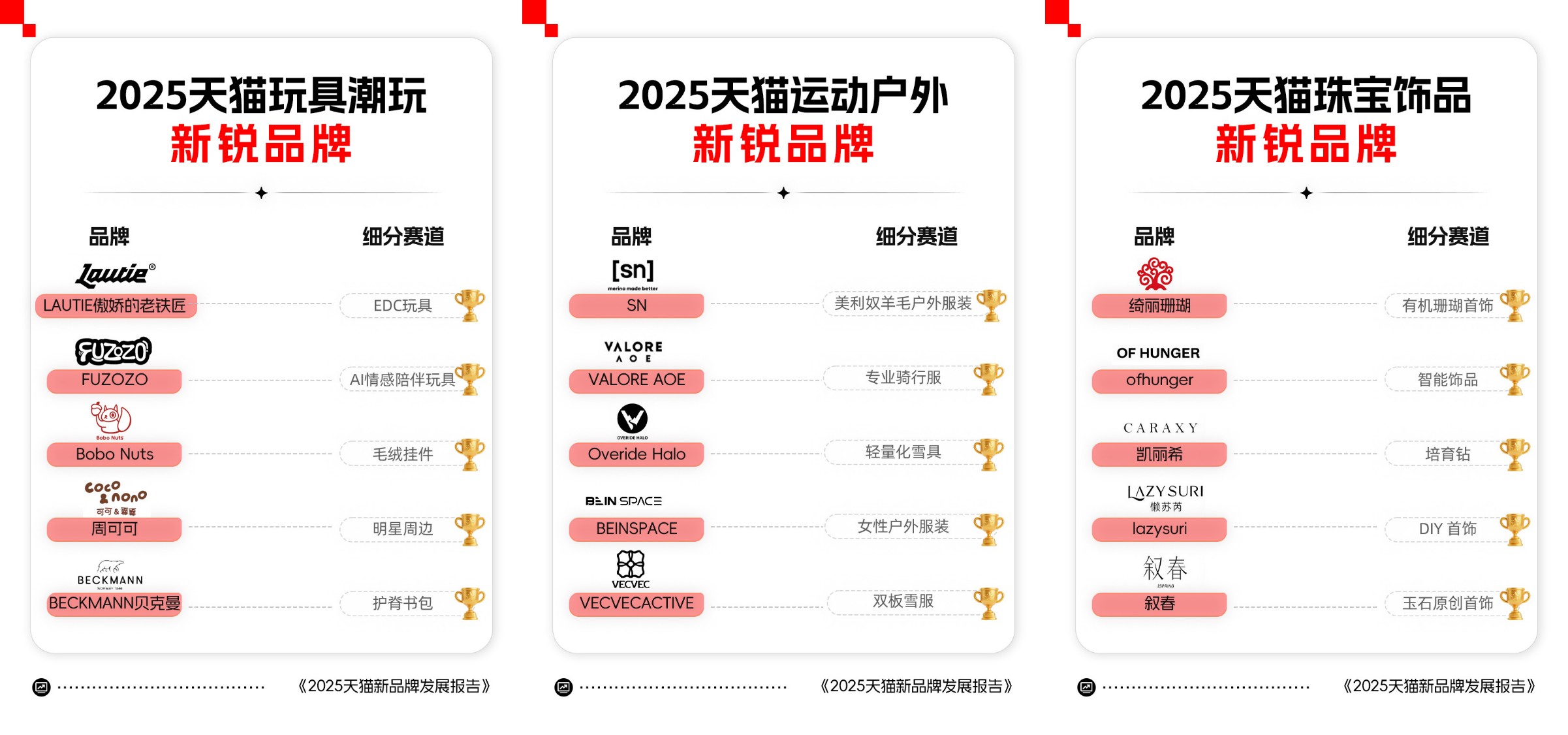
Technische Übersetzer: „Harte Parameter“ in „Benutzererfahrung“ umwandeln
Das Gewinner-Modell dieser Gruppe besteht darin, keine kalten technischen Parameter anzuhäufen, sondern die Forschungs- und Entwicklungsfähigkeit in eine für den Benutzer wahrnehmbare Erfahrung zu „übersetzen“.
In der scheinbar „bis zum Äußersten konkurrierten“ Strecke der Powerbanks wählte CUKTECH nicht den Weg der „Allgemeinware“, sondern konzentrierte sich auf die Produkte, verbesserte das Industriedesign und verließ sich auf die Markenwirkung und externe Verbreitung. Laut Tmall-Daten erzielte es allein durch spontane Bewertungen von Technik-Bloggern und die Mundpropaganda von Enthusiasten ein jährliches Wachstum von über 200 % auf Tmall.
Warum konnte diese Entscheidung richtig getroffen werden? Eric, CMO von CUKTECH, erwähnte das First-Principles-Prinzip hinter der Entscheidung: „Kombiniert mit den echten Szenarien der Nutzer, nutzen wir die Forschungs- und Entwicklungsvorteile des Teams, um die Fähigkeiten der Forschung und Entwicklung in den Wert zu übersetzen, den die Nutzer brauchen, damit die Produkte natürlich in das Leben der Nutzer passen.“
In dem noch härter umkämpften Kosmetikbereich zeigt Tongpin eine ähnliche Strategie.
Tongpin hat einen wissenschaftlichen Trumpf – Jinhui Bioengineering und seinen entwickelten rekombinanten humanisierten Kollagenbestandteil. Seit der Entwicklung neuer Produkte hat Tongpin sich auf die Einsichten der Verbrauchsdaten der Tmall-Plattform gestützt, um die tiefen Bedürfnisse der Nutzer präzise zu ermitteln. Mit Tmall als Kernbasis hat Tongpin schrittweise einen kontrollierbaren Kommunikationsbereich aufgebaut, um die Bestandteile zu erklären und die Markenbekanntheit zu steigern.
Während des Tmall-Doppel-11-Events 2025 nutzte Tongpin die Ressourcenmatrix von Tmall „Schatz der neuen Marken“ vollständig, um eine wunderbare Kombination von Maßnahmen durchzuführen: Starke Werbung außerhalb der Plattform, um Nutzer zurück zu Tmall zu locken, und groß angelegte Werbung in sozialen Medien zur Erwärmung der Stimmung. Laut Tmall-Daten zeigte diese Strategie „Inhalt zuerst, Effizienz durch Traffic-Investitionen“ deutliche Wirkung, und Tongpin erreichte den ersten Platz bei dem Jahresumsatz der neuen Marken im Bereich der Einweg-Essenz.
Schmerzpunkt-Anpasser: „Hochwertige Ausstattung“ im „Roten Meer“ durchführen
Wenn die technische Gruppe durch „Technologie“ und „Bestandteile“ hervorsticht, dann reißt diese Gruppe durch „Innovation“ und „ultimative Anpassung“ eine Lücke im wettbewerbsintensiven Roten Meer auf.
Zhou Zhimin, der für den inländischen E-Commerce der Yoga-Bekleidungsmarke Crzyoga zuständig ist, die zu den „Top 10 neuen Einflussmarken“ gehört, erwähnte, dass die Marke in der Anfangsphase Geschäfte im Ausland machte und bei ihrem Eintritt in den chinesischen Markt „nicht an die lokalen Gegebenheiten angepasst“ war.
Die Marke stellte fest, dass die westlichen Schnitte nicht für die Chinesen geeignet sind, und passte die Strategie schnell an: Sie entwickelte unabhängig „asiatische Schnitte“, die für die Figur und die Vorlieben der Chinesen geeignet sind, und kombinierte sie mit der selbst entwickelten Butterluxe-Stoffserie, um ein Gleichgewicht zwischen Unterstützung und Komfort beim Sport zu erreichen.
Zhou Zhimin erwähnte, dass das Attraktivste an der Markengründung auf Tmall die „hohe Qualität und große Anzahl der Zielgruppen“ ist. Diese hoch engagierten Kunden haben nicht nur einen Jahresumsatz von über 100 Millionen Yuan erzielt, sondern auch die kontinuierliche Iteration der Produkte rückwirkend vorangetrieben, sodass Crzyoga im Jahr 2025 einen Umsatz von über 100 Millionen Yuan erreichte.
Die Haustier-Marke Xu Cuihua folgt der gleichen Logik. Während der Markt für Katzenstreu um „9,9 Yuan inklusive Versand“ konkurriert, konzentriert sich Xu Cuihua auf die Erfahrung von „pflanzenbasiertem Material“ und „staubfrei“, löst das von Katzenbesitzern gehasste Problem des „Anhaftens am Boden“ und wurde damit die Nummer eins im Bereich der pflanzlichen Katzenstreu.
Und Pane, das in dem extrem gesättigten Schuh- und Bekleidungsmarkt erfolgreich hervorgetreten ist, fand durch die Erschließung des Nischenstils „retro deutsche Trainingsschuhe“ eine Wachstumslücke im Roten Meer. Der Gründer Gao Gao sagte: Der Erfolg von Pane ist kein Zufall, sondern konzentriert sich auf die Verfeinerung des ursprünglichen Designs und der Qualität und reagiert präzise auf die aktuelle Nachfrage der Verbraucher nach „langfristig ausgerichteten“ Produkten.
Ihr Erfolg beweist eine Logik: Es gibt keine untergehenden Branchen, sondern nur untergehende Produkte, die keine neuen Bedürfnisse erkennen. Solange man die Schmerzpunkte, die durch Gewohnheit ignoriert werden, präzise lösen kann, kann das Rote Meer zu einem Blauen Meer werden