Is the hottest track at the beginning of 2026 set to ignite the next great frontier?
Recently, the global competition for scarce space strategic resources has intensified.
China has submitted a one - time application to the International Telecommunication Union (ITU) for spectrum and orbital resources involving approximately 203,000 satellites, covering 14 constellations, setting a domestic record for a single application.
The U.S. Federal Communications Commission (FCC) has also approved SpaceX to deploy an additional 7,500 second - generation Starlink satellites.
Elon Musk has proposed one of the most ambitious manufacturing goals in the history of the aerospace industry: to produce 10,000 Starship spacecraft per year.
Guangzhou is promoting the agglomeration of commercial aerospace talents, capital, and enterprises in the city to build a complete commercial aerospace industrial ecosystem.
Over the past month or so, the aerospace sector has been the focus of the market, outperforming technology sectors such as AI.
Among them, Aerospace ETF (159227) has risen by 53.33% in 34 trading days from November 24, 2025, to January 12, 2026, and its net value has repeatedly reached new highs.
The boom in the aerospace industry stems from a profound and long - lasting industrial transformation, a golden opportunity jointly driven by major - power strategies, market explosions, and technological revolutions.
Based on these logics, Aerospace ETF (159227) has been selected as one of the top ten core ETFs in Gelonghui's "Global Vision, Bet on China" in 2026.
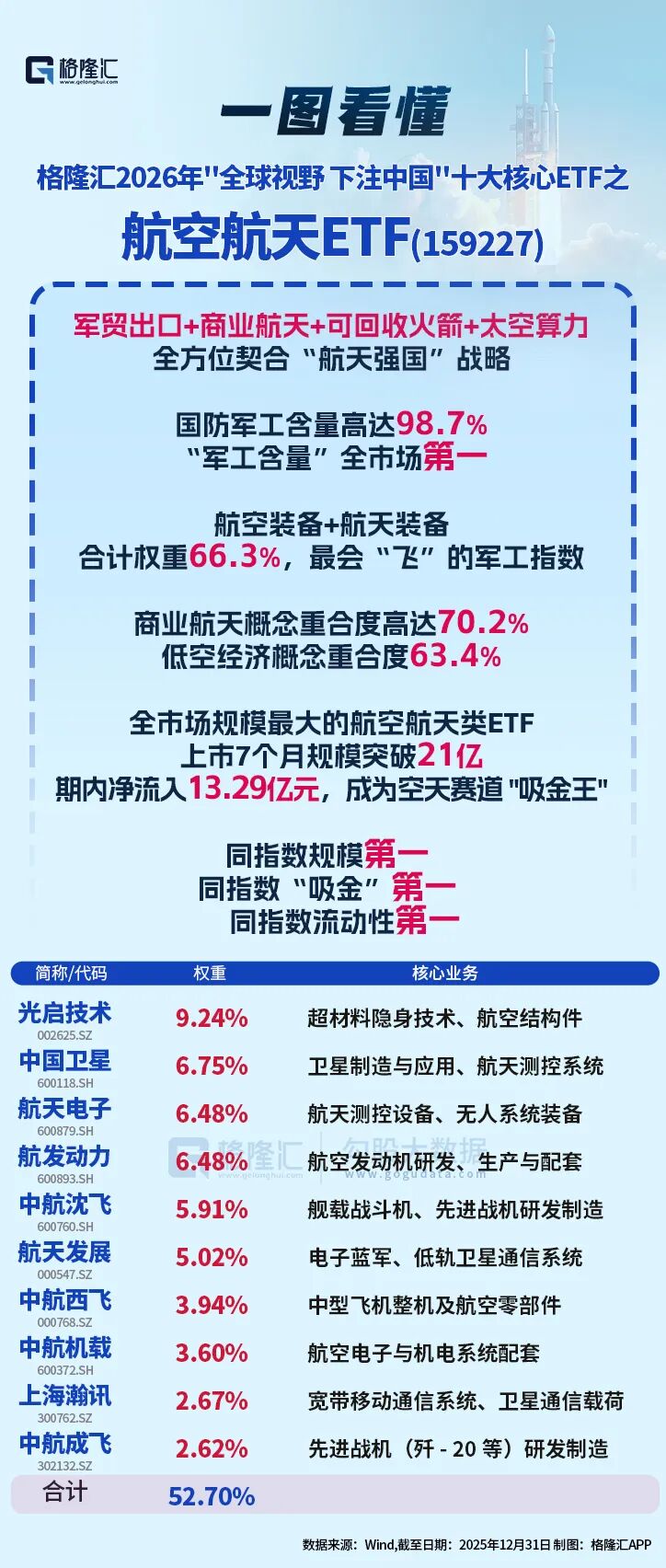
01 An Eagerly - Awaited Industrial Feast
The aerospace industry has been clearly designated as an "emerging pillar industry" to be developed by the state.
On March 5, 2025, in China's 2025 "Government Work Report", in terms of new - quality productivity, it was proposed to promote the safe and healthy development of emerging industries such as commercial aerospace and low - altitude economy;
The call to "accelerate the construction of a space - power" in the 14th Five - Year Plan marks that it has become one of the core engines of the country's economic and technological development;
In November 2025, the establishment of the Commercial Aerospace Department of the National Space Administration has greatly improved administrative efficiency in launch approval and license issuance, promoting the standardized and large - scale development of the industry.
Meanwhile, a technological singularity has emerged.
Among them, the most notable is the "reusable rocket technology", which can reduce the cost of space launches by one or even several orders of magnitude, taking the most important step in the commercialization of the space economy.
The United States, with Elon Musk's Space X, has already gained an obvious first - mover advantage.
The rapid development of technology and the situation has intensified competition and highlighted the urgency of catching up.
According to the regulations of the International Telecommunication Union (ITU), the rule for the use of satellite frequencies and orbits is "first come, first served, and permanent occupation after occupation".
According to the calculations of CCID data, the theoretical capacity of the Earth's low - Earth orbit is estimated to accommodate only about 60,000 satellites. Musk's "Starlink" is currently the fastest - progressing low - orbit satellite constellation, with more than 10,000 satellites launched cumulatively, and the goal is to launch 42,000 satellites, seizing most of the low - orbit satellite resources;
Domestically, the medium - and long - term plans of StarNet and "G60" involve nearly 30,000 satellites. The ITU rules require that 10% of the total constellation scale be completed in the 9th year; otherwise, the resources may be taken back.
On December 24, 2025, the Third Commercial Aerospace Development Conference held in Beijing pointed out that as of the end of November last year, the global average monthly launches exceeded 26 times, setting a new historical record, marking that the global aerospace industry has entered the "weekly launch era".
Fortunately, there are signs that China is taking active actions and striving to catch up.
The "GW Constellation" and the "Qianfan Constellation" are two large - scale satellite Internet projects planned by China.
Among them, the GW Constellation is a broadband Internet satellite constellation operated by China StarNet, planning to launch a total of about 12,992 satellites. It is planned to complete about 10% of the satellite deployment within 5 years and complete the launch of all satellites by 2035. As of now, 17 networking launches have been completed, with 136 networking satellites in orbit.
The Qianfan Constellation is operated by Yuanxin Satellite, planning to launch a total of about 15,000 satellites. As of now, 6 networking launches have been completed, with 108 networking satellites in orbit.
It is reported that LandSpace has signed formal launch service contracts with China StarNet and Yuanxin Satellite and will provide batch launch services in the future.
This means that the Chinese commercial aerospace industry, with a scale of 2.5 - 2.8 trillion yuan and an average annual compound growth rate of over 20% (data from the "Research Report on the Chinese Commercial Aerospace Industry"), has reached an eagerly - awaited explosion point.
02 Continuous Inflow of Funds into the Aerospace Track
Before this industrial boom, funds have already taken action.
For example, from the perspectives of more forward - looking ways to observe funds: the primary market, industrial funds, and policy - based funds.
The "Research Report on the Chinese Commercial Aerospace Industry" points out that in 2025, the total industry financing reached 18.6 billion yuan, a year - on - year increase of 32%. The top three were satellite applications (8.7 billion), rocket manufacturing (6.71 billion), and satellite manufacturing (about 3 billion).
Policy and industrial capital have also worked together. The local and central governments have provided a total of more than 20 billion yuan in support; the first domestic commercial aerospace social special fund (with an initial amount of 2 billion yuan) was established at the end of last year.
Another example is the secondary market. According to the 2025 mid - year report, many leading aerospace companies have received capital increases.
China Satcom: The number of shares held by The Hong Kong Securities Clearing Company Limited (Northbound Trading) increased by 7 million shares compared with the end of the first quarter (an increase of about 61%); AVIC Shenyang Aircraft Corporation: The 2025 third - quarter report disclosed that the number of shares held by The Hong Kong Securities Clearing Company Limited increased by about 6.7 million shares quarter - on - quarter.
This reflects that foreign capital is increasing its positions.
By the end of 2025, there were signs of accelerated capital inflow.
Statistical data shows that in the week from December 26 to 31, 2025, the "National Defense and Military Industry" (including core aerospace companies) sector in the Shenwan Primary Industry received a net purchase of 4.957 billion yuan in financing, ranking first.
How about another important indicator for observing funds - ETF?
Take the Aerospace ETF (159227), which was selected as one of the top ten core ETFs in Gelonghui's "Global Vision, Bet on China" in 2026, as an example.
Since its listing on May 16, 2025, its scale has grown astonishingly. The initial scale at the time of listing was 400 million, and by the end of 2025, it had exceeded 2.1 billion. During this period, the total net inflow was 1.329 billion, making it the "money - magnet" in the aerospace track, with an average daily trading volume of 160 million. Both its scale and liquidity rank first among the same - target products.
What are the reasons for such a strong performance?
03 ETFs Are Becoming the Choice of More and More People
There are roughly three core reasons.
The aerospace industry belongs to an emerging and high - growth technology track.
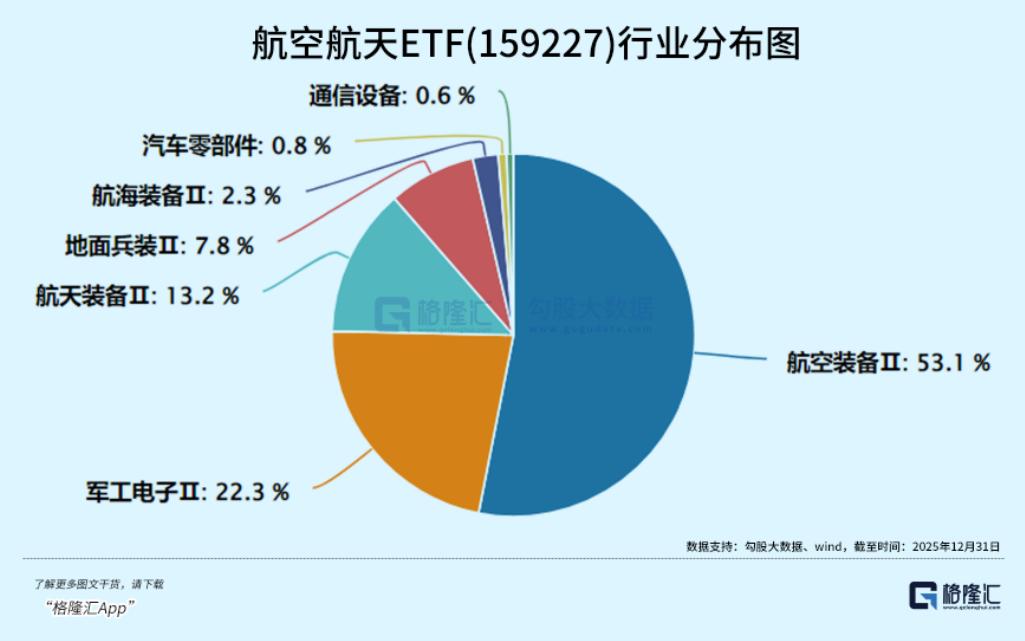
Another reason may lie in the index tracked by the Aerospace ETF (159227) - the Guozheng Aerospace Index. This index is highly consistent with the strategic direction of "air - space integration", focusing on the air power of the military industry. The weight of the Shenwan Primary National Defense and Military Industry accounts for as high as 98.7%, making it the purest military - industry index in the market.
The Guozheng Aerospace Index is also the most "flying" military - industry index. The combined weight of aerospace equipment is as high as 63.3%, and its overlap with the concept of commercial aerospace is as high as 70.2%. The content of the low - altitude economy is 63.4%. It deeply deploys in four major national strategic emerging fields: military aircraft replacement, large aircraft, low - altitude economy, and satellite Internet, which is in line with the goal of building a "space - power" in the 14th Five - Year Plan.
The top ten weighted stocks of the Aerospace ETF (159227) clearly show the core chain of the aerospace industry, from the most upstream aerospace engines, aerospace materials, and airborne systems to the final aircraft and aerospace systems. The constituent stocks cover leading companies in the entire industrial chain, such as fighter jets, aerospace engines, rockets, missiles, satellites, and radars.
Companies such as China Satcom and Aerospace Electronics are deeply involved in key commercial aerospace links such as satellite manufacturing and satellite control; technologies such as the stealth materials of Kuang - Chi Technology and the composite materials of AVIC Hi - Tech can also be applied to the lightweight and high - performance manufacturing of satellites and launch vehicles.
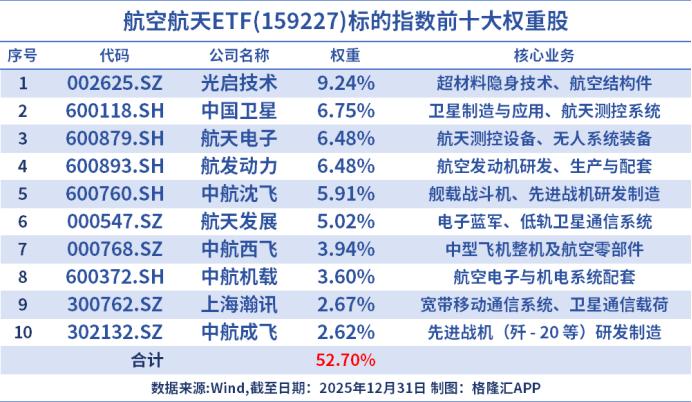
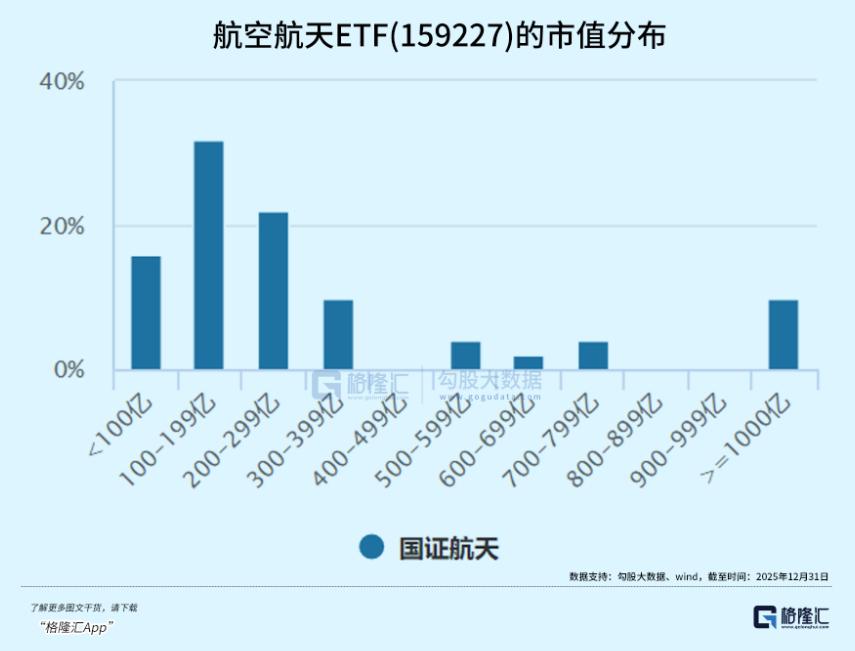
The total weight of the top ten heavy - weighted stocks is 52%, with a concentrated layout of the most competitive leading enterprises in the industry, showing a significant leading - enterprise effect. At the same time, companies with a market value of less than 20 billion account for 48%, showing a significant small - cap growth style, which often brings stronger stock - price elasticity when the industry's prosperity improves.
The third reason is the ETF tool itself.
The stock - market god Warren Buffett once said: "By regularly investing in index funds, an amateur investor who knows nothing can often outperform most professional investors."
The index - fund investment tool (ETF) mentioned by Buffett has advantages such as high transparency, stable style; low cost, flexible trading mechanism, and high capital - use efficiency; rich varieties, and the ability to meet the needs of global asset allocation.
In 2025, ETFs have become the "main channel" for domestic funds to enter the market and for asset allocation.
According to the latest data, the total scale of ETFs in the entire Chinese market has exceeded 6 trillion yuan, surpassing Japan to become the largest ETF market in Asia.
Among them, the total scale of Huaxia Fund's ETFs has been among the top 20 globally since 2022; by the end of Q3 2025, Huaxia Fund became the first domestic fund company with a total ETF scale exceeding 900 billion yuan, rising to the 18th place globally and firmly ranking first in China.
Behind this explosive growth is the concentrated manifestation of the shift of residents' wealth to financial assets, the maturity of the capital market, and the rationalization of investment concepts. At the same time, the structure of ETF market participants is also being optimized. The average proportion of institutional investors in non - monetary ETFs has reached 54.6%, promoting the formation of an ecosystem of "long - term investment with long - term funds".
ETFs have evolved from an investment product to a basic tool for asset allocation and an important infrastructure for the high - quality development of the capital market.
04 Conclusion
At the beginning of 2026, the aerospace sector is no longer an isolated and cyclically - fluctuating sub - industry of national defense, but a comprehensive high - end manufacturing and technology - growth sector that combines the strategic will of major powers, breakthroughs in cutting - edge technologies, huge market demand, and global competitiveness.
It stands at the intersection of three major era propositions: national security, technological self - reliance, and new economic growth points.
2026 is hailed as a crucial year for the verification of China's aerospace technology.
In addition to rocket recovery, mass - production lines for satellites are being built, progress has been made in the airworthiness certification of eVTOLs, and continuous breakthroughs are being made in more advanced aerospace engines...
When science fiction becomes reality and development is eagerly awaited, the curtain of a super - large - scale high - tech industry is slowly unfolding before the world.
This is a technological upsurge and the prelude to a new era, rather than a short - lived noise or simple concept speculation.
The Aerospace ETF (159227), with a high exposure to new - quality productivity fields such as commercial aerospace and low - altitude economy, can effectively capture investment opportunities brought by industrial waves such as satellite Internet and reusable rockets.
Gelonghui Statement: All the views in this article are from the original author and do not represent the views and positions of Gelonghui. It is specially reminded that investment decisions should be based on independent thinking. The content of this article is for reference only and is not intended as any actual operation advice. The trading risks shall be borne by the investors themselves.
This article is from the WeChat official account “Gelonghui APP” (ID: hkguruclub), author: Shen Peng. Republished by 36Kr with authorization.