China's "dual carbon" path now has an on-site coordinate system
There is no buffer period at the mid - term node of the "dual carbon" goal.
A few years ago, the "dual carbon" goal was more of a directional consensus. It was written into planning texts, strategic visions, and long - term goals. It was important but not urgent. Enterprises could make statements, make plans, or take a wait - and - see attitude in stages. Because 2030 was still far enough away, there was still flexibility in the path.
However, since 2026, this "sense of buffer" is rapidly disappearing.
As the countdown to the 2030 goal enters the second half, the "dual carbon" goal has begun to transform into a real constraint. More and more industry participants have realized that if they are still unable to answer "how to do it and whether it can work" at this moment, it will be difficult to leave room for systematic trial - and - error in the next five years.
This change is becoming more and more obvious in the perceptions of different roles such as capital, leading enterprises in the industry chain, and local industrial managers.
In the real front - line situation, a clear judgment criterion has emerged: "The 'dual carbon' goal is shifting from a goal - oriented narrative to a structural - ability - based one; and structural ability must be verified in the industrial field."
01
Calibration of Goals and Reality at the Mid - term Node
Against the backdrop of intensive policies, active concepts, and high capital attention, the cost of misjudgment in "dual carbon" evaluation is rising. Questions such as whether the technology can really be implemented, whether the path is replicable, and whether the efficiency can withstand the test of scale often only surface at a very late stage for enterprises.
"The realization of the national 'dual carbon' goal has never been an isolated technological breakthrough, but a close symbiosis and cooperative evolution of the industrial chain, innovation chain, and capital chain in real scenarios," said Chen Gang, the vice - president of Orient Securities.
Against this background, the Fourth "Dual Carbon Star Species" project adjusted its form.
As a "dual carbon" themed project jointly promoted by 36 Kr, Orient Securities, and its subsidiaries Orient Securities Innovation and Orient Securities Capital, the "Dual Carbon Star Species" project in previous "Sustainable Innovation Competitions" mainly focused on discovering and showcasing innovative enterprises. Through selection and roadshows, a group of green innovative forces were brought to light. However, as the "dual carbon" goal enters the mid - term, simply "showcasing innovation" is no longer sufficient to address the real problems the industry is facing.
This year, the "Dual Carbon Star Species · Carbon Exploration Plan" has chosen to go to the front - line of the industry, which essentially brings forward the verification cost. Instead of aligning consensus around stories, it brings governments, leading enterprises in the industry chain, upstream and downstream enterprises, and capital to the same scene, and aligns around hard indicators such as whether the model can work, whether it is replicable, and whether the cost - efficiency ratio is reasonable.

"Our 'Dual Carbon Star Species' project has been held for four consecutive sessions, and we can clearly see a trend: enterprises are becoming more pragmatic, and capital is becoming more patient. In the future, the 'dual carbon' industry is shifting from subsidy - driven to ability - driven," said Wang Yifei, the head of the institutional client department of Orient Securities Capital. "We have always regarded the 'Carbon Exploration Plan' as a long - term project. For us, the key is whether we can see earlier and more clearly whether an enterprise has truly entered a key position in the industry chain."
Therefore, this year's "Dual Carbon Star Species" project has been upgraded to the "Carbon Exploration Plan". It no longer stays at the stage of the stage and selection but shifts the focus to the industrial field. Through on - site visits, the evaluation is verified in real scenarios.
Feedback from enterprises also points in the same direction. Zhang Jianzheng, the co - founder and general manager of Hydrogen Easy Energy, believes that "for us start - up enterprises, whether we can really implement our projects often depends on whether we can access real resources. If we leave our enterprise's location and expand to other places without the support of the government, the difficulty will be multiplied. However, once the government gets involved, the effect is often twice the result with half the effort."
Under this logic, the itinerary design of this year's "Carbon Exploration Plan" is a conscious path deconstruction. It puts the question of how to implement the 'dual carbon' goal into three industrial systems with completely different levels of complexity and maturity. Through comparison, it approaches a more realistic judgment.
From the new energy vehicle industrial belt in Zhengzhou Airport Economic Zone, we can observe the adaptability of low - carbon technologies in high - frequency manufacturing systems; in the hydrogen energy application scenarios in Daxing, Beijing, we can examine the promotion logic of future energy at a stage when the infrastructure and standard systems are not yet fully mature; and in Shanghai, starting from artificial intelligence, we can discuss how technology can participate in the next stage of low - carbon transformation as a base variable.
For a 'dual carbon' proposition that has entered the implementation stage, the ability to reduce misjudgment is becoming more important than creating hype itself.
02
The Real Forms of Carbon Exploration in Different Industrial Contexts
The most common mistake in interpreting the "dual carbon" goal is to assume that there is a universal path.
Take this year's "Carbon Exploration Plan" as an example. Even for low - carbon transformation, in different industrial contexts, the problem forms, promotion rhythms, and key variables are almost completely different.
1. Future Transportation: When the "Dual Carbon" Goal Becomes a System Efficiency Issue
As the first stop of the "Carbon Exploration Plan", Zhengzhou Airport Economic Zone is not tasked with "showcasing new energy achievements" but with verifying a more realistic question: Can the 'dual carbon' goal still be achieved in a highly scaled - up and efficiency - oriented manufacturing system?
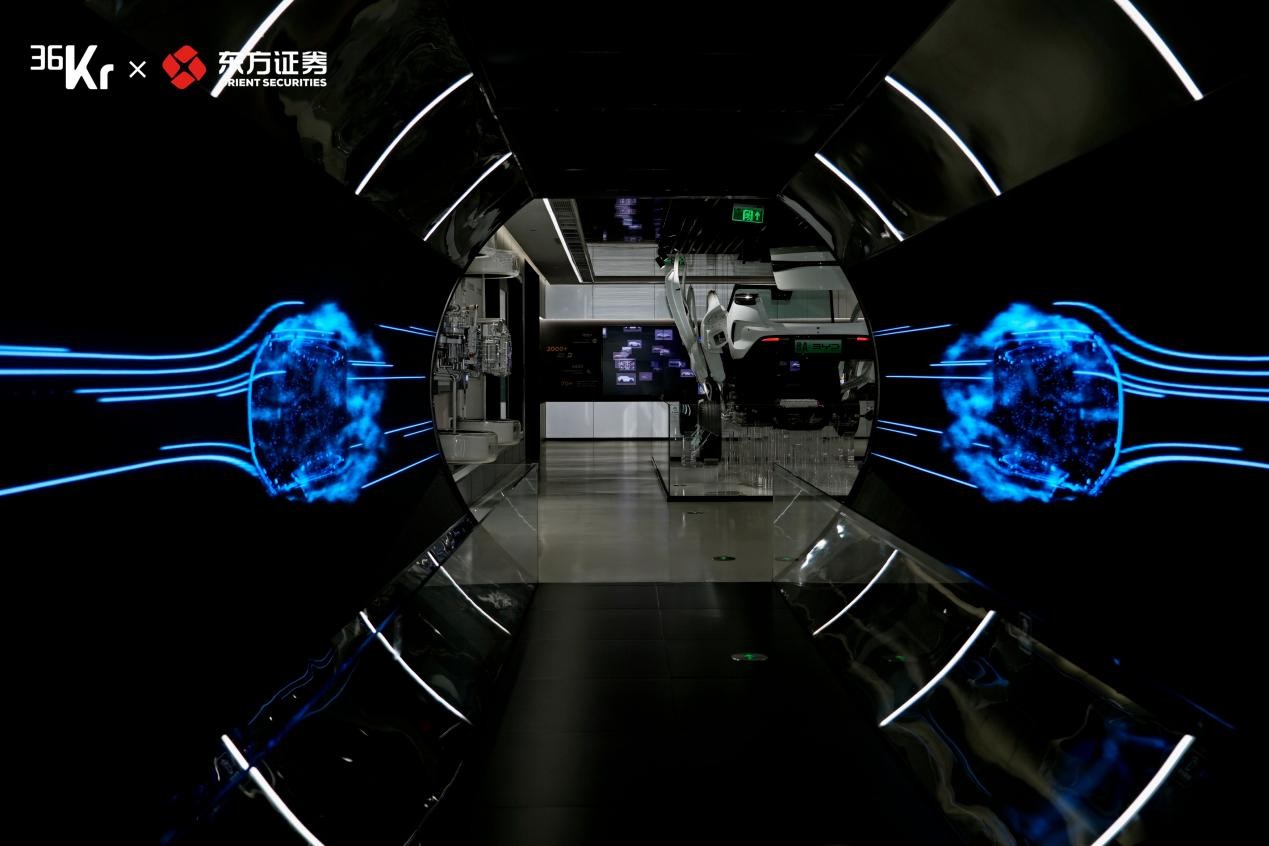
In the new energy vehicle industry chain, the production line rhythm, delivery cycle, and cost control form a highly coupled system. Any variable that cannot be embedded in the system will be quickly magnified into an efficiency loss. In this context, the "dual carbon" goal is no longer an "additional goal" but is directly tested for whether it can contribute to the improvement of system efficiency.
The judgment from leading enterprises in the industry chain is particularly straightforward. A brand and public relations director of a leading vehicle manufacturer said frankly, "For us, green is not a KPI or a compliance obligation but a direction for efficiency improvement." For vehicle manufacturers, the green strategy is not an independent compliance item but a long - term ability highly integrated with production line stability, resource recycling, and organizational efficiency.
This logic is also repeatedly verified by upstream and downstream enterprises in the industry chain. "In fact, as a product and application company, our biggest demand is to find or connect with some real end - users. Based on existing application cases, we can give them (leading enterprises in the industry chain) some inspiration or assistance, and even integrate into their production or application processes," said Fang Lei, the head of the North China region of Elite Robotics.
In fact, more than one enterprise told 36 Kr about the great pressure on start - up companies. Li Yong, the CEO of Yusheng Technology, said directly that he hoped that through the Carbon Exploration Plan, "the leading enterprises in the industry chain can understand our start - up companies and the difficulties faced by upstream and downstream enterprises." In his view, innovation without practice may face problems in multiple dimensions such as time windows and technology cycles and ultimately cannot be implemented.
In such a scenario, the real "dual carbon" path is reflected in the collaborative ability of the industrial chain: how leading enterprises can transform the end - users' green requirements into structural indicators and transmit them upstream; how upstream and downstream enterprises can shift from "providing single products" to "building a verifiable green closed - loop"; and how recycling, reuse, and green standards can be incorporated into the business model itself. The "dual carbon" goal here presents a report card on collaborative efficiency rather than a list of emission reductions.
2. Future Energy: Building an Operable System with Slow Variables
When the perspective of the "Carbon Exploration Plan" shifts from Zhengzhou to Daxing, Beijing, the form of the problem changes accordingly.
The hydrogen energy industry is not short of technological paths, but its promotion logic is completely different from that of the new energy vehicle industry. With heavy infrastructure, an imperfect standard system, and scattered application scenarios, it is naturally in a stage dominated by "slow variables". In such an industrial context, whether the 'dual carbon' goal can be achieved depends on whether someone is willing to bear the structural cost for long - term verification.
The value of the Daxing International Hydrogen Energy Demonstration Zone lies precisely in this. It does not prove the feasibility of technology through a single project but builds an operable and verifiable industrial system through the park, testing platforms, and the leadership of leading enterprises.
"We have always believed that an industry with energy attributes like hydrogen energy must be a multi - industrial and multi - dimensional integration," said Xie Tao, the director of the industrial service department of the Daxing International Hydrogen Energy Demonstration Zone, to 36 Kr. "The park mainly focuses on building common platforms to reduce the iteration cost of enterprises." From the layout of the entire industrial chain of "production - storage - transportation - refueling - utilization" to the leadership of the national - level testing center in setting standards, Daxing is trying to provide a real - world scenario for the hydrogen energy industry where it can "operate, verify, and correct simultaneously".
In fact, for the hydrogen energy industry, the maturity of technology is not the biggest bottleneck. What really affects the promotion speed is whether there are scenarios and platforms that can undertake long - term verification. If there is a lack of such systematic support, enterprises are likely to stay at the demonstration stage and have difficulty moving into large - scale application.
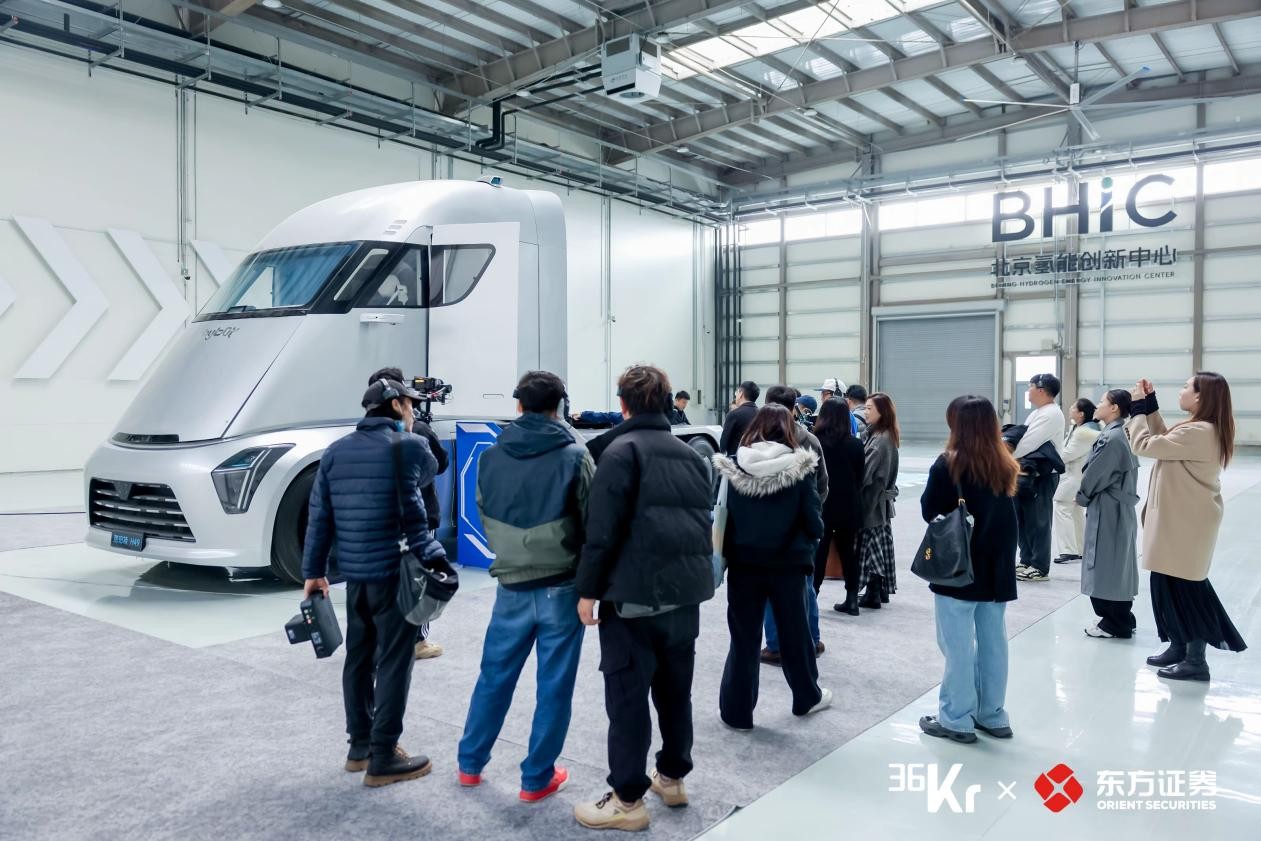
Feedback from enterprises further confirms this judgment. Many enterprises such as Hydrogen Green Mobility and Ke'an Chuangneng have expressed their willingness to establish a regular communication mechanism with upstream and downstream enterprises in the industry chain. The financing director of Hydrogen Green Mobility said, "We should work together to form a complete set of solutions, achieve cost reduction across the industry, and jointly expand the industry."
The 'dual carbon' goal here is more like a test of slow variables. It requires structure to precede scale and verification to precede expansion.
3. Future Technology: The Technological Foundation for the "Dual Carbon" Goal
The third stop of the "Carbon Exploration Plan" is in the Shanghai artificial intelligence industry, which in itself means a deeper - level discussion. Especially in highly complex and variable - dense industrial and urban systems, the continuous and stable operation of the technological foundation becomes crucial. At this time, technology is being re - examined.
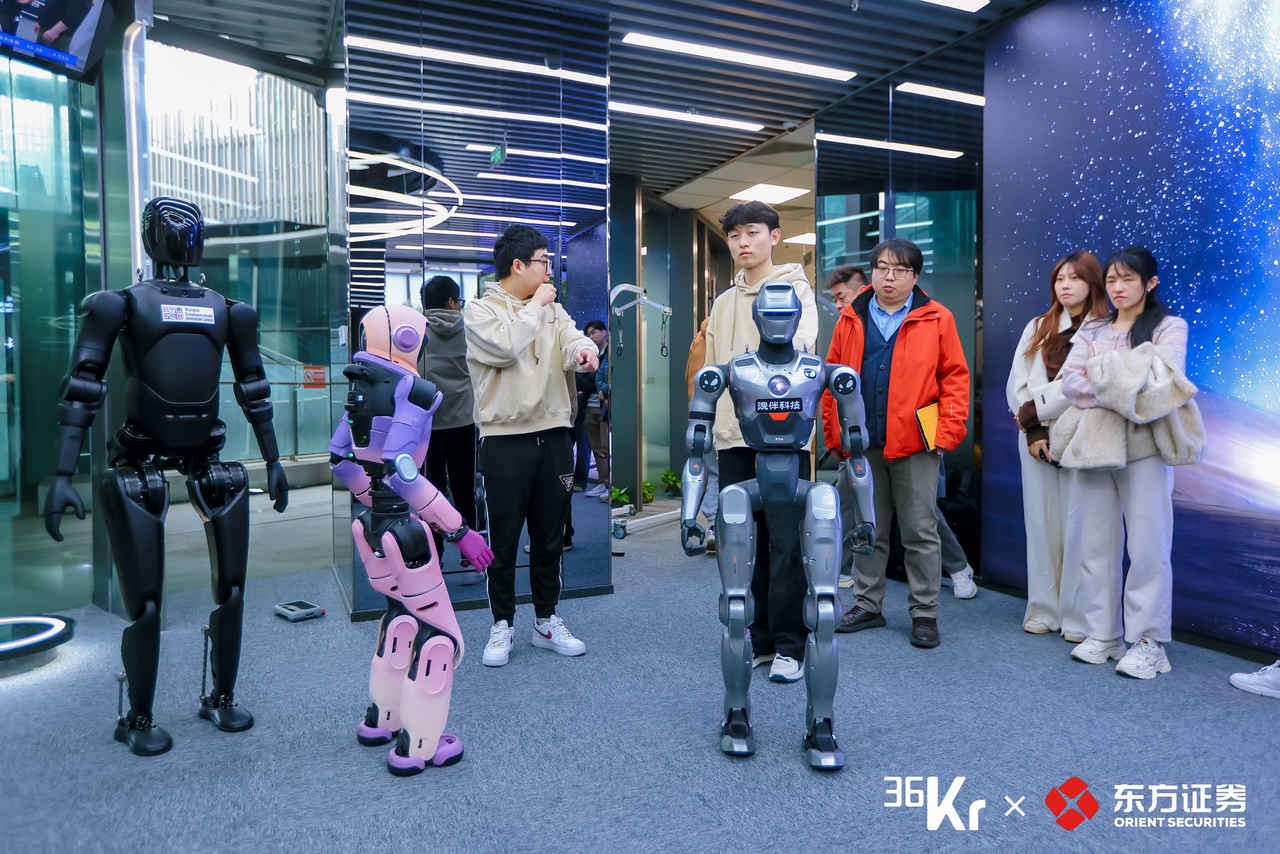
"If in the first two stops, we focused on 'seeing' industrial practices and 'connecting' various resources, then today, we hope to 'precipitate' practical insights and 'upgrade' development awareness with you all. We need to summarize the industrial experience from transportation to energy and then to technology, and explore the integration path of 'AI + green': how technology can be transformed into the core driving force for green development, and how capital can build a full - cycle service system that is understandable, investable, and helpful in cutting - edge fields," said Chen Gang in his on - site speech.
"The chemical reaction and aggregation effect generated by upstream and downstream enterprises in the 'Modular Speed Space' have greatly shortened the innovation chain," said Zhang Yun, the deputy general manager of Modular Speed Space. For the 'dual carbon' goal, the value of artificial intelligence technology lies more in infrastructure capabilities, which can be used to disassemble complex systems, quantify operating states, and continuously optimize energy consumption and efficiency.
Zhongcheng Transportation Technology is a typical example. The intelligent transportation industry has developed for many years, but the emergence and popularization of emerging AI technologies such as large - scale models have brought many new turning points. On the one hand, industry indicators such as accuracy have been optimized; on the other hand, there is the possibility of large - scale application. Shan Weile, the CEO of Zhongcheng Transportation Technology, also hopes to "further implement and replicate our benchmark projects that have already been implemented across the entire industry" through platforms such as the Carbon Exploration Plan.
However, emerging technologies cannot be quickly implemented in all fields. "In fact, many 'dual carbon' projects have excellent technologies, but their implementation paths are not clear," said Wang Yifei.
In fact, most enterprises in the Shanghai stop have a clear self - awareness. Li Xiang, the vice - president of marketing at Xin Yu Technology, said bluntly, "Whether it is a large - scale model, AI, or any other software or hardware, without an implementation application point, customers will not pay for it."
This judgment is specifically reflected in the roadshow enterprises. Whether in the fields of industrial AI, intelligent detection, or embodied intelligence, many enterprises repeatedly emphasize not the scale of the model but the system stability, interpretability, and long - term operating cost.
When technology shifts from "showcasing capabilities" to "assuming responsibilities", it enters the core of the "dual carbon" narrative: no longer an additional item but a base variable that determines the upper limit of system efficiency. The 'dual carbon' goal here is not measured by emission reduction but by operational ability.
By comparing the three stops, we can see a more realistic path: In a mature manufacturing system, the 'dual carbon' goal must serve efficiency; in a growing energy industry, the 'dual carbon' goal must be supported by the system; and at the complex system level, the 'dual carbon' goal must rely on continuous technological implementation.
03
Which Questions Have Been Answered, and Which Haven't?
Several core questions raised at the start of this session have also been recalibrated in terms of emphasis during the three on - site visits.
Q1: Is Low - carbon Transformation a "Compliance Burden" or an "Efficiency Dividend"?
This was the earliest question raised at the start and the first to be answered. After visiting the transportation, energy, and technology industries, a clear consensus has emerged: The 'dual carbon' goal no longer relies on a single driving force for promotion, nor does it mainly exist in the form of 'compliance pressure'.
Whether in a manufacturing system such as the new energy vehicle industry that has entered large - scale operation or in the hydrogen energy industry that is still in the construction stage, what drives low - carbon transformation forward is no longer a single - point policy stimulus or an isolated breakthrough in a certain technology but a set of ecological - level combined conditions: system efficiency, organizational ability, industrial collaboration, and long - term operating mechanisms.
This means that an old judgment is being constantly corrected by reality. In the mid - term, simply regarding the "dual carbon" goal as an "