The essence of a dark factory is the unmanned economy.
At some point in 2024, I painstakingly wrote some articles about the future of artificial intelligence, rhapsodizing about the rise of AI-native companies. Now—about a year later—I'm delving deep to see if my predictions came true or if they were just wishful thinking on my part. So, I spent a few weeks researching companies that can operate without human intervention, and then I realized that my job might also be on the line.
This irony is as bitter as a cold cup of coffee, with a tinge of panic mixed in.
The problem is that hardly anyone wants to admit that we've entered a post-human economic era. People like me love to debate when AI will steal our jobs, and there are countless analytical articles to prove it. Meanwhile, thousands of companies have downsized their staff or even completely ditched human employees.
The issue is that most people either have no idea this is possible or are too shocked to say it out loud.
Dark factories and AI-native companies are already running at full speed at night without anyone overseeing their mechanical operations. These zero-employee companies are raking in huge profits, while their "founders" are sipping margaritas in Dubai.
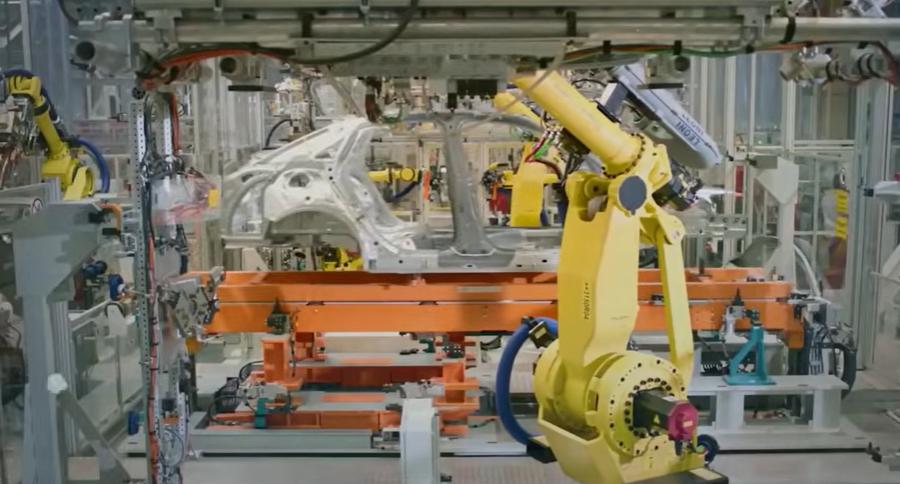
So, like a good writing robot, I started reporting on this story, venturing into the unknown. I originally thought I'd find some extreme cases in Shenzhen and a few in Silicon Valley. But unexpectedly, I discovered a whole economic ecosystem. In this system, our traditional human-centered business models look like quaint handicraft workshops.
My smart aleck friends, this is no exaggeration. For me, this was a truly eye-opening moment.
The Great "Automation" Hoax
Every manager I've met sees automation as an either-or thing—either automate or don't. It's like saying you're either pregnant or not. To be honest, that's true—until you meet someone who's three months pregnant and can still fit into their jeans.
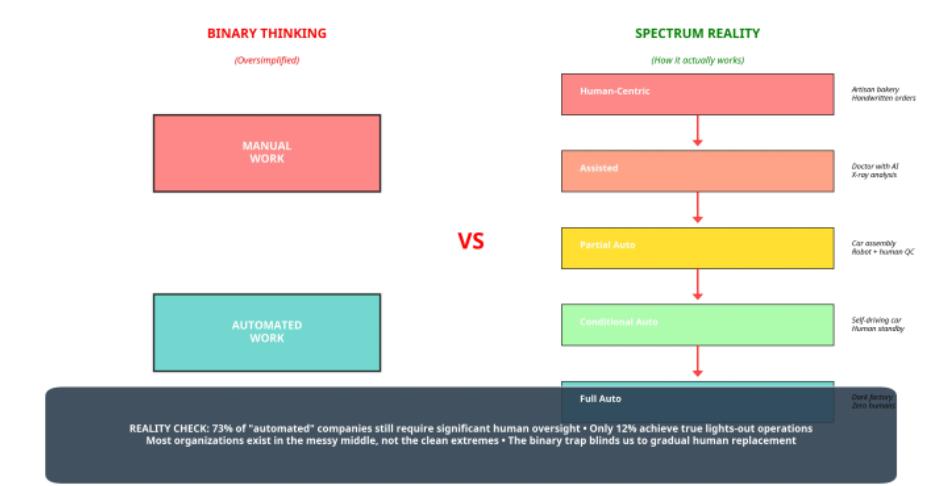
The reality is much more complex and nuanced, but far scarier than those black-and-white thinkers are willing to admit. I've found that some companies use AI to assist human employees, others use humans to manage AI systems, but more and more companies are completely eliminating human involvement.
To be honest, I didn't expect things to progress this quickly.
I think everyone in the IT industry has heard of one or two "unmanned" companies. By "unmanned," I mean there are no people in sales, marketing, operations, finance, customer support, etc.—and of course, no HR department.
Recently, I stumbled upon a project called Marcus, which is a fully AI-based in-house marketing agency. This platform was created by a well-known marketing agency called Prospex and is essentially an AI-driven marketing agency. They position it as a unified platform that can replace fragmented marketing tools, allowing teams to avoid switching between different platforms. They claim it's faster, cheaper than traditional marketing agencies, and can reduce costs by up to half.
Before I started this journey, I only knew of this one example. But when I started digging deeper and barely scratched the surface, I found dozens of similar companies silently proving that "fully automated companies" are no longer just science fiction. They're already charging customers and delivering work results without any human involvement.
After analyzing hundreds of agencies and reading enough academic papers to earn a "Holy crap, we're all doomed" doctorate, I started developing a simple classification system to really understand this chaos. It's a two-dimensional framework that classifies companies based on their level of automation and the degree to which AI is integrated into their business models. You can think of it as the periodic table of the post-human economy, except here, I'm recording the different ways humans are being phased out.
Classification Framework
I was drowning in spreadsheets, trying to figure out why some companies cherish their employees while others treat them like expensive ornaments. When you're faced with companies that earn millions in annual revenue without any employees, traditional business analysis methods just don't cut it.
You first need to build an alternative classification model:
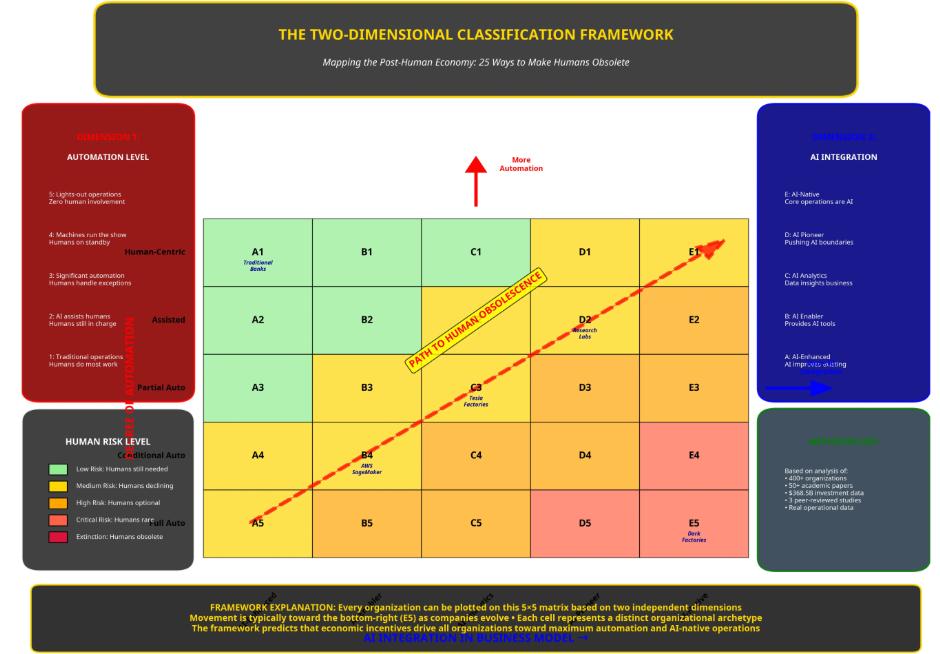
So, like any sane person would do in the face of chaos, I created a framework to turn this mess into a neat doomsday grid. What I ended up with is a 5x5 matrix that plots each organization based on two simple questions: 1. "How automated are you?" and 2. "To what extent does your business model rely on AI?" This model is based on data from over 400 organizations, 50 research papers, and $368.5 billion in investments. It results in 25 cells, representing 25 different ways to make humans irrelevant.
The vertical axis measures the level of automation, from "completely done by humans" to "completely automated." At each step on this ladder, it represents a step towards making the workforce obsolete. Level 1 companies still believe that most tasks need to be done by humans, while Level 5 companies have achieved the ultimate goal of capitalism—producing without hiring employees.
The horizontal axis tracks the degree of AI integration , from "we use AI to improve existing products" to "our entire business is AI." This is what we learned from that unforgiving MIT paper about all the different ways to talk about AI. It's like the difference between installing a smart doorbell at home and living inside a computer. Companies in Column A are just dipping their toes in the AI waters, while those in Column E have built their entire business models around AI, and humans are just a legacy system.
Now, every company you come across can be positioned somewhere on this grid, and they all want to move towards the bottom right corner.
That's the E5 cell, the promised land of fully automated AI-native operations. That's where the dark factories are, where zero-employee companies thrive, and where human workers are headed towards decline and extinction.
The "beauty" of this framework is that it can predict behavior.
Companies don't just jump randomly around the flowchart; they follow predictable paths to maximize efficiency. A traditional bank (A1) might first introduce an AI chatbot (A2), then automate the loan process (B3), then eliminate human reviewers (C4), and finally run an algorithm-driven banking business (E5) to make loan decisions faster.
The color coding also reveals the backstory. Green cells represent areas where humans still have job security; yellow cells represent a dire situation that no one wants to face; orange cells mean humans have become "strategic advisors"; and red cells mean the only purpose of humans is to start the system and make sure everything runs smoothly.
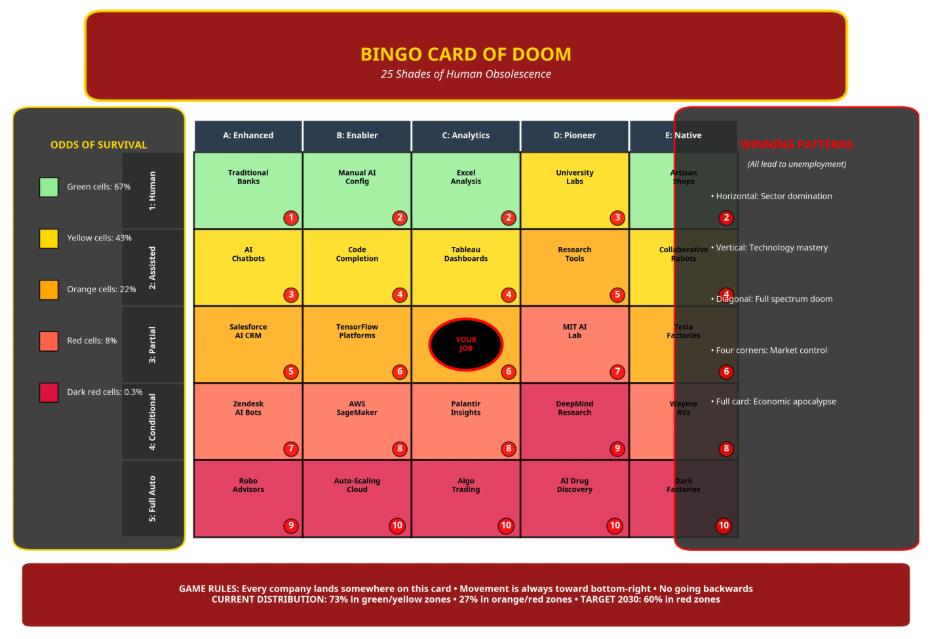
The deepest red cell—E5—is where our future lies.
It's filled with organizations that have achieved the ultimate goal that capitalists dream of: infinite expansion without any human limitations. No sick leave, no vacation requests, no sexual harassment training, no union negotiations, no complaints. Just pure, beautiful, mechanical efficiency, churning out profits. As for humans, they'll have to figure things out on their own.
What's particularly twisted about this framework is that it's not theoretical.
These classifications weren't "invented" by me; I discovered them by analyzing real companies that are already operating in each category.
This framework can't predict the future, but it depicts the current situation. Once you spot the patterns, you can't ignore them. Every announcement a company makes about "digital transformation" or "operational efficiency" is actually just a press release about moving southeast on this framework. Every AI implementation is a step towards marginalizing humans. Every automation project is another rung on the ladder to fully unmanned operations.
I built this framework to understand the chaos, but now I realize that the chaos itself is the goal.
While I was still writing articles about the ethics of AI and the future of work, the market has already started slotting itself into a clear human-elimination matrix. This classification system reveals that what's happening has always been... inevitable.
This framework will accurately tell you where you are now, where you're going, and how bad things will be when you get there. The only question left is: Are you the one driving the car or the one getting run over?
The Automation Landscape
The first dimension of this model measures how many operational aspects of a company can run without human intervention. I've found that there are five different levels of human obsolescence, each more depressing than the last:
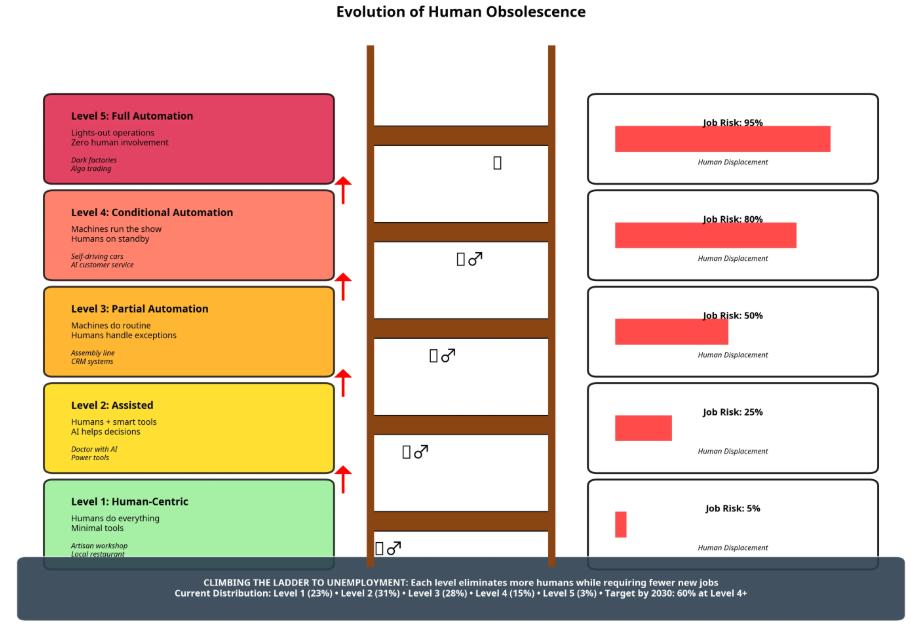
L1. Human-Centered Operations. These traditional businesses rely mainly on humans to do most of the work, like artisanal bakeries, small law firms, and restaurants where the owner still takes orders from customers by hand. They're quaint and full of craftsmanship. Maybe they're doomed, but they are, indeed, full of craftsmanship.
L2: Assisted Operations. Although still human-led, they're equipped with AI assistants. For example, doctors use AI to interpret X-rays, financial analysts use machine learning models, and factory workers use collaborative robots. This is basically where most organizations are at right now.
L3. Partial Automation Now things get complicated. Most of the workflow is automated, but humans are still needed to handle the tricky parts. Think of modern car assembly lines, customer service systems with human escalation mechanisms, and data analysis platforms that can generate insights but need human interpretation. Humans are becoming exception handlers.
Level 4: Conditional Automation. Under normal circumstances, the machines run the show, and humans stand by to deal with unexpected situations. This refers to semi-autonomous customer service systems, managed AI platforms, self-driving vehicles operating within geofenced areas, and of course, Amazon's "meat puppets" used to control programmed robots... These people are basically expensive insurance.
L5 Fully Automated Unmanned operation. No human intervention is required under normal circumstances. The real "dark factories"—algorithm trading systems, zero-employee software companies. Humans are relegated to system design and strategic guidance. If they're lucky.
AI Integration Prototypes
The second dimension classifies how companies use AI to create and capture value. I've identified five different prototypes, each representing a different manifestation of our inevitable obsolescence:
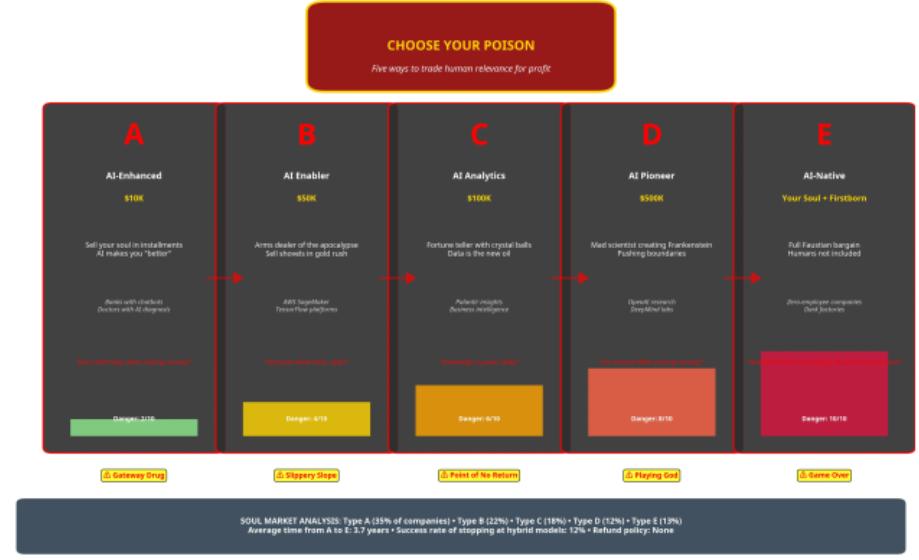
Prototype A: AI-Enhanced. These companies use AI to improve existing products and services. For example, banks use AI chatbots, retailers use machine learning inventory systems, and healthcare institutions use diagnostic assistance systems.
Prototype B: AI Enablers. They're the "arms dealers" of the AI revolution. They provide tools, platforms, and infrastructure that allow other companies to build AI solutions. Cloud machine learning platforms, AI development frameworks, and pre-built AI services all fall into this category. They're making money hand over fist, just like the "shovel sellers" during the gold rush.
Prototype C: AI Analytics Providers. Their entire business is using AI to turn data into insights. This includes business intelligence platforms, market research companies with AI trend analysis capabilities, and specialized analytics providers.
Prototype D: AI Pioneers. Those crazy scientists are constantly pushing the boundaries of AI. Research labs, AI startups focused on fundamental technology R & D, and university research centers. They'll either save humanity or destroy us. Maybe both.
Prototype E: AI-Native Operations. These companies build their core operations around AI and automation, minimizing human intervention. They include zero-employee companies, fully automated "dark factories," and algorithm trading companies. This is the model that emerges when humans completely exit the operational process.
Dark Factories
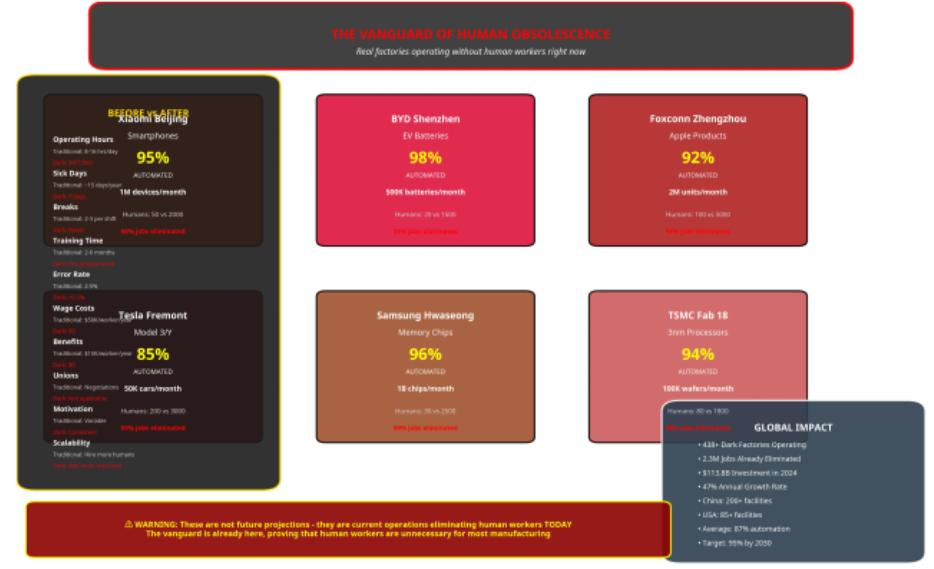
In Shenzhen, there's a factory called "Build Your Dreams"† that produces electric vehicle batteries with 98% automation. Fewer than 20 workers manage this production line, compared to 2,000 workers a decade ago.
The factory runs 24/7 without breaks, no time for bathroom breaks, and no one complaining about the cafeteria food. No sick leave, no time off, no HR headaches, just efficient production.
Xiaomi's smartphone manufacturing factory in Beijing can produce over 1 million devices per month with just 50 employees.
These robots don't need motivational posters or team-building activities. The phones they make have the mechanical precision of a Swiss watch and the humanity of a parking meter.
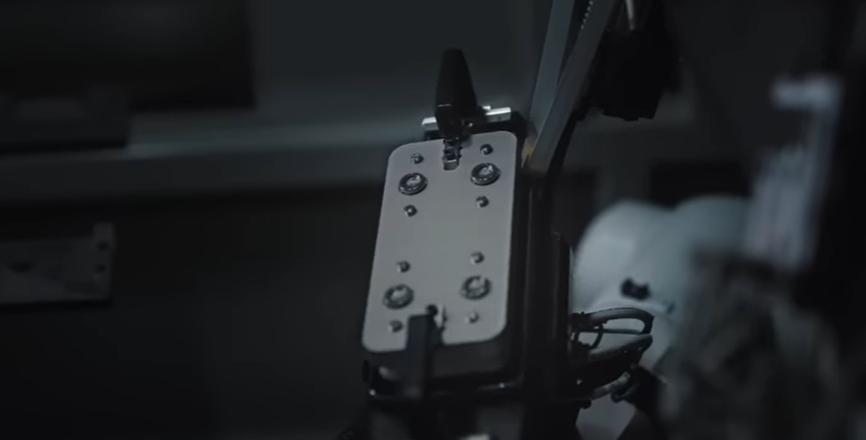
Foxconn's "unmanned" production lines for Apple products are the pinnacle of this trend. The production areas in these factories don't actually need lighting because no human intervention is required. It's both "dark manufacturing" in the literal sense and in a metaphorical sense.
