In the trillion-yuan humanoid robot market, which segment is most likely to explode?
In 2025, humanoid robots remained popular throughout the year and attracted significant attention in the capital market. The annual increase of the Wind industry index exceeded 60%.
Recently, the sector exploded again catalyzed by events such as the start of listing guidance for Deep Robotics and the acquisition by Ubtech. With Tesla's Optimus 03 set to debut in the first quarter, and companies like Ubtech and Unitree Robotics entering the era of 10,000 - unit production capacity one after another, all signs point to the industry approaching a leap towards large - scale mass production.
01 The Mass - production Inflection Point Is Approaching
2025 was hailed as the first year of commercialization for humanoid robots. From the Spring Festival Gala stage to competitive events, and then to cultural and entertainment performances, industrial manufacturing, logistics sorting, security inspections, etc., the industry has accelerated its implementation.
Entering 2026, with the rapid iteration of products and the gradual verification of commercialization, mass production has become the keyword in the industry.
Last year, Elon Musk said that 80% of the company's future market value would come from robots. In 2026, a dedicated production line with an annual output of one million units will be built, and the plan is to deliver 50,000 - 100,000 units to the outside world in 2026. Figure plans to achieve a production capacity of 12,000 units in 2026 and aims to have an annual production capacity of 100,000 units within four years.
Domestically, in 2026, the production capacities of Unitree Robotics, Zhipu Robotics, and Ubtech will also exceed 10,000 units.
In addition, the increasing terminal demand is also a major confirmation that the industry is about to enter the mass - production stage. In 2025, the sales of leading players soared from tens of millions to billions. Among them, Ubtech's total annual order amount approached 1.4 billion, Unitree Robotics' total was nearly 1.2 billion, and Yuejiang, Zhipu, and Deep Robotics all reached the 1 - billion level.
This benefits from the cost reduction. All along, cost has always been an important factor restricting the mass production of humanoid robots. The single - unit cost of Tesla's Optimus 03 is expected to drop below $20,000, a decrease of more than 60% compared to the first - generation prototype.
In the global competition of the humanoid robot industry, China has established a cost barrier over overseas counterparts with policy dividends and supply - chain advantages.
According to Morgan Stanley's research, in 2025, the BOM cost of manufacturing a humanoid robot using the Chinese supply chain was about $46,000, while the cost of non - Chinese supply chains was as high as nearly $130,000.
Currently, the humanoid robot market is in a period of rapid growth and industry explosion. According to GGII data, the market size of Chinese humanoid robots will reach nearly 38 billion yuan by 2030, with a compound annual growth rate of over 61% from 2024 to 2030. The sales volume will also increase from about 4,000 units to 271,200 units.
According to Morgan Stanley's prediction, as physical AI moves from concept to large - scale application, it will give rise to a trillion - level industrial wave of humanoid robots. It is estimated that the market size will reach $5 trillion by 2050, and the global deployment volume is expected to reach 1 billion units.
So, which segment will benefit more from the explosion of mass production?
02 Why the Lead Screw?
Humanoid robots mainly consist of three parts: the perception layer, the decision - making layer, and the execution layer. The perception layer includes sensors such as cameras and millimeter - wave radars; the decision - making layer is the robot's brain, mainly composed of AI chips and large models.
The execution layer accounts for the largest part of the cost of humanoid robots, that is, the entire - machine hardware part, including lead screws, motors, reducers, sensors, bearings, etc. Among them, the lead screw is the core component that converts the rotational motion of the shaft - end motor into linear motion and is mainly used in key parts such as the knee joint, hip joint, and arm.
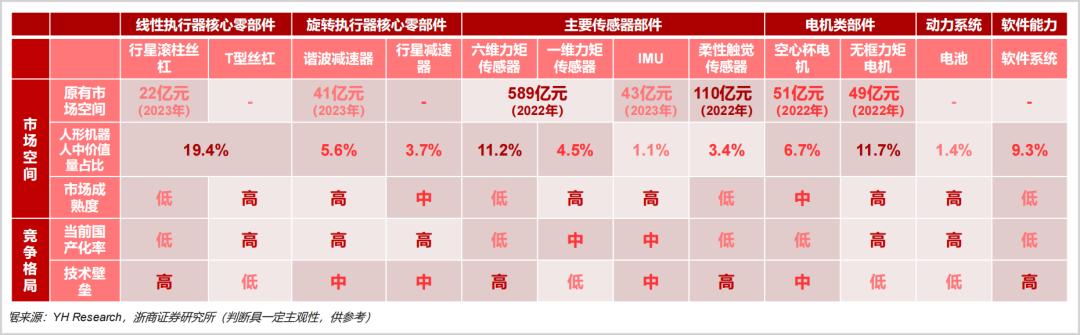
Zheshang Securities once conducted a calculation. The value - added of linear actuators, including planetary ball screws and T - type screws, accounts for 19.4%, making it the segment with the largest value in the entire machine. At the same time, the manufacturing barrier is also relatively high, which is one of the pain points in promoting the industry's mass production.
In the lead - screw segment, it is mainly divided into three categories: sliding lead screws, rolling lead screws, and hydrostatic lead screws. Rolling lead screws are more suitable for the field of humanoid robots, including ball screws and planetary roller screws. Compared with ball screws, planetary roller screws have obvious advantages in terms of accuracy, load - bearing capacity, service life, and adjustment ability.
The main difference between planetary roller screws and ball screws is that the load - transfer unit is a threaded roller rather than a ball, which can contact a longer line and surface. Under the same specifications, the rated load - bearing capacity of planetary roller screws is 3 - 6 times that of ball screws, the service life can reach 10 - 15 times, and the volume can be reduced by about 1/3, and it is also lighter. As the technology matures, it will become the mainstream solution for humanoid robots in the future, while ball screws are more widely used in the industrial field.
Currently, planetary roller screws are expensive, and cost reduction is an important direction for the future. According to Huaxin Securities' research, the unit price of planetary roller screws used in Tesla's Optimus is about 2,000 yuan each, while the price of ball screws ranges from 200 - 600 yuan.
Guojin Securities pointed out that the degrees of freedom of the dexterous hand of Tesla's third - generation Optimus will increase from 11 in the previous generation to 22, which means that a single machine may need 44 lead screws. At the same time, many companies, including Unitree Robotics and Zhipu Robotics, have also released dexterous - hand products with about 20 degrees of freedom. The upgrade of dexterous hands will inevitably drive the market space of the lead - screw industry.
According to Huaxin Securities' research, by 2030, the value - added of planetary roller screws used in humanoid robots will reach 22.96 billion yuan, with a CAGR of 154.1%.
In terms of the industry competition pattern, due to the high barriers of planetary roller screws, which mainly involve multiple aspects such as materials and heat treatment, precision machining, assembly, and inspection, the market is currently mainly dominated by overseas manufacturers. According to Huaxi Securities' research, in 2022, the market share of the top four overseas suppliers was about 78%, while the market shares of domestic manufacturers Nanjing Machine Tool Works and Jining Boter were only about 8% respectively, indicating a large space for domestic substitution.
With the upgrade of dexterous hands and the expansion of industrial volume, domestic relevant manufacturers will significantly benefit.
03 Who Will Win in the Industry's Explosion Period?
Among domestic manufacturers deploying lead screws, the main ones are Wuzhou Spring, Hengli Hydraulic, and Beite Technology.
Among them, Wuzhou Spring mainly engages in the production of automotive precision parts such as bearings and air - conditioning pipeline parts. In recent years, it has focused on deploying planetary roller screws and micro - lead screws as new growth curves.
Wuzhou Spring started deploying the lead - screw business early. As early as 2021, it began to research and develop the lead - screw nut assembly for the automotive steering system. Currently, it has successfully entered the supply chains of giants such as Tesla and Bosch and has won a fixed - point order from Chenzhi Technology under Changan Automobile. Its annual revenue from the lead - screw business was 6.13 million yuan in 2024 and 2.7 million yuan in the first half of 2025, accounting for less than 1% of the overall sales.
Hengli Hydraulic, as the absolute leader in domestic hydraulic cylinders, raised 1.4 billion yuan through a private placement in 2021 for the linear - actuator project to enter the lead - screw field. Beite Technology focuses on automotive chassis parts and has started to focus on the planetary roller screw business in recent years.
All three companies have made breakthroughs in lead - screw technology, with their own focuses. For example, Wuzhou Spring focuses on miniaturization and extreme precision. The reverse - type planetary roller screw it developed has an accuracy of level C5, approaching the international leading level. The cost is only 1/3 of that of Japan's THK, and it has broken through the technical bottleneck of 1.8 - millimeter micro - ball screws.
Beite Technology has inherent advantages in thread processing and precision control relying on its chassis - part technology. The micro - lead screws for dexterous hands developed in cooperation with Ubtech and Zhipu Robotics also have an accuracy of level C5. Hengli Hydraulic's products are mainly in the form of electric cylinders integrating "motor + lead screw + cylinder block" rather than single components.
On the eve of the explosion of humanoid robots, the production - capacity progress is the key to determining the degree of corporate benefit. Among the three, Hengli Hydraulic has the fastest progress. The production lines for 104,000 standard ball - screw electric cylinders and 4,500 heavy - duty ball - screw electric cylinders raised through the private placement in 2021 were put into production in 2024. The project of its subsidiary, Hengli Precision, with an annual output of 660,000 meters of standard ball screws and 422,000 meters of precision ball screws is expected to be put into production in November 2025, and it has currently entered Tesla's supply - chain system.
According to Guolian Securities' research, the annual industrial output value of Hengli Hydraulic's lead - screw product line will exceed 3 billion yuan.
In contrast, the production - capacity release of Wuzhou Spring and Beite Technology is relatively late. Among them, Wuzhou Spring's 1 - billion - yuan private placement project for lead screws approved in December 2025 includes the construction of 980,000 sets of planetary roller screws and 2.1 million sets of micro - ball screws, with a construction period of three years. Coupled with the previously raised investment production capacity, it can support the lead - screw production capacity of about 80,000 humanoid robots and 1.35 million intelligent vehicles, corresponding to an annual output value of more than 2 billion yuan.
Beite Technology invested 1.85 billion yuan in 2024 to build a research and production base in Kunshan. After its completion at the end of 2025, mass production is expected to be achieved in 2026, with an annual production capacity of 2.6 million sets of planetary roller screws. Combined with the progress of the 800,000 - set planetary roller screw project in Thailand, the total production capacity will reach 3.4 million sets upon completion.
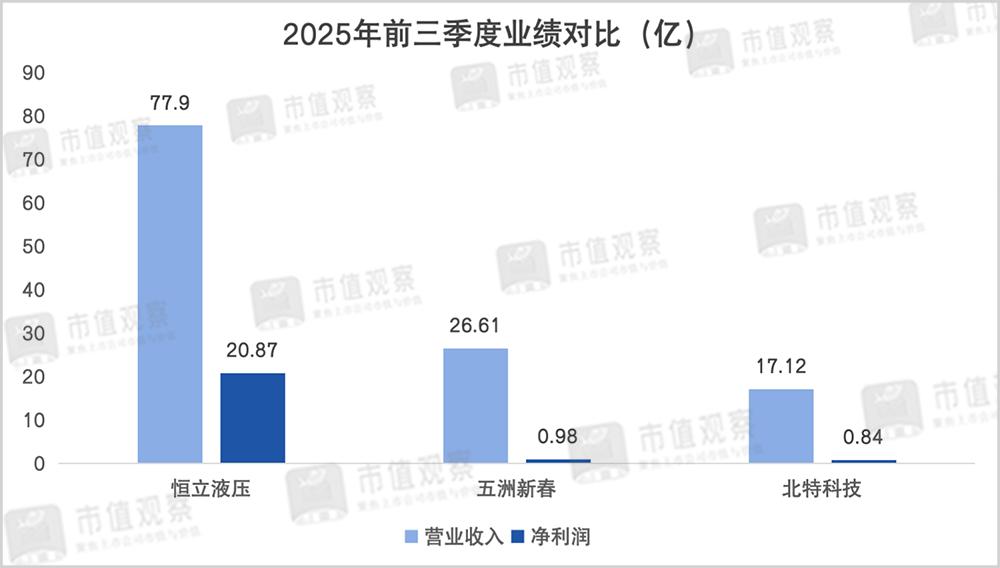
In terms of financial and growth comparison, Hengli Hydraulic has the largest scale and is a typical blue - chip stock. Although the operating revenues of the three companies in the first three quarters of 2025 were all in the billions, their net profit margins varied greatly. The net profit margins of Hengli Hydraulic, Wuzhou Spring, and Beite Technology were 26.85%, 4.1%, and 5.67% respectively, showing obvious differences in profitability.
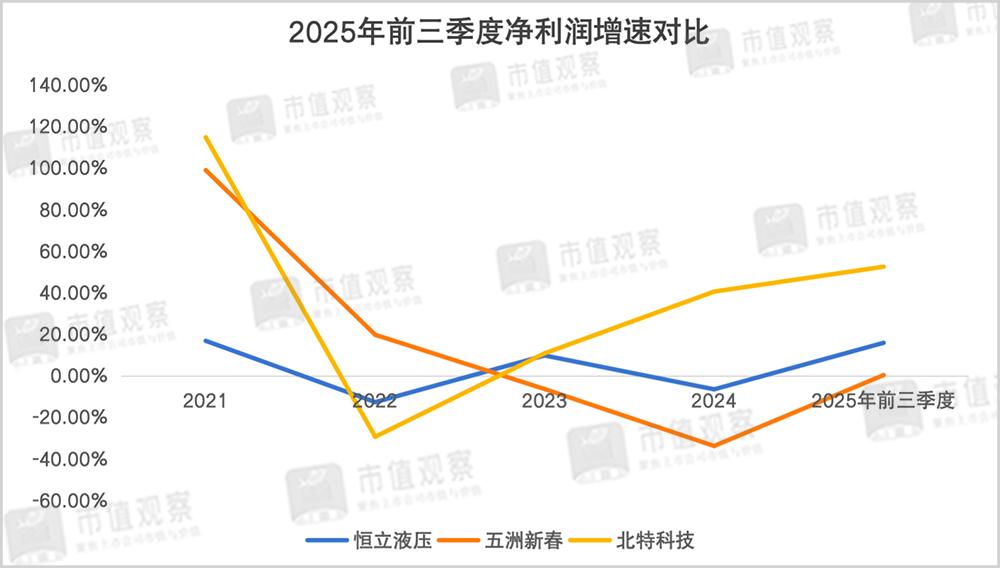
In recent years, Hengli Hydraulic's profit growth has been relatively stable. Benefiting from the recovery of the construction - machinery industry, its performance has been steadily increasing since 2022. The growth rates of Wuzhou Spring and Beite Technology have fluctuated greatly, and Beite Technology has a faster growth rate. Wuzhou Spring has been in negative growth since 2023, with almost flat growth in the first three quarters of 2025, indicating relatively weak growth momentum.
Overall, in terms of production - capacity progress, Hengli Hydraulic ranks first among the three. Both of its production lines have reached the production target, giving it a first - mover advantage in production capacity. Wuzhou Spring currently has relatively small business revenue, and the large - scale production of its investment projects is not expected until after 2027, while Beite Technology will release its production capacity in 2026.
Therefore, as the industry enters the explosive period in 2026, Hengli Hydraulic will be the first to benefit. At the same time, Beite Technology will have more flexibility in performance due to its focus on planetary roller screws and larger production - capacity scale.

This article is from the WeChat public account "Market Value Observation", author: Market Value Observation. 36Kr is published with authorization.