12 New Trends in the Entertainment Industry in 2026
In the cultural and entertainment industry in 2025, the gap between the peak and the trough may be more dramatic than any script.
At the beginning of the year, "Ne Zha: Rebirth of the Demon Child" (hereinafter referred to as "Ne Zha 2") pushed the Chinese film market to an almost incredible height with a box office of over 15 billion yuan. However, by the end of the year, people realized that the spotlight of this year actually only illuminated a very small number of works.
Judging from the data, this differentiation is more intuitive. The two films, "Ne Zha 2" and "Zootopia 2", jointly won nearly 20 billion yuan in box office, accounting for nearly 40% of the total annual box office. Among the remaining films, more and more works not only find it difficult to break through the 1 - billion - yuan mark, but even reaching the "100 - million - yuan" mark has become extremely difficult. Outside of popular movie seasons, it has almost become an impossible task to get audiences to enter cinemas for non - top - tier content.
A similar "polar contrast" is also playing out in the short drama market.
On one hand, there are constantly breaking revenue - sharing records: "Summer Fendra" earned a staggering 16 million yuan in revenue sharing in just one and a half months. Many third - and fourth - tier actors who have switched from long dramas to short dramas have said bluntly that "the money they earned in the past year is the sum of their previous careers." On the other hand, there is a cruel elimination competition: countless newcomers with gold - mining dreams have lost all their capital. A short drama director helplessly admitted that more and more of his colleagues around him can't get any work.
Looking overseas, the "subversive drama" in the cultural and entertainment industry is also reaching new heights.
In Europe and the United States, the number of traditional pay - TV users has been continuously declining, and the one occupying the living rooms of families is an unexpected competitor - YouTube. The endgame of the streaming war seems to be emerging, and the giant Netflix is trying to "usurp" the throne of Hollywood by acquiring Warner Bros. The most symbolic scene occurred at the end of the year: Disney, which had been in court battles with AI companies for years, unexpectedly shook hands and made peace with OpenAI. This "marriage" shocked the entire industry.
"Standing at the beginning of 2025, no one could have imagined what the situation would be like at the end of the year." The sigh of a practitioner from a leading short drama brand reflects the confusion of the entire industry. She said bluntly that the new entrants in the industry now are mostly unfamiliar faces to her.
The implementation of AI technology has further exacerbated this uncertainty.
Chen Hongwei, who has more than 20 years of experience in traditional film production and now teaches AI creation at Beijing Normal University, revealed that many college teachers and students majoring in film and television have expressed their anxiety to him, asking, "Where will audio - visual language go?" and "Will what we've learned still be useful in the future?" In his view, AI is not just a "patch" for the traditional film and television industry, but an upcoming and thorough reconstruction and rewrite.
Therefore, the polar contrast in 2025 may only be the prelude before the arrival of industrial transformation. Predicting 2026 may be a risky venture, but we talked to practitioners in various sectors of the general cultural and entertainment industry, trying to outline the future outline of this industry with 12 predictions and dissect the trends and possibilities hidden behind the uncertainty.
1
Short Drama Category
1. It's only a matter of time before Hongguo's users exceed those of iQiyi, Tencent Video, and Youku
In 2025, Hongguo, the short drama platform under ByteDance, caught iQiyi, Tencent Video, and Youku off guard with its "free model".
According to QuestMobile data, in the third quarter of 2025, Hongguo's monthly active users (MAU) reached 236 million, surpassing Youku and Bilibili at one stroke and ranking among the top four in the online video industry. Hongguo became an independent app from a Douyin mini - program in August 2023. That is to say, it only took two years for it to reach the user scale that most long video platforms had accumulated over more than a decade.
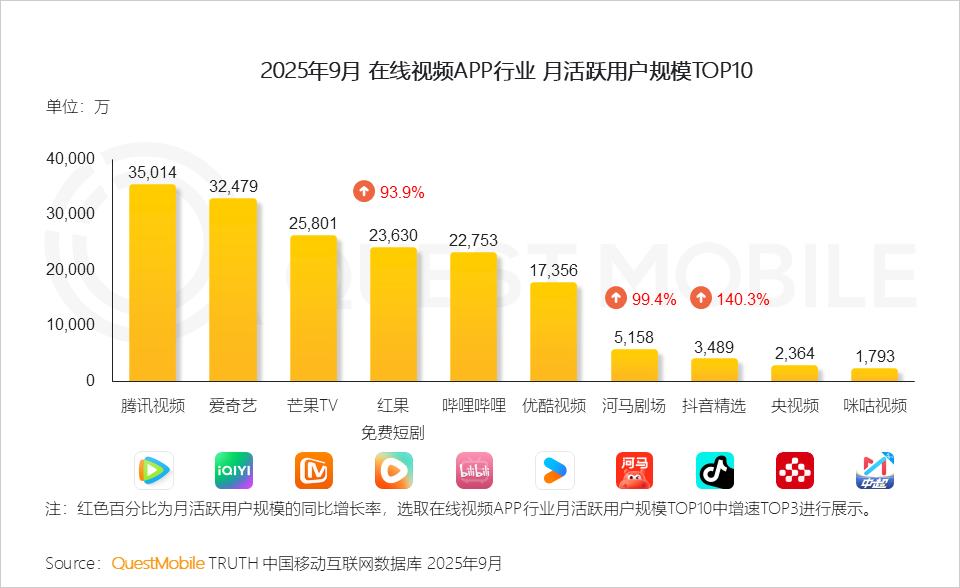
This growth occurred against the backdrop of the overall slowdown of long video platforms.
From 2024 to 2025, the monthly active user growth rates of leading platforms such as Tencent Video and iQiyi were sluggish, and there was negative growth in some quarters. The user scale has entered the stage of stock competition. However, Hongguo's growth curve is completely different. During its high - speed expansion period, its year - on - year growth rate of monthly active users once reached 1045.86%. Even after the user base expanded rapidly in 2025 and the growth rate declined, it was still significantly higher than that of traditional long video platforms.
Judging from the current two growth curves, it's only a matter of time before Hongguo surpasses Tencent Video and iQiyi in terms of user scale.
Yan Min, the person in charge of an insider's short drama community, told "Focus One" that Hongguo's internal target for monthly active users is much higher than the current data, and Hongguo's ambition is not limited to becoming the "iQiyi of short dramas". Instead, it aims to establish a reverse output mechanism around the "Tomato Series" short drama IPs, transporting mature IPs to higher - value forms such as movies and long dramas, and upgrading from a traffic entrance to a content source.
The "ebb and flow" between Hongguo and iQiyi, Tencent Video, and Youku is essentially a battle for traffic between short dramas and long dramas.
Looking forward to 2026, short drama platforms will most likely continue to erode the daily consumption scenarios of long videos in terms of usage time and frequency of opening. However, in terms of high - quality content with high willingness to pay and high production thresholds, long video platforms still have a moat that is difficult to replicate in the short term.
Therefore, the relationship between the two is not simply one of substitution, but rather a structural shift in the industry's traffic entrance and value focus: short dramas are becoming the new traffic gateway, while long videos need to adhere to and deepen their content quality and brand value.
2. A small number of high - quality short dramas coexist with a large amount of traffic - driven content
While expanding at a high speed, the short drama market is also accelerating the elimination process. Changes in the short drama market almost occur on a monthly basis. However, in conversations with multiple practitioners, a consensus is emerging: high - quality production is the general direction.
Yan Min introduced to "Focus One" that currently, the highest production cost of short drama projects has approached 3 million yuan. However, under the existing business model, it will still be difficult to significantly break through this upper limit in 2026, unless brand sponsorship can be introduced or there are more stable IP monetization paths.
Practitioners from leading short drama brands shared their coping strategies: while maintaining a stable production volume, the core focus is to explore differentiated advantages. The key methodology they have explored is "pre - layout based on trends", predicting market hotspots and user preferences 1 - 3 months in advance and developing works accordingly. Once they find a deviation in direction, they will resolutely abandon the project to avoid ineffective investment.
However, not all practitioners agree with "full - scale high - quality production".
Some production companies believe that for teams whose capabilities are not yet mature, blindly raising production standards will actually amplify risks. A short drama screenwriter told "Focus One" that as long as the target audience is clearly defined and the investment scale is controlled, the return model will be clearer. Even non - high - quality projects still have stable profit margins.
Overall, the short drama industry is not experiencing an overall "consumption upgrade", but rather a structural differentiation: at the top of the pyramid, a small number of high - cost, high - quality dramas shoulder the mission of incubating long - term IPs and expanding value; at the bottom of the pyramid, a large amount of content continues to serve the functions of traffic filling and trial and error.
In the process of this differentiation and evolution, those teams that only want to make quick money and lack professional capabilities will be accelerated out of the market. The short drama industry is bidding farewell to its initial wild growth and entering a professional competition stage that pays more attention to strategy and long - term value.
3. AI live - action short dramas will be the next big hit
If the "manga dramas" with a mainly anime style were the hot trend in 2025, then according to the general prediction of the industry, in 2026, "AI live - action short dramas" with greater potential to break through the niche will take over as the new growth point.
The core driving force behind this trend lies in the convergence of technological maturity and market demand.
Yan Min pointed out that manga dramas will still develop in 2026, but their distinct anime style objectively limits the scope of the audience. In contrast, the "live - action" images and styles generated by AI can more naturally reach a wider range of users, thus achieving real breakthroughs. He observed that almost all short drama companies have made arrangements in this field, waiting for the opportunity to explode.
The rapid progress of technology is quickly removing the obstacles to AI content. Wu Jiexi, the founder of the AI film and television production company Haoye Technology, told "Focus One" that the sense of incongruity in currently AI - generated videos is disappearing rapidly. The top level in the industry can now make it "almost indistinguishable from non - AI content" to the audience. She further pointed out that from 2024 to 2025, AI's exploration in long narratives was mainly concentrated in the animation field, and starting from 2026, the application of AI technology in live - action short dramas will see a significant increase.
Based on this, a clear path for the implementation of technology is emerging: AI will first be widely applied and verified in short, fast - paced short dramas, then gradually penetrate into medium - length content, and ultimately challenge longer narrative forms. This indicates that AI live - action short dramas are not only the next content hotspot but also the key prelude to promoting the productivity transformation of the entire video industry.
2
AI + Cultural and Entertainment Category
4. AI may give rise to "algorithmic movies"
As the pearl of the cultural and entertainment industry, movies have long represented the highest form of video production. Therefore, when AI can master long - form narrative and achieve large - scale application naturally becomes the focus of the industry's attention.
Currently, there have been long - form movies led or deeply involved by AI at home and abroad, but their influence is still limited to a small scale. In Wu Jiexi's view, the core reason for their failure to break through the niche lies in quality - the current AI long - form movies have not yet reached the industry - recognized standards in terms of narrative, aesthetics, and industrial details.
She pointed out that the core bottleneck faced by AI long - form movies is no longer technology, but whether they can meet the "industrial standards of movies". This requires that the details of the pictures can withstand scrutiny, and the story, rhythm, and aesthetics all need to reach an extremely high level. For professional film and television creators, using AI tools to make movies may even be a "painful" experience because the existing tools and processes are still difficult to fully match their strict artistic pursuits and control requirements.
This extreme insistence on quality directly affects the output rhythm of AI content. Wu Jiexi observed that although many people in the industry have been testing the waters of AI creation, they generally adopt a cautious attitude: if the quality of the work does not meet the standard, they would rather keep it on hold than easily release it to the market. In other words, although AI technology can "make movies" at the present stage, it has not reached the maturity level that "filmmakers are willing to release".
If AI long - form movies want to truly reach the general public, in addition to having high - quality content themselves, they also need external impetus. Wu Jiexi believes that a platform willing to invest resources in promoting and marketing is crucial. Just as the Spring Festival Gala in 2025 helped Unitree Robotics gain popularity, AI movies also need a similar landmark event to detonate attention.
Looking further into the future, producer Chen Hongwei proposed the concept of "algorithmic movies". He believes that the form of movies has evolved from film to digital, and in the AI era, it will enter a new stage of "algorithmic movies". By then, editing may go beyond the traditional definition and become the core creative link integrating vision, narrative, and algorithmic generation.
5. A small number of super tools will emerge in the field of text - to - video
From a technical perspective, Wu Jiexi summarized the development of AI videos into three highly certain trends: the stability of characters has been significantly enhanced, the duration of generatable videos has been continuously extended, and audio - video synchronization is becoming a basic ability.

Image source / Screenshot of the Ke Ling AI video account
In her view, the AI video field has entered a critical period of screening and consolidation from the initial stage of chaos. In the past two years, the cultural and entertainment industry has witnessed an intensive "battle of multiple models" - video models, music models, and script models have emerged one after another. Entering 2026, as product stability and actual word - of - mouth become the core evaluation criteria, users will accelerate their concentration on a small number of mature products.
More importantly, AI video is not a single technical point but a complete and long production chain: from the script, storyboard, to video generation, style conversion, resolution improvement, and then to post - processing, any shortcoming in one link will amplify the instability of the overall experience.
Wu Jiexi believes that in the stage when the technology is not yet fully mature, achieving breakthroughs around a single link is often a more realistic choice. However, after the tools in each link gradually reach the "usable" level, the advantages of the full - process system in terms of efficiency and stability will begin to emerge and become the key to competition in the next stage.
6. The relationship between AI companies and IP holders will shift from confrontation to game - playing
With the rapid development of AI technology, legal disputes between AI companies and content copyright holders have never ceased. However, the cooperation between Disney and OpenAI at the end of 2025 indicates that a crucial turning point in the industry may have arrived.
Regarding the future relationship, Wu Jiexi believes that the coexistence of lawsuits and cooperation will become the norm. Whether the two parties end up in court or at the negotiation table depends mainly on whether they can reach an agreement on commercial interests: when the benefits created by cooperation are greater than the differences, an alliance will be formed naturally; if the interests cannot be reconciled, lawsuits are inevitable. In her view, there is no absolute moral high ground in this, and it is essentially a pure commercial calculation and game.
As for whether there will be more stable camp - style cooperation in the future, she pointed out that this also completely depends on the commercial negotiations and interest distribution among all parties, rather than the differences in technological routes or stances. The alliances and realignments in the industry will be mainly driven and reshaped by commercial logic.
7. "Technical ability" will become the dividing line for cultural and entertainment companies
Another issue brought about by AI is whether technology will become the dividing line in the future industry. Will companies with a complete AI toolchain and high - quality data assets build a more solid moat in the future?
Wu Jiexi observed that almost all large and medium - sized cultural and entertainment companies have established AI departments, and AI has entered the strategic core of most companies. She predicts that in the future competition among talents and companies, those who master the technical principles > those who only know how to use tools > those who refuse to transform. "AI will not eliminate content companies, but it will accelerate the elimination of those backward ones that cannot adapt to the new productivity."
Chen Hongwei described the upcoming transformation from the perspective of creation. He predicted that within the next 12 months, the technical threshold for audio - visual creation will be significantly lowered, becoming "as simple as writing a