AI takes over everything, and everyone becomes a Michelin-starred chef. Smart kitchen appliances are extremely competitive at this year's CES.
On January 6th, North American time, the annual "Tech Gala" - the CES exhibition officially kicked off in Las Vegas. The latest technologies and innovative products from various countries/regions and industries around the world gathered here. Lei Technology sent its largest reporting team in history, traveling 11,000 kilometers to the scene to bring you first-hand on-site reports.
The most prominent theme at CES last year was AI. There were a plethora of AI hardware products, especially "AI hardware" like the Rabbit R1 and AI Pin, which attracted a great deal of market attention. However, after a year of the AI trend, manufacturers seem to have finally realized that using AI to transform existing products is more practical and down-to-earth than "AI-native hardware".

(Image source: Captured on-site by Lei Technology)
After a tour at CES 2026, Lei Technology noticed a very interesting phenomenon: AI has entered the kitchen and started to have an impact on people's food. More precisely, AI kitchen appliances have become the most noticeable and shining new stars at this year's CES.
Wandechu: Free Your Hands, Integrate Smart Agents into Kitchen Appliances
Undoubtedly, the general direction of AI kitchen appliances at this year's CES is to "free your hands". From ingredient selection and cooking instruction to cooking and dishwashing, almost every step is covered. So, will there be kitchen appliances that focus on your dietary health?
At CES 2026, Wandechu introduced its recently launched AIChef Ultra. What's even more unimaginable is that the entire Wandechu exhibition hall only featured a large number of this single product. In terms of appearance, it actually looks a bit like a microwave oven. However, rather than being a specific kitchen appliance, it's more like a complete "cooking system".
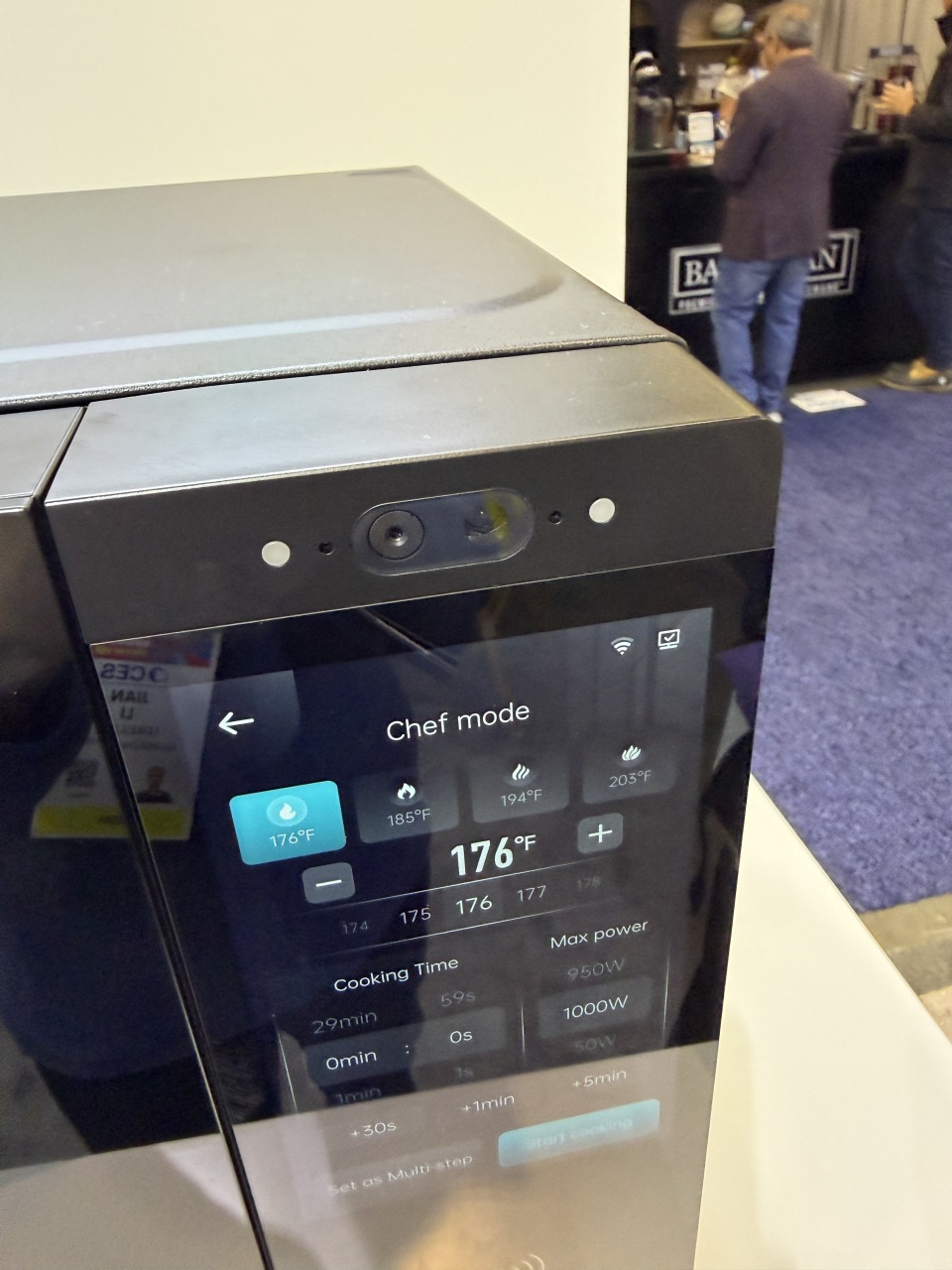
(Image source: Captured on-site by Lei Technology)
The AIChef Ultra is equipped with two high-definition cameras inside the machine for ingredient recognition. At the same time, relying on its built-in large model technology, it forms a complete perception system, including the recognition of ingredient status and continuous judgment of the cooking progress. Whether it's uneven ingredient sizes, random ingredient placement, or changing your mind midway through cooking, the AIChef Ultra can handle these "unexpected situations" with ease.
During the CES 2026 exhibition, Lei Technology conducted an in-depth interview with Huo Liyi, the general manager of Wandechu. Huo Liyi told Lei Technology, "All traditional kitchen utensils have fixed heating programs and power. They don't pay attention to the quantity, size, initial temperature, and changes in shape and color of the food during the cooking process like a human chef does." That's why Wandechu didn't choose to simply add more modes to existing programs. Instead, it tried to make the machine truly "see" the food and make decisions based on the real-time status.
Currently, the AIChef Ultra has a built-in large cooking model with over 400 recipes, covering a wide range of daily cuisines. That means users only need to prepare the ingredients, put them in, and wait for the cooking to finish. The Lei Technology CES reporting team witnessed the entire cooking process of a shrimp dish on-site. The staff put the prepared ingredients in, and in about four minutes, a delicious meal was ready.
If that were all, the AIChef Ultra would only be considered a powerful AI cooking utensil. However, with an external camera that supports health recognition, it completes a logical loop regarding "healthy eating". That's right. This external camera supports face recognition and can conduct health checks on users. It can actively recommend healthier foods and a more suitable diet structure.
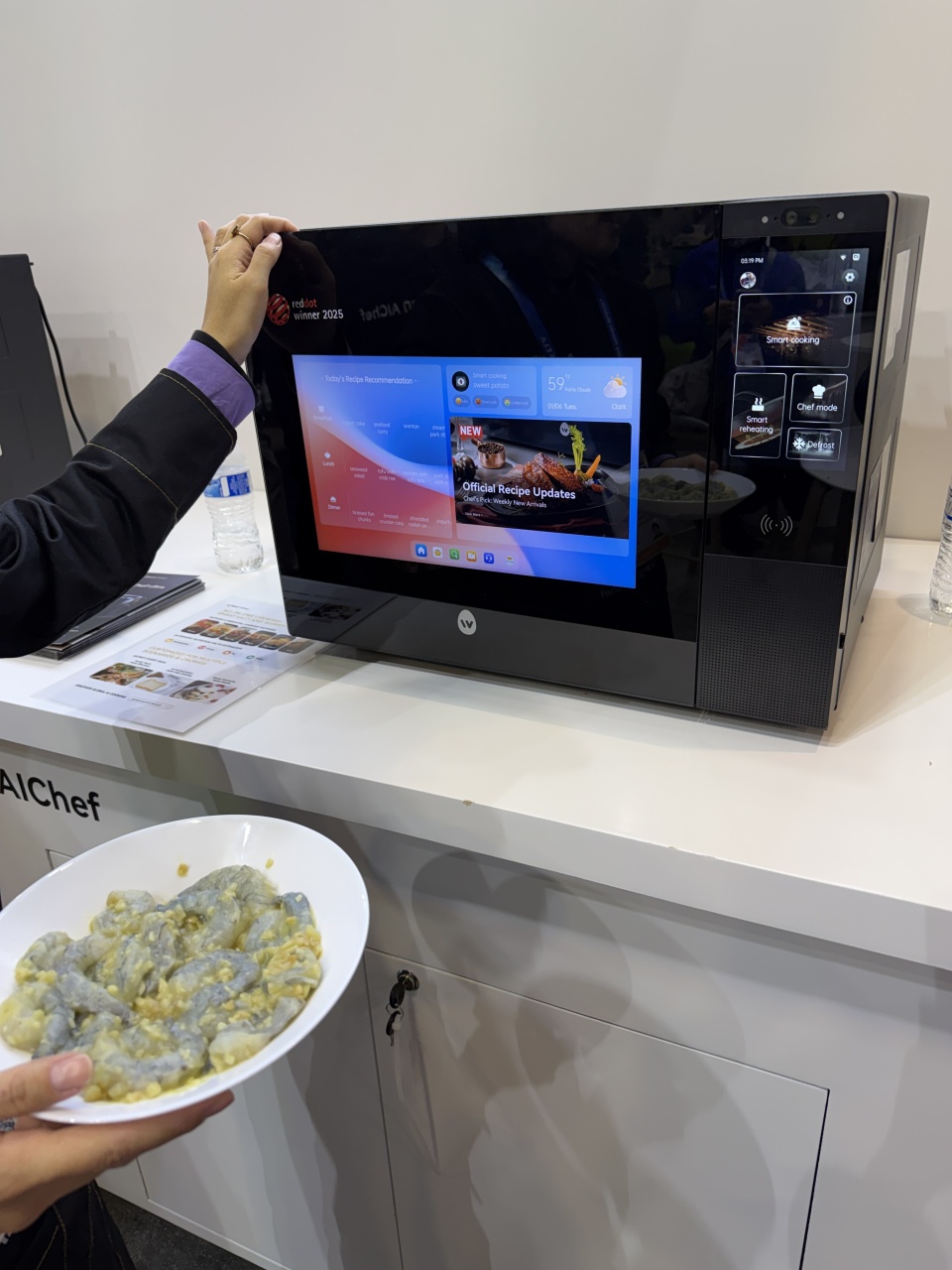
(Image source: Captured on-site by Lei Technology)
It's not hard to see that Wandechu's confidence in only showcasing the AIChef Ultra at CES, a stage where companies are showing off their capabilities, is quite evident.
Huo Liyi also explained the source of this confidence during the interview with Lei Technology: "We have a global team of chef consultants. Based on their professional advice, we conduct R & D work in our professional cooking laboratories in Guangzhou, Shenzhen, and Guigang. Whether we're developing American, European, or Japanese cuisine, we'll invite consumers from the corresponding countries to participate in taste tests. After collecting feedback, we'll optimize the dishes before finally launching them."

(Image source: Wandechu)
After experiencing it, Lei Technology also found that compared with the previously mentioned products with similar solutions, the AIChef Ultra outperforms in both usage conditions and understanding of the dietary ecosystem.
Cheng Yi Technology: AI Hasn't Reached the Stovetop, but It's Already Taking Care of Your Respiratory Health
At the CES 2026 exhibition, where everyone is talking about AI and large models, Cheng Yi Technology's booth is a bit different. There are no screens teaching you how to cook, and no system helping you plan your menu. Instead, they aim to solve the problem of respiratory health during cooking. Cheng Yi Technology, making its debut at CES, brought three products: the Arspura P2, Arspura Pro, and the high-speed Arspura F1.
First, let's talk about the P2 range hood. Different from traditional range hoods that suck in the fumes after they rise, the Arspura P2 creates a stable low-pressure area directly above the cookware through its multi-airflow structure, locking in the fumes, odors, and fine particles at the moment they are generated.
This experience is completely different from what we're used to with regular range hoods. In the past, range hoods dealt with the visible smoke, such as the heavy stir-frying in Chinese cuisine. We only started to worry about the impact of the fumes on our health after the smoke had fully risen. However, the P2 deals with the things you're not even aware of but that can be inhaled into your lungs.
During the communication with Lei Technology, Ren Yong, the founder of Cheng Yi Technology, directly pointed out the core issue they're concerned about. He told Lei Technology, "Many people think that cooking fumes are just about the smell and discomfort, but the real danger lies in the PM2.5 and even finer particles. These particles can spread throughout the room with the air."
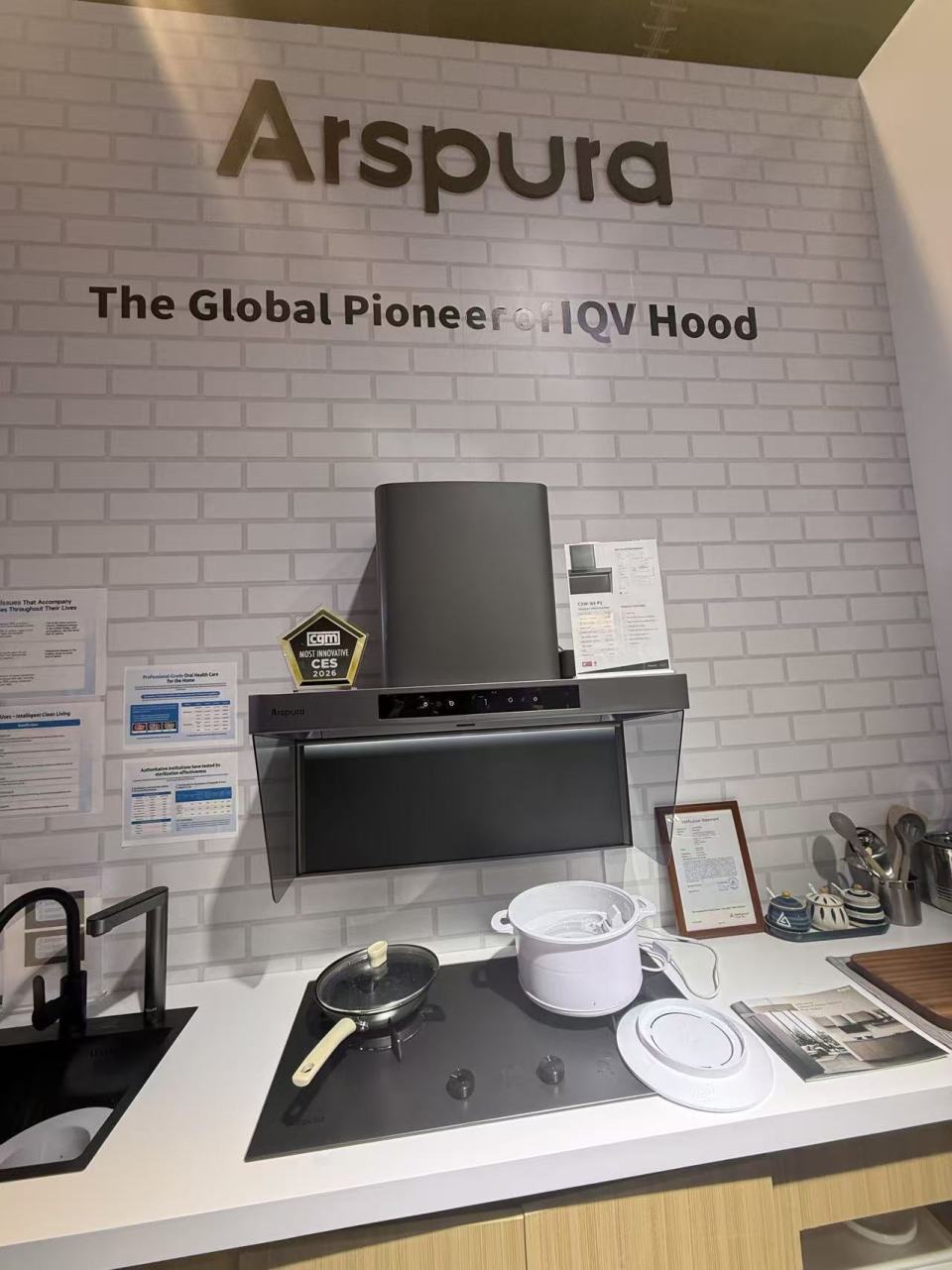
(Image source: Captured on-site by Lei Technology)
He mentioned that the team first noticed this problem from research in the field of public health, rather than the "parameter competition" within the kitchen appliance industry.
In contrast, the Arspura Pro is more practical in its positioning. It's also based on the IQV airflow structure but emphasizes more on stability in the daily household environment. Many families don't pursue "completely smokeless" kitchens. Instead, they want to avoid having to ventilate the living room and kitchen for half an hour after a meal. The Arspura F1, on the other hand, is clearly designed for high-intensity cooking. The goal of its high-speed airflow is simple: to keep the fumes within the stovetop area during moments like stir-frying and tossing the pan, which are difficult to control.
The IQV airflow structure is actually one of the biggest technological highlights of Cheng Yi Technology at this exhibition. Traditional range hoods create a strong negative pressure above the stovetop to suck away the rising fumes. However, the fumes have already spread before they're sucked in, especially the invisible PM2.5 particles, which can enter the breathing area with the hot air from the pan and the air turbulence during cooking.
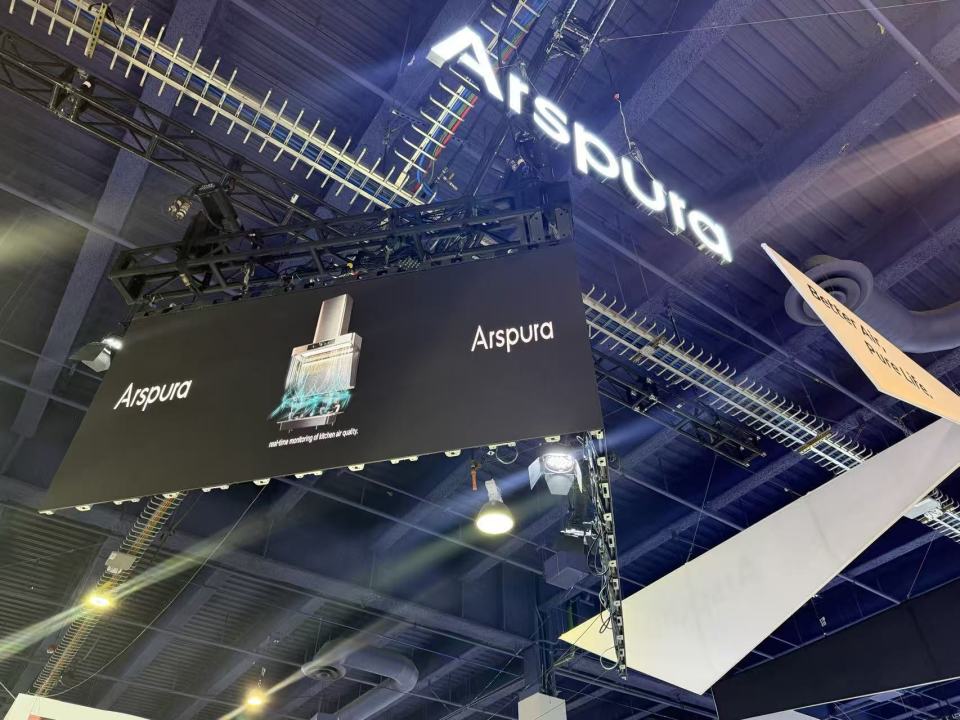
(Image source: Captured on-site by Lei Technology)
The IQV airflow structure creates a stable low-pressure area to limit the movement of the fumes first, and then uses a high-speed backward-tilted airflow to quickly guide them into the suction path. Thanks to the design of the backward-tilted airflow, the fumes don't rush directly towards people but are sucked in along the structure of the device, without reaching the breathing area.
It's easy to see that compared with other kitchen appliance products at CES 2026, which are mainly about making cooking easier, Cheng Yi Technology is more inclined to create an airflow control system that focuses on respiratory health. Perhaps in the near future, when we talk about AI kitchen appliances, we won't just discuss whether they can cook a delicious meal but also whether they can make people feel comfortable standing in front of the stovetop and using them for a long time.
Bosch Cook AI: A "Thunderbolt" at the Opening - Would You Dare to Eat an AI-Cooked Steak?
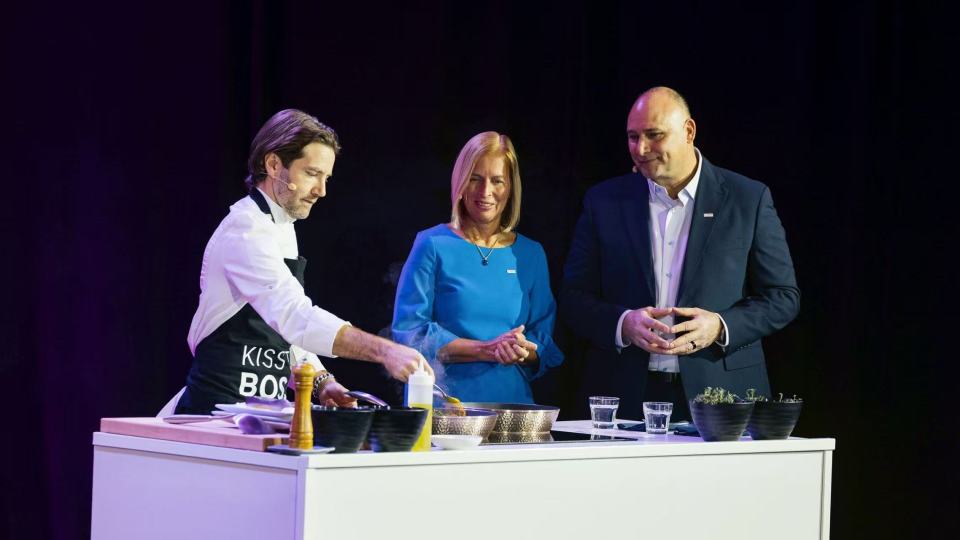
At the CES 2026 Media Day on January 5th (North American time), the well - established German home appliance manufacturer pulled off a major event. They not only launched their new Bosch Cook AI product line but also invited Marcel Vigneron, the champion of the well - known American cooking show "The Last Chef", to cook delicious food for the on - site guests using this set of kitchen utensils.
Actually, AI kitchen appliances, especially cooking tools, are not new to us in the past two years. However, Bosch Cook AI's approach is quite different. Bosch Cook AI adds an Agentic AI, also known as proxy - type AI. Different from cooking tools that help you plan the cooking steps in advance, it will break down your actions step by step according to your preset goals. Even if you change your mind midway, it can still guide you to cook a delicious meal.
Cook AI has designed a live guidance system through its app. It doesn't just simply calculate the time to flip a steak. Instead, it reminds you of every action in real - time during the cooking process. Chef Marcel Vigneron at the CES 2026 site said that this function is more suitable for cooking complex cuisines, especially those that require precise control of time and heat. For example, if you want to cook multiple steaks with different levels of doneness at the same time, Cook AI can provide real - time guidance according to the requirements of each steak.
(Image source: Bosch)
If just teaching you how to cook doesn't seem that amazing, after all, a slight difference in heat doesn't affect the edibility. But Cook AI also takes into account the "age - old problem" of not knowing what to eat. The system will adjust according to the ingredients and conditions you have on hand, rather than requiring you to strictly follow the recipe. In other words, it's more like answering the question "With only these ingredients I have now, how can I get as close as possible to the result I want", rather than simply matching a fixed recipe.
In addition, Cook AI will also achieve "orchestrate multiple Bosch appliances", which means it will interact with other Bosch kitchen appliances, such as stoves, ovens, thermometers, and sensors. That is to say, if you join this ecosystem, even when you're cooking alone, AI will help you monitor the heat of the oven, the cooking time of the soup, and whether the meat in the pot is well - cooked.
It's not hard to see that Bosch Cook AI doesn't just aim to create a set of AI kitchen appliances but to build a complete AI kitchen appliance ecosystem. Through the interconnection of the ecosystem, it will completely solve the problems of difficult cooking and how to make food more delicious.
Brisk It: Incorporating Visual Solutions into the Oven - Can AI Kitchen Appliances Be Played Like This?
As a traditional home appliance giant, Bosch's Cook AI ecosystem is indeed fascinating. However, new players like Brisk It, which focus on single - point breakthroughs, have also offered different answers. At CES 2026, Brisk It launched the Neoma AI Countertop Oven - an AI oven.
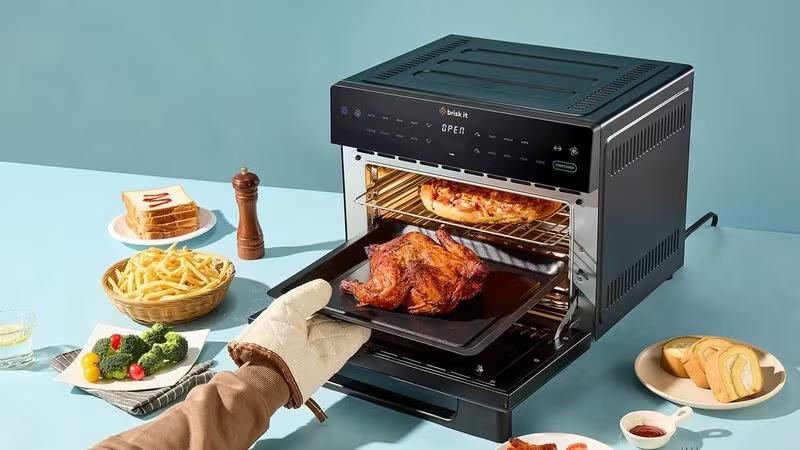
From the outside, the Neoma AI Countertop Oven looks no different from an ordinary oven. The key innovation lies in its internal capabilities. Brisk It has equipped this oven with multiple sensors such as cameras, temperature, and humidity sensors. The system will continuously observe the state of the ingredients during the cooking process, rather than just relying on preset programs. Simply put, this is an oven that can help you constantly monitor the state of the food during the baking process.
Moreover, the Vera AI installed in the Neoma can achieve "intelligent cooking". Users don't need to input a complete standard recipe. They just need to set a goal, such as the desired dish or doneness. The system will generate a cooking process based on the current ingredient conditions and continuously adjust the parameters during the process to achieve the perfect baking state.
(Image source: Brisk It)
This solution gives users extremely flexible choices. People who often use ovens know that different forms of ingredients require different time and heat settings. For example, a whole chicken and pre - cut chicken pieces need different parameters. However, with the Neoma AI Countertop Oven, users don't need to worry about these. They just need to prepare the ingredients and put them in. Vera AI can automatically determine all the parameters through visual recognition.
For new AI kitchen appliance players like Brisk It, it's clearly unrealistic to build a complete AI ecosystem like home appliance giants such as Bosch, Samsung