Semiconductor equipment, the hottest trend in 2026
The rapid development of AI computing power is reshaping the demand logic of the entire semiconductor industry. In this industrial chain, there is a "shovel-selling" segment that is experiencing a definite boom - semiconductor equipment.
01
Semiconductor Equipment Rides the "Fast Train"
In 2025, the price increase in the storage market persisted throughout the year. Coupled with the concentrated explosion of demand for HBM (High - Bandwidth Memory) and DDR5, as well as the capacity expansion moves of global industry giants, the semiconductor equipment market directly caught the "fast train" of demand growth and became one of the biggest beneficiaries.
The report "Semiconductor Equipment Year - End Forecast - OEM Perspective" recently released by the Semiconductor Industry Association (SEMI) sent a clear signal: It is estimated that the total sales of semiconductor manufacturing equipment by global semiconductor equipment original equipment manufacturers (OEMs) will reach a record $133 billion in 2025, a year - on - year increase of 13.7%. It is expected that the sales of semiconductor manufacturing equipment will continue to grow in the next two years, reaching $145 billion and $156 billion in 2026 and 2027 respectively. This growth is mainly driven by AI - related investments, especially in the application of cutting - edge logic circuits, memory, and advanced packaging technologies.
Looking at the segmented fields, the growth trend is also clearly distinguishable. SEMI pointed out that after the wafer fabrication equipment (WFE) segment set a sales record of $104 billion in 2024, it is expected to grow by 11.0% to $115.7 billion in 2025. This forecast is an upward adjustment from the $110.8 billion in SEMI's mid - 2025 equipment forecast, reflecting that the investment in the DRAM and high - bandwidth memory (HBM) fields to support AI computing exceeds expectations.
The capacity expansion and technological upgrading moves of global storage manufacturers are becoming the core engine driving the demand for semiconductor equipment.
Domestically, according to the prospectus of Yangtze Memory Technologies Co., Ltd., its raised funds will be mainly invested in three major directions: the "Technical Upgrading and Transformation Project of Memory Wafer Manufacturing Mass - Production Line" (planned investment of 7.5 billion yuan), the "DRAM Memory Technology Upgrading Project" (planned investment of 13 billion yuan), and forward - looking R & D projects. The implementation of these projects is expected to directly drive the growth of demand in the semiconductor equipment market.
International storage giants are also making frequent moves. South Korea's two major storage chip companies, Samsung and SK Hynix, are accelerating the expansion of memory production capacity. Samsung Electronics has recently not only improved the operating efficiency of its DRAM and NAND flash production lines in South Korea but also concentrated its resources on the manufacturing of high - end products such as HBM. In addition, the company restarted the construction of its Pyeongtaek Line 5 in November and plans to start mass production in 2028, aiming to enhance its supply capacity in the field of advanced storage technologies.
Meanwhile, SK Hynix's new M15X plant in Cheongju has entered the critical preparation stage before production. The plant will focus on DRAM and storage solutions for AI applications. According to industry insiders, SK Hynix is striving to complete the construction of its first wafer factory in the Yongin Semiconductor Complex by 2027. The overall scale of this project is equivalent to six M15X - level factories, indicating its positive layout for future market demand. It is worth noting that SK Hynix's monthly DRAM production capacity is 500,000 wafers. Even with the addition of M15X chips, it can only reach 550,000 wafers. In contrast, Samsung Electronics has a monthly production capacity of up to 650,000 wafers.
SEMI data shows that South Korea is expected to return to the second place in global chip equipment spending by 2026, reaching approximately $29.66 billion, a 27.2% increase from the estimated $23.32 billion in 2025. This significant increase directly reflects the strong rebound of capital expenditure in South Korea's semiconductor field driven by global memory - related demand.
From the perspective of the phased changes in the global semiconductor equipment investment pattern, Taiwan, China will still rank second globally with an investment of approximately $26.16 billion in 2025, slightly ahead of South Korea. However, by 2026, the ranking will reverse - South Korea will return to the second place, while the Chinese mainland will remain firmly in the first place, with an estimated investment in the semiconductor equipment field of approximately $39.25 billion in that year.
So, as the heat in the storage market rises, which semiconductor equipment categories are core - driven?
02
These Semiconductor Equipment Categories See Soaring Popularity
The evolution history of storage chips is essentially a "space battle". From 2D planar to 3D stacking, the number of NAND flash memory layers has exceeded the 400 - layer mark and will continue to move towards 1000 layers in the future. DRAM is evolving towards vertical channel transistors (VCT), and HBM realizes vertical interconnection of chips through through - silicon via (TSV) technology. This technological leap poses disruptive requirements for semiconductor equipment.
Among them, the expansion of 3D NAND production and the evolution of DRAM technology have the strongest driving effect on etching/deposition equipment, while the expansion of HBM production further boosts the demand for equipment such as lithography, ALD, and hybrid bonding.
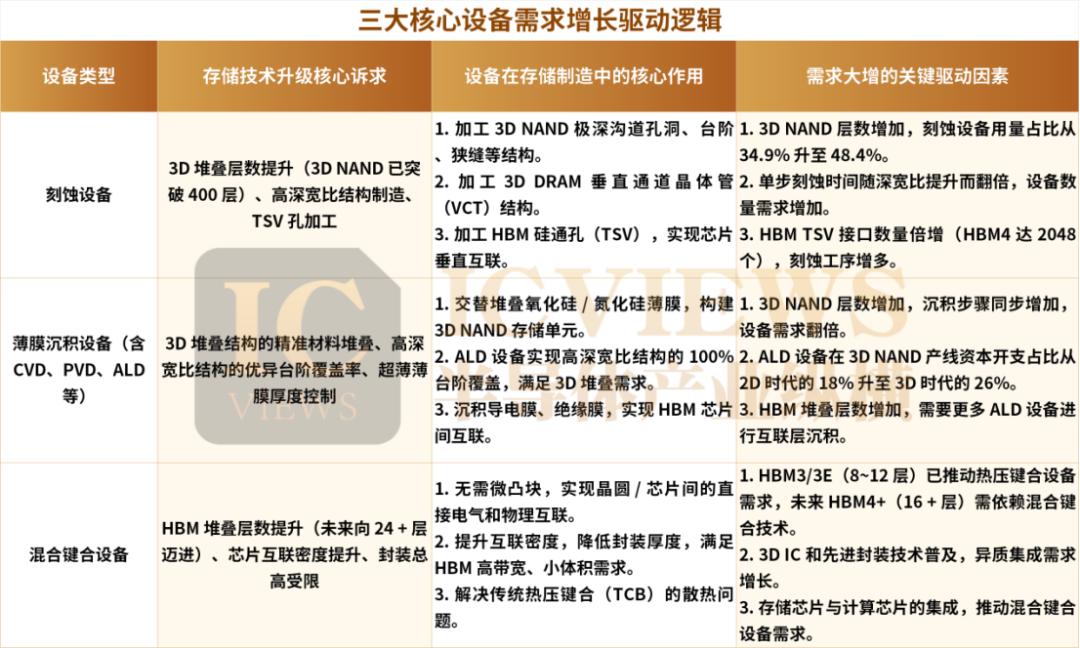
3D NAND/DRAM: Surging Demand for Etching and Deposition Equipment
Etching equipment is like a "precision carving knife" in semiconductor manufacturing. Its core function is to selectively remove unnecessary materials on the wafer surface according to the preset pattern.
Different from the 2D NAND era, when etching was only a supporting process for lithography, in the 3D NAND manufacturing process, the main method to increase integration is no longer to reduce the line width on a single layer but to increase the number of stacked layers. Etching needs to process extremely deep holes or trenches with an aspect ratio of 40:1 to 60:1 on a stacked structure of silicon oxide and silicon nitride. The increase in the number of 3D NAND layers requires etching technology to achieve a higher aspect ratio.
Taking a certain 3D NAND technology route as an example, assuming a monthly production capacity of 150,000 units, as the number of stacked layers increases, the proportion of etching equipment usage continues to rise. When the number of 3D NAND layers increases from 32 to 128, the proportion of etching equipment usage increases from 34.9% to 48.4%. For the usage of etching equipment in different etching processes at different technology nodes, for 3D NAND with different numbers of stacked layers, the demand for etching equipment in the CMOS driver part remains unchanged, while the change in the number of etching equipment in the Array storage structure is more obvious. The etching processes involved are channel holes, stair steps, slits, contact vias, and cleaning. Since the number of steps formed in a single step - etching process is fixed, the demand for equipment is almost proportional to the number of stacked layers. On the other hand, as the number of stacked layers continues to increase, the thickness of the film to be etched also increases accordingly. The etching processing time for channel vias, slits, and contact vias will become longer or even double. The decrease in the WPH of a single device leads to an increase in the demand for process equipment.
SEMI predicts that the global equipment expenditure in the storage field will reach $136 billion between 2026 and 2028, of which the investment related to 3D NAND accounts for more than 40%. As a core link, etching equipment will continue to enjoy the benefits of this wave of capacity expansion.
DRAM also has a similar technology roadmap for the number of 3D stacked layers. This causes the demand and performance requirements for etching equipment to increase exponentially.
If etching is a "subtraction" operation, then thin - film deposition is an "addition" operation - By alternately stacking conductive films, insulating films, and other materials on the wafer surface, a basic stacked structure is constructed for semiconductor devices. The more the number of 3D NAND layers, the more deposition steps are required, and naturally, the demand for deposition equipment also explodes synchronously. For example, from 24 - layer to 232 - layer 3D NAND, each layer needs to go through the thin - film deposition process step, giving rise to more demand for thin - film deposition equipment.
Thin - film deposition technology can be divided into chemical vapor deposition (CVD) and physical vapor deposition (PVD). In addition, other processes such as electroplating and evaporation are also used in small quantities. In recent years, a relatively advanced atomic layer deposition (ALD) has emerged for deposition with high precision requirements.
Among them, compared with CVD and PVD equipment, ALD equipment can achieve excellent step coverage and precise thin - film thickness control for high - aspect - ratio and extremely narrow trench openings. Therefore, the demand proportion of ALD equipment in the NAND Flash process when transitioning from 2D to 3D stacked structure will increase. According to the disclosure of Tokyo Electron, in the capital expenditure of the Flash chip production line, the proportion of thin - film deposition equipment in the 2D era was 18%, and in the 3D era, it is 26%. At the same time, as the number of layers continues to increase and the aspect ratio further increases, more ALD equipment is needed. HBM: Soaring Demand for Lithography, ALD, and Bonding Equipment
HBM forms high - density storage units by vertically stacking multiple layers of DRAM chips (usually 4 - 16 layers), with a capacity of 2 - 24GB per layer, using TSV technology.
In addition to etching and thin - film deposition equipment, HBM also poses higher requirements for lithography equipment and hybrid bonding equipment.
The core reason for the upgrading of lithography equipment demand comes from the extreme requirements of DRAM process miniaturization and HBM high - density interconnection for patterning accuracy. EUV lithography has been widely used in the sixth - generation DRAM process (D1c). Although Samsung, Micron, and SK Hynix have different technology routes, they all rely on EUV to achieve precision breakthroughs. Compared with ArFi lithography, EUV with a wavelength of 13.5nm can reduce the dependence on multiple patterning and provide support for the formation of the VCT structure. In the HBM field, the multiplication of TSV interfaces (up to 2048 in HBM4) and the micron - level spacing of circuits further increase the priority of EUV lithography demand.
Hybrid bonding equipment is one of the key equipment in the HBM manufacturing process. At present, HBM3/3E (8 - 12 layers) mainly relies on traditional micro - bump technology, and the thermo - compression bonding (TCB) equipment uses two parallel development routes: TC - NCF (non - conductive film thermo - compression bonding) and TC - MUF (molding underfill thermo - compression bonding). However, as the number of stacked layers increases, the heat - dissipation problem of traditional TC - NCF is gradually magnified, and TC - MUF technology has become the mainstream technology for the mass production of the new - generation HBM. In the future, with the further increase in the number of layers and the premise of limited total height, hybrid bonding is regarded as the key to the further evolution of HBM.
03
The Path of Domestic Equipment Localization
With the rapid iteration of storage chip technologies such as 3D NAND, DRAM, and HBM, the demand for three types of core equipment, namely etching, thin - film deposition, and hybrid bonding, will continue to explode, becoming the key support for the upgrading of the storage industry. At the same time, supporting equipment such as cleaning, ion implantation, rapid thermal processing, photoresist coating and development, packaging and testing, electroplating, and polishing have also benefited from the wave of wafer factory capacity expansion and the surging storage market, achieving a significant increase in demand, jointly constructing a complete equipment system for storage chip manufacturing.
In terms of etching equipment, the main representative manufacturers are AMEC, Naura Technology Group Co., Ltd., and E-Tron Technology Group Co., Ltd. AMEC is a leading enterprise in etching equipment. Its CCP equipment has achieved full coverage of most applications above 28 nanometers and has made important progress at the 28 - nanometer and below nodes. In the high - aspect - ratio etching of 3D NAND chips and the front - end etching of logic chips, AMEC's technology has reached some advanced nodes and is adopted by global top - tier chip manufacturers.
Naura Technology Group Co., Ltd.'s CCP equipment has dominated the silicon etching and dielectric etching applications in 8 - inch production lines and has also been successfully applied to key non - core steps such as hard - mask etching and aluminum - pad etching in 12 - inch production lines.
E - Tron Technology Group Co., Ltd. was formerly the semiconductor wet - process equipment business department of Applied Materials. It was re - established through domestic acquisition in 2015 and has currently formed three major core equipment product lines: etching, thin - film deposition, and rapid thermal processing.
In terms of thin - film deposition equipment, a group of thin - film deposition equipment manufacturers such as Naura Technology Group Co., Ltd., Top Achievement Technology Co., Ltd., AMEC, and Micro Nano Technology Co., Ltd. have emerged. Top Achievement Technology Co., Ltd. has been deeply involved in the field of thin - film deposition equipment and has formed a series of thin - film equipment products such as PECVD, ALD, SACVD, HDPCVD, and Flowable CVD, which are widely used in the manufacturing of integrated circuit logic chips and storage chips. Its customers include Semiconductor Manufacturing International Corporation (SMIC) and Huahong Group.
As early as 2023, AMEC had thin - film equipment delivered to customers, mainly CVD/HAR/ALD W tungsten equipment and TiN/TiAI/TaN ALD equipment. The Q3 2025 financial report shows that several thin - film equipment such as LPCVD and ALD developed by AMEC for advanced storage devices and logic devices have successfully entered the market.
Naura Technology Group Co., Ltd. is the domestic leader in PVD, with strong uniqueness, and has also made arrangements in the fields of LPCVD, APCVD, and ALD. Micro Nano Technology Co., Ltd. started with ALD equipment and is the first domestic equipment company to successfully apply mass - production High - k ALD to the front - end production line of 28nm - node integrated circuit manufacturing. ACM Research, Inc. started with cleaning equipment and is gradually expanding into a platform - type equipment company. It currently has products in the fields of cleaning, electroplating, Track, polishing, and thin - film deposition.
In terms of bonding equipment, domestic manufacturers have made obvious progress in the field of hybrid bonding.
Qinghe Jingyuan released the world's first independently developed C2W & W2W dual - mode hybrid bonding equipment, the SAB82CWW series, in 2025, which has been successively delivered and verified in the market. This equipment shows broad application prospects in multiple fields such as memory, Micro - LED display, CMOS image sensors, and optoelectronic integration.
Top Achievement Technology Co., Ltd., relying on its accumulation in thin - film deposition technology, has developed the Dione 300 series wafer - to - wafer (W2W) bonding equipment, which can achieve high - precision bonding of multi - material surfaces at room temperature and is widely used in high - end fields such as 3D IC, advanced packaging, and CIS. The Dione 300 eX is used for W2W high - precision hybrid bonding and has been shipped to customers for verification. Concurrently launched, the Pollux series chip - to - wafer (D2W) bonding surface pretreatment equipment forms a complete "pretreatment + bonding" solution, with core indicators such as alignment accuracy and bonding strength approaching the international first - class level. It has also launched the chip - to - wafer (C2W) hybrid bonding equipment Pleione 300, which is mainly used in the fields of HBM and chip three - dimensional integration and is undergoing industrialization verification.
Maxwell Technologies Co., Ltd. focuses on general semiconductor cutting and 2.5D/3D advanced packaging, providing overall packaging process solutions. It has successfully developed equipment such as wafer hybrid bonding.