What are all our efforts ultimately for?
We have entered the era of AI in our daily lives, using AI for navigation, watching videos, and seeking medical advice.
We have also entered the AI industry, using AI for autonomous driving, robotics, hardware, and so on.
Finally, there will be a group of people who will enter the AI class.
All of us are in the midst of great changes. We have no idea what kind of mindset we will ultimately develop.
With the rapid technological changes, the uncertainty in society is increasing. What should people do? Should we be pessimistic or optimistic?
Today, we have compiled the wonderful insights of Professor Su Dechao, the founding consultant of Notesman PPE Academy and the tutor of the Western Philosophy module, from his lectures in the "Notesman Su Dechao's Western Philosophy Workshop" over the past two years. Let's discuss how to use philosophy to find the real problems and real meanings in an era when everyone is chasing after AI.
1. Will we be swept along by AI in the AI era?
AI has helped us do many things that were previously impossible. Shi Yigong said that in the past, it took ten PhD students five years to complete the structural research of a large complex, but now, with the help of AI tools, one student can do it in one to two weeks.
We should embrace new technologies. This is the trend of the times. People should make in - depth use of AI.
However, AI often makes mistakes. If people lack the ability to distinguish or have insufficient systematic training, problems will arise.
Therefore, how can AI help us expand our knowledge and capabilities while we are able to identify the limitations of AI?
Professor Su Dechao used a startling analogy to remind us: Over - reliance on AI may lead to an increasing tendency to become "plant - like."
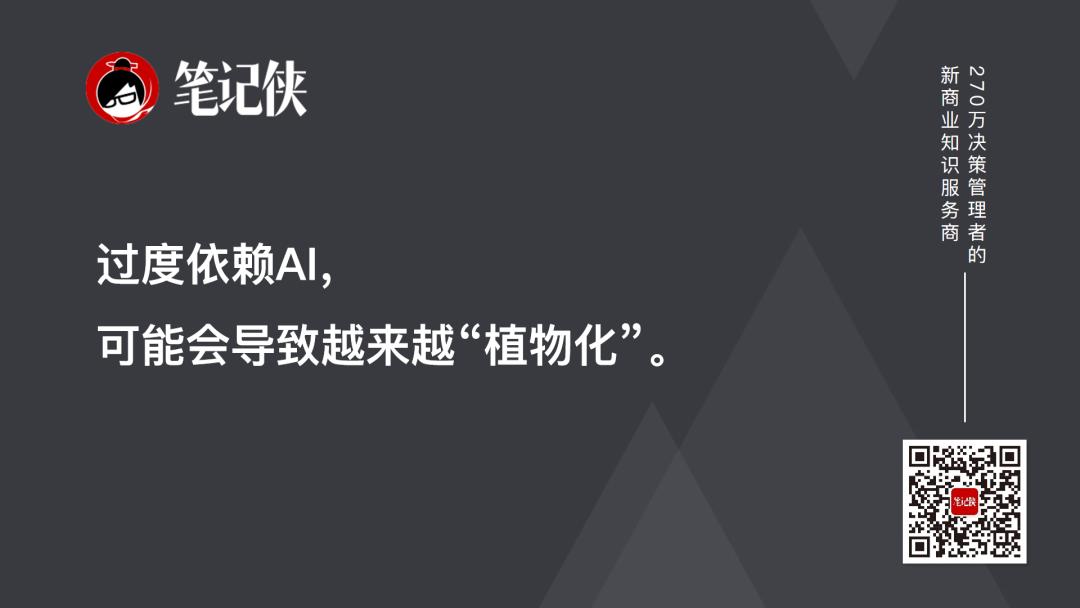
What does it mean to be "plant - like"?
You can imagine a dense forest. The trees there grow independently, obtaining what they need for survival from the soil and sunlight, and there is no rich and complex interaction between them.
Professor Su Dechao warned that if people get used to "asking AI directly for answers rather than asking other people," human society may shift from a "human state" of frequent interaction and ideological collision to a relatively isolated and static state of existence similar to a plant community.
This is not an alarmist statement. Just think about our daily work:
When we need market insights, our first reaction is to ask AI for an analysis report, rather than chatting with customers or making observations. When facing management problems, we may search for "best practice" cases in the database, rather than convening a team for a brainstorming session full of debates.
AI can give us many good suggestions, but AI is only our auxiliary system.
Our most precious ability is the ability to ask questions, those "whys" that stem from curiosity, restlessness, and a continuous questioning of the status quo.
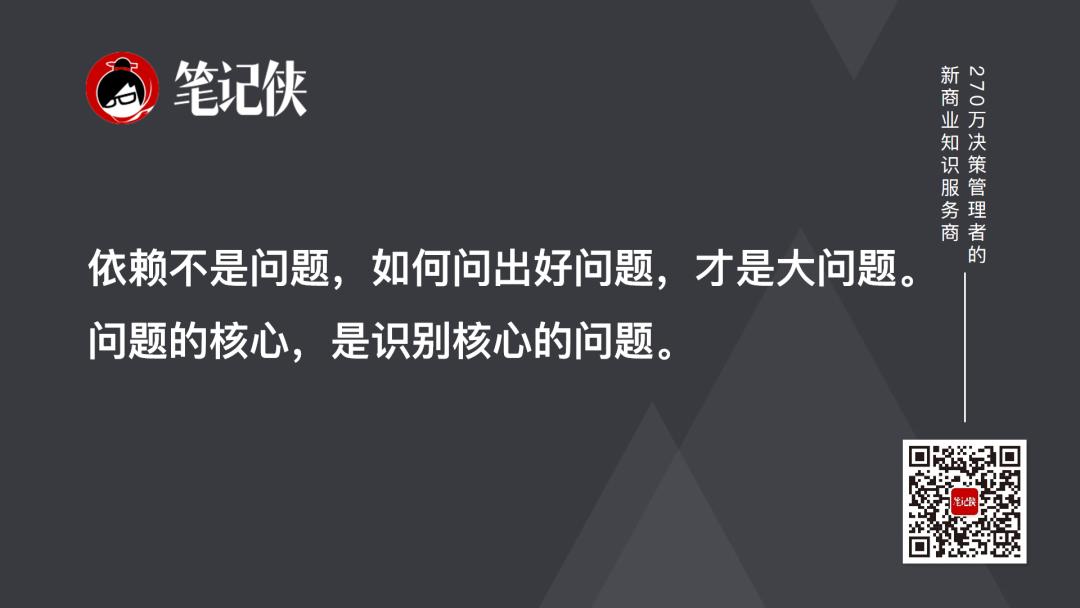
Dependence is not the problem. The real problem is how to ask good questions. The core of the problem is to identify the core issues.
2. What are the three powerful tools of philosophy?
What Professor Su Dechao has sorted out for us in Western philosophy is precisely such a set of cognitive tools. These tools do not produce new methods, but they can reshape our thinking framework for processing all information.
1. First - principles thinking: Why?
First - principles thinking is one of the most highly regarded philosophical tools in the field of innovation today. It originated from Aristotle in ancient Greece. The core idea is to, like peeling an onion, put aside all the "common sense" and "conventions" told to you by others, reach the most fundamental and irreducible factual foundation of the problem, and then rebuild from scratch.
It is completely opposite to the "analogical thinking" we are used to. Analogical thinking is to look at what others do and then copy or make slight improvements: "Since others are doing it this way, so should we."
On the other hand, first - principles thinking asks: "What is the essence of this thing? Putting aside all existing paths, what could be the optimal solution to achieve the goal?"
Elon Musk is a vivid example of this thinking. When he founded SpaceX, the "common sense" in the aerospace industry was that building rockets was expensive and they were single - use. However, he did not start from this premise to seek "optimization." Instead, he returned to the most basic physical principles and material costs: What are rockets made of? How much do these raw materials cost in the market?
The answer shocked him: The manufacturing cost was only a small part of the selling price. So, Musk decided to manufacture most of the parts himself to control the manufacturing cost. At the same time, he changed the prejudice that "rockets are single - use consumables" and made rockets reusable, thus reducing the cost of rockets.
It was this questioning based on first - principles thinking that ultimately changed the entire aerospace industry.
Professor Su Dechao also reminded us to be vigilant against the over - simplification of "first - principles thinking."
However, the over - simplification of "first - principles thinking" can also lead to other problems.
For example, it may lead to the neglect of "emergence."
Take water as an example. Water is composed of two hydrogen atoms and one oxygen atom, but the overall properties of water cannot be explained by either hydrogen atoms or oxygen atoms. In a sense, emergence is against first - principles thinking.
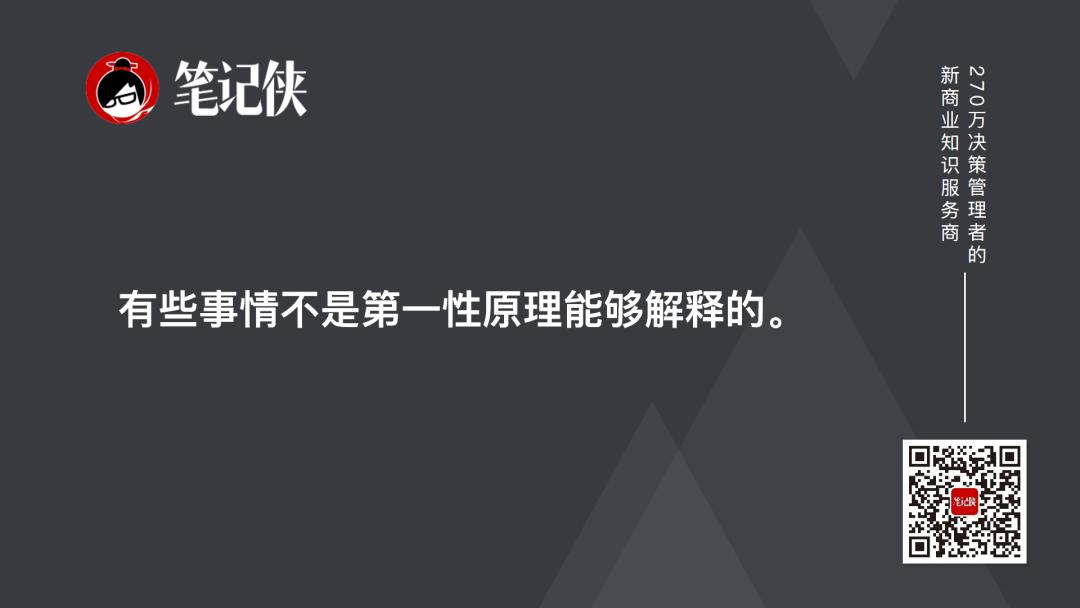
Therefore, some things cannot be explained by first - principles thinking.
An excellent thinker needs to strike a balance between the two: being able to dissect the problem to its essence like a surgeon and seeing the new possibilities that emerge when the parts of a system are connected like an architect. This is true whether you are managing a team or developing a product.
2. The Dichotomy of Control: How to act?
The Dichotomy of Control originated from the Stoic school in ancient Greece. It provides us with an emotional anchor to "settle ourselves." It clearly divides all things in the world into two categories:
First, things that you can completely control (your beliefs, attitudes, goals, and actions).
Second, things that you have no control over (others' opinions, market changes, past events).
In today's business world, which is called the "VUCA era" (Volatile, Uncertain, Complex, and Ambiguous), this ancient wisdom is extremely valuable.
Entrepreneurs are bombarded with a vast amount of "uncontrollable" information every day: policy changes, competitors' moves, technological disruptions, public opinion storms... If their mental energy is exhausted by these uncontrollable things, they will quickly fall into anxiety and passivity.
The real entrepreneurial mindset is the mindset of an actor.
They rarely spend time complaining about "Why is it always me who is unlucky?" Instead, they will immediately start thinking: "In this situation, what can I do to change or improve the situation?"
The training of the Dichotomy of Control is to guide you to invest all your precious energy in the things you can fully control: such as refining the core value of your product, building the cultural resilience of your team, optimizing your decision - making process, and maintaining continuous thinking and learning.
The more uncertain the external world is, the more important the inner determination of entrepreneurs becomes, especially in the AI era.
3. The Intentional Stance
When dealing with complex systems composed of people - whether it's a team, customers, or the entire market - the "Intentional Stance" proposed by philosopher Daniel Dennett is a unique key.
The method is to regard a system (which can be a person, an animal, or even a complex organization or AI) as an actor with its own "beliefs," "desires," and "intentions," and then predict and understand its behavior.
This may sound a bit abstract, but in fact, we use it unconsciously every day. For example, you predict that your colleague will file important documents because you assume that he "believes" that filing is important and "wants" to keep things organized. This is using the Intentional Stance.
Professor Su Dechao pointed out that this thinking is particularly useful in business. When the sales of your product stagnate, you can regard the "market" as an intentional actor: What does it currently "believe"? (Maybe it believes that the existing products are good enough.) What does it "desire" but has not been satisfied? (Maybe it's convenience, emotional identification, or new experiences.)
Through this anthropomorphic perspective, it is easier for you to penetrate the cold sales data and understand the real human needs and group psychology behind it.
More importantly, the Intentional Stance can help us collaborate with AI more effectively. When you regard AI as a partner with specific beliefs and goals, you can recognize its ability boundaries and inherent biases, and then make more appropriate judgments instead of blindly following it.
You see, these philosophical tools do not provide a universal formula for the "correct answer." They provide different perspectives for examining the world and principles for action.
3. How can entrepreneurs in the AI era
create the infinite in the finite?
When it's quiet at night, a voice will pop up: "What is all this ultimately for?"
This is no longer a management problem, or even a business problem. Professor Su Dechao has laid this problem in front of us: What really drives us to keep creating and never stop may be the answer that we all know deep down - whether it's a company or an individual, everything we do has a time limit.
1. Understand the three lives of an enterprise
When we say a company "dies," it usually means bankruptcy and liquidation. However, Professor Su Dechao reminded us that a company actually has three "lives":
The first is the physical life, which includes the cash in the bank, the goods in the warehouse, and the desks, chairs, and computers in the office. This is the most tangible and what people stare at every day.
The second is the relational life, which refers to whether customers really recognize you, whether partners trust you, and whether you have influence in the industry.
The third is the spiritual life, which is the reason why the company exists. Do employees feel that they are doing something meaningful besides getting paid? This is the "soul" of the company.
Many companies fail not because they suddenly run out of money, but because they first lose the hearts of people and finally forget why they exist.
It is certainly important to protect the "body" of the company, but taking the time to nourish its "trust" and "spirit" is the cornerstone of long - term and healthy development.
2. Why do companies always become "stupid"?
The scientist Ilya Prigogine has a theory called the "dissipative structure," which means that a living system must, like breathing, continuously exchange things with the outside world to maintain its vitality.
For a company, this exchange means: continuously introducing new blood; actively exploring new and emerging trends on the fringes rather than just focusing on the mainstream market; and having the courage to admit that some projects have failed and openly learning from them.
The secret of companies that can survive economic cycles is to always keep the "window" open.
3. Entrepreneurs have to choose between "comfortable numbness" and "painful growth"
Professor Su Dechao used a very vivid analogy to divide people (or companies) into four states:
The first state is being poor and confused, worrying about survival, like a wild wolf.
The second state is being materially prosperous but having a boring life, repeating the same things every day and feeling empty inside, like a domestic pig.
The third state is not being extremely wealthy materially but constantly breaking through and creating every day, feeling extremely excited. This kind of person is called an "improver."
The fourth state is being both wealthy and having a meaningful life. This is the most ideal state but is very rare.
Which one are you?
What kind of entrepreneur do you want to be?
No matter how advanced artificial intelligence becomes, only people themselves can answer this question. We are creating to "live up to our lives."
Ultimately, we have to think about what we need: meaning, interest, and value.
Conclusion: Find inner certainty
in an uncertain world
An interesting phenomenon is that in Silicon Valley, where technological changes are the most