Grade A office buildings in Beijing: Rent adjustment slows down
In 2025, the Beijing office market entered a critical stage of in - depth adjustment and structural reconstruction. On the leasing side, it showed prominent features of renewal dominance and an increase in tenants' bargaining power, and the rent of Grade A office buildings continued to be adjusted. On the investment side, the scale of large - scale transactions shrank significantly, but commercial retail assets were favored against the trend. Coupled with the implementation of the policy to expand the underlying assets of public REITs, new development momentum was injected into the market. Data from multiple institutions show that although the market still faces challenges in supply - demand balance, signs of partial stabilization and policy benefits are reshaping the industry's development logic.
01 Grade A Office Building Market: Renewal Becomes the Mainstream and Rent Adjustment Slows Down
In 2025, the demand side of the Beijing Grade A office building market continued to maintain a rational attitude. Tenants' awareness of cost control was significantly improved, and their relocation behavior became more cautious. According to JLL data, renewal transactions gradually dominated the office market throughout the year. Especially in the fourth quarter, to avoid large one - time expenditures such as decoration and restoration, most enterprises chose to renew or downsize their leases in the same building, further consolidating the dominant position of renewal transactions. Against this background, the strategies of landlords shifted significantly, and ensuring the occupancy rate became the core goal. They actively retained existing tenants by restructuring leases and lowering rents.
Looking at the core data, there was no new supply in the Beijing Grade A office building market in the fourth quarter of 2025. The continuous digestion of existing properties drove the vacancy rate to decline slightly. By the end of the year, the overall vacancy rate decreased by 0.3 percentage points quarter - on - quarter to 15.2% (the statistical scope does not include self - used projects in the city), and the net absorption volume of the whole city reached 21,790 square meters. Although it declined slightly compared with the previous quarter, the concentrated leasing transactions in the core sub - markets supported the market to show signs of improvement. The regional differentiation was more obvious. The CBD and Wangjing areas performed relatively well in digestion thanks to the landlords' rent - concession strategies.
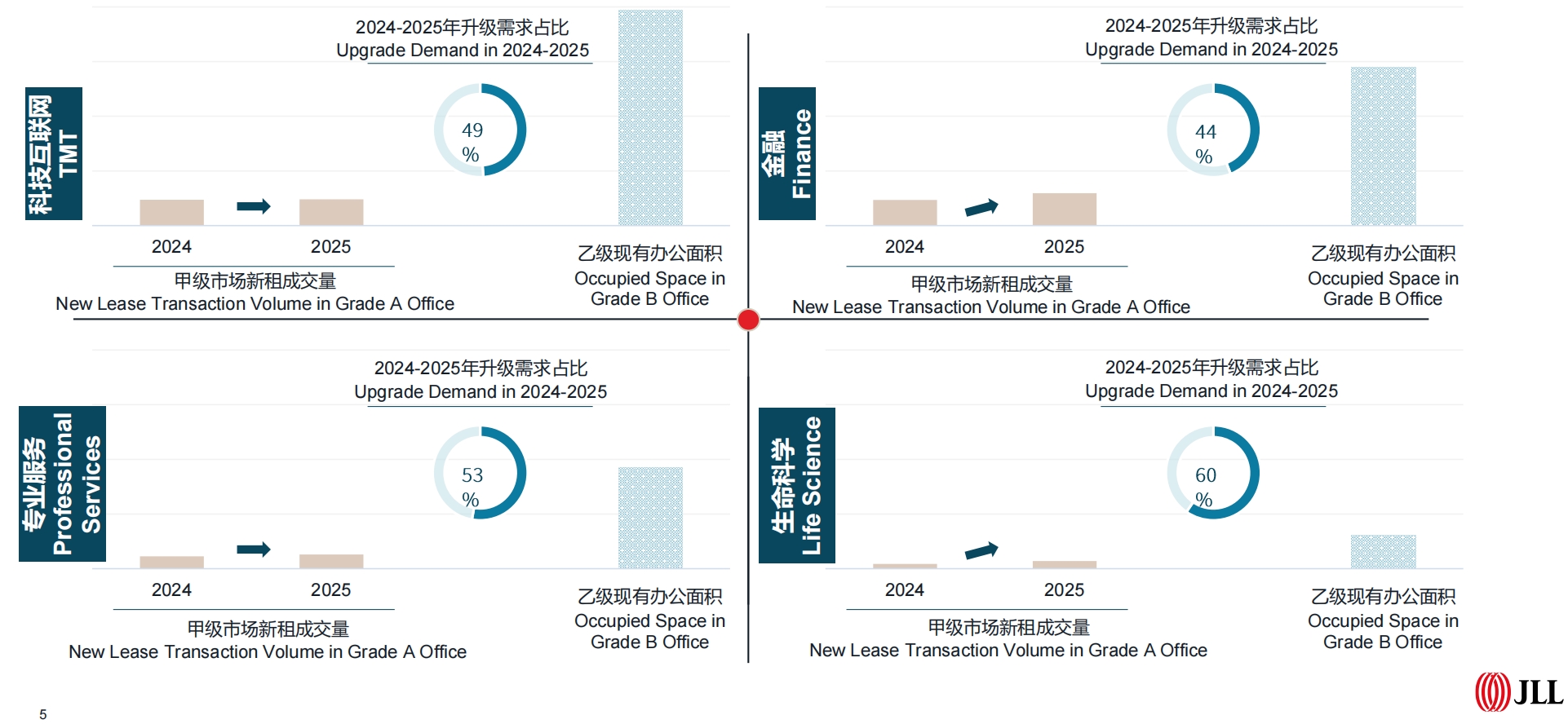
Data source: JLL
While the rent adjustment continued to deepen, the transparency of market pricing increased significantly. In the fourth quarter of 2025, the average monthly rent of Beijing Grade A office buildings was 210 yuan per square meter, a quarter - on - quarter decline of 5.6% and a year - on - year decline of 16.3%. It is worth noting that the rent decline rate has shown signs of slowing down. JLL predicts that the average rent decline in 2026 will narrow to 6.6%, reflecting the partial stabilization of the leasing performance in some sub - markets. However, with the planned concentrated delivery of 700,000 square meters of new projects in 2026, especially 90% of the new supply concentrated in the eastern sub - markets, the rent will still face certain downward pressure in the future.
The emerging demand highlights are also worthy of attention. In non - renewal transactions, the health service segments such as medical aesthetics and physical examination, as well as artificial intelligence application enterprises, are gradually becoming important sources of incremental demand, injecting new vitality into the market.
Zhang Siliang, a senior director of JLL's Beijing commercial real estate department, said: "Although the rent adjustment rhythm may slow down, the market will still maintain a tenant - dominated pattern. For landlords, ensuring the occupancy rate will continue to take precedence over pursuing rent growth."
02 Investment Market: Large - scale Transactions Cool Down, Retail Assets Are Favored, and REITs Expansion Brings Opportunities
In line with the adjustment trend of the leasing market, the Beijing commercial real estate investment market also slowed down in 2025. According to JLL data, the total amount of large - scale transactions throughout the year was about 18 billion yuan, a 58% decrease compared with 2024 and roughly halved compared with the average of the past five years. The market activity further weakened in the fourth quarter. In terms of asset categories, commercial retail assets became the focus of capital attention, showing relatively strong anti - cyclical properties.
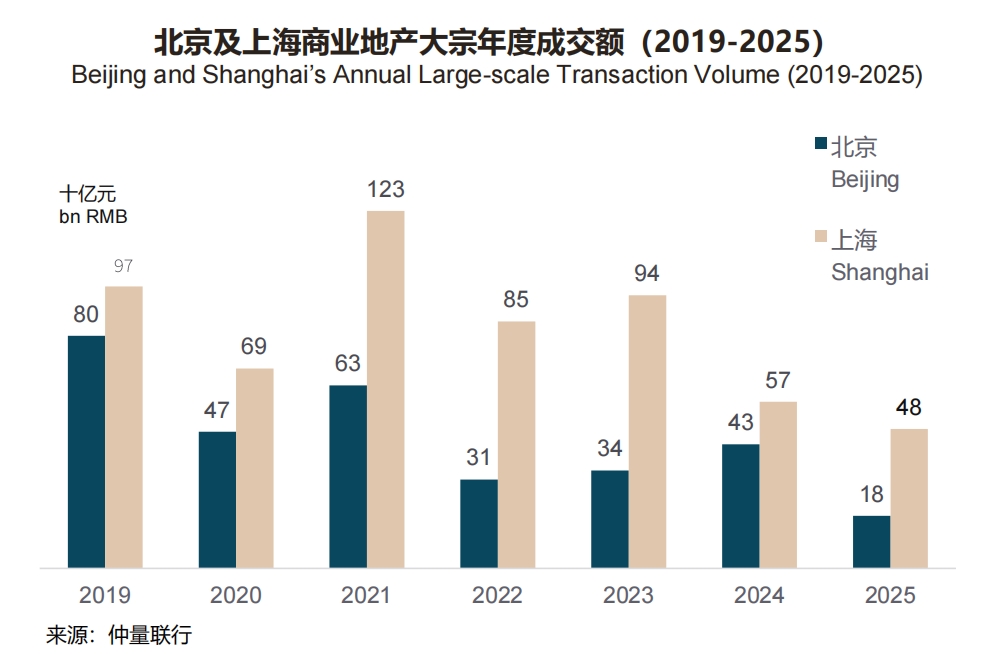
Data source: JLL
In terms of typical cases, in the fourth quarter, Ingka Centres announced a strategic cooperation with Gaohe Capital to set up a special real - estate fund to jointly hold the assets of three shopping centers including Beijing Lido Mall. Ingka will continue to be responsible for the project management and operation. This transaction is regarded as an important signal for the re - evaluation of retail asset value, and its subsequent progress has attracted much market attention. In terms of investment entities, self - use buyers and insurance institutions became the main participants in the market, reflecting the cautious attitude of the current investment market.
Significant policy breakthroughs have brought long - term benefits to the commercial real estate market. In 2025, the China Securities Regulatory Commission and the National Development and Reform Commission successively issued relevant policies, including ultra - Grade A and Grade A commercial office building projects in megacities and first - tier cities, and four - star and above hotel projects into the pilot scope of public REITs, marking the official expansion of the underlying assets of public REITs to the commercial office and hotel sectors. Previously, there had been successful cases in Beijing such as the CICC First Agricultural REIT and the Huaxia Jinyu Smart Factory REIT. The underlying asset of the First Agricultural REIT is the First Agricultural Yuanzhong Center project, which has attracted Kuaishou and Xiaomi's headquarters to settle in. It rose by more than 28% on the first day of listing, fully confirming the market's recognition of the securitization of high - quality commercial real estate.
Xu Xixi, the head of JLL's investment and capital markets business operations in China and the head of the North China region, said: "The further expansion of the Chinese public REITs market will promote the commercial real estate industry to accelerate the transformation to a refined asset management model and bring liquidity premiums to projects with core locations and outstanding operational resilience."
The industry generally believes that this policy will significantly improve the market liquidity of commercial office assets, effectively promote the revitalization of existing assets, and relieve the liquidity pressure of some asset holders.
03 Market Outlook: Challenges and Opportunities Coexist, and Refined Operation Becomes the Core Competitiveness
Looking forward to 2026, the Beijing office market will face the dual tests of the concentrated entry of new supply and the slow recovery of demand. There is still pressure for the vacancy rate to rise temporarily, but the rent decline is expected to narrow further. Regional differentiation, business - format upgrading, and policy dividends will become the core variables driving the market development. The demand of new - quality productivity enterprises in the western sub - markets and the opportunities for stock optimization in the eastern markets complement each other, promoting the continuous reconstruction of the market structure.
For industry participants, landlords need to continuously optimize lease strategies, strengthen refined operation capabilities, and attract high - quality tenants by improving building quality and service levels. Investors need to focus on high - quality assets in core locations with stable operations and seize the liquidity dividends brought by the expansion of public REITs. Against the background of the industry transformation of "intense competition and evolution", the commercial office market is accelerating the transformation from incremental expansion to stock optimization, and refined asset management ability will become the core competitiveness for enterprises to survive the cycle.