Interview with XIAO Ang of Squirrel Power: The Smart RV Market is Booming, and the Former First Product Manager of Anker Has Already Entered the Arena | Hardcore Krypton Exclusive Interview
Author | Huang Nan
Editor | Yuan Silai
After Xiao Ang left Anker, where he had worked for more than a decade, he spent some time wandering around the United States. He deliberately avoided big cities and drove to Indiana, a state that is not so trendy.
At that time, the venture capital circle was still digesting the aftermath of the slowdown from the previous year. As the first product manager at Anker Innovations, Xiao Ang witnessed the golden decade of consumer electronics going global. He was in charge of different businesses at Anker each year, was deeply involved in building the company's complete product planning system, and managed a business line that accounted for over 40% of Anker's revenue. Before leaving, he was the only core manager within the company who served as both the product director and the general manager of the product line.
People knew he would start a business, but they didn't expect him to enter a completely unfamiliar industry.
During that hot summer, Xiao Ang drove across the vast plains of the American Midwest and stopped at RV factories and wilderness camps that few Chinese people had ever visited.
In the workshops of the RV factories, wooden boards and nails were piled up beside the modern production lines. Craftsmen were still using woodworking skills to build products called "mobile homes." In the repair areas of the dealers, the disassembled RV bodies exposed rotten wooden structures, and the soaked and moldy boards had to be completely replaced. At the camps, retirees were still content with the "mobile community" life with water and electricity connections. Many young families shook their heads at the configuration that "cut off supplies once leaving the camp" but had to compromise with the reality of lacking electricity and water.
At that moment, the puzzle in Xiao Ang's mind was complete. On one side was an ancient industry in urgent need of technological innovation but locked by monopoly interests. On the other side were the rapidly growing but unmet needs of the new generation. A huge market gap means unprecedented opportunities. Amid the dusty and choking air, Xiao Ang determined his next stop.
The electrification of traditional RVs is not a new concept, but Xiao Ang found that the half - hearted "pure - electric" solutions only scratched the surface. The real pain point is not whether there is electricity, but whether there is "unlimited and inexhaustible" power freedom. Based on this, Xiao Ang founded Squirrel Power and made a crucial and differentiated technological decision: adopting the range - extended solution.
He was determined to enter the overseas blue - ocean market, which has an annual increment of hundreds of thousands of units but has been ignored by traditional manufacturing, with an unprecedented intelligent range - extended towable RV.
Facts have proved that Xiao Ang didn't choose the wrong direction. Three years later, intelligent RVs have become a popular startup track.
In July 2025, the first camping trailer of Pebble Flow, founded by former Chinese employees of Apple, was officially delivered. In December 2025, KEPLO, an intelligent RV enterprise founded by a former Li Auto team, announced the completion of a $45 million angel round of financing. At the same time, Hard Krypton learned that a senior employee of DJI also plans to enter the RV field after leaving the company.
At CES in January this year, Squirrel Power's first product, Evotrex - PG5, was officially launched. It is also the industry's first self - generating towable RV, featuring an uncompromising lifestyle of off - grid and outdoor freedom, with a starting price of $120,000.
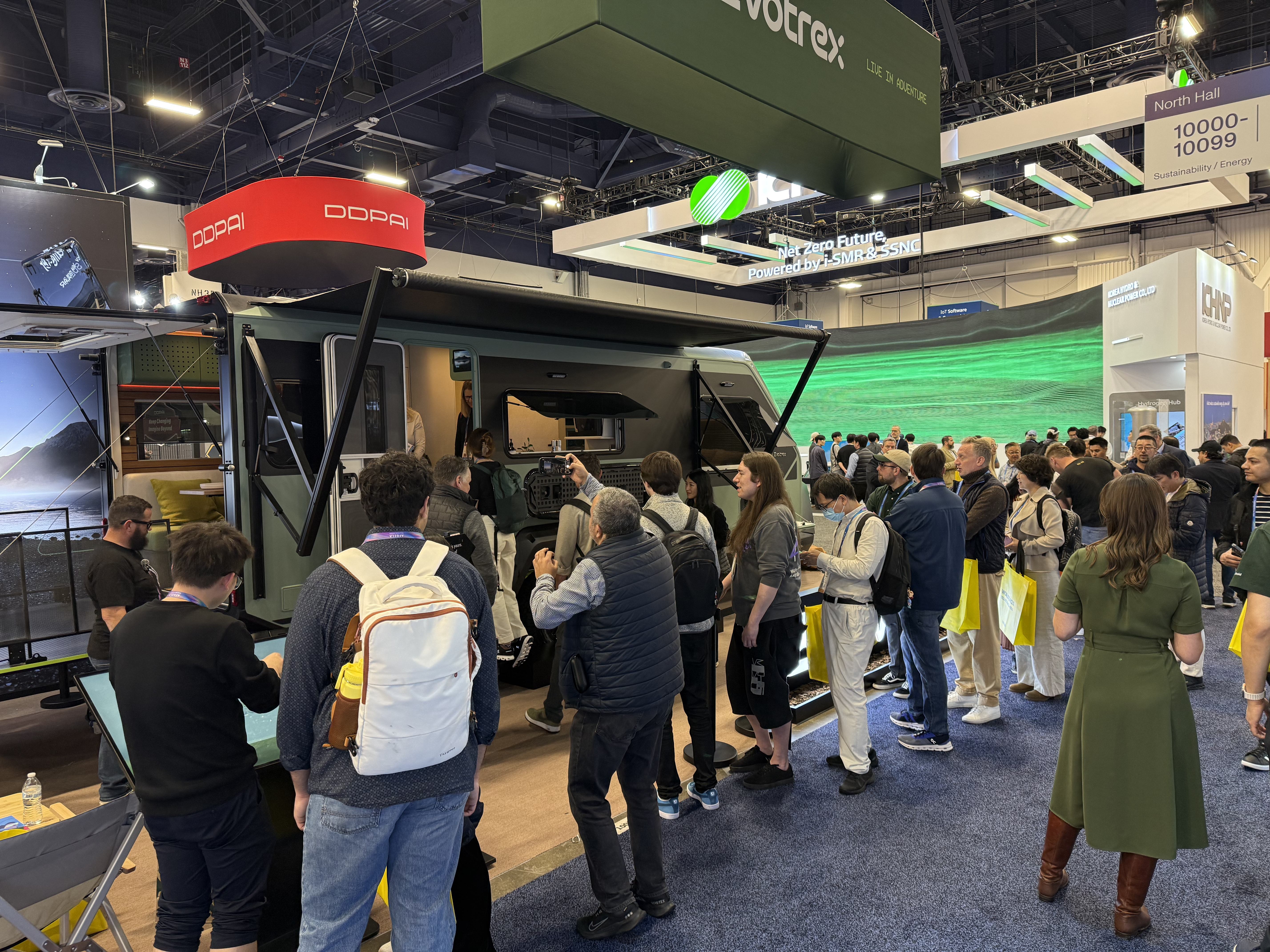
Squirrel Power's booth at CES 2026 (Source: Company)
This is not only a startup but also a refinement of Xiao Ang's more than a decade of product experience. From lightweight consumer electronics to heavy "mobile homes," this time, Xiao Ang has to cross a longer, heavier, and wider river.
We had a two - hour in - depth conversation with Xiao Ang, listening to him share how to apply a proven hardware methodology to traditional industries and thus define the thinking and ambition behind a brand - new experience.
Below is the transcript of the conversation between Hard Krypton and Xiao Ang, the founder and CEO of Squirrel Power. The content has been edited:
Young Users Become the Main Force
Hard Krypton: From the appearance, the structure and shape of Squirrel Power's first product are different from the RVs commonly seen in China.
Xiao Ang: Overseas RVs and domestic ones are completely "two different species." Due to different regulatory restrictions, most domestic RVs are modified in the mode of "cab + rear living cabin." The interior space is relatively cramped, and some users even prefer to carry tents for outdoor accommodation. In markets such as the United States, Australia, and Canada, 90% of RVs are towable RVs, which do not need to be modified and are produced in batches.
We chose towable RVs as our entry point. They don't have a cab and need to be towed by a front vehicle, usually a pickup truck. This means that it is first and foremost a living space. Users are buying a pure living experience without having to consider driving performance, which significantly reduces our R & D and verification costs.
Hard Krypton: An RV has the attributes of both a "house" and a "car." How do you define your product?
Xiao Ang: In the overall design, we created a sense of being in nature while having the comfort of home around the "forest - style" concept. For example, the design inspiration for the bed comes from the concept of the "human cave." It has a strong sense of enclosure in appearance, which can provide a sense of security for users in the wild and isolate external noise.
Many hidden technological elements are integrated into the interior details, such as the intelligent brain function provided by the touch panel, mural - style intelligent speakers, and intelligent projectors. These household products provide functions with a sense of ritual and surprise to optimize the user's living experience.
In terms of structure, we have an original design - the tailgate, which can be opened to become an outdoor balcony. This is a function that most RVs on the market did not have before. Users can drink tea and fish on the balcony, greatly expanding the scenarios of RV life.
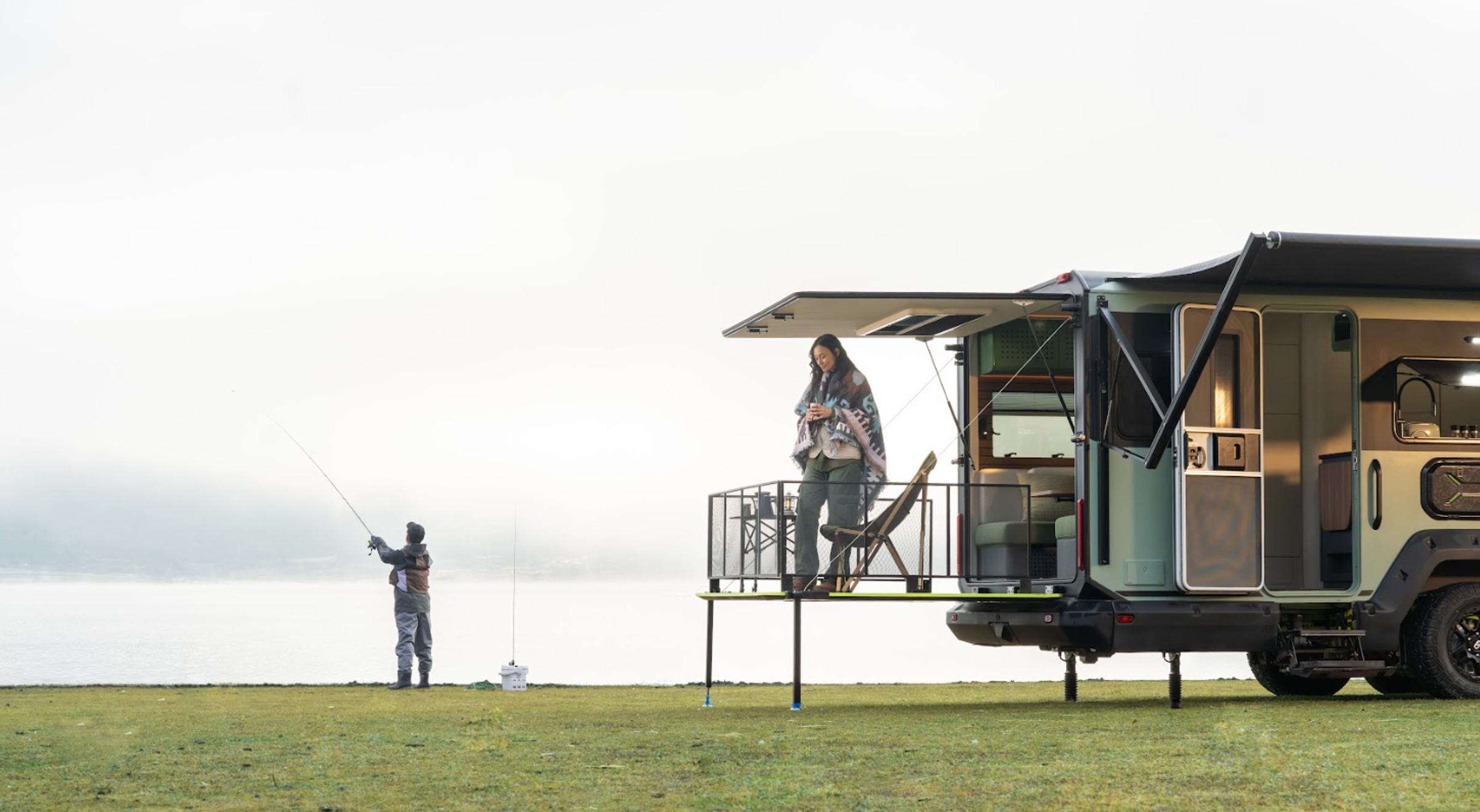
The original tailgate design can be extended to an outdoor balcony (Source: Company)
The essence of RV life is to escape from the urban steel forest and integrate into nature. Traditional RVs may only support users to stay in the wild for one day, while ours can allow users to live comfortably in the wild away from infrastructure for several days, a week, or even longer.
Hard Krypton: Different users have their own style preferences for a "home." How do you meet these personalized needs?
Xiao Ang: We have to make trade - offs. As a startup, providing a large number of customization options will bring huge inventory and delivery pressure. Therefore, our strategy is to offer only 1 to 2 options for interior styles and a limited number of exterior colors on the basis of providing core capabilities such as long - term off - grid survival that other manufacturers can hardly offer.
In addition, we have added some optional configuration packages, such as electric and manual sunshades, electric and manual footboards, etc. These can be adjusted during local assembly in the United States without increasing inventory pressure.
Hard Krypton: Compared with the previous generation of RV products, how do you hope the users with the most purchasing power or decision - making power in the family to view this product?
Xiao Ang: We often tell investors that what we are creating is not a simple hardware replacement or function addition but a brand - new experience. This experience of seamlessly transplanting the "complete comfort of home" into the wilderness was impossible in the past use of RVs.
The target group is the users of the ultra - luxury Glamping (glamorous camping) lifestyle. This target market is extremely large overseas. Among the more than 300 million people in the United States, 170 million participate in outdoor sports, 80 million have the habit of camping, and the number of RVs in use is as high as 14 million, with hundreds of thousands of new RVs added each year.
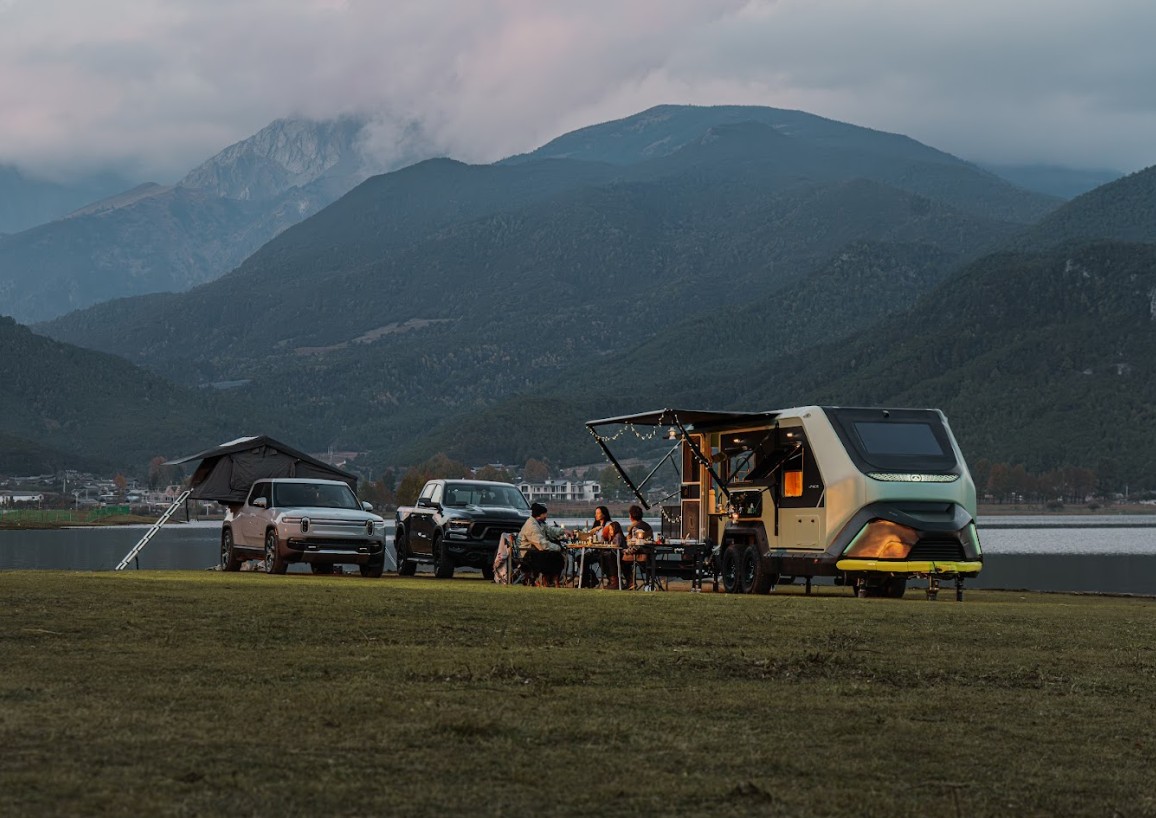
Ultra - luxury Glamping scenario (Source: Company)
For outdoor enthusiasts, they don't have to compromise on basic living quality while getting close to nature. This is an innovation in lifestyle, not just a product iteration.
In fact, the traditional RV industry has existed for nearly a century. Without technological breakthroughs, it's difficult to have startup opportunities. The spill - over of electric vehicle technology has just brought the possibility of electrification to it.
Behind this is the superposition of two core trends: the change in the consumer group and the rise of the outdoor boom. People hope to stay in the wild for a longer time, which requires solving basic survival problems such as electricity and water. This is also the core starting point for us to define a brand - new experience product.
Hard Krypton: What are the significant characteristics of this group? Are they the same as traditional RV users?
Xiao Ang: Previously, the main users of RVs in Europe and the United States were retirees over 55 years old. Their usage scenarios were concentrated in RV camps, where water and electricity connections were provided. It was like a "mobile house," but users had to pay $60 to $100 per night, costing over $10,000 a year. Some people even sold their houses and lived in RVs for a long time, forming exclusive RV communities surrounded by peers with similar lifestyles. This model has continued for decades.
Until the post - pandemic era, the industry logic completely changed. Young users have become the main force. They dislike the centralized living model in camps and are more eager to escape from the city, stay away from people, and go camping in wild places such as deserts, forests, and beaches. These places have no camp facilities, no water and electricity, and even no mobile phone signal, but they can meet their need to get close to nature.
This group of users usually travels in groups of several friends or families, driving towable RVs and bringing food and off - road equipment, staying outdoors for a long time. Towable RVs are the core carriers for them to carry this lifestyle.
For them, the biggest bottleneck is water and electricity. Traditional RVs cannot be separated from the water and electricity supply of camps, and electrification just solves this pain point.
The Choice of the Range - Extended Route
Hard Krypton: How does Squirrel Power's electrification solution specifically solve the problems of water and electricity?
Xiao Ang: Traditional RVs are usually equipped with 2 to 3 kWh of electricity at most, and users can increase it to about 10 kWh by installing additional battery packs. In contrast, we adopted the very mature "range - extended" solution in China.
Currently, the range - extended vehicle technology in China is mature and the supply is sufficient. By burning oil to generate electricity, the thermal efficiency of the range extender can reach over 40%. One liter of oil can generate more than 3 kWh of electricity. According to our 75 - liter fuel tank and 43 - kWh battery, it can provide up to 270 kWh of electricity, which is completely enough for long - term use in the wild. With sufficient electricity, many things become possible, such as taking a hot bath every day, using the air - conditioner all night, and cooking hot food at any time.
Many users, including investors, don't have a quantitative perception of the off - grid water and electricity demand. Therefore, we specially developed an off - grid calculator and put it on our official website for everyone's reference.
Users can input a few simple indicators according to their usage scenarios and needs, such as the number of people, the season and weather, the number of meals to be cooked per day, and the number of showers per day. It will automatically calculate the daily water and electricity consumption and the number of days that the PG5 can support.
The calculation result in the following figure is for a normal summer sunny day. It's worth noting that the daily electricity consumption in such a situation is as high as 30 kWh.
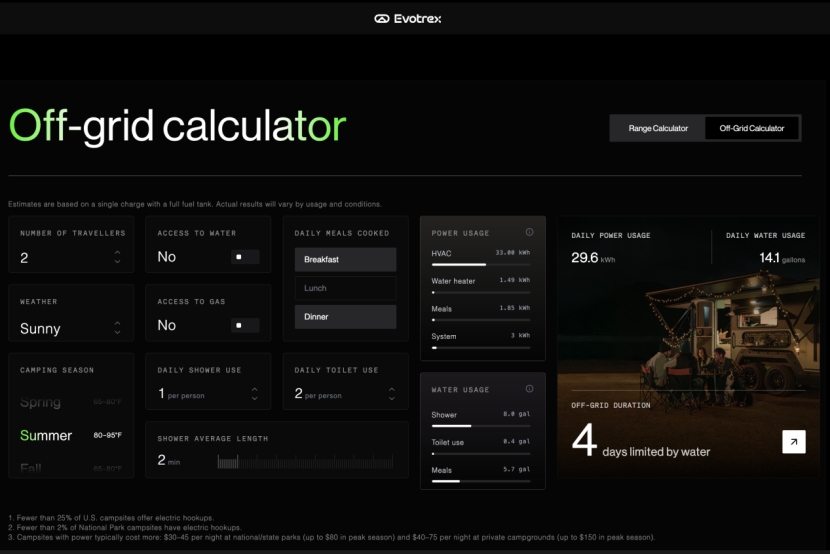
It can automatically calculate the daily water and electricity consumption (Source: Company)
At the same time, our design also considers several core scenarios. The first is the idle time. Many RVs are parked at home 80% of the time. For young, non - retired users, the RV can be used as a home energy storage device when idle, supplying power to the home through a circuit connection.
The second is the energy consumption during towing. When an electric pickup truck tows an RV, its range will be reduced by 60% - 70%. Squirrel Power's RV has its own motor, which can provide auxiliary power during towing to help the front vehicle increase its range. During this process, the range extender can generate electricity while driving, which can not only be used by itself but also charge the front vehicle in reverse, like an external "mobile power bank" for electric vehicles, just forming a closed - loop of "refueling - generating electricity - charging" to eliminate range anxiety.
Hard Krypton: Besides the range - extended solution, what other intelligent upgrades have been made to the living space?
Xiao Ang: Intelligence must serve user value, which is mainly reflected in three aspects: convenience, comfort, and safety.
In terms of convenience, we have electrified all controls. Components such as heavy sunshades, footboards, and tailgates can be opened and closed with one key. In the future, these can also be opened through voice commands and induction, bringing great convenience to users.
Regarding comfort, intelligent climate control is the key. The system will adjust the in - car temperature in advance based on the user's daily usage habits and the location information of the mobile terminal, so that users can enjoy a suitable environment as soon as they enter the car.
In terms of safety, we introduced the concept of security. The vehicle is equipped with cameras and other devices, as well as a sentry mode. It is also designed to support the installation of Starlink satellite Internet to ensure stable Internet connection even when the vehicle is in a remote area.
The intelligent experience of our product is a generation ahead of traditional RVs, but the prices are similar. Therefore, we believe that even users who are 50 years old and about to retire and drive fuel - powered cars will be willing to choose Squirrel's products with better experience.
Hard Krypton: What was the biggest difficulty the team encountered in the process of realizing these functions?
Xiao Ang: The supply chain is the biggest challenge. When making hardware products, there are always a large number of details to balance, such as having an idea but the supply chain not supporting it, being able to do it but at a very high cost, and whether the input - output ratio of mold - opening is reasonable.
Of course, we also have to make some compromises. Our R & D investment cannot be compared with that of