90 billion, the fastest IPO of Chinese AI is born.
The new year has witnessed an exciting scene.
Today (January 9th), MiniMax officially listed on the Hong Kong Stock Exchange. The IPO issue price was HK$165 per share, and after the opening, it soared by over 70%, with its market value once exceeding HK$90 billion. It is worth mentioning that the public offering part of MiniMax was over - subscribed by a staggering 1,837 times. The top - tier long - term institutional investors and sovereign funds from Europe, the United States, Canada, South Africa, the Middle East, and Southeast Asia all invested, indicating its popularity.
Based in Shanghai, MiniMax was founded in 2022 by Yan Junjie, a former senior executive of SenseTime. It has since become one of the fastest - growing AI unicorns globally from its establishment to IPO. This 1989 - born doctor has become an iconic figure in China's new wave of AI.
"He looks gentle and even a bit cute." However, in the eyes of Huang Mingming, the founding partner of Mingshi Venture Capital, Yan Junjie has a firm belief in making choices and a certain determination, which is the quality only seen in top - notch founders. Since the first investment in March 2022, Mingshi Venture Capital has continuously increased its investment in six consecutive rounds, becoming the institution that participated in the most investment rounds among all institutional investors in MiniMax.
Looking back at MiniMax's financing history, the lineup of investors is particularly impressive. Everyone has used real money to support Chinese large - model companies to take the global stage, jointly creating the magnificent AI era we see today.
Four Meetings and the First Investment in MiniMax Four Years Ago
Before investing in MiniMax, the Mingshi team had four intensive meetings with founder Yan Junjie and co - founder Yun Yeyi.
At that time, there was no systematic research on large - model investment in the market. However, after seizing the opportunities brought by the era of intelligent electric vehicles, Xia Ling, a partner at Mingshi Venture Capital, had long been interested in the end - to - end autonomous driving technology path based on the Transformer architecture and was the first to sense the new AI paradigm brought by end - to - end data - driven methods.
Later, in a conversation with Liu Wei, the co - founder of Mihoyo, Huang Mingming, the founding partner of Mingshi Venture Capital, was told by Liu Wei that "the next wave of AI will definitely be generative. You, senior brother, should pay attention to this trend. There is a small team in the same park as Mihoyo working on this, and it's very interesting." For this reason, Huang Mingming mobilized the team to make inquiries from various sources and finally established contact with Yan Junjie.
The first meeting between the two sides was when Huang Mingming, accompanied by his investment partner Xia Ling and another colleague, Xu Zhihao, met Yan Junjie, who was reading a paper in the lobby of a hotel on Zhichun Road in Beijing. This scene was unexpected to them because in previous first meetings with entrepreneurs, most of them were looking at business plans, while Yan Junjie was quite different. "My first impression was that this guy was interesting and seemed to want to do something long - term," Xia Ling still remembers clearly.
Right from the start, Yan Junjie talked about AGI (Artificial General Intelligence), a topic rarely mentioned in the industry at that time. Subsequently, his discussions on end - to - end data - driven methods and the leap from AI 1.0 to AI 2.0 completely touched the Mingshi team.
Just 10 days later, introduced by Yan Junjie, Huang Mingming led the team to meet MiniMax co - founder Yun Yeyi in Mihoyo's office in Building C46 of the Caohejing Development Zone in Shanghai. This young entrepreneur's strong business intuition and resource - integration ability gave Huang Mingming and his colleagues more confidence. Huang Mingming immediately called Yan Junjie and said that Mingshi would firmly participate in the investment in MiniMax.
At this time, the global AI field was at its lowest point. On the one hand, the investment enthusiasm had dropped to freezing point; on the other hand, there were few emerging AI companies. Even the so - called "Four AI Unicorns" in China at that time were not developing satisfactorily. So when Xia Ling talked to his peers about his interest in the AI industry, they would ask rhetorically what was left to see in AI.
However, this time, Mingshi Venture Capital saw new opportunities in Yan Junjie's description, although it was only a vague glimpse of the future. At the year - end review meeting at the end of 2021, Xia Ling boldly proposed that the biggest variable driving the development of information technology in the next 10 years: a 100 - fold increase in both AI computing power and algorithms in 10 years. This includes breakthroughs in brain science and brain - like technology, AI algorithms and data, AI chips, and gives rise to systematic opportunities for a new generation of AI.
In the primary market at that time, it was difficult for Mingshi Venture Capital to find like - minded people for these judgments, and even some members of the team were skeptical. But Huang Mingming believes that "historical experience shows that the best investments are often non - consensus, which is also the concept we have always adhered to."
Meanwhile, in early 2022, Yan Junjie officially founded MiniMax in Shanghai. In a room of less than 100 square meters, he wrote down the mission and path - with the mission of "Intelligence with Everyone".
For Mingshi Venture Capital, this was not an easy investment decision. Huang Mingming admitted that start - ups usually focus on a single point, but MiniMax was developing multiple modalities simultaneously, which entailed significant development risks. Moreover, this team was very young, with an average age of less than 30, and had not yet withstood major tests. Therefore, there were significant disputes about this project at the investment committee at first.
Partner Xia Ling and his colleagues then had two more intensive exchanges with Yan Junjie, covering both Mingshi's understanding of the development trend of the new generation of AI and a full communication on MiniMax's path from technology to engineering to productization. Yan Junjie's in - depth thinking and pragmatic style strengthened the determination of the investment committee, and the professionalism and meticulousness of the Mingshi team also won Yan Junjie's support.
As an early - stage investment institution, finding non - consensus opportunities and firmly betting on them is the fundamental ability for Mingshi Venture Capital to continuously seize the biggest opportunities. In MiniMax, they saw the founder's iteration speed and learning ability. If they over - emphasized the original experience background and the bias towards successful people, it would instead become a hindrance to investing in excellent companies.
More importantly, Mingshi Venture Capital believes that the best founders see because they believe, and then let more people see. Naturally, they are willing to believe in those who dare to believe, and Yan Junjie is a prime example.
So one month later, Mingshi Venture Capital became one of the early investors in MiniMax. Eight months after this investment, ChatGPT emerged out of nowhere, igniting the "Battle of a Hundred Models" in China.
Six Consecutive Rounds of Investment: They Invested in MiniMax the Most Times
Making the first investment in MiniMax was just the beginning of Mingshi Venture Capital's non - consensus bets.
In the summer of 2022, shortly after MiniMax released its second - generation model, Huang Mingming took the lead and invited two of the most influential "product managers" in the industry to meet Yan Junjie - Li Xiang, the founder of Li Auto, and Wang Xing, the founder of Meituan. "Li Xiang shared how Li Auto understands user needs, and Wang Xing talked about the underlying logic of product iteration."
Moreover, Mingshi Venture Capital continued to increase its investment in each subsequent round of financing and ultimately invested in six consecutive rounds. There was an episode during this period: before participating in MiniMax's Pre - IPO round of financing, Mingshi Venture Capital's cumulative investment amount had exceeded the single - project investment limit stipulated by the fund. For this reason, Mingshi Venture Capital actively communicated with overseas LPs and obtained a waiver. Eventually, it became the investment institution that participated in the most investment rounds in MiniMax.
The reason for their firm belief in MiniMax lies in Yan Junjie's decision - making ability on key issues, which exceeded Mingshi Venture Capital's expectations every time and increasingly conformed to their image of a founder who can anchor the end - game. "Such founders often dare to bet all their resources in the most difficult and painful decisions."
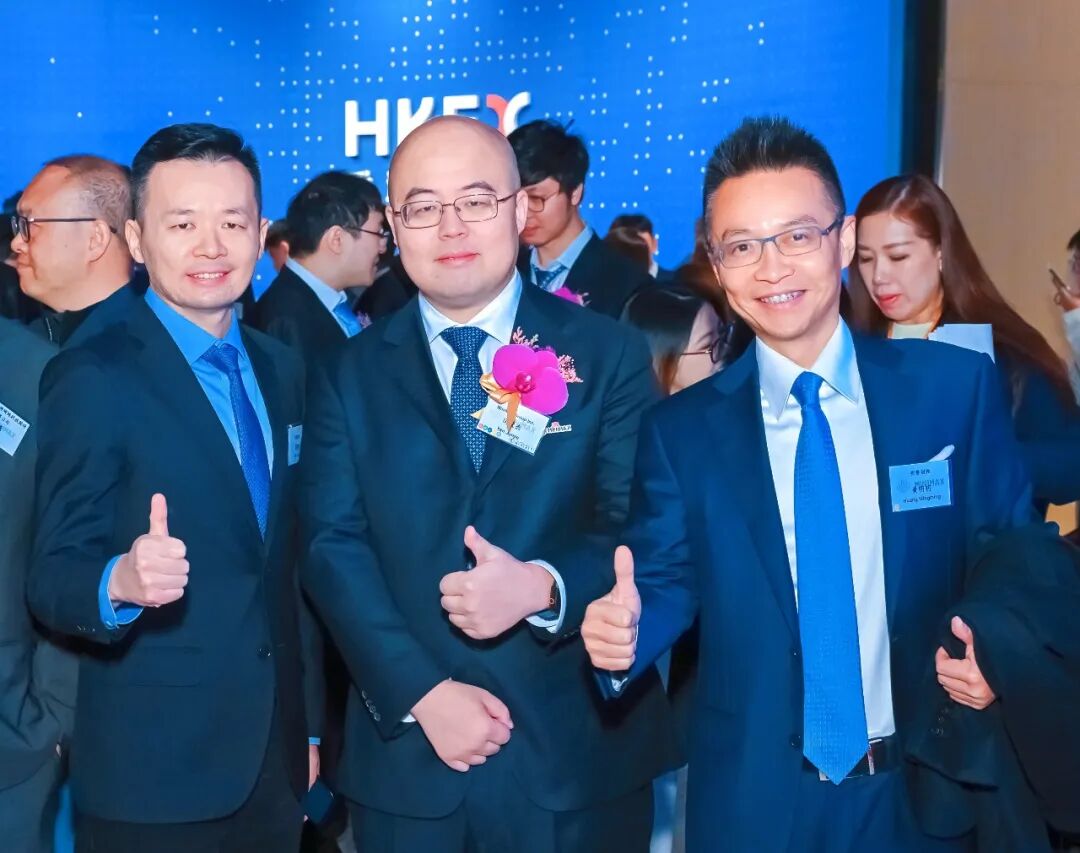
Yan Junjie (middle), the founder and CEO of MiniMax, Huang Mingming (right), the founding partner of Mingshi Venture Capital, and Xia Ling (left), a partner of Mingshi Venture Capital, at MiniMax's listing ceremony on the main board of the Hong Kong Stock Exchange
In the second half of 2023, MiniMax unexpectedly invested a large amount of resources in the pre - training of the MoE architecture, which was not a consensus in the industry at that time. "Even the proposer of MoE himself was not very confident about this path," Huang Mingming recalled. However, MiniMax still persevered and launched the abab 6.5 series of models, pioneering the large - scale commercial deployment of the MoE architecture.
This scene is of great significance as a trendsetter. However, few people outside know that MiniMax failed twice during the R & D process. It was not until the third attempt was successful that Yan Junjie told the investors that MoE was almost ready. Huang Mingming asked Yan Junjie at that time, "Why did you take such a big risk? If you failed, the company might go bankrupt."
The other party replied calmly, "Only by making MoE work can we evolve to a higher - level model at a lower cost. Otherwise, the cost would be immeasurable, and no company can support the token consumption required to serve tens of millions or even hundreds of millions of users." After hearing this reply, Huang Mingming remembered that the first thing he said to Xia Ling after walking out was: "Yan Junjie is a determined person. We didn't invest enough in MiniMax."
Undoubtedly, Yan Junjie and MiniMax have achieved their goals. Through the prospectus, we can see that MiniMax achieved only a 5% performance gap with 1% of the cost of top - tier US models and achieved a high gross profit margin. This also confirms Mingshi Venture Capital's judgment - MiniMax can break the impossible triangle of high performance, low cost, and commercial profitability.
During the communication, Xia Ling also mentioned an impressive detail - MiniMax is the large - model company in the industry with the shortest lease term and the lowest rent for computing power chips. "Yan Junjie's thinking is straightforward and based on fundamental principles. He believes that chips are updated every two years, so the latest chips must be used for model training." Therefore, although MiniMax's requirements in the chip supply market are the most stringent, suppliers also believe that MiniMax is really committed to making large - model technology a success.
Today, Mingshi Venture Capital witnessed MiniMax ringing the bell on the Hong Kong Stock Exchange, thus achieving a "home run" - level investment return. However, for this early - stage institution, the great sense of surprise does not come from the return itself but from the profound realization that the disruptive changes brought by AI are greatly underestimated by the outside world.
This scene has even more far - reaching significance. Huang Mingming said that the recognition of MiniMax by global mainstream long - term investors also means the recognition of the capabilities of Chinese AI companies. "I firmly believe that more Chinese technology companies that have been severely underestimated will also shine on the global stage."
An AI Investment Map: Seeking Early - Stage Non - Consensus Opportunities
With the ringing of the bell for MiniMax's listing, Mingshi Venture Capital's AI investment map is gradually unfolding.
Many years ago, Mingshi Venture Capital formed an internal judgment: Autonomous driving, large - language models, and embodied intelligence are essentially extensions of the same AI paradigm in different fields. Therefore, following this idea, they integrated across paradigms and fields and carried out investment layout throughout the entire AI industry chain.
Through horizontal comparison, we can find that Mingshi Venture Capital is one of the few venture capital institutions in the primary market that takes the rapid evolution of AI models as the core and integrates the entire upstream and downstream of the industry chain.
After careful analysis, Mingshi Venture Capital began to systematically layout the upstream and downstream of large - language models in 2023, including the "AIDC supply chain" represented by computing, storage, communication, power management, thermal management, and energy, various AI - native hardware and software, embodied intelligence, and key upstream core components.
Among them, Mingshi Venture Capital's bet on Zhujidongli is also impressive. In July 2022, also at an internal review meeting, Xia Ling continued to look for non - consensus directions based on the Transformer + end - to - end technology logic and proposed that the combination of AI model - driven technology and robots might generate a new wave of investment opportunities. At that time, the concept of "embodied intelligence" had not yet emerged.
With the direction determined, the next step was how to discover hidden projects. Through paper searches, Xia Ling found that Zhang Wei, a former professor at Southern University of Science and Technology, had started a business and just founded Zhujidongli. Later, introduced by Professor Li Zexiang, a long - time friend of Huang Mingming, the Mingshi team got to know Zhang Wei. At that time, Zhujidongli had excellent core - component design capabilities, AI, and control algorithms and was one of the few global teams that mastered the technology of integrating AI environmental perception and motion control.
Therefore, Mingshi Venture Capital resolutely participated in Zhujidongli's angel - round financing and continued its consistent investment style by increasing its investment in multiple consecutive rounds. The latter also received a new round of financing in July 2025, led by JD.com strategically, and recently released a new multi - form embodied robot, TRON 2.
Nowadays, embodied intelligence has become a consensus in the venture capital circle, but Mingshi Venture Capital has become more cautious in its investments. Huang Mingming said bluntly, "Precisely because our team has conducted earlier and deeper research on embodied intelligence, we have judged that the GPT 3 moment for embodied intelligence has not yet arrived. We are closely tracking the iteration of the basic models of embodied intelligence."
Meanwhile, Mingshi Venture Capital has also successively laid out AI autonomous driving, AI + entertainment, AI + smart hardware, AI + productivity tools, and AI + science according to the sequence of application industry implementation. Among them, the investments in Genspark and Lovart are two counter - cyclical operations.
As early as 2023, Mingshi first contacted Jing Kun, the founder of Genspark. As the founder of Microsoft Xiaoice and Xiaodu Technology, he is one of the earliest domestic practitioners deeply involved in AI Assistant and AIOS and is also a key figure that Xu Zhihao, the managing director of Mingshi Venture Capital, has been tracking for a long time.
What really accelerated this relationship was an afternoon tea on a Saturday in the autumn of 2023. Huang Mingming and Jing Kun started chatting from the girlfriend - style car and Li Auto and hit it off. This meeting quickly made Huang Mingming confirm one thing: Jing Kun is an extremely rare super product manager who thinks with product as the first - principle.